
Quick Answer
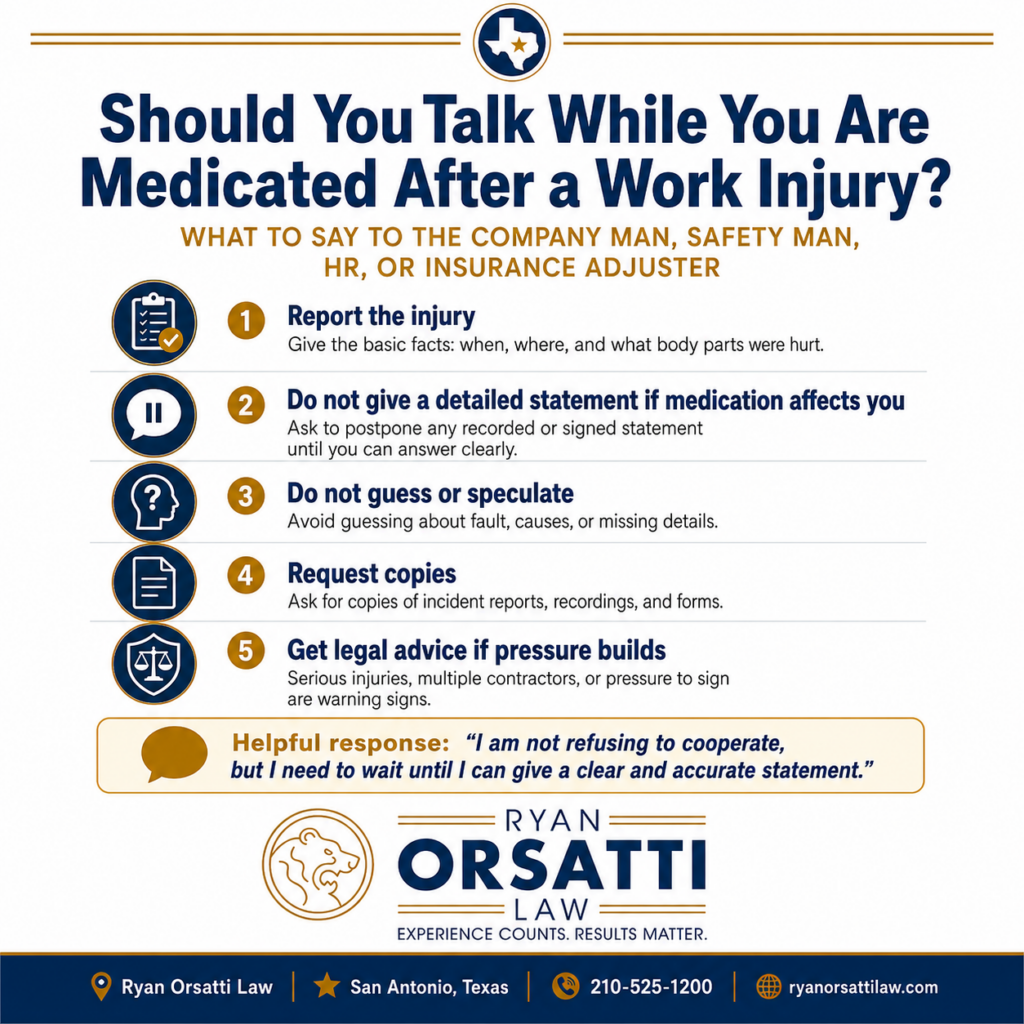
Generally, you should not give a detailed, recorded, or signed statement while pain medication, sedation, a head injury, severe pain, or shock may be affecting your memory or alertness. Report the injury, identify urgent safety hazards, and provide the basic facts needed for medical care, but ask to postpone the detailed interview until you can give a reliable account.
Key Takeaways
- Report the work injury promptly, even if you are not ready for a detailed interview.
- Do not guess, speculate, minimize your symptoms, or sign a statement you cannot carefully review.
- Tell the interviewer what medication you received and why you need the interview postponed.
- The company man, safety representative, HR employee, and insurance adjuster may be gathering evidence for different organizations.
- Request copies of every incident report, recording, written statement, photograph, and form involving you.
- Serious injuries, multiple contractors, disputed fault, or pressure to sign paperwork are reasons to get legal advice promptly.
Who Are the Company Man, Safety Man, HR, and Insurance Adjuster Representing?
The company man, safety representative, HR employee, and insurance adjuster may be courteous and genuinely concerned, but none should automatically be treated as your personal legal adviser. Their responsibilities usually involve company operations, regulatory reporting, employment matters, accident investigation, or insurance claim evaluation.
| Person requesting information | Typical role after an accident | Information to provide promptly | Information to postpone if medication affects you |
|---|---|---|---|
| Company man or site representative | Protects the operator’s or site owner’s operations and coordinates the initial response | Location, time, injured body parts, immediate hazards, and need for medical care | Detailed fault opinions, contractor responsibility, equipment history, or a recorded reconstruction |
| Safety or HSE representative | Creates the incident file and investigates safety procedures | Known hazards, witnesses, equipment involved, and immediate medical needs | Speculation about causes, policy violations, or technical issues you have not verified |
| Human resources | Handles employment reporting, leave, work status, and company paperwork | Notice of injury, medical restrictions, contact information, and work status | Broad medical authorizations, resignation documents, releases, or a narrative you cannot review |
| Insurance adjuster | Investigates coverage, compensability, medical treatment, wages, and possible defenses | Date of injury, basic mechanism, treatment provider, and work-status changes | A detailed recorded statement while impaired, estimates of recovery, or admissions about fault |
| Your medical provider | Diagnoses and treats the injury | Complete symptoms, medication history, how the injury occurred, and changes in condition | Nothing relevant should be intentionally withheld from your treating provider |
Texas Department of Insurance guidance says an injured worker should provide the employer with information about how, where, and when the injury occurred and notify the carrier about the injury, medical care, work status, and wages. That necessary reporting is different from immediately agreeing to a lengthy recorded interview.
Key takeaway: Provide accurate notice and urgent safety information, but postpone detailed questioning when your medical condition may prevent a reliable statement.
What Should I Say If They Approach Me While I Am Medicated?
Tell them that you are injured, identify the essential facts, disclose that medication or your medical condition may affect your ability to answer, and request a reasonable postponement. Do not simply disappear, refuse all communication, or use medication as a reason to hide information.
A practical response is:
“I was injured at approximately [time] at [location] while performing [task]. I need medical care, and the injury involves [body parts]. I have received medication or treatment that may affect my ability to give a complete and reliable statement. I am not refusing to cooperate, but I need to postpone any detailed, recorded, or signed statement until I am medically able to review the questions and answer accurately. Please send any requests in writing and provide me with copies of any reports or recordings.”
You should still disclose an immediate danger. For example, tell the company if equipment remains energized, a line is pressurized, a trench is unstable, chemicals were released, or another worker may be at risk. Preserving your claim should never come before preventing another injury.
Why Is a Medicated Statement Risky in a Texas Work-Injury Claim?
A medicated statement is risky because pain, shock, sleep deprivation, head trauma, and certain medications may affect attention, memory, and communication. The FDA identifies dizziness, drowsiness, and weakness as possible side effects of opioid pain medicines, although medication affects different people differently and many medications do not impair a person’s thinking.
The statement does not automatically become invalid because you were medicated. Under the current Texas Rules of Evidence, a party’s statement may be offered against that party under Rule 801(e)(2), subject to other evidentiary requirements and objections. Prior inconsistent statements may also become subjects of examination.
This matters because workplace incidents generate extensive records. The U.S. Bureau of Labor Statistics reported approximately 172,800 recordable injuries and illnesses in Texas private industry during 2024, including about 102,600 cases involving days away from work, job restrictions, or job transfers. Each serious incident can produce medical records, safety reports, witness statements, photographs, electronic data, and insurance documents that may later be compared with the worker’s first account.
Attorney Insight: The most harmful incident statements are often not deliberately false. They are incomplete and signed too early. A worker may remember that equipment moved unexpectedly but not know which contractor controlled it, whether a safety device failed, or what medication was administered during transport. An incomplete first report may later be portrayed as a contradiction instead of a medically understandable limitation.
Do I Still Have to Report the Injury in Texas?
Yes. Postponing a detailed interview does not mean you should postpone reporting the injury. For a Texas workers’ compensation claim, the Division of Workers’ Compensation says an employee generally must notify the employer within 30 days and submit DWC Form-041 within one year to protect the right to benefits.
Your initial notice should identify:
- Your name and contact information
- The date, approximate time, and location
- The task you were performing
- The body parts that hurt
- The equipment or event involved
- Known witnesses
- Where you received medical care
- Any work restrictions
- The person to whom you reported the injury
Send the notice by a method that creates a record, such as email, text message, an employee portal, or a signed form. Keep a screenshot or copy. Do not rely only on a supervisor saying, “I will take care of it.”
The Texas Department of Insurance injured employee guidance also advises workers to keep the carrier updated about medical care, work status, wages, and contact information. Cooperation should be accurate and medically appropriate, not rushed.
How Does the Type of Texas Work-Injury Claim Affect Who May Be Liable?
The available claim depends on whether the employer carries Texas workers’ compensation insurance, whether a third party contributed to the accident, and whether another legal system applies. Texas does not require most private employers to carry traditional workers’ compensation coverage, so confirming coverage is an early priority.
What If My Employer Has Texas Workers’ Compensation?
A subscribing employer generally receives protection from most employee negligence lawsuits, while the injured employee may seek authorized medical and income benefits through the workers’ compensation system. A separate third-party claim may still exist against an operator, general contractor, trucking company, property owner, equipment manufacturer, or another company whose conduct contributed to the injury.
What If My Employer Is a Texas Nonsubscriber?
An employer without workers’ compensation coverage may be sued for a workplace injury when employer negligence caused the harm. Under Texas Labor Code § 406.033, a nonsubscriber generally cannot rely on contributory negligence, assumption of risk, or a coworker’s negligence as defenses, although other defenses and factual disputes may remain.
What If Several Companies Were Working at the Site?
Multiple contractors can create separate lines of responsibility for training, supervision, equipment, transportation, site control, and hazard correction. The person taking your statement may work for only one of those organizations, which is why you should identify the interviewer’s employer and ask who will receive the information.
Workers injured at oilfields can review the firm’s guide on what to do immediately after a Texas oilfield accident. Construction workers can also review the differences between workers’ compensation and personal injury claims after a construction accident.
Can My Employer Punish Me for Postponing an Interview?
An employer generally may not retaliate against an employee merely for accurately reporting a work-related injury, but that does not create an unlimited right to refuse every internal question. OSHA requires reasonable reporting procedures and prohibits discharging or discriminating against an employee for reporting a workplace injury or illness.
Employment policies, collective bargaining agreements, and the reason for the interview can affect the worker’s obligations. The safer approach is usually to make a documented request for postponement based on your medical condition rather than issuing a blanket refusal to cooperate.
A union-represented employee may have Weingarten rights, meaning the employee can request union representation during an investigatory interview that the employee reasonably believes could result in discipline. Under current National Labor Relations Board guidance, that federal right applies to union-represented employees and is not an automatic right to bring a personal attorney into every private workplace meeting.
Ask these questions before an interview:
- Is this meeting part of the safety investigation, insurance claim, or a disciplinary investigation?
- Is the meeting being recorded?
- Who does the interviewer work for?
- Who will receive the report?
- Am I expected to sign a statement?
- May I receive the questions and documents in writing?
- If I am union-represented, may my representative attend?
What Should I Do If I Already Gave or Signed a Statement?
Do not panic and do not make an unplanned call to “fix” the statement. First obtain the exact statement, preserve evidence of your medical condition, and prepare an accurate chronology while the events are still fresh.
- Request the recording, transcript, and incident report. Ask in writing for every version containing your words or signature.
- Document your medication. Preserve the medication administration record, discharge instructions, prescription labels, dosage information, and the times medication was given.
- Write a private chronology. Record what happened before, during, and after the incident, including witnesses, equipment, supervisors, photographs, and treatment.
- Identify incorrect or incomplete information. Separate genuine errors from details you simply did not know during the first interview.
- Do not destroy or edit evidence. Preserve texts, photographs, work schedules, safety documents, clothing, equipment information, and social media.
- Avoid casual supplemental statements. A second rushed explanation can create another inconsistency.
- Obtain advice before signing a correction, release, resignation, or authorization. The proper response depends on the claim system, employer policies, and the significance of the error.
Employees and certain representatives may also request access to applicable OSHA injury records. Under 29 C.F.R. § 1904.35, an employee or personal representative requesting the OSHA 301 Incident Report concerning that employee must generally receive the report by the end of the next business day, subject to the rule’s scope and recordkeeping requirements.
For additional guidance about insurer interviews, see what a recorded statement is and whether to give one.
When Should I Contact a Texas Work-Injury Lawyer?
Consider contacting a lawyer promptly when the injury is serious, you were questioned while medicated, several companies were involved, fault is disputed, evidence may disappear, or someone is pressuring you to sign. Early review can help identify the correct claim system, preserve evidence, and prevent an incomplete statement from becoming the only account in the company’s file.
Legal review is especially useful when:
- You suffered a head injury, fracture, burn, amputation, spinal injury, or hospitalization.
- The company interviewed you in the ambulance, emergency room, or shortly after surgery.
- The written report contains facts you did not provide.
- A drug or alcohol allegation has been raised.
- The employer’s workers’ compensation status is unclear.
- Several contractors, vehicles, or equipment owners were involved.
- You are being asked to sign a release, resignation, medical authorization, or benefits election.
- You are threatened with discipline after reporting the accident.
- Video, electronic data, maintenance records, or physical evidence may be lost.
Texas Civil Practice and Remedies Code § 16.003 generally provides a two-year limitations period for personal-injury lawsuits, but workers’ compensation filings, claims against governmental entities, maritime claims, railroad claims, and contractual benefit plans may have different or shorter requirements.
Ryan Orsatti Law helps injured people in San Antonio and across Texas evaluate employer coverage, third-party responsibility, insurance communications, medical documentation, and evidence preservation after serious workplace accidents. The firm’s client-service model emphasizes individualized handling and direct attorney involvement.
Information about representation in construction injury matters is available on the firm’s San Antonio construction accident lawyer page.
Frequently Asked Questions
Can I Refuse to Talk to the Company Man After an Oilfield Accident?
You can request that detailed questioning be postponed when medication, hospitalization, pain, or a head injury prevents a reliable account. However, you should still report the accident, disclose immediate hazards, and comply with reasonable safety instructions. Put the postponement request in writing, explain the medical reason, and ask who the company man represents before providing a recorded or signed narrative.
Do I Have to Give a Recorded Statement to a Workers’ Compensation Adjuster in Texas?
Texas DWC guidance requires injured employees to provide basic information about the injury, medical treatment, work status, and wages, but it does not direct workers to give a recorded interview while medically impaired. Do not ignore the adjuster. Provide accurate essential information, ask for questions in writing, and request a reasonable rescheduling if you cannot presently give reliable answers.
Does Pain Medication Automatically Make My Statement Invalid?
No. A statement is not automatically invalid because you received pain medication. The relevant questions include what medication was given, the dosage, timing, documented side effects, your mental condition, and whether you understood the questions. Because an opposing party’s statement may later be offered as evidence, preserve your treatment records and avoid signing language you cannot carefully verify.
Can I Ask for a Lawyer or Union Representative During the Interview?
You may ask for legal advice before giving a detailed statement, but a nonunion employee does not automatically have a federal right to bring a personal attorney into every private employer interview. A union-represented employee may request a Weingarten representative during an investigatory interview the employee reasonably believes could lead to discipline. Employment agreements and collective bargaining provisions may provide additional rights.
What If HR Asks Me to Sign an Incident Report at the Hospital?
Tell HR that you will report the essential facts but cannot certify a detailed narrative until you are medically able to review it. Ask for a copy, read every page, correct blank or inaccurate sections, and do not sign language written by someone else as though it were your own. Document your medication and the time the report was presented.
What If I Said I Was Fine While I Was Medicated?
A statement that you were “fine” does not necessarily resolve whether you were injured, but it may be compared with later medical records and testimony. Document why you made the statement, including medication, shock, confusion, or symptoms that developed later. Continue giving medical providers an accurate history, obtain the original statement, and seek advice before submitting a formal correction.
Ryan Orsatti Law
4634 De Zavala Rd, San Antonio, TX 78249
Phone: 210-525-1200
ryanorsattilaw.com
This blog is for informational purposes only, not legal advice. Reading it does not create an attorney-client relationship. Past results do not guarantee future results.
Hurt in an accident in San Antonio? Learn how a San Antonio traumatic brain injury lawyer can help with your claim. Call 210-525-1200 or request a free consultation.
The firm works on a contingency fee. You pay nothing unless the firm recovers money for you, and that covers case expenses as well as the fee: if there is no recovery, you owe no attorney's fee and no case expenses. Ask for the fee agreement and read the fee and expense section before you sign anything.
Related San Antonio legal resources
Primary legal and public-data sources
Ryan Orsatti Law
4634 De Zavala Road, San Antonio, TX 78249
General reference links. Consult each source for its current text.