
Quick Answer
No. Current official San Antonio bicycle planning materials state that San Antonio does not currently have a bicycle helmet law, and Texas does not have a statewide bicycle helmet requirement. That means a rider is not automatically violating San Antonio or Texas law simply by riding a bicycle without a helmet, but helmets are still strongly recommended for safety. (San Antonio)
If you were hurt in a San Antonio bicycle crash, not wearing a helmet does not automatically defeat an injury claim. The more important questions are who caused the crash, what injuries were caused by the crash, what evidence exists, and whether insurance companies can fairly evaluate the claim.
Key Takeaways
- San Antonio does not currently require ordinary bicycle riders to wear helmets under the official city bicycle materials reviewed for this article.
- Texas does not have a statewide bicycle helmet law, but local cities can adopt their own helmet rules.
- San Antonio and Texas still have bike rules for lights, brakes, roadway position, safe passing, and sidewalk riding.
- Not wearing a helmet does not automatically bar a Texas bicycle injury claim, but insurers may try to use it in disputed head-injury cases.
- Texas generally gives injured people two years to file a personal injury lawsuit, but claims involving government vehicles or entities may have shorter notice issues.
- Ryan Orsatti Law helps injured cyclists in San Antonio and across Texas evaluate fault, insurance coverage, medical bills, and evidence preservation after serious bicycle crashes.
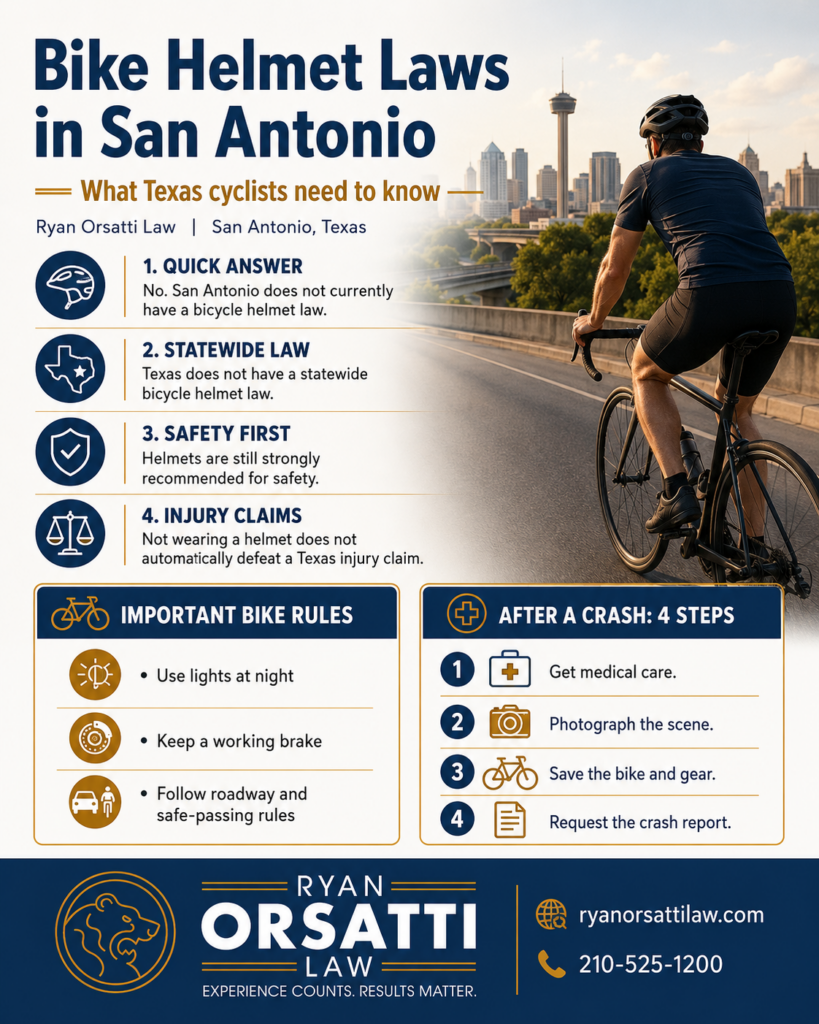
Do San Antonio bicycle riders have to wear helmets?
San Antonio bicycle riders are not currently required to wear helmets under the official city bicycle materials reviewed for this article. The City of San Antonio Bike Network Plan states that Texas does not have a statewide helmet law and that San Antonio does not currently have a helmet law. (San Antonio)
That answer applies to ordinary bicycle riding in San Antonio. It does not mean helmets are a bad idea. It means helmet use is a safety decision, not currently a citywide legal requirement for standard bicycle riders in San Antonio.
Some older online summaries may say San Antonio requires helmets for riders under 18. The safer current answer is to rely on the City’s own materials and the current City Code. If a ticket, citation, school rule, event waiver, bike-share policy, or private property rule is involved, check the exact rule that applies to that situation.
Does Texas have a statewide bicycle helmet law?
Texas does not have a statewide bicycle helmet law. The City of San Antonio’s Bike Network Plan identifies Texas as a state without a statewide helmet law and notes that some Texas cities have adopted local age-based helmet rules. (San Antonio)
This matters because bicycle helmet rules can change from city to city. A rider in San Antonio may face a different local rule than a rider in Austin, Dallas, Fort Worth, Houston, or another city with its own ordinance. For San Antonio riders, the key current point is that helmet use is encouraged, but not currently mandated by the citywide bicycle law materials reviewed here.
What San Antonio bicycle laws still matter if helmets are not required?
San Antonio cyclists still have to follow important roadway safety rules even though helmets are not currently required. Texas Transportation Code Chapter 551 gives bicyclists many of the same rights and duties as drivers, and San Antonio has local rules on safe passing, lights, and sidewalk riding. (Texas Legislature Online)
| Issue | Current rule or source | Practical meaning for San Antonio cyclists |
|---|---|---|
| Helmet use | San Antonio Bike Network Plan says San Antonio does not currently have a helmet law | You are not automatically violating city bicycle law by riding without a helmet, but wearing one is still a smart safety step |
| Rights and duties | Texas Transportation Code § 551.101 | Bicyclists generally have the rights and duties that apply to vehicle drivers, unless a bicycle-specific rule changes that |
| Riding near the right | Texas Transportation Code § 551.103 | A cyclist moving slower than traffic generally rides as near as practicable to the right curb or edge, with exceptions for passing, left turns, hazards, narrow lanes, and certain lane conditions |
| Night lights and brakes | Texas Transportation Code § 551.104 | A bike must have a working brake, a white front light visible from at least 500 feet at night, and a rear red reflector or red lamp |
| Safe passing | San Antonio local safe passing rule | Drivers should leave at least 3 feet when passing a vulnerable road user, and commercial or large trucks should leave at least 6 feet when road conditions allow |
| Sidewalk riding | San Antonio Code § 19-286 | San Antonio generally prohibits riding bicycles on sidewalks, except for law enforcement and emergency personnel |
Key takeaway: Even without a helmet mandate, a San Antonio bicycle crash claim may turn on lights, lane position, safe passing distance, sidewalk riding, driver inattention, and whether the evidence supports the cyclist’s version of events.
Are children required to wear bicycle helmets in San Antonio?
Current official San Antonio bicycle materials say San Antonio does not currently have a helmet law, which means the city materials do not show a current helmet mandate for children either. Parents should still require children to wear helmets because child bicycle crashes can produce serious head, face, and dental injuries. (San Antonio)
Texas law also makes parents and guardians responsible for not knowingly allowing a child or ward to violate the bicycle rules in Transportation Code Chapter 551. That rule is not a helmet requirement, but it does matter for lights, brakes, roadway use, and other bicycle safety rules. (Texas Legislature Online)
What about e-bikes, scooters, and shared bikes in San Antonio?
E-bikes and shared mobility devices can have different rules than ordinary bicycles, so riders should check the exact device, city rule, and rental agreement. Texas Transportation Code Chapter 551 applies certain bicycle rules to electric bicycles where the nature of the rule fits, and Texas law sets a minimum operator age of 15 for Class 3 electric bicycles. (Texas Legislature Online)
For injury claims, the device matters. A pedal bicycle, Class 1 e-bike, Class 3 e-bike, rented scooter, and delivery bike may involve different evidence, different insurance issues, and different defendants. Save the device, app records, receipts, trip data, photos, and the exact location where the crash occurred.
Can not wearing a helmet hurt a Texas bicycle accident claim?
Not wearing a helmet does not automatically defeat a Texas bicycle accident claim. Comparative responsibility means Texas can reduce or bar recovery based on the injured person’s percentage of fault, but the defense still has to connect the facts to the injuries and legal issues in the case. (Texas Legislature Online)
Texas Civil Practice and Remedies Code § 33.001 bars recovery only if the claimant’s percentage of responsibility is greater than 50%. If the claimant is not barred, § 33.012 generally reduces damages by the claimant’s percentage of responsibility. (Texas Legislature Online)
In a bicycle crash, an insurance company may argue that a cyclist failed to protect themselves by not wearing a helmet. That argument is not the same thing as proving the cyclist caused the crash. A driver who failed to yield, passed too closely, ran a red light, opened a car door into a cyclist, or drove distracted may still be legally responsible.
When does a no-helmet argument matter most?
A no-helmet argument usually matters most when the claimed injury involves the head, brain, face, or skull. If the primary injuries are a broken wrist, torn shoulder, knee injury, spinal injury, or road rash, the connection between helmet use and the claimed injury may be weaker.
The defense may try to use helmet evidence to shift attention away from driver conduct. That is why medical records, imaging, helmet photos, bike damage, clothing, witness statements, and crash-scene evidence matter. The question is not just whether the cyclist wore a helmet. The question is what caused the crash and what caused the injury.
Attorney Insight: In bicycle claims, adjusters often focus less on the helmet rule and more on documentation: lighting, direction of travel, camera angles, treatment timing, and whether the injury claimed could have been affected by helmet use. A preserved bike, lights, helmet, clothing, and early medical records can make the difference between a factual claim file and a blame-shifting claim file.
What if the driver says the bicyclist was at fault?
If the driver blames the bicyclist, the claim should be evaluated through evidence, not assumptions. In San Antonio bicycle crashes, fault disputes often involve visibility, lane position, safe passing distance, traffic signals, stop signs, sidewalk riding, driveway exits, dooring, and whether either person was distracted.
Helpful evidence may include:
- Crash-scene photos and videos.
- The bicycle, helmet, lights, reflectors, and damaged clothing.
- Vehicle damage photos.
- Business, home, dashcam, doorbell, or parking-lot video.
- Witness names and phone numbers.
- EMS, ER, urgent care, orthopedic, neurology, or physical therapy records.
- The TxDOT crash report, if law enforcement investigated.
TxDOT reported 2,761 crashes involving bicyclists in Texas in 2024. TxDOT also reported that crashes involving pedestrians and bicyclists together accounted for more than 20% of all Texas traffic deaths that year. (Texas Department of Transportation)
What should you do after a bike crash in San Antonio if you were not wearing a helmet?
If you were not wearing a helmet, act quickly to document the crash, your injuries, and the facts that show what the driver did wrong. Do not assume the claim is over because of the helmet issue. The evidence may show the driver caused the collision regardless of helmet use.
Bicycle crash checklist for San Antonio riders
- Get medical care right away. Tell the provider you were hit while riding a bicycle and describe every symptom, including headache, dizziness, confusion, nausea, neck pain, back pain, shoulder pain, wrist pain, and numbness.
- Call law enforcement if there is injury, death, or major damage. Texas law requires law enforcement to report certain crashes to TxDOT when they involve injury, death, or apparent property damage of $1,000 or more. (Texas Department of Transportation)
- Photograph everything before repairs. Take photos of the bike, vehicle, helmet if you had one, lights, reflectors, clothing, road surface, bike lane, intersection, signals, signs, skid marks, debris, and weather or lighting conditions.
- Save the bike and gear. Do not repair, throw away, donate, or sell the bicycle, helmet, lights, shoes, backpack, or clothing until the claim is evaluated.
- Look for video fast. Nearby stores, apartment complexes, homes, buses, rideshare vehicles, and commercial vehicles may have footage that is overwritten quickly.
- Avoid casual recorded statements. The other driver’s insurance company may ask questions designed to create fault arguments before the medical facts are clear.
- Track insurance and medical bills. Save health insurance explanations of benefits, hospital bills, ambulance bills, prescriptions, imaging bills, and letters about liens or reimbursement.
- Talk to a Texas personal injury lawyer if fault or injuries are serious. Ryan Orsatti Law helps injured cyclists in San Antonio and across Texas evaluate evidence, coverage, medical bill issues, and claim deadlines.
How do insurance and medical bills work after a San Antonio bicycle crash?
Bicycle crash bills may involve auto liability insurance, health insurance, PIP, MedPay, UM/UIM coverage, hospital liens, and reimbursement claims. The available coverage depends on who hit you, what policies exist, and whether the crash involved a motor vehicle.
Personal injury protection, often called PIP, is auto coverage that may help pay medical bills or lost income regardless of fault if it applies. MedPay is medical payments coverage that may help pay medical bills under certain policies. UM/UIM means uninsured or underinsured motorist coverage, which may matter if the driver had no insurance, too little insurance, or fled the scene.
Subrogation means a health insurer or benefit plan may claim a right to be paid back from a settlement. A hospital lien is a legal claim a hospital may assert against part of a personal injury recovery. These issues can affect the net amount the injured person receives after medical bills, liens, and insurance reimbursement claims are addressed.
How long do you have to file a bicycle accident lawsuit in Texas?
Texas generally gives an injured person two years to file a personal injury lawsuit after a bicycle accident. Texas Civil Practice and Remedies Code § 16.003 provides a two-year deadline for personal injury claims and wrongful death claims. (Texas Legislature Online)
Do not treat two years as a reason to wait. Bicycle crash evidence can disappear quickly. Video may be overwritten, witnesses may become hard to find, road conditions may change, and the bicycle itself may be repaired or discarded before anyone documents it.
If the crash involved a City of San Antonio vehicle, county vehicle, school vehicle, VIA bus, TxDOT vehicle, or another government-related entity, shorter notice issues may apply. Those situations should be evaluated quickly because government claims can involve rules beyond the general two-year statute of limitations.
How do you get the crash report after a San Antonio bicycle accident?
If law enforcement investigated the crash, the crash report is usually obtained through TxDOT’s crash report system, but reports are not available for open public viewing online. TxDOT states that law enforcement must submit certain crash reports no later than the tenth day after the crash. (Texas Department of Transportation)
The crash report can matter, but it is not the whole case. Police reports may identify parties, insurance, roadway conditions, contributing factors, diagrams, citations, witnesses, and officer narratives. Still, an attorney may need to gather more evidence from the scene, vehicles, medical records, and witnesses.
When should you call a San Antonio bicycle accident lawyer?
You should consider calling a San Antonio bicycle accident lawyer if you were injured, needed medical care, missed work, suffered a head injury, had broken bones, were blamed for the crash, or were hit by an uninsured, commercial, rideshare, delivery, or government vehicle. Legal help is especially useful when evidence needs to be preserved quickly.
Ryan Orsatti Law helps injured people in San Antonio and across Texas evaluate bicycle crash claims, including fault disputes, insurance coverage, medical bills, liens, subrogation, UM/UIM issues, and evidence preservation. The goal is to help the injured person understand the process and make informed decisions without relying on the insurance company’s version of the case.
For more information, see Ryan Orsatti Law’s resources on San Antonio bicycle accident claims, bicycle safety laws in San Antonio, and how bicycle accident case value is evaluated.
What is the practical answer for San Antonio riders?
The practical answer is simple: San Antonio does not currently require bicycle helmets, but riders should still wear them. A helmet can reduce risk, and it can also reduce the opportunity for an insurance company to distract from the driver’s conduct after a crash.
For legal purposes, helmet use is only one piece of the picture. The larger issues are whether the driver followed the rules, whether the cyclist followed applicable bicycle laws, what injuries were caused by the crash, and what evidence exists to prove the claim.
FAQ
Does Texas have a statewide bicycle helmet law?
No. Texas does not have a statewide bicycle helmet law for ordinary bicycle riders. San Antonio’s Bike Network Plan also states that San Antonio does not currently have a helmet law. Local cities can adopt their own helmet ordinances, so riders should check the current rule in the specific Texas city where they are riding. (San Antonio)
Are children required to wear bicycle helmets in San Antonio?
Current official San Antonio bicycle materials reviewed for this article do not show a current citywide helmet requirement for children. Parents should still require children to wear properly fitted helmets because child riders are vulnerable to head, face, and dental injuries. If a citation or school-related rule is involved, check the exact current City Code or policy.
Can I recover money if I was not wearing a helmet when a car hit me?
Possibly. Not wearing a helmet does not automatically bar a Texas bicycle accident claim. Texas comparative responsibility rules can reduce or bar recovery depending on fault percentages, but the insurance company still must connect the facts to the crash and injuries. Driver negligence, medical causation, and evidence preservation remain central issues. (Texas Legislature Online)
Can police ticket me for riding a bike without lights at night in San Antonio?
Yes, riding without required lights at night can create a citation issue. Texas bicycle law requires a white front light visible from at least 500 feet and a rear red reflector or red lamp at night. San Antonio’s bicycle law page also identifies bike light requirements and notes that violations can be Class C misdemeanors. (Texas Legislature Online)
Can I ride my bicycle on the sidewalk in San Antonio?
Generally, no. San Antonio Code § 19-286 prohibits riding bicycles on sidewalks, with exceptions for law enforcement and emergency personnel. If a sidewalk-riding issue is part of a crash, it may become part of the fault dispute, especially near driveways, crosswalks, parking lots, and intersections. (San Antonio)
How soon should I request the crash report after a San Antonio bicycle accident?
You should request the crash report after law enforcement has had time to submit it to TxDOT. TxDOT states that officers must submit certain crash reports no later than the tenth day after crashes involving injury, death, or apparent property damage of $1,000 or more. A lawyer can also help gather video, witnesses, and scene evidence. (Texas Department of Transportation)
Ryan Orsatti Law
4634 De Zavala Rd, San Antonio, TX 78249
Phone: 210-525-1200
ryanorsattilaw.com
This blog is for informational purposes only, not legal advice. Reading it does not create an attorney-client relationship. Past results do not guarantee future results.
Hurt in an accident in San Antonio? Learn how a San Antonio bicycle accident lawyer can help with your claim. Call 210-525-1200 or request a free consultation.
The firm works on a contingency fee. You pay nothing unless the firm recovers money for you, and that covers case expenses as well as the fee: if there is no recovery, you owe no attorney's fee and no case expenses. Ask for the fee agreement and read the fee and expense section before you sign anything.
Related San Antonio legal resources
Primary legal and public-data sources
- TxDOT: Texas crash reports, data, and statistics
- Texas Civil Practice and Remedies Code Chapter 33: proportionate responsibility
Ryan Orsatti Law
4634 De Zavala Road, San Antonio, TX 78249
General reference links. Consult each source for its current text.