
Quick Answer
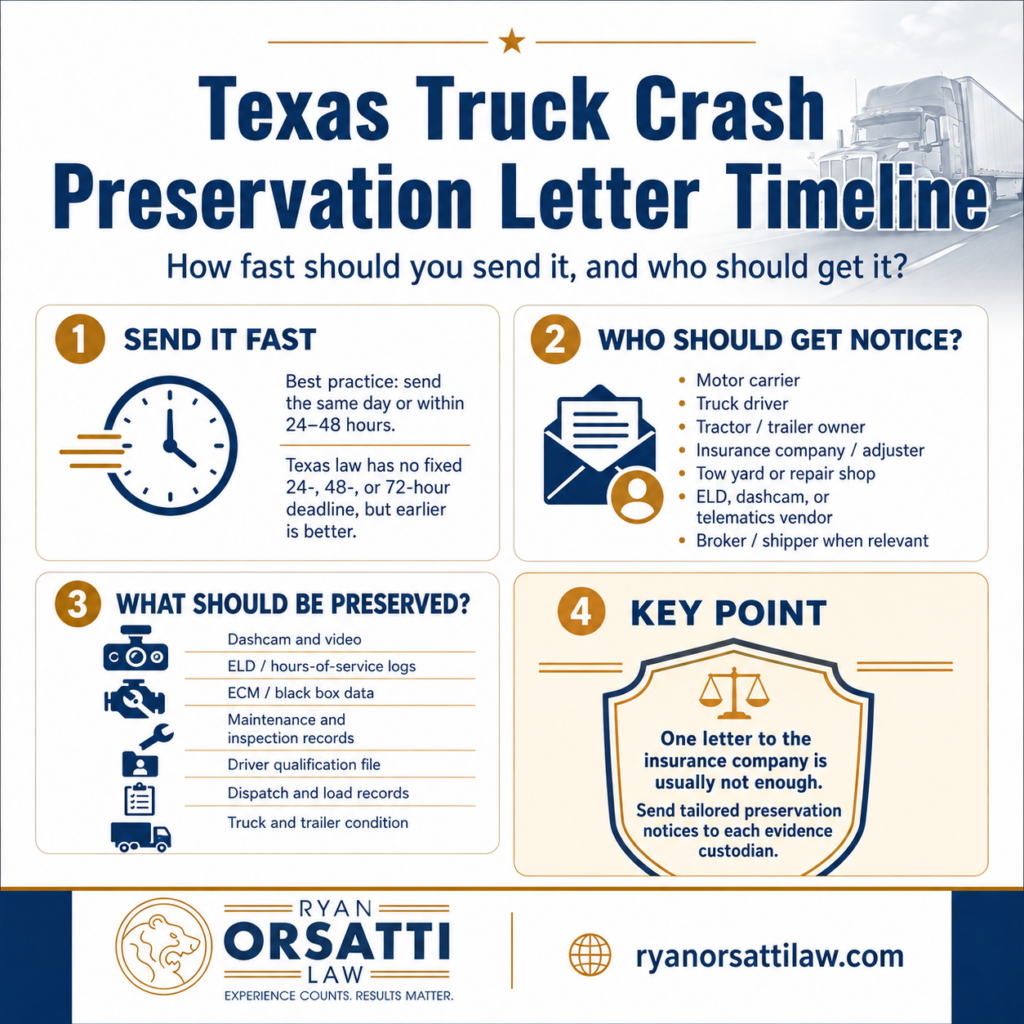
Send a truck-crash preservation letter as soon as the responsible companies and evidence custodians can be identified, preferably the same day counsel is retained and within the first 24 to 48 hours when possible. Texas law does not impose a universal 24-hour, 48-hour, or 72-hour deadline. Separate notices should reach the motor carrier, driver, tractor and trailer owners, insurer, and any broker, repair facility, tow yard, or technology vendor that may control evidence.
Key Takeaways
- There is no Texas statute making 72 hours a safe deadline. Earlier is better because video, telematics, vehicle condition, and third-party data can change quickly.
- A litigation hold is usually an internal instruction. The document sent to an opposing company is more accurately called a preservation letter or spoliation notice.
- Sending one letter to the insurance adjuster is usually not enough. Each important evidence custodian should receive a targeted notice.
- Federal regulations require some trucking records to be retained for months or years, but those minimum periods do not cover every electronic system or physical item.
- A preservation letter does not automatically produce the evidence. Inspection agreements, subpoenas, discovery, or an emergency court order may still be necessary.
Is There a Texas Deadline for Sending a Truck-Crash Spoliation Letter?
Texas law does not establish a fixed deadline for sending a litigation-hold or spoliation letter after a commercial truck crash. The practical deadline is controlled by the evidence most likely to disappear first. For a serious crash, that usually means sending notices immediately after identifying the motor carrier and other custodians, without waiting for medical treatment to finish or for the final crash report.
“Spoliation” means the loss, destruction, alteration, or failure to preserve evidence relevant to an anticipated claim. Under the Texas Supreme Court’s decision in Brookshire Brothers, Ltd. v. Aldridge, a preservation duty arises when a party knows or reasonably should know that there is a substantial chance a claim will be filed and that evidence within its possession or control will be material and relevant to the claim.
A court considering spoliation asks whether the party had a duty to preserve evidence and whether it intentionally or negligently breached that duty. The judge, not the jury, decides those questions and selects a proportionate remedy based largely on culpability and prejudice.
A preservation letter does not magically create every legal duty. Its major value is that it documents notice, identifies the evidence believed to be relevant, and asks the recipient to suspend routine deletion, repair, recycling, or overwrite processes.
For a broader explanation of the document itself, read what a spoliation letter is and why it matters after a truck accident.
Why Should the Letter Go Out Within the First 24 to 48 Hours?
The first 24 to 48 hours are a practical target because some of the most valuable evidence is stored in systems that operate continuously. A truck may be moved, inspected, repaired, downloaded, reassigned, or returned to service. Dashcam video and telematics may be governed by company-specific retention settings that are much shorter than federal recordkeeping periods.
The Federal Motor Carrier Safety Administration’s current Texas summary reports 18,833 fatal and nonfatal large-truck crashes during calendar year 2024, resulting in 11,026 reported injuries. FMCSA identifies the figures as MCMIS data that remain subject to revision, but the scale shows why carriers, insurers, investigators, repair facilities, and technology vendors regularly process large volumes of crash information.
The evidence at immediate risk may include:
- Road-facing and driver-facing camera footage
- GPS location history and harsh-event alerts
- Electronic control module data concerning speed, braking, throttle, and engine activity
- Physical brake, tire, coupling, lighting, and cargo-securement components
- Dispatch messages and mobile application communications
- Tow-yard photographs and post-crash inspection materials
- The driver’s phone, photographs, notes, and electronic messages
Ryan Orsatti Law has separate guides explaining seven categories of evidence that can disappear after a truck crash and the differences among EDR or ECM data, telematics, and electronic logging devices.
Who Should Receive the Litigation-Hold Letter After a Texas Truck Crash?
The notice should reach each company or person who possesses, controls, stores, maintains, or can obtain relevant evidence. Sending only to the name printed on the truck may miss the trailer owner, driver’s employer, motor carrier operating under the USDOT number, maintenance vendor, insurer, broker, or cloud-based technology provider.
| Potential recipient | Evidence the recipient may control |
|---|---|
| Motor carrier operating the truck | ELD records, dispatch communications, safety files, driver qualification records, accident files, policies, training, and internal investigation materials |
| Truck driver | Phone data, messages, photographs, handwritten records, personal devices, and information identifying dispatchers or vendors |
| Tractor owner or lessor | Vehicle condition, ownership and lease documents, maintenance records, ECM access, and post-crash repairs |
| Trailer owner or intermodal equipment provider | Trailer condition, inspections, repairs, lighting, brakes, tires, coupling systems, and identifying records |
| Commercial insurer, TPA, or defense counsel | Claim photographs, recorded statements, adjuster notes, inspection reports, investigator files, and expert materials |
| Broker, shipper, consignee, or cargo loader | Load assignments, bills of lading, appointment times, cargo documents, loading instructions, and communications |
| Tow yard, repair shop, maintenance contractor, or salvage facility | Physical custody of the vehicles, photographs, replaced parts, diagnostic downloads, repair records, and disposal plans |
| ELD, telematics, dashcam, or fleet-management vendor | Cloud-hosted logs, GPS history, videos, alerts, audit trails, user activity, and system-retention settings |
Key takeaway: A preservation strategy should follow the evidence, not merely the insurance claim. Each custodian should receive a notice tailored to the information and physical items it controls.
Is Sending the Letter to the Registered Agent Enough?
Sending a copy to the company’s registered agent can help document delivery, but it should not be the only delivery method. A registered agent primarily receives legal process. The agent may not have direct access to the carrier’s fleet, safety department, information-technology systems, cloud vendors, or repair decisions.
The notice should also go directly to known operational contacts, such as:
- The carrier’s safety or risk-management department
- The carrier’s legal department
- The insurance adjuster or third-party administrator
- Known defense counsel
- The fleet or maintenance manager
- The facility physically holding the tractor or trailer
- Each identified data vendor
Use several verifiable delivery methods when possible, including email, certified mail, overnight delivery, fax, and an insurer’s claim portal. Save the complete notice, attachments, delivery confirmations, email headers, and any acknowledgment.
Is Sending the Letter Only to the Insurance Company Enough?
An insurer may control its own claim file, but it may not possess or control the motor carrier’s ELD platform, onboard cameras, truck, trailer, driver files, or maintenance system. The carrier should therefore receive a direct notice even when the adjuster says the insurer will “handle everything.”
The insurer should still receive a separate notice covering evidence it creates or obtains, including photographs, recorded statements, estimates, downloads, inspections, investigator reports, and communications with the insured.
How Do You Identify the Correct Motor Carrier and Other Recipients?
Start with the truck’s USDOT number, company markings, license plates, unit numbers, trailer number, VINs, and insurance information. Do not assume the company logo identifies the correct legal entity. Leased equipment, independent contractors, related companies, and brokered loads can place different parts of the evidence under different entities’ control.
Use this identification process:
- Preserve photographs from the scene. Capture both cab doors, USDOT and MC numbers, license plates, tractor and trailer numbers, company names, and insurance documents.
- Search the USDOT number. FMCSA’s SAFER Company Snapshot can identify the carrier’s legal name, doing-business-as name, address, operating status, and equipment information.
- Check operating authority and insurance filings. FMCSA’s Licensing and Insurance Carrier Search can help identify authority and insurance information associated with an interstate carrier.
- Confirm the business entity and registered agent. The Texas Secretary of State provides business searches through SOSDirect.
- Trace the equipment and shipment. Obtain the crash report, tow record, repair location, bill of lading, lease information, and insurer contacts as soon as they become available.
A commercial collision can involve more corporate layers than an ordinary passenger-car wreck. The firm’s guide to the differences between car and truck accident claims explains why identifying the correct entities matters.
What Should a Texas Truck-Crash Preservation Letter Cover?
The letter should identify the crash precisely, describe the evidence to be preserved, require suspension of routine deletion, and prohibit alteration of physical evidence before an inspection can occur. A generic demand to “preserve everything” may be less useful than a focused notice naming the vehicles, custodians, systems, date ranges, file types, and known vendors.
A well-developed notice should address at least these subjects:
- Crash identifiers: Date, time, location, driver, parties, USDOT number, unit numbers, VINs, claim number, and investigating agency.
- Electronic data: ELD records, ECM or engine-module data, GPS, telematics, dashcam video, driver-facing video, collision alerts, mobile applications, infotainment data, and electronic audit histories.
- Native files and metadata: Preserve the original electronic format, timestamps, edit history, annotations, user activity, export logs, and chain-of-custody information.
- Driver records: Qualification file, employment application, driving history, training, medical qualification, prior incidents, disciplinary records, and hours-of-service documentation.
- Vehicle and trailer condition: No repair, disassembly, diagnostic reset, firmware update, salvage, sale, destructive testing, or disposal before inspection arrangements are addressed.
- Maintenance and inspection records: Preventive maintenance, repair orders, invoices, roadside inspections, pre-trip reports, post-trip reports, defect reports, tire records, brake work, and post-crash evaluations.
- Shipment and dispatch evidence: Bills of lading, rate confirmations, trip assignments, schedules, cargo records, weight tickets, route instructions, delivery appointments, and dispatcher communications.
- Third-party systems: Identify ELD, telematics, camera, maintenance, dispatch, and fleet-management vendors, then direct them to suspend deletion under the carrier’s account.
For mechanical-failure claims, review how maintenance records can establish what the carrier knew about the truck’s condition.
How Long Do Federal Regulations Require Trucking Records to Be Kept?
Federal minimum-retention periods vary by record type and do not cover every piece of evidence generated by a commercial truck. For many federally regulated carriers, ELD records may have a six-month minimum, while an accident register must be maintained for three years. Vendor video, some telematics, physical components, and nonregulated business records may follow much shorter company policies.
| Record category | Federal minimum for many regulated carriers |
| Records of duty status and supporting documents | At least six months from receipt under 49 C.F.R. § 395.8(k) |
| Driver qualification file | During employment and for three years afterward, subject to record-specific provisions in 49 C.F.R. § 391.51 |
| Vehicle maintenance records | One year while maintained or housed, plus six months after the vehicle leaves the carrier’s control under 49 C.F.R. § 396.3 |
| Driver vehicle inspection reports identifying defects | Three months under 49 C.F.R. § 396.11 |
| Accident register and specified accident reports | Three years under 49 C.F.R. § 390.15 |
| Drug and alcohol program records | One, two, five, or longer periods depending on the record under 49 C.F.R. § 382.401 |
FMCSA confirms that carriers must generally retain ELD records of duty status and supporting documents for six months, including a backup copy stored separately from the original system.
Key takeaway: Regulatory minimums are not waiting periods. A carrier’s duty to preserve relevant evidence may arise before the normal retention period expires, and many valuable data sources are not protected by the six-month ELD rule.
Does a Spoliation Letter Force the Trucking Company to Produce Evidence?
A preservation letter is not a subpoena, discovery request, or court order. It tells the recipient to retain identified evidence, but it does not necessarily require immediate production or allow the injured person to inspect the truck without an agreement. Production may require consent, formal discovery, a subpoena, or judicial relief.
Counsel should follow the notice with concrete action, such as:
- Requesting written acknowledgment of the hold
- Identifying the employees and vendors responsible for preservation
- Negotiating a nondestructive inspection and forensic download
- Confirming where the tractor, trailer, and removed components are stored
- Filing suit and serving discovery when voluntary cooperation is insufficient
- Seeking an emergency order when evidence faces imminent alteration or disposal
If evidence later disappears, a Texas court will not automatically punish the recipient merely because a letter was sent. Under Brookshire Brothers, the court evaluates whether a preservation duty existed, whether the duty was breached intentionally or negligently, and how the loss prejudiced the other party. Severe jury instructions generally require specific intent to conceal evidence, subject to a narrow exception for extraordinary prejudice from negligent destruction.
What Should I Do If Days or Weeks Have Already Passed?
Send the preservation notices immediately even if the preferred early window has passed. Some records may still exist under federal retention rules, in cloud backups, in a vendor account, at a repair facility, or in the files of the insurer, police department, tow company, shipper, broker, or driver.
A delayed investigation can still pursue:
- ELD records and supporting documents
- Accident-register materials
- Driver qualification and maintenance files
- Insurer photographs and inspections
- Tow-yard and repair-shop records
- 911 audio and law-enforcement photographs
- Nearby business or residential video
- Toll, fuel, scale, dispatch, and delivery records
- Witness statements and vehicle-damage documentation
The priority is to determine what still exists, who controls it, what changed after the crash, and whether any deletion occurred after the recipient reasonably anticipated a claim.
When Does Legal Help Matter in Preserving Truck-Crash Evidence?
Legal help becomes particularly important when the crash caused serious injuries, a death, disputed fault, a mechanical failure, a cargo problem, or involvement by multiple transportation companies. A lawyer can identify the operating carrier, map each evidence custodian, issue targeted notices, arrange inspections, and determine whether formal court action is needed.
Ryan Orsatti Law helps injured people in San Antonio, Bexar County, and across Texas evaluate motor-carrier responsibility, preserve commercial-vehicle evidence, and address insurance and medical-bill issues. More information is available in the firm’s San Antonio truck accident guide.
Attorney Insight: The most common preservation mistake is sending one broad letter to an insurance adjuster and assuming the truck, carrier data, cloud video, and repair records are covered. They are often controlled by different entities. I identify who controls each evidence source, send separate notices, and preserve proof of delivery before the evidence chain becomes harder to reconstruct.
Frequently Asked Questions
Is there a 72-hour Texas deadline for sending a truck-crash spoliation letter?
No. Texas law does not establish a universal 72-hour deadline or safe harbor. The letter should be sent as soon as the likely claim and relevant custodians can be identified. The first 24 to 48 hours are a practical target because video, telematics, vehicle condition, and third-party records may change before federally regulated documents reach their formal retention deadlines.
Should I wait for the Texas crash report before sending the letter?
No. A preservation notice can be sent using the information already available, including the crash date, location, driver’s name, truck markings, USDOT number, license plates, unit numbers, and insurer claim number. The notice can be supplemented after the CR-3 report identifies additional companies, vehicles, owners, or witnesses.
Can I send a preservation letter myself after an 18-wheeler crash?
An injured person can send written preservation requests, but the request should accurately identify the entities, evidence, systems, vehicles, and relevant time period. Overlooking the operating carrier, technology vendor, trailer owner, or repair facility may leave important evidence unprotected. A letter also does not replace a subpoena, inspection agreement, lawsuit, or court order when compulsory action is needed.
Should the truck driver receive a separate preservation notice?
Usually, yes. The driver may control a phone, text messages, photographs, handwritten notes, personal application data, social-media content, or communications not stored in the carrier’s central system. A separate notice also reduces later disputes over whether the driver knew that personally controlled evidence was relevant to an anticipated Texas injury claim.
Can the trucking company repair the truck after receiving the letter?
The carrier may have legitimate safety and business reasons to move or repair equipment, but it should not alter relevant physical evidence without reasonable preservation steps. A targeted notice should request that the tractor, trailer, components, electronic modules, photographs, measurements, and removed parts remain available until the parties can address a nondestructive inspection and forensic download.
What happens if truck evidence was destroyed before the letter arrived?
The absence of an earlier letter does not automatically eliminate a spoliation issue. Under Texas law, a preservation duty may arise when the company already knows or reasonably should know that a substantial claim is likely and relevant evidence is within its control. The court will examine notice, timing, relevance, fault, available substitutes, and the prejudice caused by the loss.
Does the six-month ELD rule mean I can safely wait six months?
No. The six-month rule applies to particular records of duty status and supporting documents. It does not guarantee preservation of every dashcam clip, telematics event, ECM record, mobile message, physical component, or vendor file. Waiting also increases the risk that the truck will be repaired, parts discarded, personnel changed, or relevant third-party information lost.
Ryan Orsatti Law
4634 De Zavala Rd, San Antonio, TX 78249
Phone: 210-525-1200
ryanorsattilaw.com
This blog is for informational purposes only, not legal advice. Reading it does not create an attorney-client relationship. Past results do not guarantee future results.
Hurt in an accident in San Antonio? Learn how a San Antonio car accident lawyer can help with your claim. Call 210-525-1200 or request a free consultation.
The firm works on a contingency fee. You pay nothing unless the firm recovers money for you, and that covers case expenses as well as the fee: if there is no recovery, you owe no attorney's fee and no case expenses. Ask for the fee agreement and read the fee and expense section before you sign anything.
Related San Antonio legal resources
Primary legal and public-data sources
Ryan Orsatti Law
4634 De Zavala Road, San Antonio, TX 78249
General reference links. Consult each source for its current text.