
Quick Answer: Car and truck accident claims differ because truck claims often involve commercial defendants, federal trucking rules, higher insurance requirements, and time-sensitive electronic evidence. In Texas, most injury lawsuits must be filed within two years under Texas Civil Practice & Remedies Code § 16.003, but truck evidence can disappear much sooner because FMCSA guidance says motor carriers keep ELD records and supporting documents for six months. TxDOT reported 2,684 commercial motor vehicle-involved crashes in Bexar County in 2024, including 18 fatal crashes, so serious San Antonio truck claims usually require a wider investigation than a standard two-car wreck. Ryan Orsatti Law helps injured Texans evaluate which claim path fits the facts.
Key Takeaways
- A car accident claim usually centers on the drivers, their personal auto policies, the crash report, photos, vehicle damage, and medical records.
- A truck accident claim may involve the driver, motor carrier, truck owner, trailer owner, maintenance vendor, cargo loader, shipper, or broker, depending on the facts.
- Texas minimum personal auto liability coverage is commonly called 30/60/25, while FMCSA insurance requirements for many for-hire property carriers can start at $750,000.
- Truck cases often turn on electronic logging device data, dashcam video, GPS, dispatch records, inspection records, and maintenance documents.
- Texas proportionate responsibility rules can reduce or bar recovery if fault is shifted to the injured person, so early evidence matters.
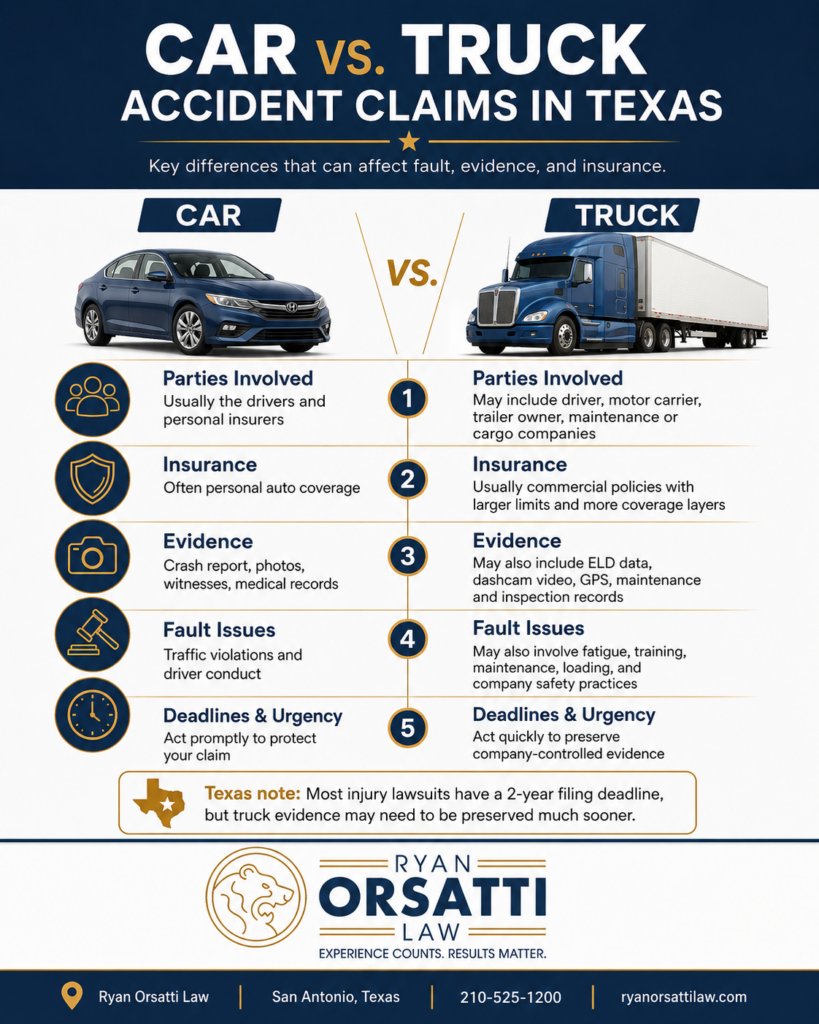
What are the main differences between car and truck accident claims in Texas?
The main difference is that truck accident claims usually involve more parties, more insurance, more regulations, and more evidence than a typical car accident claim. A car wreck may involve two private drivers and two personal auto policies. A truck crash on I-35, Loop 410, Loop 1604, I-10, or US-281 may involve a commercial driver, motor carrier, trailer owner, cargo company, maintenance records, federal safety rules, and corporate insurance layers.
Texas crash law still starts with negligence, which means failing to use reasonable care. But proving negligence in a truck case often requires more than the police report. The investigation may need driver logs, dispatch communications, safety files, repair histories, and data showing what the truck was doing before impact.
| Issue | Typical car accident claim | Truck accident claim |
|---|---|---|
| Main parties | Usually the drivers and their personal insurers | Driver, motor carrier, owner, trailer company, maintenance vendor, cargo loader, shipper, broker, or others |
| Insurance | Personal auto liability, PIP, MedPay, UM/UIM, collision | Commercial auto, excess coverage, FMCSA filings, possible MCS-90 issues, cargo-related coverage |
| Rules | Texas traffic laws and ordinary negligence standards | Texas law plus FMCSA regulations for many commercial motor vehicles |
| Evidence | CR-3, photos, witnesses, vehicle damage, medical records | ELD data, ECM data, dashcam, GPS, bills of lading, inspection records, driver qualification file, maintenance records |
| Fault disputes | Who had the light, who changed lanes, who followed too closely | Blind spots, stopping distance, fatigue, load securement, driver training, route pressure, maintenance, company safety practices |
| Timeline pressure | Evidence should still be gathered quickly | Evidence preservation is often urgent because some records have regulatory retention periods |
Key takeaway: Do not treat an 18-wheeler crash like a larger car wreck; the legal deadline may be similar, but the evidence and coverage investigation usually start faster and reach more entities.
Why do truck accident claims usually involve more parties?
Truck accident claims usually involve more parties because a commercial truck may be operated, owned, loaded, maintained, dispatched, and insured by different people or companies. Liability means legal responsibility for the crash. In a truck case, liability may extend beyond the person driving if another company’s decisions contributed to the wreck.
For example, the driver may have made an unsafe lane change, but the motor carrier may also have failed to train the driver, ignored safety violations, or pushed a schedule that created fatigue risk. A maintenance company may matter if bad brakes contributed. A loader may matter if unsecured cargo shifted. A broker or shipper may matter in limited fact-specific situations, but broker and shipper liability should not be assumed without evidence.
Can a trucking company be responsible even if only the driver hit me?
Yes, a trucking company can be responsible if the driver was acting within the scope of employment or if the company’s own conduct contributed to the crash. Common theories include negligent hiring, negligent training, negligent supervision, negligent maintenance, and responsibility for an employee driver’s conduct while working.
This is why truck cases often require corporate documents. A crash report may identify the driver, vehicle, and insurance, but it may not show whether the company reviewed the driver’s safety history, monitored hours, repaired the vehicle, or enforced its own policies.
How is insurance different in car accident claims and truck accident claims?
Insurance is different because personal car accident claims usually involve personal auto limits, while many truck accident claims involve commercial policies and federal insurance filing rules. The Texas Department of Insuranceexplains that Texas drivers must generally carry at least $30,000 per injured person, $60,000 per accident, and $25,000 for property damage. FMCSA’s insurance filing requirements list $750,000 in BIPD coverage for many for-hire non-hazardous property carriers with vehicles weighing 10,001 pounds or more.
Higher insurance limits do not automatically mean a claim is easy or that a particular amount is available. Commercial insurers often investigate quickly, assign adjusters early, and look for ways to shift fault. The real insurance analysis may include the tractor policy, trailer policy, excess policy, employer coverage, driver status, cargo type, and whether the carrier had the required filings.
Personal auto policies may also matter. PIP means personal injury protection, which can help pay medical bills and some lost wages regardless of fault if available. MedPay means medical payments coverage. UM/UIM means uninsured or underinsured motorist coverage, which may apply when the at-fault driver has no insurance or not enough insurance. TDI explains that Texas auto policies include PIP unless rejected in writing, and insurers must offer UM/UIM unless it is rejected in writing.
Should you give a recorded statement after a truck crash?
You should be cautious before giving a recorded statement to a trucking company’s insurer because the questions may focus on fault, injury timing, prior conditions, and gaps in treatment. You may need to report the crash to your own insurer, but a detailed recorded statement to the opposing commercial carrier can affect how the claim is evaluated.
This does not mean you should ignore insurance deadlines. It means you should understand who is asking, whose insurer they represent, what policy applies, and whether the statement is required. In serious injury cases, getting legal advice before a recorded statement is often a safer step.
What evidence makes truck accident claims different from car accident claims?
Truck accident claims are different because key evidence is often controlled by the trucking company or its vendors. In a car accident claim, the most important evidence may be photos, the Texas Peace Officer’s Crash Report, witness names, medical records, and repair estimates. In a truck case, the proof may also include ELD records, GPS data, ECM data, dashcam video, inspection reports, driver qualification files, dispatch messages, and maintenance records.
FMCSA guidance states that motor carriers must retain electronic logging device records of duty status and supporting documents for six months. That six-month retention point is a practical reason truck crash evidence should be requested quickly. A preservation letter, often called a spoliation letter, tells parties to preserve relevant evidence because litigation may be reasonably anticipated.
Attorney Insight: In truck cases, the first dispute is often about control of evidence. The carrier may have ELD data, dashcam footage, inspection records, dispatch messages, and maintenance documents that an injured person cannot access alone. The sooner those items are identified and preserved, the harder it is for a liability story to be built on memory alone.
What should you preserve after either kind of crash?
You should preserve anything that shows how the crash happened, how you were injured, and how the crash affected your life. This matters in both car and truck claims, but it is especially important after a commercial vehicle crash because the other side may begin investigating immediately.
- Take photos of all vehicles, damage, debris, skid marks, traffic lights, lane markings, and visible injuries.
- Save the names, phone numbers, and email addresses of witnesses.
- Get the investigating officer’s name, agency, and crash report number.
- Request the Texas Peace Officer’s Crash Report, also called a CR-3, through TxDOT crash reports and recordswhen available.
- Keep all medical records, discharge papers, prescriptions, work notes, and therapy instructions.
- Do not repair or dispose of a severely damaged vehicle until photos, estimates, and evidence issues are addressed.
- In a truck crash, ask a lawyer about preserving ELD data, dashcam video, ECM data, GPS, dispatch records, inspection reports, and maintenance records.
How do Texas fault rules apply to car and truck accident claims?
Texas fault rules apply to both car and truck accident claims through proportionate responsibility. Proportionate responsibility means Texas can reduce a person’s recovery by their percentage of fault, and Texas Civil Practice & Remedies Code § 33.001 says a claimant may not recover damages if their percentage of responsibility is greater than 50 percent.
In a car wreck, an insurer may argue that the injured driver was speeding, distracted, following too closely, or failed to keep a proper lookout. In a truck case, those same arguments may appear, but the defense may also claim the injured driver was in a blind spot, cut off the truck, braked suddenly, or failed to account for the truck’s stopping distance.
That is why physical and electronic evidence matters. Photos, lane position, vehicle crush patterns, dashcam footage, ECM data, witness statements, and crash reconstruction analysis can affect fault allocation. A claim can change significantly if evidence shows the truck was speeding, the driver was out of hours, the brakes were poorly maintained, or the carrier ignored prior safety issues.
Are truck accident injuries and damages handled differently?
Truck accident injuries and damages are handled differently when the crash causes more severe trauma, longer treatment, higher medical bills, lost earning capacity, or long-term impairment. Damages means the losses claimed in a personal injury case, including medical expenses, lost income, pain, physical impairment, disfigurement, and other legally recognized losses.
A serious truck crash may require future medical opinions, life-care planning, vocational analysis, and careful review of liens. Subrogation means a health insurer may claim a right to be reimbursed from a settlement. A hospital lien is a legal claim a hospital may assert against part of a personal injury recovery. These issues can also exist in car accident cases, but they tend to be more important when medical bills are high.
Truck crashes also create property damage issues beyond ordinary repairs. A vehicle may be a total loss, the owner may need rental coverage, and commercial insurers may dispute storage, towing, or diminished value. Diminished value means the vehicle may be worth less after crash repairs than it was before the crash.
Do truck accident claims have a different Texas filing deadline?
Usually no, truck accident lawsuits and car accident lawsuits are generally subject to the same two-year Texas personal injury deadline under Texas Civil Practice & Remedies Code § 16.003. The major practical difference is that truck evidence often has shorter preservation windows, including FMCSA’s six-month ELD record retention guidance.
Do not confuse the lawsuit deadline with evidence deadlines, insurance deadlines, or notice issues. If a city, county, school district, public bus, or other governmental entity is involved, notice rules may apply sooner than the lawsuit deadline. If a crash involves a commercial vehicle, it is safer to evaluate deadlines early rather than assume every issue can wait two years.
How long do car and truck accident claims take?
Car and truck accident claims take as long as needed to investigate liability, complete medical treatment or understand future care, evaluate insurance, negotiate, and, if necessary, file suit. A straightforward car accident claim may move faster when liability is clear and treatment is limited. A truck accident claim often takes longer because there are more records to obtain, more potential defendants, and more coverage issues.
The timing should be driven by evidence and medical documentation, not pressure from an adjuster. A demand sent too early may miss future treatment, lost wage documentation, surgical recommendations, impairment issues, liens, or subrogation claims. A lawsuit may be needed when liability, damages, or insurance coverage cannot be resolved through the claim process.
For a broader overview of the civil case process, Ryan Orsatti Law explains how a personal injury lawsuit works in Texas injury cases.
When should you call a lawyer after a car or truck accident in San Antonio?
You should call a lawyer quickly after a truck crash, serious injury, disputed fault, commercial vehicle collision, hit-and-run, low insurance limits, or any request for a recorded statement from the other side. Many simple property-damage-only car claims can be handled directly, but injury claims involving medical treatment, lost wages, or disputed liability deserve a careful review.
Ryan Orsatti Law helps injured people in San Antonio and across Texas evaluate fault, insurance coverage, evidence preservation, medical documentation, liens, and next steps after serious car and truck crashes. The firm’s San Antonio truck accident lawyer page covers commercial vehicle claims, and the San Antonio car accident attorney page covers wrecks involving passenger vehicles.
You can also contact Ryan Orsatti Law to discuss whether your crash should be handled as a standard auto claim, a commercial vehicle claim, or a more complex injury case.
What should you do next after a car or truck crash in Texas?
You should focus first on medical care, documentation, insurance notice, and evidence preservation. After a car crash, that may mean getting treatment, obtaining the CR-3, photographing damage, and identifying the other driver’s policy. After a truck crash, it may also mean preserving ELD data, dashcam video, ECM data, driver logs, inspection reports, and company safety documents.
If you are unsure whether the vehicle was a regulated commercial motor vehicle, save what you have and ask questions early. A delivery van, box truck, dump truck, tow truck, company pickup, rideshare vehicle, bus, oilfield truck, and 18-wheeler can all raise different insurance and liability issues.
FAQ
Are truck accident claims worth more than car accident claims?
Truck accident claims are not automatically worth more, but they often involve higher medical bills, more severe injuries, and larger commercial insurance policies. Value still depends on liability, injury proof, medical treatment, future care, lost income, impairment, available coverage, and fault allocation under Texas law. A minor truck impact may be limited, while a serious car crash can be substantial.
Do I sue the truck driver or the trucking company after an 18-wheeler crash in Texas?
You may have claims against the truck driver, the trucking company, or both, depending on the facts. Other parties may also matter, including the truck owner, trailer owner, maintenance company, cargo loader, or another company involved in the trip. A proper investigation should identify who controlled the driver, vehicle, load, route, maintenance, and insurance.
How long do I have to file a car or truck accident lawsuit in Texas?
Most Texas car and truck accident injury lawsuits must be filed within two years under Texas Civil Practice & Remedies Code § 16.003. That does not mean you should wait. Truck cases often require fast evidence preservation, and claims involving governmental entities may involve earlier notice issues. Deadlines should be checked as soon as possible.
What evidence disappears fastest after a truck accident?
Truck accident evidence that may disappear quickly includes dashcam video, ELD data, GPS data, ECM data, dispatch messages, inspection records, maintenance records, and witness memories. FMCSA guidance says motor carriers must retain ELD records of duty status and supporting documents for six months. A preservation letter can help protect important records before they are overwritten or discarded.
Should I talk to the trucking company’s insurance adjuster?
You should be careful before giving a recorded statement or detailed injury discussion to the trucking company’s insurance adjuster. The adjuster may ask questions designed to limit liability, minimize injuries, or create fault arguments. You can report basic facts, but serious injury claims often benefit from legal guidance before recorded statements or settlement discussions.
Can I still recover if I was partly at fault in a Texas car or truck accident?
Yes, you may still recover if you were partly at fault, but Texas proportionate responsibility rules can reduce your recovery by your percentage of fault. If your responsibility is greater than 50 percent, Texas law can bar recovery. That is why photos, witnesses, vehicle data, crash reports, and medical documentation matter in both car and truck claims.
Ryan Orsatti Law
4634 De Zavala Rd, San Antonio, TX 78249
Phone: 210-525-1200
ryanorsattilaw.com
This blog is for informational purposes only, not legal advice. Reading it does not create an attorney-client relationship. Past results do not guarantee future results.
Hurt in an accident in San Antonio? Learn how a San Antonio car accident lawyer can help with your claim. Call 210-525-1200 or request a free consultation.
The firm works on a contingency fee. You pay nothing unless the firm recovers money for you, and that covers case expenses as well as the fee: if there is no recovery, you owe no attorney's fee and no case expenses. Ask for the fee agreement and read the fee and expense section before you sign anything.
Related San Antonio legal resources
Primary legal and public-data sources
Ryan Orsatti Law
4634 De Zavala Road, San Antonio, TX 78249
General reference links. Consult each source for its current text.