
Quick Answer
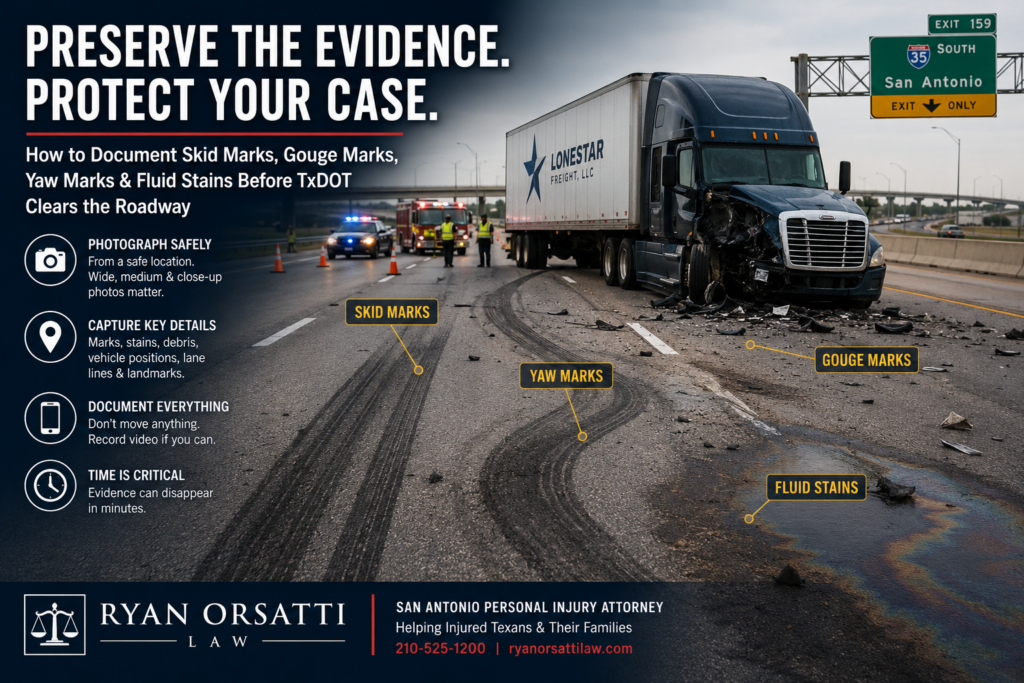
To preserve skid marks, gouge marks, yaw marks, and fluid stains at a Texas commercial-vehicle crash scene, document them immediately from a safe location with wide, medium, and close-up photos or video before the roadway is cleared. Do not step into traffic, disturb debris, move vehicle parts, or interfere with police, fire, EMS, tow operators, or TxDOT crews.
The most useful evidence usually shows where the mark begins, where it ends, its direction, its relationship to the vehicles, and fixed landmarks such as lane lines, signs, mile markers, bridges, exits, traffic signals, or guardrails.
Key Takeaways
- Physical roadway evidence can disappear within minutes after a commercial-vehicle crash because traffic, weather, tow trucks, absorbent material, and roadway cleanup can change the scene.
- A Texas Peace Officer’s Crash Report, or CR-3, is important, but it usually does not replace scene photos, dashcam footage, witness video, ECM data, ELD records, or reconstruction work.
- Safety comes first. Texas law recognizes situations where vehicles may need to be moved from freeway lanes when they can be safely driven and no serious injury or death is apparent.
- Photograph skid marks, yaw marks, gouge marks, fluid stains, debris fields, final resting positions, vehicle damage, license plates, DOT numbers, company names, and nearby surveillance cameras.
- In a commercial-vehicle case, early preservation letters should target the trucking company, driver, broker or shipper when appropriate, insurer, tow yard, maintenance vendor, dashcam provider, and telematics provider.
- If a government vehicle, roadway defect, construction zone, or TxDOT-maintained condition may be involved, notice deadlines can be much shorter than the ordinary personal injury limitations period.
Why Roadway Evidence Matters in a Texas Commercial-Vehicle Crash
Skid marks, gouge marks, yaw marks, and fluid stains can help answer the questions that trucking insurers often dispute: speed, braking, lane position, point of impact, evasive action, vehicle rotation, and whether the truck driver had time to avoid the crash.
In a Texas commercial-vehicle crash, the physical scene often changes faster than the insurance claim. By the time an injured person leaves the ER, the roadway may be swept, the tractor-trailer may be at a tow yard, the debris may be gone, and the carrier’s insurer may already have an investigator working the file.
A skid mark is usually a tire mark caused by braking or tire friction. A yaw mark is a curved tire mark often associated with a vehicle rotating or sliding sideways. A gouge mark is a cut, scrape, or scar in the pavement that may show where metal struck the roadway. A fluid stain is a trail, pool, splash, or sprayed pattern from oil, coolant, fuel, brake fluid, transmission fluid, or other vehicle fluids.
These details matter because Texas uses proportionate responsibility, meaning fault can be divided among the people or entities involved. Under Texas Civil Practice & Remedies Code § 33.001, a claimant generally cannot recover damages if that claimant’s percentage of responsibility is greater than 50 percent. (Texas Statutes)
For more on how these cases are built, see our page on Texas commercial vehicle accident claims.
First Rule: Preserve Evidence Without Risking Another Crash
Do not walk into active lanes to photograph evidence. Do not stand behind disabled vehicles. Do not cross a freeway to get a better angle. If law enforcement tells you to move, move.
Texas Transportation Code § 550.022 addresses duties after certain collisions involving only vehicle damage, including situations on freeway main lanes, ramps, shoulders, medians, or adjacent areas in metropolitan areas where vehicles can be normally and safely driven. In those situations, the law can require drivers to move vehicles from the collision location to reduce interference with traffic. (Texas Statutes)
That means preservation must be practical. You are not trying to run a crash-reconstruction investigation from the shoulder. You are trying to create a reliable record before the visible scene is lost.
What to Photograph Before TxDOT or Responders Clear the Roadway
Use your phone from a safe location. Take more photos than you think you need. Video is often helpful because it shows the relationship between marks, vehicles, debris, and landmarks in one continuous view.
| Evidence | Why it matters | How to document it safely |
|---|---|---|
| Skid marks | May show braking, speed issues, or delayed reaction | Photograph the full length, beginning, end, lane location, and direction of travel |
| Yaw marks | May show loss of control, rotation, or evasive steering | Capture the curve from several angles with lane lines and nearby vehicles visible |
| Gouge marks | May help identify point of impact or where a vehicle part struck pavement | Take close-ups and wider shots showing the gouge in relation to debris and vehicle rest positions |
| Fluid stains | May show impact area, post-impact movement, mechanical failure, or vehicle rest path | Photograph the source, trail, pooling, direction, color, and distance to vehicles |
| Debris field | Can help reconstruct impact angle and vehicle movement | Take wide shots before debris is swept or moved |
| Final resting positions | Shows where the truck, trailer, cars, motorcycles, or pedestrians ended up | Capture all vehicles from front, rear, sides, and corners |
| Commercial identifiers | Identifies the carrier and potential defendants | Photograph DOT number, license plate, trailer number, company logo, cab number, and placards |
| Roadway landmarks | Helps locate evidence later | Include mile markers, exit signs, traffic lights, bridges, lane arrows, medians, guardrails, and businesses |
After a Texas Commercial-Vehicle Crash, Do These 9 Things to Preserve Scene Evidence
- Call 911 and get medical help first. Injuries, fire risk, fuel spills, hazardous cargo, and traffic danger come before evidence.
- Stay in a safe place. Use the shoulder, sidewalk, parking lot, nearby business, or another protected area. Do not enter the roadway for photos.
- Take a slow 360-degree video. Start with your location, say the date and time if you can, and slowly pan across vehicles, lane positions, marks, debris, signs, signals, and weather conditions.
- Photograph wide, medium, and close. A close-up of a gouge mark is weak without a wide photo showing where it sits in the lane. A wide photo is weak without detail showing what the mark is.
- Capture direction and landmarks. Photograph signs for I-35, I-10, Loop 410, US 281, I-37, FM roads, exit numbers, intersections, mile markers, businesses, and traffic-control devices.
- Do not alter the scene. Do not move debris, wipe fluid, kick vehicle parts aside, chalk marks, collect truck parts from active lanes, or interfere with cleanup.
- Identify witnesses and cameras. Photograph business names, nearby cameras, dashcams, doorbell cameras, TxDOT cameras, construction cameras, and fleet vehicles that may have recorded the crash.
- Preserve your originals. Do not edit, crop, filter, or overwrite the photos. Back them up to cloud storage and keep the original files with metadata when possible.
- Contact counsel quickly in serious truck cases. Commercial-vehicle evidence can involve the roadway, vehicles, tow yards, electronic control modules, dashcams, ELD data, dispatch records, maintenance files, and post-crash testing.
For related guidance, read our page on 18-wheeler accident claims in Texas.
How to Photograph Each Type of Roadway Mark
Skid Marks
For skid marks, try to capture:
- the start of the mark;
- the end of the mark;
- whether the mark is straight, curved, broken, dark, light, or overlapping;
- which lane the mark is in;
- whether it lines up with the truck, trailer, or another vehicle;
- whether there are multiple tire paths;
- nearby lane stripes, reflectors, shoulder lines, and barriers.
Do not assume every dark tire mark came from the crash. Busy corridors like I-35 in San Antonio, Austin, Dallas, and Laredo can have older tire marks. The best photos show why the mark appears connected to this crash.
Yaw Marks
Yaw marks deserve special attention because they may show sideways motion or loss of control. They are often curved and may have striations, which are visible streaks within the mark.
Photograph the entire curve. If you only capture a close-up, an investigator may not be able to evaluate the vehicle’s path. Include the truck, trailer, median, lane lines, debris, and final rest positions when possible.
Gouge Marks
Gouge marks can be highly useful because they may identify where hard metal contacted the roadway. In serious commercial-vehicle cases, gouges can help a reconstructionist evaluate impact location, underride, override, rollover sequence, trailer swing, or post-impact movement.
Take a close-up, then step back and photograph the gouge in relation to lane markings, debris, and vehicle positions. Do not put your foot or hand in the roadway for scale if traffic is moving. Safety overrides perfect documentation.
Fluid Stains
Fluid evidence can show impact location, direction of post-impact travel, mechanical failure, or where a vehicle came to rest. Photograph color, spread, trail direction, and whether absorbent material has already been placed.
If fuel, chemicals, or cargo are involved, stay away. Hazardous material scenes are not safe for civilian evidence collection.
Do Not Rely Only on the Texas Crash Report
A Texas Peace Officer’s Crash Report, commonly called a CR-3, is often important, but it is not the whole case. TxDOT states that it is the custodian of crash records for Texas and that law enforcement officers must submit written reports to TxDOT for crashes involving injury, death, or apparent property damage of $1,000 or more not later than the tenth day after the crash. (Texas Department of Transportation)
TxDOT also explains that it is the custodian of the crash report only; subpoena requests for dashcam videos, field notes, photographs, or other information taken at the scene should go to the investigating agency because those materials are not part of TxDOT’s custodial files. (Texas Department of Transportation)
That distinction matters. In commercial-vehicle cases, the CR-3 may identify vehicles and contributing factors, but separate requests may be needed for:
- bodycam video;
- dashcam video;
- officer photographs;
- 911 audio;
- CAD notes;
- incident reports;
- tow records;
- hazmat or fire department records;
- scene diagrams;
- supplemental reports.
Commercial-Vehicle Evidence Beyond the Roadway
The roadway marks are only one part of the preservation job. Commercial trucks, delivery vans, buses, construction vehicles, oilfield vehicles, and fleet vehicles often create electronic and business records that can disappear or be overwritten.
In a truck or commercial fleet case, preservation should usually target:
- electronic control module, or ECM, data;
- event data recorder information;
- electronic logging device, or ELD, records;
- GPS and telematics data;
- dashcam and inward-facing camera footage;
- driver qualification file;
- hours-of-service records;
- dispatch communications;
- bills of lading and load documents;
- maintenance and inspection records;
- brake, tire, and lighting records;
- post-crash drug and alcohol testing documents;
- accident register records;
- tow yard intake photos;
- repair estimates and teardown photos.
Federal motor carrier regulations require motor carriers to retain records of duty status and supporting documents for at least six months, and federal accident-register rules require motor carriers to maintain an accident register for three years after certain accidents. (eCFR)
Post-accident testing rules may also apply after certain commercial motor vehicle crashes. Under 49 C.F.R. § 382.303, post-accident alcohol and controlled-substance testing duties depend on the circumstances, including fatalities and other triggering conditions. (eCFR)
For injuries involving brain trauma, memory gaps, or loss of consciousness after a truck crash, see our page on traumatic brain injury claims.
Attorney Insight: The First 72 Hours Can Decide What Evidence Exists
In commercial-vehicle matters our office reviews, the fight is often not only about what happened. It is about what evidence still exists by the time the injured person calls a lawyer.
A trucking insurer may have an adjuster, investigator, reconstruction consultant, and tow-yard access before the injured person has even ordered the crash report. That does not mean the evidence is gone, but it means delay can matter.
The practical move is to preserve three categories at once: scene evidence, vehicle evidence, and company evidence. Scene evidence includes skid marks, yaw marks, gouges, stains, debris, and camera locations. Vehicle evidence includes ECM downloads, photographs, inspections, and repair status. Company evidence includes driver logs, dispatch, maintenance, safety, hiring, and post-crash testing records.
Spoliation Letters and Texas Discovery Tools
A spoliation letter is a written notice demanding that a person or company preserve evidence that may be relevant to a claim. It should be specific. A generic “preserve everything” letter is less useful than a targeted letter identifying the tractor, trailer, ECM data, ELD data, dashcam footage, inspection records, repair records, tow records, photographs, and communications.
In Texas litigation, electronic evidence is addressed by Texas Rule of Civil Procedure 196.4. The rule requires a party seeking electronic or magnetic data to specifically request it and specify the form of production. It also addresses data that is reasonably available in the ordinary course of business and objections when data cannot be retrieved or produced in the requested form through reasonable efforts.
Texas Rule of Civil Procedure 202 may allow a person to petition for a pre-suit deposition to investigate a potential claim or preserve testimony for an anticipated suit, but the court must make required findings before ordering the deposition.
Texas spoliation law is fact-specific. In Brookshire Brothers, Ltd. v. Aldridge, the Texas Supreme Court addressed when courts may impose spoliation remedies and held that the trial court abused its discretion by imposing a severe spoliation instruction in that case. (Justia)
What if TxDOT, a City, or a Road Contractor Is Involved?
Some crashes involve more than a truck driver and trucking company. Possible additional issues include roadway defects, construction zones, missing signs, malfunctioning signals, dangerous lane closures, loose gravel, poor lighting, or government vehicles.
Claims involving governmental units can have notice requirements that are separate from ordinary limitations rules. Texas Civil Practice & Remedies Code § 101.101 generally requires notice to a governmental unit not later than six months after the incident, and city charter provisions may impose shorter notice periods. (Justia)
That does not mean every crash near a work zone is a government claim. It means potential roadway, construction, and public-entity issues should be evaluated early.
How Long Do You Have to Act?
The ordinary Texas personal injury limitations period is commonly two years, but evidence preservation cannot wait two years. Texas Civil Practice & Remedies Code § 16.003 sets a two-year deadline for personal injury claims, and death claims also have a two-year limitations provision measured from the death. (Texas Statutes)
The legal filing deadline is not the evidence deadline. Skid marks may fade in hours or days. Video can overwrite in days. ELD and supporting documents may have regulatory retention periods, but practical preservation still requires fast written notice. Tow yards may move, repair, salvage, or release vehicles. Witnesses may forget details.
For fatal commercial-vehicle crashes, families may also need information about preservation, probate authority, and wrongful death claims. See our page on Texas wrongful death cases.
Common Mistakes That Can Hurt Roadway Evidence
Avoid these mistakes after a Texas commercial-vehicle crash:
- taking only close-up photos with no landmarks;
- failing to photograph the truck’s DOT number, trailer number, and company name;
- assuming the police report will include every skid mark, gouge, and stain;
- waiting weeks to request dashcam, bodycam, or business surveillance footage;
- posting crash photos or opinions on social media;
- giving a recorded statement before understanding the evidence;
- letting the insurer inspect or move your vehicle without documenting it;
- repairing or selling your vehicle before preserving photos and data;
- failing to identify tow yards and storage lots;
- assuming “TxDOT has everything” when TxDOT may only have the CR-3 crash report.
For more general crash guidance, visit our Texas car accident lawyer resource page.
FAQ
Can I legally take photos at a Texas commercial-vehicle crash scene?
Yes, you may generally take photos from a safe, lawful location, but you cannot interfere with police, fire, EMS, tow operators, or roadway crews. Do not enter active lanes or restricted areas. If an officer instructs you to move, comply. Your safety and the safety of other motorists come first.
Are skid marks enough to prove the truck driver was speeding?
Not by themselves. Skid marks can be important, but speed analysis usually requires measurements, roadway conditions, vehicle data, tire information, braking evidence, impact damage, and reconstruction work. A photo of skid marks helps preserve the evidence, but a qualified reconstructionist may be needed to interpret what the marks actually mean.
What is the difference between skid marks and yaw marks?
A skid mark is commonly associated with braking or tire lockup. A yaw mark is usually curved and may suggest sideways movement, rotation, or loss of control. The distinction matters because each type of mark can point to different driver actions and vehicle movement before impact. Clear photos of the full mark are more useful than close-ups alone.
Will TxDOT have photos of the skid marks and gouge marks?
Not necessarily. TxDOT is the custodian of Texas crash reports, but TxDOT states that dashcam videos, field notes, photographs, and other scene materials should be requested from the investigating agency, not TxDOT, because they are not part of TxDOT’s custodial files. That is why early preservation requests to the right agencies matter.
What should a preservation letter request after a commercial-vehicle crash?
A preservation letter should request roadway evidence, vehicle evidence, electronic data, and company records. That may include ECM data, ELD records, dashcam footage, GPS data, maintenance files, inspection reports, driver qualification records, post-crash testing documents, photos, tow records, and communications. The exact request should be tailored to the crash facts.
What if the crash happened on I-35, I-10, Loop 410, or US 281 in San Antonio?
The same preservation principles apply, but fast-moving freeway crashes create extra danger and faster cleanup pressure. Stay out of traffic. Use photos and video from a safe shoulder, parking lot, overpass sidewalk, or nearby business when lawful and safe. Capture exit numbers, mile markers, signs, lane lines, barriers, and vehicle resting positions.
Do I need a lawyer just to preserve skid marks and roadway evidence?
Not always, but serious commercial-vehicle crashes often involve evidence that an injured person cannot realistically preserve alone. A lawyer can send preservation letters, identify potential defendants, request police materials, hire a reconstructionist, coordinate vehicle inspections, and pursue court tools when needed. The need for representation depends on injury severity, liability disputes, and available evidence.
Ryan Orsatti Law
4634 De Zavala Rd, San Antonio, TX 78249
Phone: 210-525-1200
ryanorsattilaw.com
This blog is for informational purposes only, not legal advice. Reading it does not create an attorney-client relationship. Past results do not guarantee future results.
Hurt in an accident in San Antonio? Learn how a San Antonio personal injury lawyer can help with your claim. Call 210-525-1200 or request a free consultation.
The firm works on a contingency fee. You pay nothing unless the firm recovers money for you, and that covers case expenses as well as the fee: if there is no recovery, you owe no attorney's fee and no case expenses. Ask for the fee agreement and read the fee and expense section before you sign anything.
Related San Antonio legal resources
Primary legal and public-data sources
Ryan Orsatti Law
4634 De Zavala Road, San Antonio, TX 78249
General reference links. Consult each source for its current text.