
Quick Answer
The Good Samaritan Law in Texas generally protects a person who gives good-faith emergency care from civil damages unless the person acts with willful or wanton negligence. The main Texas rule is Texas Civil Practice & Remedies Code § 74.151, but there are important exceptions for paid care, business solicitation, and a person whose own negligence helped cause the emergency. (Texas Statutes)
After a crash or emergency in San Antonio, the safest first steps are to call 911, avoid creating new danger, give only reasonable emergency help, and preserve witness information. Ryan Orsatti Law helps injured people in San Antonio and across Texas evaluate how emergency care, crash evidence, insurance, and fault issues affect a personal injury claim.
Key Takeaways
- Texas Good Samaritan protection is broad, but it is not unlimited.
- The law generally protects good-faith emergency care, including CPR and AED use, unless the helper acts with willful or wanton negligence.
- A driver who caused a crash does not avoid liability just because they later tried to help.
- Drivers involved in Texas crashes also have separate duties to stop, provide information, and render reasonable aid under Texas Transportation Code Chapter 550. (Texas Legislature Online)
- If insurance later blames a rescuer, the injured person should preserve 911 records, witness names, photos, video, medical records, and the TxDOT crash report.
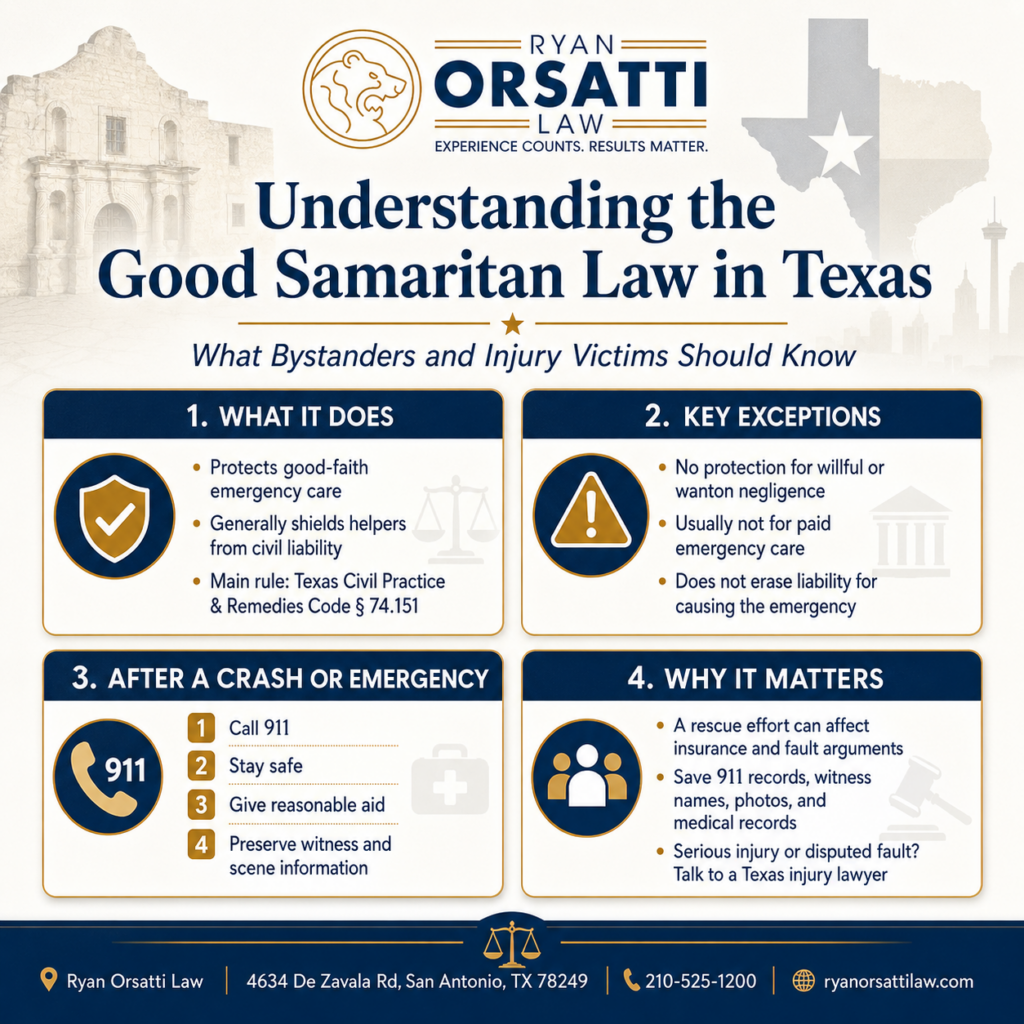
What Does the Good Samaritan Law in Texas Actually Protect?
The Texas Good Samaritan Law protects good-faith emergency care from ordinary civil liability, but it does not protect reckless conduct or erase liability for causing the emergency. Under Texas Civil Practice & Remedies Code § 74.151, a person who gives emergency care in good faith is generally not liable for civil damages unless the act is willfully or wantonly negligent. (Texas Statutes)
In plain English, the law is designed to encourage bystanders to help in real emergencies. It may apply when someone gives CPR, applies pressure to bleeding, uses an automated external defibrillator, calls 911, or gives basic aid at a crash scene.
The protection is not a free pass to act carelessly. If a person takes extreme risks, ignores obvious danger, or causes the emergency in the first place, the Good Samaritan Law may not protect them.
Who Is Covered by the Good Samaritan Law in Texas?
Texas Good Samaritan protection can cover ordinary bystanders, certain emergency responders, and people using an AED, but the exact protection depends on who gave the care and why they were there. The strongest protection usually applies to a person who was not being paid, was not soliciting business, and acted in good faith during a real emergency. (Justia Law)
A “Good Samaritan” does not have to be a doctor. The law may protect a stranger who stops after a crash on Loop 410, a coworker who uses an AED, or a passerby who helps after a pedestrian collision near downtown San Antonio.
| Situation | Texas rule | Practical point |
|---|---|---|
| Bystander gives CPR, applies pressure, or calls 911 | Texas Civil Practice & Remedies Code § 74.151 generally protects good-faith emergency care unless it is willfully or wantonly negligent | Stay within reasonable emergency help and follow dispatcher instructions |
| Person uses or helps provide an AED | Texas law includes protection for AED-related emergency care, and Health & Safety Code § 779.006 provides related AED protections | AED immunity can apply even if the user did not receive AED training |
| Person caused the crash and then helped | The Good Samaritan statute generally does not protect a person whose negligence was a producing cause of the emergency | Helping after the crash does not erase liability for causing it |
| Person gives care for payment or expected payment | Section 74.151 has an exception for emergency care provided for or in expectation of remuneration | Paid medical care and ordinary bystander aid are treated differently |
| Hospital emergency medical care | Texas Civil Practice & Remedies Code § 74.153 uses a separate emergency medical care standard for certain hospital settings | Medical malpractice emergency cases have different proof issues |
Key takeaway: Texas Good Samaritan protection depends on the helper’s role, motive, conduct, and connection to the emergency.
What Should You Do If You Help After a Crash in San Antonio?
If you help after a crash in San Antonio, call 911 first, keep yourself safe, and provide only reasonable emergency help until trained responders arrive. This matters because Texas roads see a high volume of serious crashes: TxDOT reported 251,977 people injured in Texas motor vehicle crashes in 2024, with one reportable crash occurring about every 57 seconds. (Texas Department of Transportation)
Crash scenes on I-35, Loop 1604, I-10, Loop 410, and US-281 can become dangerous fast. Traffic, broken glass, leaking fuel, rain, low visibility, and distracted drivers can turn one collision into another.
Crash Scene Helper Checklist
- Call 911 and give the dispatcher the exact location.
- Move yourself to a safe place before helping anyone else.
- Warn others only if you can do so safely.
- Do not move an injured person unless there is immediate danger, such as fire, flooding, or oncoming traffic.
- Give basic aid within your ability, such as applying pressure to bleeding or following AED prompts.
- Follow 911 dispatcher instructions.
- Give responding officers or EMS your name and what you observed.
- Write down witness names, vehicle descriptions, and timing if you can do so without interfering with care.
Does Texas Good Samaritan Law Protect CPR or AED Use?
Texas Good Samaritan law can protect good-faith CPR or AED use during an emergency, unless the person acts with willful or wanton negligence. Texas Civil Practice & Remedies Code § 74.151 expressly includes emergency care involving an automated external defibrillator, and Texas Health & Safety Code § 779.006 provides related AED liability protection. (Justia Law)
This matters because CPR and AED use can involve imperfect, urgent decisions. A person may break ribs during CPR or use an AED because the device instructs them to do so. The legal question is usually not whether the rescue was perfect, but whether the person acted in good faith and avoided extreme misconduct.
Texas law also states that certain AED protections may apply regardless of whether the person who used, attempted to use, or failed to use the AED had received training. (FindLaw)
What Are the Main Exceptions to Good Samaritan Protection in Texas?
The main exceptions to Texas Good Samaritan protection involve willful or wanton negligence, payment, business solicitation, and causing the emergency. If a person fits one of those exceptions, the statute may not shield them from civil damages. (Justia Law)
Willful or wanton negligence means more than a simple mistake. In a related Texas emergency medical care context, the Texas Supreme Court has treated “willful and wanton negligence” as at least gross negligence, which involves an extreme risk and conscious indifference to the safety of others.
Texas Good Samaritan protection also usually does not apply to someone giving care for payment or expected payment. It also does not protect a person who was at the scene because they were soliciting business or trying to provide a service for payment.
The most important injury-claim exception is causation. If a driver ran a red light, caused a crash, and then helped pull someone from a vehicle, the later help does not erase the driver’s original negligence.
Does a Driver Involved in a Texas Crash Have to Stop and Render Aid?
Yes, a driver involved in a Texas crash has separate legal duties to stop, provide information, and render reasonable assistance when the crash results in injury, death, or certain vehicle damage. Texas Transportation Code Chapter 550 requires the driver to remain at the scene, provide identifying and insurance information, and provide reasonable assistance, including arranging medical transport when necessary. (Texas Legislature Online)
That duty is different from Good Samaritan immunity. A bystander who voluntarily helps may be protected by the Good Samaritan statute. A driver involved in the crash may have a legal duty to stop and help, but that duty does not protect the driver from liability if their negligence caused the crash.
In injury claims, this distinction matters. Insurance companies may try to blur the issue by focusing on what happened after impact. A careful claim analysis separates three questions: who caused the crash, who had a duty to stop and render aid, and whether any later emergency care caused additional injury.
What If a Good Samaritan Makes the Injury Worse?
If a Good Samaritan allegedly makes an injury worse, the legal issue is whether the helper acted in good faith and whether any statutory exception applies. Even when a rescuer is protected, the injured person may still have a claim against the driver, company, property owner, or other party who caused the original emergency.
This is a common insurance defense issue. An adjuster may argue that the crash was not the real cause of the worst injury because a bystander moved the person, CPR was performed, or a rescue was chaotic. That argument should be tested against EMS records, 911 audio, body camera footage, witness statements, ER records, and treating doctor opinions.
Comparative responsibility means Texas can allocate fault among responsible parties. In serious injury cases, the way fault is assigned can affect settlement value, litigation strategy, and whether a defendant tries to shift blame away from itself.
What Evidence Should You Save If Good Samaritan Care Happened?
If Good Samaritan care happened after your injury, save evidence that separates the original incident from the rescue effort. The most useful evidence usually includes the 911 timeline, names of helpers, EMS records, photos, video, witness statements, the crash report, and medical records documenting what injuries existed before and after emergency care.
For Texas crash cases, the investigating officer’s crash report can be important but incomplete. Texas Transportation Code § 550.062 requires an officer’s written crash report to be filed with TxDOT within 10 days after investigating certain crashes involving injury, death, or property damage of at least $1,000. (Texas Legislature Online)
Save these items if you can:
- Names and phone numbers of bystanders who helped
- Names of responding police, fire, and EMS agencies
- 911 call time and incident number, if available
- Photos of vehicle positions, roadway debris, lighting, weather, and traffic controls
- Dashcam, business surveillance, doorbell camera, or nearby traffic camera information
- ER records, EMS run sheets, imaging reports, and discharge instructions
- Insurance claim numbers and adjuster communications
- Any statement where an insurer blames a rescuer or denies causation
Does Texas Law Protect Breaking Into a Vehicle to Rescue a Child or Vulnerable Person?
Texas has a separate civil immunity law for certain vehicle rescues involving a vulnerable person, including a child younger than 7. Under Texas Civil Practice & Remedies Code Chapter 92A, a person may be immune from civil liability for entering a locked vehicle by force to remove a vulnerable individual if specific conditions are met, including calling 911, using no more force than necessary, and staying nearby until help arrives. (Justia Law)
This rule is related to Good Samaritan protection, but it is not the same statute. It applies to a specific situation: a vulnerable person trapped in a vehicle where the rescuer reasonably believes entry is necessary to avoid imminent harm.
For parents, caregivers, and bystanders in Texas heat, the practical rule is simple: call 911 immediately, act only when immediate harm appears likely, use the least force necessary, and remain with the person until law enforcement or first responders arrive.
How Does the Good Samaritan Law Affect a Texas Personal Injury Claim?
The Good Samaritan Law can affect a Texas personal injury claim by changing who may be liable, what defenses may be raised, and what evidence must be preserved. In most crash cases, the central claim still focuses on the person or company that caused the crash, not the bystander who tried to help.
The law can matter when an insurer argues that emergency care, not the crash, caused the injury. It can also matter if a defendant tries to blame a rescuer to reduce its own exposure. In those situations, the medical timeline and witness evidence become critical.
Attorney Insight: After a Bexar County crash, adjusters often look for the simplest way to dispute causation. If a bystander moved someone, performed CPR, used an AED, or pulled a person from a vehicle, document that rescue separately from the crash itself. The rescue may be legally protected while the original driver, employer, property owner, or other responsible party remains the main claim target.
When Should You Talk to a Texas Personal Injury Lawyer About a Good Samaritan Issue?
You should talk to a Texas personal injury lawyer if there is a serious injury, disputed fault, an insurer blaming a rescuer, delayed medical treatment, a commercial vehicle, or confusion about who caused what harm. Most Texas personal injury lawsuits must be filed within two years under Texas Civil Practice & Remedies Code § 16.003, although specific facts can change the analysis. (Texas Statutes)
Ryan Orsatti Law helps injured people in San Antonio and across Texas evaluate injury claims involving crash evidence, medical causation, insurance defenses, and emergency-scene facts. The firm handles serious vehicle and injury matters, including San Antonio car accident claims, truck accident claims, and catastrophic injury claims.
A lawyer can help request crash reports, preserve video, obtain EMS records, analyze the medical timeline, communicate with insurance carriers, and identify whether Good Samaritan immunity is actually relevant. You can also learn more about Ryan Orsatti Law or use the firm’s contact page to start a case review.
Frequently Asked Questions About the Good Samaritan Law in Texas
Can I be sued for giving CPR after a Texas car accident?
Yes, someone can file a lawsuit, but Texas Good Samaritan law may provide a strong civil-liability defense if you gave CPR in good faith during an emergency. The protection does not apply if the conduct was willfully or wantonly negligent, or if another statutory exception applies. The exact answer depends on the facts. (Justia Law)
Does the Good Samaritan Law in Texas apply if I am paid to help?
Usually, Texas Civil Practice & Remedies Code § 74.151 does not protect emergency care provided for payment or expected payment. There are separate rules for certain emergency medical personnel, including Texas Civil Practice & Remedies Code § 74.152. Paid medical providers, EMS personnel, and ordinary bystanders can be treated differently under Texas law. (Justia Law)
Does Texas Good Samaritan law protect the driver who caused the crash?
Texas Good Samaritan law generally does not protect a person from liability for causing the emergency. If a negligent driver caused a collision and then tried to help, the later aid may be relevant to the timeline, but it does not erase the original crash-causing conduct. Fault and emergency care should be analyzed separately. (Justia Law)
Should I move an injured person from a crashed vehicle in Texas?
You generally should not move an injured person unless there is immediate danger, such as fire, flooding, smoke, or oncoming traffic, or unless 911 dispatch or first responders instruct you to do so. Moving someone with a possible neck, back, or head injury can create new medical issues. Call 911 first and follow emergency instructions.
Does Texas Good Samaritan law cover AED use without training?
Texas law includes protection for emergency care involving an automated external defibrillator, and Texas Health & Safety Code § 779.006 provides related AED protections. The AED statute states that certain immunity applies regardless of whether the person who used, tried to use, or failed to use the AED had received training. (Justia Law)
What should I do if insurance says a Good Samaritan caused my injury?
If insurance blames a Good Samaritan, preserve the full emergency timeline immediately. Ask for the crash report, EMS records, 911 audio, witness names, photos, videos, and medical records. The issue is usually causation: whether the original crash, the rescue, or another event caused the injury. A lawyer can help separate those issues.
Does Texas Good Samaritan law apply to rescuing a child from a hot car?
Texas has a separate civil immunity statute for entering a locked vehicle to rescue a vulnerable person, including a child younger than 7, if specific conditions are met. Those conditions include calling 911, having a good-faith belief that entry is necessary to avoid imminent harm, using no more force than necessary, and staying nearby until help arrives. (Justia Law)
Ryan Orsatti Law
4634 De Zavala Rd, San Antonio, TX 78249
Phone: 210-525-1200
ryanorsattilaw.com
This blog is for informational purposes only, not legal advice. Reading it does not create an attorney-client relationship. Past results do not guarantee future results.
Hurt in an accident in San Antonio? Learn how a San Antonio personal injury lawyer can help with your claim. Call 210-525-1200 or request a free consultation. There is no fee unless we win.
Related San Antonio legal resources
Primary legal and public-data sources
- Texas Civil Practice and Remedies Code Chapter 16: limitations
- Texas Civil Practice and Remedies Code Chapter 33: proportionate responsibility
Ryan Orsatti Law
4634 De Zavala Road, San Antonio, TX 78249
Source links verified August 7, 2026.