
Quick Answer
Carbon monoxide poisoning in Texas may create a personal injury or wrongful death claim when another person, business, property owner, contractor, employer, or product maker caused or failed to prevent the exposure. The CDC reports that more than 400 Americans die each year from unintentional, non-fire carbon monoxide poisoning, with more than 100,000 emergency department visits and more than 14,000 hospitalizations. (CDC) Most Texas injury and wrongful death lawsuits must be filed within two years, but workplace claims and claims involving government property may have shorter notice steps. Ryan Orsatti Law helps injured people in San Antonio and across Texas evaluate the source, responsible parties, evidence, insurance coverage, and deadlines after serious carbon monoxide exposure.
Key Takeaways
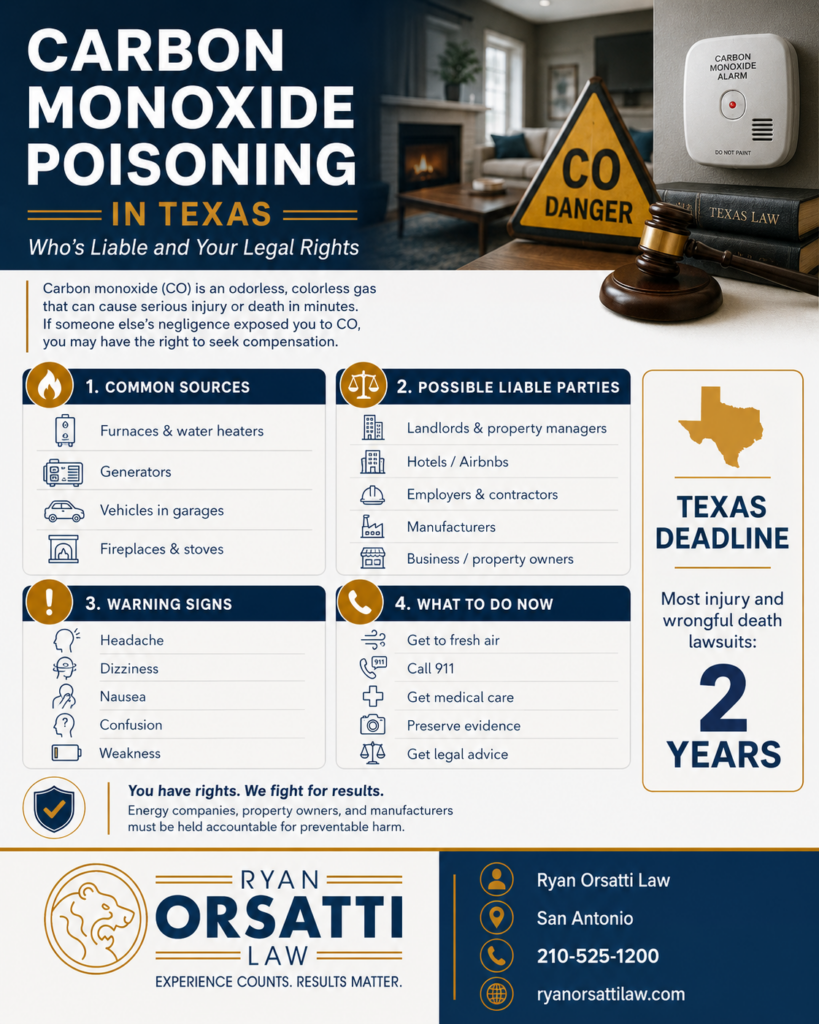
- Carbon monoxide is a colorless, odorless gas that can come from furnaces, water heaters, vehicles, generators, grills, and fuel-burning appliances. (CDC)
- Liability usually turns on who controlled the source, who had notice of the danger, and who had the duty to maintain, repair, warn, or design the product safely.
- Texas claims may involve landlords, hotels, short-term rental operators, property owners, maintenance contractors, product manufacturers, employers, or third-party contractors.
- Most Texas personal injury and wrongful death claims have a two-year lawsuit deadline, but government and workers’ compensation deadlines can be shorter. (Texas Statutes)
- The most important early evidence often includes medical testing, fire department readings, gas utility findings, appliance records, detector data, photos, lease documents, work orders, and witness statements.
- Ryan Orsatti Law helps people in San Antonio, Bexar County, and across Texas investigate serious injury claims involving unsafe property conditions, defective products, workplace hazards, and wrongful death.
What makes carbon monoxide poisoning in Texas a legal claim?
Carbon monoxide poisoning becomes a Texas legal claim when exposure causes injury or death and another party’s conduct, property condition, product, or failure to act caused or contributed to the exposure. The legal theory may be negligence, premises liability, product liability, workplace injury, or wrongful death, depending on where the exposure happened and who controlled the danger.
Carbon monoxide is dangerous because people often cannot see it, smell it, or recognize the exposure before symptoms become serious. The CDC identifies common symptoms as headache, dizziness, weakness, upset stomach, vomiting, chest pain, and confusion, and warns that high exposure can cause loss of consciousness or death. (CDC)
A Texas carbon monoxide case usually requires proof of four things:
- Source: Where the carbon monoxide came from, such as a water heater, furnace, generator, vehicle, boiler, grill, fireplace, or industrial equipment.
- Responsibility: Who owned, controlled, installed, maintained, repaired, inspected, sold, or warned about the source.
- Causation: Medical and factual proof connecting the exposure to the injury or death.
- Damages: Medical bills, lost earnings, long-term health effects, pain, impairment, funeral losses, or other legally recoverable harm.
Negligence means a person or company failed to use reasonable care and caused harm. Premises liability means a property owner or occupier may be responsible for an unsafe condition on property. Product liability means a manufacturer, seller, or distributor may be responsible for a defective product or inadequate warning.
Who can be liable for carbon monoxide poisoning in Texas?
The liable party in a Texas carbon monoxide poisoning case is usually the person or company that controlled the source, created the hazard, failed to maintain equipment, ignored warning signs, or sold a defective product. In serious cases, more than one party may share responsibility, especially when a property owner, maintenance contractor, and product manufacturer all played a role.
Carbon monoxide cases are fact-intensive. A landlord may blame a tenant. A hotel may blame a maintenance vendor. A contractor may blame an appliance manufacturer. A manufacturer may blame improper installation. Texas proportionate responsibility rules can reduce or bar recovery depending on how fault is allocated among parties. (Texas Statutes)
| Exposure scenario | Possible liable parties | Evidence that matters | Main legal issue |
|---|---|---|---|
| Apartment or rental home exposure | Landlord, property manager, maintenance company, appliance contractor | Lease, repair requests, inspection records, water heater or furnace records, detector evidence | Did the property owner or manager know or have reason to know about an unsafe condition? |
| Hotel, motel, or short-term rental exposure | Property owner, operator, management company, cleaning or maintenance vendor | Guest records, maintenance logs, prior complaints, fire department readings, surveillance, appliance service history | Did the business fail to keep the premises reasonably safe for guests? |
| Generator exposure after a storm or power outage | Generator manufacturer, seller, renter, installer, user, property owner | Product warnings, manual, placement, receipts, photos, witness statements | Was the product defective, inadequately warned about, or used in a way another party controlled? |
| Workplace exposure | Employer, workers’ compensation carrier, third-party contractor, site owner, equipment company | Incident report, OSHA-related records, air monitoring, jobsite photos, equipment logs | Is the claim limited to workers’ compensation, or is there a third-party injury claim? |
| Vehicle or garage exposure | Vehicle owner, repair shop, garage owner, property owner, product maker | Exhaust system inspection, garage ventilation, repair records, vehicle data | Did negligent maintenance, unsafe property design, or product failure cause exposure? |
| Public housing, school, jail, or government facility exposure | Government unit, contractor, maintenance vendor, product manufacturer | Notice records, maintenance contracts, inspection records, incident reports | Are Texas Tort Claims Act notice rules or immunity issues involved? |
Key takeaway: Carbon monoxide liability is rarely proven by symptoms alone; the strongest Texas cases connect the medical injury to a specific source and a specific person or company with control, notice, or responsibility.
Can a landlord or property manager be liable for carbon monoxide poisoning in a Texas apartment?
A Texas landlord or property manager may be liable for carbon monoxide poisoning if an unsafe rental condition caused the exposure and the landlord had a legal duty to repair, maintain, warn, or respond. Texas renter law gives tenants the right to demand repair of conditions that materially affect physical health or safety, and the Texas Attorney General explains that tenants should use proper written notice procedures before taking repair-related legal steps. (Texas Attorney General)
In apartment and rental home cases, the source often matters more than the label “carbon monoxide claim.” A faulty gas water heater, blocked vent, furnace problem, attached garage issue, fireplace defect, or improperly maintained appliance may create different legal and insurance issues.
Useful evidence may include:
- Prior written complaints about fumes, headaches, odors, heater problems, pilot light issues, or detector alarms
- Maintenance requests through an online portal
- Texts, emails, or letters to the landlord
- Lease terms about appliances, repairs, alarms, or tenant duties
- Service records for water heaters, furnaces, boilers, fireplaces, or gas lines
- Fire department or gas utility readings
- Photos showing appliance location, venting, soot, rust, disconnected pipes, or missing detector hardware
Do not assume the case rises or falls only on whether a carbon monoxide detector was installed. Texas rental law expressly addresses health-and-safety repairs and smoke detectors, but a CO case usually requires reviewing the lease, local code, appliance source, maintenance history, and who controlled the hazard.
What if the poisoning happened at a hotel, Airbnb, restaurant, school, or public building?
Carbon monoxide poisoning at a hotel, short-term rental, restaurant, school, or public building may create a claim against the property operator, owner, maintenance contractor, product maker, or government entity. The key question is whether a responsible party failed to keep the property reasonably safe, failed to inspect or repair dangerous equipment, or failed to warn people about a known or discoverable hazard.
Commercial carbon monoxide cases often involve equipment that guests, customers, or visitors never see. Examples include boilers, pool heaters, restaurant appliances, HVAC systems, water heaters, laundry equipment, generators, and attached parking or service areas.
If the exposure happened at a government-owned or government-operated property, the timeline can change quickly. Under the Texas Tort Claims Act, a government unit is generally entitled to notice of a claim within six months, and some city charter or ordinance provisions may require shorter notice. (Texas Statutes)
For San Antonio and Bexar County incidents, evidence may involve the responding fire department, EMS records, property maintenance files, inspection history, gas utility involvement, and contracts with outside vendors. A prompt investigation matters because the scene may be ventilated, equipment may be repaired, and digital maintenance records may be overwritten.
What if carbon monoxide poisoning happened at work in Texas?
Workplace carbon monoxide poisoning in Texas may involve workers’ compensation, a third-party injury claim, or both. If the employer carries Texas workers’ compensation insurance, the injured worker generally must report the injury to the employer within 30 days and file DWC Form-041 with the Division of Workers’ Compensation within one year to protect benefits. (Texas Department of Insurance)
A work exposure can happen in warehouses, garages, construction sites, oilfield locations, restaurants, hotels, plants, loading docks, enclosed job trailers, and buildings with temporary generators. OSHA lists carbon monoxide exposure limits, including a permissible exposure limit of 50 parts per million as an 8-hour time-weighted average, while NIOSH identifies lower recommended limits and an immediately dangerous to life or health level of 1,200 parts per million. (OSHA)
A third-party claim may exist if someone other than the employer contributed to the exposure. That may include a general contractor, subcontractor, property owner, equipment rental company, product manufacturer, HVAC contractor, or maintenance vendor.
For example, a worker exposed to carbon monoxide from a rented generator on a construction site may have workers’ compensation issues and a separate claim involving the generator supplier, site controller, or contractor responsible for ventilation.
Can a defective generator, heater, water heater, or CO detector create product liability?
A defective generator, heater, water heater, furnace, boiler, vehicle part, or carbon monoxide detector may create a Texas product liability claim if a design defect, manufacturing defect, or inadequate warning caused injury or death. Product cases focus on the product itself, the warnings, the instructions, foreseeable use, and whether a safer reasonable alternative design or warning issue may exist.
Portable generators are a major recurring source of CO danger. The Consumer Product Safety Commission warns that nearly 100 consumers die each year from carbon monoxide poisoning involving portable generators and recommends operating generators outside at least 20 feet from the house. (U.S. Consumer Product Safety Commission)
Product evidence must be preserved carefully. Do not throw away the generator, heater, detector, batteries, packaging, receipt, manual, extension cord, fuel container, or appliance parts. If a landlord, insurer, vendor, or contractor wants to remove or repair the product, ask for the request in writing and talk to a lawyer before agreeing when possible.
Product liability cases often require engineers, product warnings analysis, recall research, incident history, and inspection of the actual equipment. Ryan Orsatti Law can help evaluate whether a serious CO exposure involves a property claim, product claim, contractor claim, or a combination of those theories.
How long do I have to file a carbon monoxide poisoning lawsuit in Texas?
Most Texas carbon monoxide personal injury and wrongful death lawsuits must be filed within two years, but shorter notice rules may apply when the exposure happened at work or involved a government entity. Texas Civil Practice and Remedies Code § 16.003 generally provides a two-year limitations period for personal injury claims, and wrongful death claims also generally use a two-year period measured from death. (Texas Statutes)
The deadline analysis can change depending on the facts. Do not wait until the two-year mark to investigate a carbon monoxide claim. The source may be repaired, inspection logs may be lost, surveillance may be deleted, witnesses may move, and medical proof may become harder to connect to the exposure.
Common timing issues include:
- Personal injury lawsuit: Generally two years from the injury date under Texas law.
- Wrongful death lawsuit: Generally two years from the date of death under Texas law.
- Government property or public entity claim: Notice may be required within six months, and sometimes sooner under local rules.
- Workers’ compensation claim: Report to the employer within 30 days and file the proper DWC form within one year to protect benefits. (Texas Department of Insurance)
- Claims involving minors or incapacitated people: Special timing rules may apply and should be reviewed case by case.
A missed deadline can affect legal rights even when the underlying exposure was serious. The safest approach is to identify the correct deadline early and preserve evidence immediately.
What evidence should I save after carbon monoxide poisoning in Texas?
After suspected carbon monoxide poisoning in Texas, save evidence that proves the exposure source, who controlled it, how long the exposure lasted, what symptoms occurred, and what medical testing showed. Carbon monoxide evidence can disappear quickly because rooms are ventilated, equipment is repaired, and blood levels can change after oxygen treatment or time.
Use this checklist as soon as it is safe:
- Leave the area and call 911 if anyone has symptoms. Carbon monoxide can cause confusion, loss of consciousness, and death.
- Get medical care promptly. Tell the ER or doctor that carbon monoxide exposure is suspected.
- Ask whether carbon monoxide testing is medically appropriate. Doctors may consider carboxyhemoglobin testing and oxygen treatment based on timing, symptoms, and clinical judgment.
- Request the incident report. This may include fire department readings, EMS notes, or gas utility findings.
- Photograph the scene. Capture appliances, vents, garage doors, generator placement, detector location, warning labels, and any soot or corrosion.
- Preserve the equipment. Do not discard generators, heaters, detectors, batteries, cords, fuel containers, or appliance parts.
- Save written notices and maintenance records. Keep leases, work orders, texts, emails, portal requests, receipts, manuals, and service invoices.
- Write down witness names. Include roommates, hotel guests, coworkers, neighbors, maintenance workers, EMS, and responding officials if known.
- Avoid recorded statements until you understand the claim. Insurance adjusters may ask questions before the source and medical proof are clear.
- Contact a Texas personal injury lawyer if symptoms are serious or liability is disputed. Early evidence preservation can affect the entire claim.
This evidence helps establish causation, which means proving that the exposure caused the injury. It also helps prove notice, control, and responsibility, which often determine who may be legally liable.
How do insurance companies evaluate Texas carbon monoxide poisoning claims?
Insurance companies evaluate Texas carbon monoxide claims by looking for proof of exposure, proof of the source, medical timing, symptom consistency, who had control, and whether another cause explains the injury. A serious claim can be undervalued if the file lacks early medical testing, clear maintenance evidence, or a reliable timeline of symptoms.
Adjusters may focus on these issues:
- Did a fire department, gas utility, OSHA-related investigation, or qualified technician document CO levels?
- Was there a known appliance problem before the incident?
- Did the injured person delay medical care?
- Were symptoms consistent among multiple people in the same location?
- Did the claimant have pre-existing neurological, cardiac, respiratory, or cognitive issues?
- Was the exposure source repaired before inspection?
- Was anyone using a generator, grill, heater, or vehicle contrary to warnings?
- Did the property owner, employer, or vendor have prior notice?
Comparative responsibility means Texas can reduce recovery by the percentage of fault assigned to the injured person, and a claimant who is found more than 50% responsible may be barred from recovery. This issue may arise if an insurer claims the injured person misused a generator, ignored alarms, disabled a detector, or failed to leave after symptoms began.
Attorney Insight: In carbon monoxide cases, the dispute often shifts from “Was there CO?” to “Where did it come from, who controlled it, and who had notice before anyone got hurt?” The most valuable early evidence is often the fire department reading, gas utility finding, medical timing, appliance service history, and written complaints made before the exposure.
What damages can be included in a Texas carbon monoxide poisoning claim?
A Texas carbon monoxide poisoning claim may include medical expenses, lost income, future care needs, physical pain, mental anguish, impairment, disfigurement, and other damages supported by the facts. If the exposure causes death, eligible family members may have a wrongful death claim under Texas law.
Medical damages may include ambulance care, emergency room evaluation, oxygen treatment, hospitalization, hyperbaric oxygen treatment if ordered by physicians, neurology follow-up, cardiology follow-up, therapy, medication, cognitive testing, and future treatment. Carbon monoxide can affect the cardiovascular system, lungs, blood, and central nervous system according to NIOSH. (CDC)
Financial issues can also become complicated. Subrogation means a health insurer may claim a right to be paid back from a settlement. A hospital lien is a legal claim a hospital may assert against part of a personal injury recovery. These issues can affect the net recovery and should be evaluated before settlement.
For severe injuries, Ryan Orsatti Law may evaluate carbon monoxide claims alongside related catastrophic injury claims, traumatic brain injury claims, workplace and construction accident claims, and premises liability claims.
When should you call Ryan Orsatti Law after carbon monoxide poisoning in Texas?
You should contact a Texas personal injury lawyer promptly after serious carbon monoxide poisoning if anyone went to the hospital, lost consciousness, had ongoing neurological symptoms, died, was exposed at work, or was exposed in a rental property, hotel, business, short-term rental, or public facility. Early legal help matters because the source may be repaired or removed before it can be inspected.
Ryan Orsatti Law helps injured people in San Antonio, Bexar County, and across Texas evaluate serious carbon monoxide claims involving unsafe property conditions, defective products, workplace exposures, contractor negligence, and wrongful death. The firm can help identify responsible parties, send evidence-preservation letters, request records, evaluate insurance coverage, and coordinate investigation steps.
If the exposure happened near San Antonio, relevant local evidence may include SAFD or other fire department records, EMS records, property maintenance files, utility findings, leases, service logs, and witness statements. If the exposure happened elsewhere in Texas, the same core issues apply in Comal, Guadalupe, Kendall, Wilson, Atascosa, Medina, Travis, Harris, Dallas, Tarrant, Nueces, Hidalgo, Cameron, Webb, and other Texas counties.
For help evaluating a serious carbon monoxide injury claim, contact a San Antonio personal injury attorney or contact Ryan Orsatti Law directly.
FAQ
Can I sue my landlord for carbon monoxide poisoning in Texas?
You may be able to sue a Texas landlord for carbon monoxide poisoning if an unsafe rental condition caused the exposure and the landlord had a duty to repair, maintain, or warn. Useful evidence includes written repair requests, lease terms, maintenance records, fire department readings, gas utility findings, and medical records connecting the exposure to injury.
What proof do I need for a Texas carbon monoxide poisoning claim?
A Texas carbon monoxide claim usually needs proof of the source, exposure, medical injury, and responsible party. Important evidence includes carboxyhemoglobin testing when medically appropriate, fire department or gas utility readings, photos, appliance records, detector evidence, repair requests, witness statements, and records showing who owned, controlled, installed, or maintained the equipment.
How long do I have to file a carbon monoxide poisoning lawsuit in Texas?
Most Texas personal injury and wrongful death lawsuits involving carbon monoxide poisoning must be filed within two years. Shorter notice rules may apply if the exposure involved a government entity, and workers’ compensation claims have separate reporting and filing requirements. The safest step is to identify the deadline early and preserve evidence immediately.
What if carbon monoxide poisoning happened at work in Texas?
If carbon monoxide poisoning happened at work in Texas, report the injury to your employer promptly. TDI explains that injured workers generally must report a work injury within 30 days and file DWC Form-041 within one year to protect workers’ compensation rights. A separate third-party claim may exist if another company caused the exposure.
Can a defective generator or heater lead to a product liability claim in Texas?
A defective generator, heater, water heater, furnace, or detector can lead to a Texas product liability claim if a design defect, manufacturing defect, or inadequate warning caused injury or death. Preserve the product, packaging, receipt, manual, warnings, fuel source, batteries, photos, and any repair records before anyone alters or discards the equipment.
What if a family member died from carbon monoxide poisoning in Texas?
If a family member died from carbon monoxide poisoning in Texas, eligible relatives may have a wrongful death claim if another party’s wrongful act, neglect, carelessness, unskillfulness, or default caused the death. The case may involve property owners, contractors, employers, product makers, or multiple parties, depending on the source and setting.
Should I talk to the insurance adjuster after carbon monoxide poisoning?
Be careful before giving a recorded statement to an insurance adjuster after carbon monoxide poisoning. Adjusters may ask about symptoms, generator use, alarms, alcohol, prior medical conditions, or who controlled the property before the investigation is complete. For serious injuries, it is usually safer to get legal advice before making recorded statements.
Ryan Orsatti Law
4634 De Zavala Rd, San Antonio, TX 78249
Phone: 210-525-1200
ryanorsattilaw.com
This blog is for informational purposes only, not legal advice. Reading it does not create an attorney-client relationship. Past results do not guarantee future results.
Hurt in an accident in San Antonio? Learn how a San Antonio personal injury lawyer can help with your claim. Call 210-525-1200 or request a free consultation.
The firm works on a contingency fee. You pay nothing unless the firm recovers money for you, and that covers case expenses as well as the fee: if there is no recovery, you owe no attorney's fee and no case expenses. Ask for the fee agreement and read the fee and expense section before you sign anything.
Related San Antonio legal resources
Primary legal and public-data sources
- Texas Civil Practice and Remedies Code Chapter 16: limitations
- Texas Civil Practice and Remedies Code Chapter 33: proportionate responsibility
Ryan Orsatti Law
4634 De Zavala Road, San Antonio, TX 78249
General reference links. Consult each source for its current text.