
Quick Answer
An oilfield company may ask you to complete an incident report, but Texas law generally does not require you to sign the company’s private form while you are hospitalized, sedated, medicated, confused, or medically unstable. Report the injury in writing, request a copy of every document, and defer any detailed statement until you can understand it and obtain legal advice.
The company’s OSHA and insurance deadlines are primarily its responsibility. Ryan Orsatti Law helps injured oilfield workers in San Antonio, the Eagle Ford Shale, and across Texas evaluate these requests and protect time-sensitive evidence.
Key Takeaways
- You should promptly notify your employer that the injury happened at work, but notice does not require signing an inaccurate company narrative.
- Do not sign a statement while sedated, heavily medicated, cognitively impaired, or unable to read and understand it.
- An internal incident report is different from the employer’s OSHA report, the DWC-001, and your DWC-041 workers’ compensation claim.
- Request a complete copy of anything the company asks you to sign.
- Do not sign a release, resignation, arbitration agreement, broad medical authorization, or fault admission without legal review.
- If you already signed something, obtain a copy and document any errors immediately.
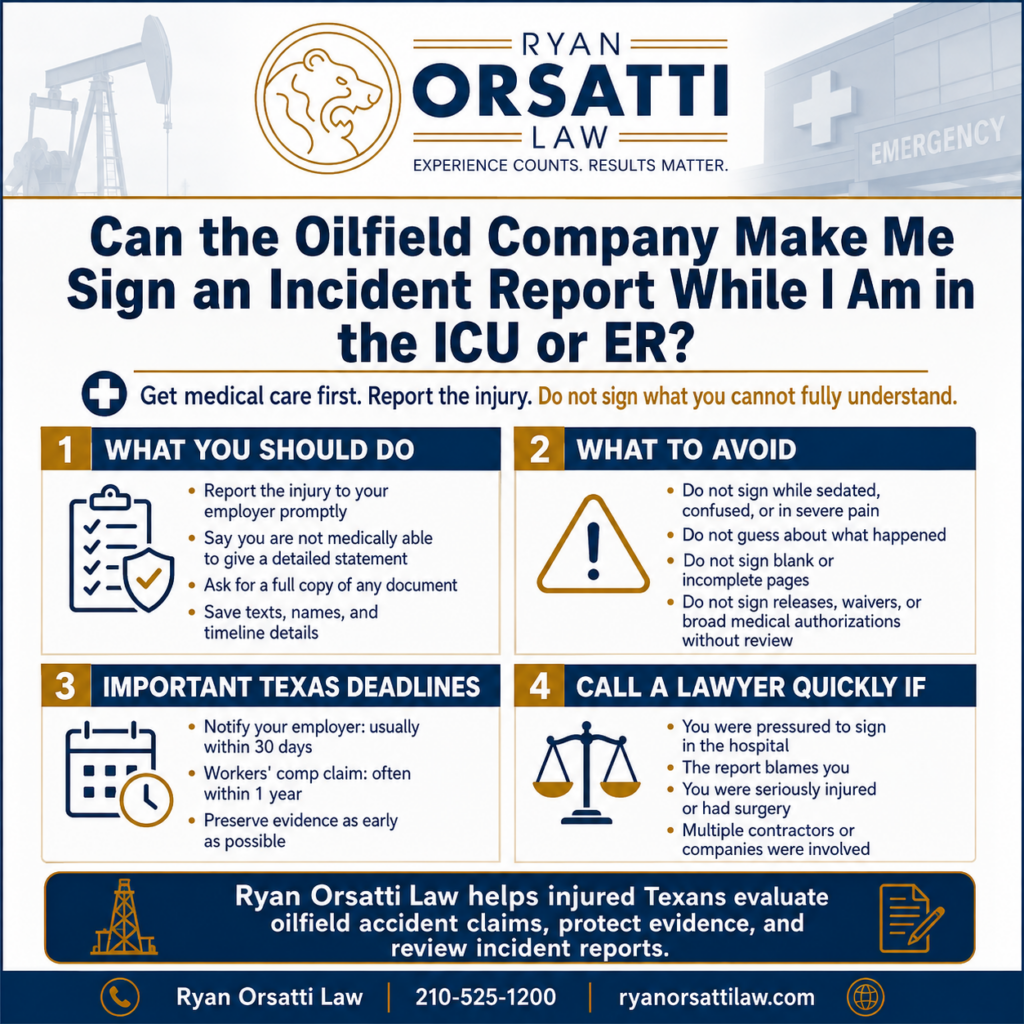
Can an Oilfield Company Require an Incident Report in the Hospital?
An oilfield company can have a reasonable workplace policy requiring employees to report accidents and cooperate with safety investigations. That does not mean the company can force an injured worker to sign a detailed statement while the worker is receiving emergency treatment or lacks the ability to understand the document.
A company representative may tell you that the report is “just routine” or “required for workers’ comp.” The form may actually contain much more than basic notice. It may include:
- A narrative written by a supervisor or safety employee
- Questions suggesting that you violated a safety rule
- Statements about fatigue, medication, alcohol, or drug use
- A release of medical information
- An authorization for a recorded interview
- Arbitration, resignation, or waiver language
- A statement that no unsafe condition existed
- A statement that the injury was your fault
Your first responsibility in the ICU or ER is medical care. A reliable account can be provided after your condition stabilizes and you can review the facts, photographs, records, and document language.
Does Texas Law Require Me to Sign the Company’s Internal Incident Report?
Texas workers’ compensation law requires an injured employee to notify the employer of a work-related injury, but it does not make the employee’s signature on a private company incident report the condition for giving notice. The Texas Division of Workers’ Compensation advises workers to report an injury within 30 days and separately file a DWC Form-041 within one year.
Under Texas Labor Code § 409.001, notice may be given to the employer or to someone in a supervisory or management position. The statute focuses on notice of the injury, not approval of a company-drafted account.
A safer approach is to send a text message or email stating:
“I am reporting that I was injured while working on [date] at [location]. I am currently receiving emergency medical treatment and am not medically able to provide or sign a detailed statement. Please send me a complete copy of any requested form. I will respond after I am medically stable and able to review it.”
Keep a screenshot of the message and any response.
Why Is the Oilfield Company Trying to Get a Signature So Quickly?
The company may be facing immediate reporting, insurance, investigation, and evidence-preservation duties. Those deadlines can explain the urgency, but they do not justify obtaining a potentially unreliable statement from an incapacitated patient.
Under 29 C.F.R. § 1904.39, an employer must report a work-related fatality to OSHA within eight hours. An employer generally must report an inpatient hospitalization, amputation, or loss of an eye within 24 hours. OSHA defines inpatient hospitalization as formal admission for care or treatment, not an ER visit involving only observation or diagnostic testing.
The employer’s report to OSHA requires a brief description of the incident and information such as the location, time, type of event, and injured employee’s name. OSHA does not require the hospitalized employee to sign the employer’s report.
The urgency is understandable because oilfield incidents can be severe. The U.S. Bureau of Labor Statistics counted 65 fatal occupational injuries in oil and gas extraction industries during 2024, including oil and gas extraction, drilling, and support operations.
What Is the Difference Between an Incident Report and Official Injury Forms?
An internal incident report is not the same as a Texas workers’ compensation claim or an OSHA filing. Signing one document does not necessarily complete the other reporting obligations.
| Document or request | Who usually prepares it? | What it does | Main concern for the worker |
|---|---|---|---|
| Internal incident report | Supervisor, safety manager, HR, or employee | Records the company’s account of the event | May contain disputed facts, fault language, or admissions |
| OSHA severe-injury report | Employer | Reports qualifying fatalities and severe injuries to OSHA | Employer’s duty, not a statement the worker must sign |
| DWC Form-001 | Employer | Reports a qualifying injury to the workers’ compensation carrier | Request a copy and check factual information |
| DWC Form-041 | Injured employee | Files the employee’s workers’ compensation claim with DWC | Generally due within one year |
| Medical authorization | Employee, carrier, or employer | Permits access to specified medical information | May be broader than necessary |
| Release, waiver, or arbitration agreement | Employer or insurance representative | May affect legal rights or where disputes are decided | Obtain legal review before signing |
Key takeaway: Reporting that you were injured is necessary, but signing a company-prepared narrative, medical authorization, release, or arbitration document is a separate decision that may affect your claim.
Texas employers with workers’ compensation coverage generally must submit a DWC Form-001 to their carrier within eight days when an employee misses more than one day of work, or immediately for an occupational disease or death. The employer must provide the employee a copy when it files the form.
What Should I Do If the Company Brings Papers to My ICU or ER Room?
You should provide basic notice of the injury, protect your medical care, and avoid signing documents you cannot fully understand. A polite refusal to sign immediately is different from refusing to report the accident.
Use this checklist:
- Tell the company the injury occurred at work. Identify the date, approximate time, location, and supervisor.
- State that you are not medically able to give a detailed statement. Mention sedation, pain medication, surgery, concussion symptoms, or confusion when applicable.
- Ask what the document is called. Do not rely on someone describing everything as an “incident report.”
- Request a complete copy. Photograph every page, including signature pages and attachments.
- Do not guess. Say you do not remember rather than filling gaps with assumptions.
- Do not accept a supervisor’s wording as your own. Correct anything you know is inaccurate.
- Do not sign blank or incomplete pages.
- Ask hospital staff to document your condition. Medication administration records, neurological observations, and nursing notes may later show why a statement was unreliable.
- Preserve communications. Save texts, emails, voicemails, call logs, and names of visitors.
- Contact a Texas oilfield injury lawyer promptly. Evidence at a rig or well site can be moved, repaired, overwritten, or controlled by several different companies.
Ryan Orsatti Law represents workers and families dealing with Texas oilfield accidents, including serious incidents in the Eagle Ford Shale.
What Should I Avoid Signing After an Oilfield Injury?
Avoid signing any document that contains terms you do not understand or language extending beyond a factual injury report. A document’s title is not controlling. Read every paragraph and attachment.
Use particular caution with language involving:
- Release or waiver of claims
- Full and final settlement
- Resignation or voluntary separation
- Arbitration or alternative dispute resolution
- Admission of fault
- Violation of a safety rule
- Intoxication or drug use
- Preexisting injuries
- Permission to access all lifetime medical records
- Permission to communicate directly with every health care provider
- Assignment of benefits
- Election of remedies
- Confidentiality or nondisparagement
- Authorization to obtain a recorded statement
HIPAA permits certain medical disclosures necessary for workers’ compensation, but that does not mean every broad authorization presented by an employer is required. The U.S. Department of Health and Human Services explains that workers’ compensation disclosures may occur without an employee authorization when authorized by law, while other disclosures may depend on a valid authorization.
What If I Was Given Fentanyl, Morphine, Sedatives, or Anesthesia?
Do not sign a detailed incident report while medication or a medical condition prevents you from understanding the document or accurately remembering events. Whether a signature can later be challenged is fact-specific, so do not assume medication automatically makes the document disappear.
Important evidence may include:
- Medication administration records
- Dosages and administration times
- Operative and anesthesia records
- Glasgow Coma Scale scores
- Neurological assessments
- Notes describing confusion or altered consciousness
- Family or nursing observations
- The time the document was presented and signed
- The identity of every company representative present
Head trauma can also affect memory, attention, judgment, and language even when a patient appears awake. Workers with suspected head injuries should prioritize appropriate medical evaluation and avoid detailed statements until they are capable of participating reliably. Learn more about traumatic brain injury claims and catastrophic injury cases.
Attorney Insight: After a serious oilfield incident, the first company narrative can become the framework used by safety personnel, insurers, and defense lawyers. A short statement such as “I lost my footing” may later be treated as an admission even when missing equipment, pressure conditions, inadequate supervision, or another contractor’s conduct caused the event. Accuracy matters more than speed.
What If I Already Signed an Inaccurate Incident Report?
Signing an inaccurate report does not necessarily end your claim, but you should act quickly to preserve the circumstances and correct the record. Do not alter the original document or pretend the signature did not happen.
Take these steps:
- Request the complete signed report and all attachments.
- Write down who presented it, what was said, and who witnessed the conversation.
- Record the date and exact or approximate time.
- Obtain medical records showing your condition and medications at that time.
- Prepare a separate dated correction identifying each inaccurate or incomplete statement.
- Preserve texts, photographs, video, and witness information.
- Do not give another recorded statement before obtaining legal advice.
Your correction should explain what is wrong without speculation. For example: “The report says I removed the guard. I did not remove it, and I did not see who removed it.”
Does It Matter Whether My Employer Has Texas Workers’ Compensation?
Yes. Texas allows most private employers to choose whether to carry workers’ compensation insurance, so the employer’s subscriber status can substantially change the claim. The Texas Division of Workers’ Compensation provides an online system for verifying workers’ compensation coverage.
If the employer is a subscriber, the worker may pursue workers’ compensation benefits, and the compensation system generally limits claims directly against the employer. Claims may still exist against negligent third parties such as:
- The well operator
- A drilling contractor
- A trucking company
- An equipment manufacturer
- A maintenance contractor
- A property owner
- Another subcontractor
If the employer is a non-subscriber, the injured worker may have a negligence claim directly against the employer. Texas Labor Code § 406.033 restricts certain traditional defenses in qualifying non-subscriber cases, including contributory negligence, assumption of risk, and negligence by a fellow employee.
Oilfield employment arrangements often involve staffing agencies, payroll companies, operators, drilling contractors, and service companies. Determining the actual employer and every potentially responsible third party should occur early.
Can the Company Retaliate Because I Reported the Injury or Contacted a Lawyer?
Federal law prohibits retaliation for reporting a work-related injury or raising protected workplace-safety concerns. OSHA regulations require a reasonable reporting procedure that does not deter or discourage accurate injury reporting. An OSHA whistleblower complaint under Section 11(c) generally must be filed within 30 calendar days after the retaliatory decision is communicated.
For employees covered by the Texas workers’ compensation system, Texas Labor Code § 451.001 prohibits discharge or discrimination because an employee filed a good-faith workers’ compensation claim, hired a lawyer for the claim, instituted a proceeding, or testified in one.
Not every disciplinary action is unlawful retaliation. The timing, stated reason, company policy, past treatment of other employees, and communications between supervisors may determine whether a viable retaliation claim exists.
What Deadlines Apply After a Texas Oilfield Injury?
Several deadlines can run at the same time, and an internal company report does not necessarily satisfy them.
| Potential claim or report | General deadline | Important qualification |
| Notice to employer for Texas workers’ compensation | 30 days | Exceptions may apply, but do not rely on them |
| DWC Form-041 employee claim | One year | Generally measured from the injury date |
| OSHA Section 11(c) retaliation complaint | 30 calendar days | Runs from communication of the retaliatory decision |
| Texas personal injury lawsuit | Two years | Exceptions and different claims may change the deadline |
Key takeaway: The safest course is to provide prompt written notice, verify coverage, preserve evidence, and obtain claim-specific advice rather than assuming the company’s incident report protects every right.
The general two-year limitation period for Texas personal injury claims appears in Texas Civil Practice and Remedies Code § 16.003. Workers’ compensation claims operate under different statutory notice and filing periods.
When Should I Contact an Oilfield Injury Lawyer?
Contact a lawyer promptly when the injury required hospitalization, surgery, intensive care, an amputation, treatment for burns or head trauma, or substantial time away from work. Early legal review is also important when several contractors were present, equipment failed, the employer disputes how the incident occurred, or company representatives are seeking statements in the hospital.
Ryan Orsatti Law can evaluate:
- Whether the employer is a subscriber or non-subscriber
- Whether third-party negligence claims may exist
- Who controlled the worksite and equipment
- Whether safety, maintenance, training, and inspection records should be preserved
- Whether an incident report contains inaccurate or harmful language
- What communications should be sent to the employer, carrier, and contractors
- Which Texas and federal deadlines may apply
Frequently Asked Questions
Can my supervisor fill out the incident report if I am unconscious?
Yes. An employer can investigate and document an injury without obtaining the injured employee’s signature. The employer also has independent reporting duties under OSHA and, when applicable, the Texas workers’ compensation system. You should request a complete copy later and provide written corrections if the report contains inaccurate statements or leaves out important facts.
Will refusing to sign an incident report cause me to lose workers’ compensation benefits?
Refusing to sign a private company narrative does not automatically eliminate Texas workers’ compensation benefits. You must still give timely notice of the injury and file any required DWC claim documents. Because an employer may have a reasonable reporting policy, explain in writing that you are medically unable to give a detailed statement and will respond after stabilization.
Can the company record me while I am in the hospital?
A company representative may ask to record an interview, but you generally should not consent while medicated, confused, exhausted, or undergoing emergency treatment. Hospital rules and privacy considerations may also limit access. State clearly that you are reporting the injury but are not medically able to participate in a recorded interview. Document who requested it and when.
Can my spouse or family member tell the company I was injured?
A family member may provide notice or basic information when the injured worker is unconscious or unable to communicate. Texas Labor Code § 409.001 allows an employee or someone acting on the employee’s behalf to notify the employer. The family member should give only confirmed facts and avoid speculating about fault, equipment conditions, or events they did not witness.
What if the incident report says the accident was my fault?
Do not sign a fault statement you believe is inaccurate. Request a copy, identify the disputed language in writing, and preserve evidence showing what actually happened. Fault at an oilfield site may involve unsafe equipment, inadequate training, pressure to hurry, missing guards, defective components, or the conduct of another contractor, even when the first report blames the worker.
Should I give the company access to all my medical records?
Do not assume a broad medical authorization is required merely because the injury occurred at work. Workers’ compensation laws permit access to certain information needed to administer a claim, but a proposed authorization may reach unrelated medical history. Review the document’s scope, recipients, expiration date, and purpose before signing, particularly in a non-subscriber or third-party liability claim.
Ryan Orsatti Law
4634 De Zavala Rd, San Antonio, TX 78249
Phone: 210-525-1200
ryanorsattilaw.com
This blog is for informational purposes only, not legal advice. Reading it does not create an attorney-client relationship. Past results do not guarantee future results.
Hurt in an accident in San Antonio? Learn how a San Antonio personal injury lawyer can help with your claim. Call 210-525-1200 or request a free consultation.
The firm works on a contingency fee. You pay nothing unless the firm recovers money for you, and that covers case expenses as well as the fee: if there is no recovery, you owe no attorney's fee and no case expenses. Ask for the fee agreement and read the fee and expense section before you sign anything.
Related San Antonio legal resources
- San Antonio construction-accident representation
- Texas personal-injury services
- Contact Ryan Orsatti Law
Primary legal and public-data sources
- Texas Civil Practice and Remedies Code Chapter 16: limitations
- Texas Civil Practice and Remedies Code Chapter 33: proportionate responsibility
Ryan Orsatti Law
4634 De Zavala Road, San Antonio, TX 78249
General reference links. Consult each source for its current text.