
Quick Answer
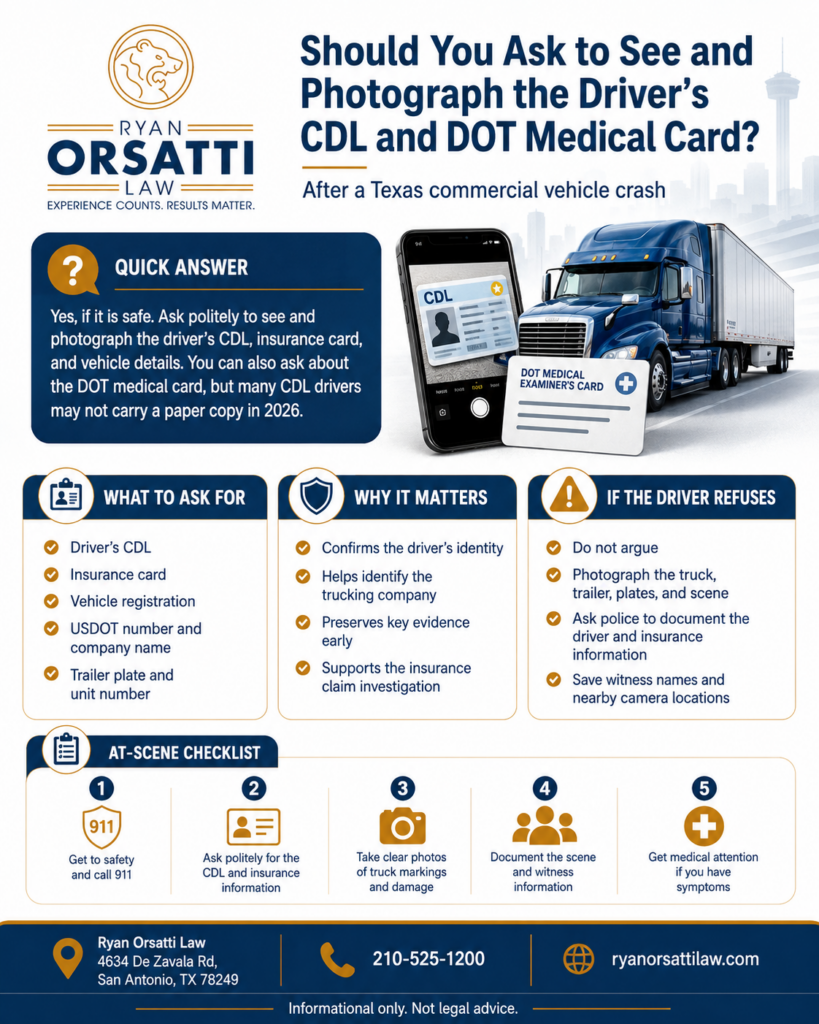
Yes. After a commercial truck or business vehicle crash, ask politely to see and photograph the driver’s commercial driver’s license (CDL) if it is safe and the driver cooperates. Texas Transportation Code § 550.023 requires an involved driver to exchange identifying, vehicle, and insurance information, and to show a driver’s license if requested and available. (Texas Legislature Online)
You may also ask for the DOT medical examiner’s certificate, but many CDL drivers no longer have to carry a paper copy after June 23, 2025. A missing paper medical card does not end the inquiry. The better evidence may be the driver’s CDLIS medical status, driver qualification file, and motor carrier records. (eCFR)
Key Takeaways
- Ask, do not demand. Safety, medical care, and law enforcement come first.
- Photograph the CDL only if the driver shows it or allows it. Do not grab, block, threaten, or argue.
- A DOT medical examiner’s certificate may not be physically carried by a CDL driver in 2026.
- Photos of the truck, USDOT number, carrier name, trailer plate, cab number, insurance card, and crash scene can be just as important.
- If the driver refuses, write down what happened and let law enforcement, preservation letters, and discovery handle the records.
- In a San Antonio truck crash, quick documentation can help identify the correct driver, motor carrier, insurer, and evidence sources before they disappear.
Should I ask to see and photograph the driver’s CDL at the scene?
Yes, if it is safe, you should ask politely to see and photograph the driver’s CDL, insurance card, vehicle registration, and commercial vehicle markings. A CDL, or commercial driver’s license, identifies a driver authorized to operate certain commercial motor vehicles. For many commercial motor vehicles, federal regulations require the driver to possess a CDL that meets federal standards. (eCFR)
Texas Transportation Code § 550.023 lets an injured person or involved vehicle occupant ask a crash driver to show a driver’s license if it is requested and available, but it does not require you to argue at the roadside. In a commercial vehicle crash, a calm photo of the CDL, insurance card, USDOT number, and truck identifiers protects more evidence than a confrontation. (Texas Legislature Online)
The practical rule is simple: ask once, document the answer, and stay safe. If the driver says no, do not escalate. Photograph the truck, trailer, company markings, license plates, roadway, debris, skid marks, traffic signals, and visible damage instead.
This matters on San Antonio roads like I-35, I-10, Loop 410, Loop 1604, US-281, and the industrial routes around Bexar County. Trucking cases often start with one basic question: who was actually operating and controlling the commercial vehicle?
What does Texas law require drivers to exchange after a crash?
Texas law requires an involved driver to share basic identifying, vehicle, and insurance information, and to show a driver’s license if requested and available. Under Texas Transportation Code § 550.023, a driver involved in a reportable crash must give the driver’s name, address, vehicle registration number, liability insurer, and other required information to injured persons or involved occupants, and must show the driver’s license if requested and available. (Texas Legislature Online)
That statute supports asking to see the driver’s license. It does not mean you have a right to take the card, force a photo, detain the driver, or search the truck.
Use this wording:
“Can I please take a photo of your CDL, insurance card, and vehicle registration for the crash report and insurance claim?”
If the driver cooperates, take clear photos. If the driver refuses, say:
“Okay. I’m going to let the officer know I requested it.”
Then stop. Your goal is not to win an argument at the scene. Your goal is to preserve facts.
Should I ask for the DOT medical examiner’s certificate?
Yes, but treat the DOT medical examiner’s certificate as an optional scene request, not a confrontation point. A DOT medical examiner’s certificate, often called an MEC or medical card, is Form MCSA-5876. It is issued when a certified medical examiner determines that a commercial driver meets federal physical qualification standards. (FMCSA)
After June 23, 2025, 49 C.F.R. § 391.41 says many CDL and CLP drivers no longer need to carry a paper DOT medical examiner’s certificate. The better preservation target is the CDLIS medical certification status, the driver qualification file, and any medical variance documentation held by the motor carrier or licensing agency. (eCFR)
CDLIS means the Commercial Driver’s License Information System. It is the electronic system used to track commercial driver licensing information. In Texas, the Department of Public Safety explains that medical certification has moved toward electronic processing, and Texas no longer accepts paper medical certificates after April 10, 2026. (Texas Department of Public Safety)
So, if the driver does not have a paper medical card, that fact alone does not prove the driver was medically unqualified. It is still worth noting. But the records that matter may be electronic.
What should I photograph after a San Antonio commercial vehicle crash?
Photograph anything that identifies the driver, carrier, vehicle, trailer, insurer, cargo, and crash location, as long as doing so does not put you in traffic or interfere with police or EMS. In commercial cases, the side of the truck can be more useful than the driver’s wallet.
| Evidence to photograph | Should you ask? | Why it matters | If unavailable |
|---|---|---|---|
| Driver’s CDL | Yes, politely | Confirms driver identity and licensing category | Write down the name given, description, and officer information |
| Insurance card | Yes | Identifies the liability coverage, meaning the policy that may cover crash-related losses | Photograph company markings and ask the officer to document insurance |
| Vehicle registration | Yes | Helps connect the truck or tractor to an owner | Photograph plate, VIN if visible, and cab number |
| DOT medical examiner’s certificate | Yes, if offered or carried | May show medical certification dates, but paper cards are not always required in 2026 | Ask an attorney to preserve CDLIS, MVR, and driver qualification records |
| USDOT number and company name | Yes | Identifies the motor carrier, which may be different from the driver or truck owner | Photograph all door decals, cab numbers, trailer markings, and bills of lading if visible |
| Trailer plate and trailer number | Yes | Trucks and trailers can be owned, leased, or controlled by different entities | Photograph both sides and rear of the trailer |
| Crash scene | No permission needed from a safe public area | Shows lane positions, debris, traffic controls, weather, road defects, and sight lines | Take wide, medium, and close photos before vehicles are moved |
| Witness vehicles and businesses | No permission needed from public view | Helps locate dashcam, surveillance, or third-party witnesses | Save names, phone numbers, store names, and camera locations |
In 2024, TxDOT reported 2,684 commercial motor vehicle involved crashes in Bexar County and 39,393 statewide. Those numbers matter because a truck claim often starts with scene proof: who the driver was, which carrier controlled the vehicle, what company markings appeared on the cab, and whether federal safety records should be preserved. (TxDOT)
What if the driver refuses, says no, or does not have the medical card?
If the driver refuses or does not have the card, stop asking, document the refusal, and let law enforcement and later legal preservation requests do the work. A refusal is a fact. It is not worth risking your safety or creating a confrontation.
Do these things instead:
- Write down the exact words used by the driver.
- Note whether the driver appeared to be driving a tractor-trailer, box truck, dump truck, delivery van, rideshare vehicle, shuttle, or company vehicle.
- Photograph the USDOT number, company name, truck number, trailer number, license plates, and any visible placards.
- Ask the responding officer to document that you requested driver and insurance information.
- Get the officer’s name, agency, and crash report number.
- Save original photos and videos without editing them.
- Do not post the photos on social media.
- Do not send a broad written statement to the trucking insurer before you understand the claim.
- Seek medical evaluation if you have pain, dizziness, numbness, confusion, headache, neck pain, back pain, or abdominal symptoms.
- Contact a lawyer quickly enough to send evidence preservation letters before electronic and company records are overwritten or discarded.
When a crash is investigated by law enforcement and meets reporting requirements, the officer’s crash report is generally submitted to TxDOT within 10 days. TxDOT is the custodian of Texas crash records and retains reportable crash records for 10 years plus the current year. (TxDOT)
Why does this evidence matter in a Texas truck accident claim?
This evidence matters because truck claims often turn on carrier identity, driver qualification, medical certification, insurance coverage, and fault allocation. A normal car wreck may involve one driver and one insurer. A commercial vehicle crash can involve a driver, motor carrier, vehicle owner, trailer owner, maintenance company, shipper, broker, and multiple insurance policies.
Driver qualification is a formal issue in trucking cases. Federal regulations require a motor carrier to investigate a driver’s safety performance history and obtain certain motor vehicle record information before allowing the driver to operate. Federal rules also require a driver qualification file, often called a DQF, that includes specific records such as the employment application, motor vehicle record, road test or equivalent certificate, annual review, and medical certification materials. (eCFR)
A driver qualification file is the carrier’s personnel and safety file for that driver. It can show whether the company checked licensing, medical qualification, prior violations, and other required records. It is not something an injured person can usually obtain at the scene.
Spoliation means the loss, destruction, or failure to preserve evidence after a duty to preserve has arisen. In truck cases, a preservation letter may ask the carrier to keep records such as the driver qualification file, electronic logging device data, dispatch communications, inspection records, maintenance records, dashcam footage, event data, and post-crash drug and alcohol testing records when applicable.
Texas proportionate responsibility is also important. It means fault can be divided by percentage among parties. Under Texas Civil Practice & Remedies Code § 33.001, a claimant may not recover damages if the claimant’s percentage of responsibility is greater than 50 percent. Scene photos can help answer later blame-shifting arguments about lane position, speed, lookout, following distance, and evasive action. (Texas Statutes)
Attorney Insight: In Bexar County truck cases, a faded photo of the USDOT number, cab unit number, trailer plate, and company door decal is often more useful than a heated argument over a medical card. If the driver refuses to show documents, that refusal is a fact to document, not a scene to win. We can later request the CDLIS record, driver qualification file, dispatch records, logs, inspection records, and safety history through preservation letters and discovery.
How do these documents affect insurance, MedPay, liens, and subrogation?
The documents help identify the right insurer and carrier, but they do not pay medical bills by themselves. Insurance issues after a commercial vehicle crash can become complicated quickly.
Here are the terms to know:
- Liability coverage means insurance that may cover the at-fault driver or company.
- UM/UIM means uninsured or underinsured motorist coverage. It may apply through your own auto policy if the responsible party lacks enough coverage.
- MedPay means medical payments coverage. It is optional first-party auto coverage that may help pay medical bills regardless of fault.
- Subrogation means a health insurer’s claim to be reimbursed from a personal injury recovery.
- An ERISA plan is an employer health benefit plan that may have strong reimbursement rights under federal law.
- A hospital lien is a claim a hospital may assert against a recovery for certain unpaid emergency care.
- A letter of protection, often called an LOP, is an agreement where a medical provider waits for payment from the injury claim rather than collecting immediately from the patient.
A CDL photo or medical card photo may help identify the driver, but the carrier’s insurance policy, employment records, vehicle ownership, and dispatch records usually matter more to the claim value and liability investigation. In matters our office reviews, adjusters often focus on whether the injured person can connect the driver to the carrier, connect the carrier to the vehicle, prove the crash mechanics, document consistent medical care, and show how the injuries changed daily life.
After a commercial vehicle crash, do these 10 things
These steps protect safety first and evidence second.
- Call 911 if anyone is hurt, traffic is blocked, a commercial vehicle is involved, or the crash appears serious.
- Get yourself and passengers out of moving traffic if you can do so safely.
- Request EMS evaluation if you have pain, confusion, dizziness, numbness, weakness, head impact, chest pain, or worsening symptoms.
- Ask politely for the driver’s name, address, insurance, vehicle registration, and CDL.
- Ask, “Can I take a photo of your CDL and DOT medical card if you have one?”
- Photograph the tractor, trailer, plates, VIN if visible, USDOT number, company decals, cab number, trailer number, cargo markings, and damage.
- Photograph the roadway, traffic signals, lane markings, debris field, skid marks, gouge marks, construction zones, and weather conditions.
- Get names and phone numbers for witnesses, nearby businesses, and anyone with dashcam or surveillance footage.
- Avoid guessing about fault, injuries, speed, or what the driver “must have” done.
- Preserve your photos, videos, medical records, repair records, tow documents, and insurance letters in one folder.
For more background on how these cases differ from ordinary car wrecks, Ryan Orsatti Law has a San Antonio truck accident lawyer guide and a guide to differences between car and truck accident claims. (Ryan Orsatti Law)
How can Ryan Orsatti Law help preserve trucking evidence?
A lawyer can send preservation letters and, if litigation is filed, request trucking records that a crash victim cannot realistically obtain at the roadside. That can include the driver qualification file, CDLIS medical certification information, motor vehicle records, dispatch records, inspection records, maintenance documents, dashcam footage, electronic logging data, and insurance information.
This is why early action matters after a crash involving an 18-wheeler, delivery truck, dump truck, oilfield truck, company van, shuttle, or rideshare vehicle. The driver’s CDL photo may be helpful, but it is only one piece of the case.
Ryan Orsatti Law handles personal injury cases involving commercial vehicles in San Antonio, Bexar County, and across Texas. For related information, review the firm’s San Antonio commercial vehicle accident lawyer page or contact Ryan Orsatti Law after a serious truck or commercial vehicle crash. (Ryan Orsatti Law)
FAQ
Is a truck driver legally required to let me photograph their CDL in Texas?
Texas Transportation Code § 550.023 requires an involved driver to provide identifying, vehicle, and insurance information, and to show the driver’s license if requested and available. The statute says “show,” not “pose for a photo.” Ask politely. If the driver refuses a photo, write down what happened and ask the officer to document the identifying information. (Texas Legislature Online)
Does a CDL driver have to carry a DOT medical card in 2026?
Not always. Under 49 C.F.R. § 391.41, after June 23, 2025, many CDL and CLP drivers with a current medical examiner’s certificate no longer need to carry a paper copy. Texas DPS also moved medical certification toward electronic processing and stopped accepting paper medical certificates after April 10, 2026. (eCFR)
What is the difference between a DOT medical examiner’s certificate and the medical examination report?
The DOT medical examiner’s certificate, Form MCSA-5876, is the limited certificate showing medical qualification information. The Medical Examination Report, Form MCSA-5875, contains more detailed medical history. Do not ask to photograph a driver’s private medical examination report at the scene. If medical qualification becomes disputed, an attorney can seek appropriate records through formal legal channels. (FMCSA)
What if the DOT medical examiner’s certificate looks expired?
An expired paper card is a warning sign, not a final legal conclusion. The driver’s electronic CDLIS medical status, state licensing record, medical variance documentation, and driver qualification file may be more accurate. Photograph the card if the driver allows it, note the expiration date, and ask a lawyer to preserve the carrier’s qualification records. (FMCSA)
Should I send CDL and medical card photos to the insurance adjuster right away?
Do not rush to send sensitive photos without understanding the claim. Save the original images, including metadata, and keep backup copies. Insurance adjusters may use early statements, photo gaps, and wording against you later. It is safer to provide required claim information while avoiding guesses about fault, speed, injury severity, or whether the driver was legally qualified.
Is the missing medical card enough to prove the trucking company was negligent?
No. A missing paper medical card may be relevant, but it usually does not prove negligence by itself. In 2026, many CDL drivers do not have to carry a paper certificate. The stronger inquiry is whether the driver was medically certified, whether the motor carrier checked required records, and whether the driver qualification file was complete.
What if the truck driver leaves before I can ask for documents?
Call 911, report the vehicle description, direction of travel, company name, USDOT number, plate number, and any trailer markings you saw. Take photos of debris, damage, roadway conditions, and nearby cameras. Even partial information can help law enforcement, insurers, and attorneys identify the carrier through crash reports, surveillance, and vehicle records.
Do I still need a lawyer if I photographed the CDL and DOT medical card?
Photos help, but they do not replace a full trucking investigation. A commercial vehicle case may require driver qualification records, CDLIS status, maintenance files, ELD data, dispatch records, insurance policies, medical billing review, lien analysis, MedPay coordination, UM/UIM review, and subrogation planning. The earlier those issues are identified, the easier they are to preserve.
Ryan Orsatti Law
4634 De Zavala Rd, San Antonio, TX 78249
Phone: 210-525-1200
ryanorsattilaw.com
This blog is for informational purposes only, not legal advice. Reading it does not create an attorney-client relationship. Past results do not guarantee future results.
Hurt in an accident in San Antonio? Learn how a San Antonio personal injury lawyer can help with your claim. Call 210-525-1200 or request a free consultation.
The firm works on a contingency fee. You pay nothing unless the firm recovers money for you, and that covers case expenses as well as the fee: if there is no recovery, you owe no attorney's fee and no case expenses. Ask for the fee agreement and read the fee and expense section before you sign anything.
Related San Antonio legal resources
Primary legal and public-data sources
- Texas Civil Practice and Remedies Code Chapter 16: limitations
- Texas Civil Practice and Remedies Code Chapter 33: proportionate responsibility
Ryan Orsatti Law
4634 De Zavala Road, San Antonio, TX 78249
General reference links. Consult each source for its current text.