
Quick Answer
To locate the truck’s USDOT number after a Texas crash, start by photographing every visible identifier on the tractor, trailer, driver documents, license plates, VIN plate, company names, unit numbers, and load paperwork. Then cross-check those details through the officer’s CR-3 crash report, the FMCSA SAFER Company Snapshot, and the TxDMV Texas Truck Stop lookup.
If the USDOT number was scraped off, taped over, or covered with a magnetic sign, do not remove anything yourself. Photograph it, tell the responding officer, preserve the evidence, and act quickly before the truck, trailer, lease documents, electronic logging device data, and shipping records disappear.
Key Takeaways
- A USDOT number is often the fastest way to identify the motor carrier responsible for a commercial truck trip.
- Federal rules generally require the operating motor carrier’s name and USDOT number to appear on both sides of a covered commercial motor vehicle and be readable from 50 feet in daylight.
- A magnetic or removable sign can be allowed, but it still has to identify the correct operating carrier and meet federal marking rules.
- The company painted on the truck may not be the company legally responsible for the trip.
- The CR-3 crash report, FMCSA SAFER, TxDMV Truck Stop, lease agreement, ELD records, and bill of lading can help identify the correct carrier.
- Hidden or altered markings should trigger immediate evidence preservation steps in a Texas truck accident claim.
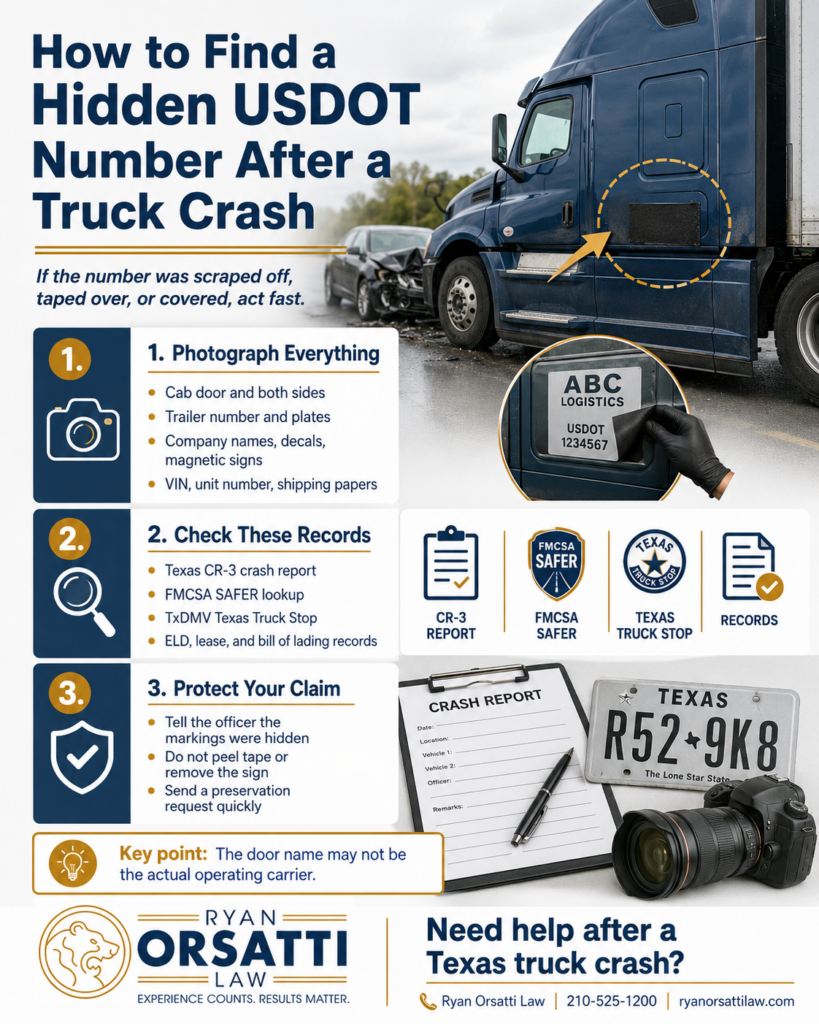
How Do I Locate the Truck’s USDOT Number After a Crash in Texas?
Start with the physical identifiers you can still see, then cross-check them against the officer’s CR-3 report, FMCSA SAFER, and TxDMV Truck Stop.
A USDOT number is a federal identifier issued by the Federal Motor Carrier Safety Administration. FMCSA explains that the USDOT number serves as a unique identifier when collecting and monitoring a motor carrier’s safety information, including crash investigations and inspections. (FMCSA)
After a crash in San Antonio, Bexar County, or anywhere in Texas, look for the USDOT number on:
- Both sides of the tractor cab
- A magnetic sign on the door
- Company decals near the sleeper, fuel tank, or step
- The front bumper, rear of cab, or side fairing
- The trailer, especially if the tractor markings are missing
- Insurance documents or a cab card
- Shipping papers, bill of lading, or delivery documents
- The Texas Peace Officer’s Crash Report, often called the CR-3
- FMCSA SAFER Company Snapshot
- TxDMV Texas Truck Stop
Do not stop at the door sign. In truck cases, the visible company name can point to the wrong entity if the truck is leased, rented, operated under another carrier’s authority, or hauling a load arranged by a broker.
If you were hit by a commercial vehicle in San Antonio, Ryan Orsatti Law’s commercial vehicle accident lawyer pageexplains how these claims can involve more than the driver and the truck owner.
Why Does a Scraped, Taped, or Covered USDOT Number Matter?
A scraped, taped, or covered USDOT number matters because it can hide the operating carrier, which is the company responsible for the trip.
Under 49 C.F.R. § 390.21, a covered self-propelled commercial motor vehicle must display the legal name or single trade name of the operating motor carrier and the FMCSA-issued identification number preceded by “USDOT.” The marking must appear on both sides of the vehicle, contrast sharply with the background, be readily legible from 50 feet in daylight while the vehicle is stationary, and be maintained. (eCFR)
That does not mean every damaged or covered number proves wrongdoing. Trucks get repainted. Doors get repaired. Magnetic signs may fall off. Contractors may use leased equipment. But if a USDOT number was scraped off, taped over, or hidden by a magnetic sign after a crash, that fact should be documented carefully.
A missing USDOT number can affect:
- Which company receives the claim
- Which insurance policy applies
- Which safety records are searched
- Which electronic logging device records are requested
- Which driver qualification file must be preserved
- Which company controlled the driver’s route, load, dispatch, and schedule
A hidden USDOT number can turn a simple-looking crash into an operating-carrier investigation. In Texas truck accident claims, the key question is not only “who owned the truck?” It is often “who controlled this commercial motor vehicle trip when the collision happened?”
What Should I Photograph Before the Truck Leaves the Scene?
Photograph every identifier that can connect the truck, trailer, driver, load, and carrier before the vehicle leaves the scene.
If you are physically able to do so safely, use this checklist after a crash involving an 18-wheeler, box truck, dump truck, delivery truck, tow truck, or other commercial vehicle.
- Photograph both sides of the cab. Take wide photos from a distance and close photos of the door, sleeper, decals, numbers, tape, residue, magnetic signs, and any scratched-off area.
- Photograph the trailer. Get the trailer plate, unit number, company name, seal number, trailer VIN if visible, and any markings on the rear doors or side rails.
- Photograph the license plates. Capture the tractor plate and trailer plate. If either plate is bent, dirty, missing, temporary, or partially covered, photograph that too.
- Photograph the VIN and unit numbers. Look for a VIN plate near the driver door jamb, dashboard, frame, or registration paperwork if the driver or officer makes it visible.
- Photograph the driver and insurance documents only if shown to you. Do not grab, enter the cab, or argue. If the officer or driver displays documents, photograph what you can see.
- Photograph shipping papers and cargo clues. A bill of lading, placards, trailer seal, delivery label, load number, broker name, or warehouse paperwork may help identify the carrier, broker, or shipper.
- Photograph the scene with landmarks. Include lane position, skid marks, debris, road signs, intersections, mile markers, and landmarks on I-35, I-10, Loop 410, Loop 1604, US-281, or nearby access roads.
- Tell the officer the USDOT number was hidden. Ask the responding officer to document that the USDOT number appeared scraped off, taped over, covered, or inconsistent with the company name.
- Get the crash report information. Ask for the officer’s name, agency, incident number, and instructions for obtaining the Texas CR-3 crash report.
Do not peel tape, move a magnetic sign, enter the truck, or remove anything from the scene. Your job is to preserve what you saw, not alter it.
Where Else Can the USDOT Number Be Found if the Door Marking Is Missing?
If the door marking is missing, the USDOT number may still appear in records tied to the truck, trip, driver, load, or Texas motor carrier registration.
The Texas A&M Transportation Institute has published a commercial motor vehicle crash tip card warning that vehicle registration information may not identify the responsible carrier and that investigators should verify motor carrier information through FMCSA SAFER, lease agreements, driver records of duty status, ELD records, and shipping papers.
| Source to Check | What It May Show | Why It Matters |
|---|---|---|
| FMCSA SAFER Company Snapshot | USDOT number, MC or MX number, legal name, address, safety rating, inspections, and crash information | SAFER allows searches by DOT number, MC or MX number, or company name and provides a free company snapshot. (SAFER Web) |
| TxDMV Texas Truck Stop | Company name, DBA, USDOT number, TxDMV number, or VIN | TxDMV says the tool can be used to determine whether a motor carrier is properly licensed in Texas. (apps.txdmv.gov) |
| Texas CR-3 crash report | Driver, vehicle, insurance, carrier fields, and crash details | TxDOT is the custodian of Texas crash records, and officers must submit qualifying crash reports to TxDOT not later than the tenth day after the crash. (Texas Department of Transportation) |
| Lease or rental agreement | Renter, lessee, motor carrier, and possibly USDOT number | Federal rules address leased and rented commercial motor vehicles and allow certain lease or rental documents to carry carrier information. (eCFR) |
| ELD or driver log | Carrier account, driver duty status, route, and timing | ELD data can help connect the driver to the motor carrier controlling the trip. |
| Bill of lading or shipping papers | Load number, shipper, receiver, broker, carrier, and destination | Load paperwork may show who arranged, accepted, or controlled the shipment. |
| Insurance documents | Policyholder, insured entity, vehicle, and coverage clues | The named insured may differ from the driver, truck owner, or operating carrier. |
| Cab card, registration, or VIN | Owner, registrant, unit number, and vehicle history | Ownership is useful, but it may not prove who operated the truck at the time of the crash. |
For a serious truck case, the goal is to build a carrier-identification map. That means matching the physical truck, trailer, driver, load, dispatch, insurance, and safety authority records.
Ryan Orsatti Law has a related resource on black box data and electronic logging devices in 18-wheeler accidents that explains why digital truck records can matter after a San Antonio crash.
Can a Magnetic USDOT Sign Be Legal?
Yes, a magnetic or removable sign can satisfy federal marking rules if it displays the correct operating carrier information and remains legible as required.
Federal marking rules allow the required information to be painted on the vehicle or shown through a removable device if the device meets the same marking requirements. Those requirements include proper carrier information, the USDOT number, placement on both sides, sharp contrast, daylight legibility from 50 feet, and maintenance. (eCFR)
A magnetic sign becomes a problem when it:
- Covers a different USDOT number
- Lists a company that did not control the trip
- Falls off or is removed after the crash
- Is used to hide an out-of-service or unauthorized carrier
- Makes the carrier information unreadable
- Conflicts with the CR-3, ELD, insurance, lease, or bill of lading
Texas DPS also summarizes commercial vehicle marking requirements and explains that certain Texas commercial motor vehicles must display required markings, including USDOT numbers and legal carrier names, depending on the vehicle type and operation. (Texas Department of Public Safety)
A magnetic USDOT sign is not automatically suspicious. A magnetic sign that hides, changes, or conflicts with the actual operating carrier is worth investigating.
What if the Company Name on the Door Is Not the Actual Carrier?
Do not assume the company name on the door is the responsible carrier, because the operating carrier can differ from the owner, lessor, broker, or shipper.
The “operating carrier” means the motor carrier responsible for operating the commercial vehicle for that trip. The “broker” usually arranges transportation of freight. The “shipper” sends or owns the cargo. The “lessor” may own or lease the truck, trailer, or equipment.
Those roles can overlap, but they often do not.
For example, a crash on I-35 in San Antonio may involve:
- A driver employed by one company
- A tractor owned by another company
- A trailer leased from another entity
- Freight arranged by a broker
- Cargo shipped by a manufacturer or retailer
- Insurance issued to a named insured that does not match the door sign
This is why a truck crash investigation should not rely only on a scraped, taped, or magnetic door marking. A correct investigation checks the route, load, driver records, lease documents, ELD data, registration, and federal or Texas motor carrier records.
FMCSA’s current Texas A&I large-truck crash query shows 19,688 large-truck crashes and 750 fatal large-truck crashes in one recent annual row. FMCSA identifies MCMIS as the data source and states that MCMIS data are preliminary for 22 months, which means current crash data can change as records are updated. (A&I Online)
With that many Texas large-truck crash records being tracked, a hidden USDOT number is not a minor clerical issue. It can affect whether the right company, right insurer, and right safety history are identified early.
How Does This Evidence Affect a Texas Truck Accident Claim?
Hidden carrier identification can affect liability, insurance coverage, preservation of evidence, and the value analysis of a Texas truck accident claim.
“Liability” means legal responsibility. In a truck crash, liability may involve the driver, operating carrier, maintenance contractor, loading company, broker, shipper, truck owner, trailer owner, or another party, depending on the facts.
“Negligence” means failing to use ordinary care under the circumstances. A trucking company may be investigated for negligent hiring, negligent supervision, unsafe dispatch, maintenance failures, hours-of-service issues, or failure to follow safety rules if the evidence supports those claims.
“Spoliation” means the destruction, alteration, or failure to preserve relevant evidence. If a company knows a serious crash occurred, records such as ELD data, dashcam footage, dispatch messages, maintenance records, driver qualification files, and lease documents may need to be preserved.
Hidden USDOT markings can also affect insurance. The correct policy may depend on which carrier was operating the truck, whether the truck was in interstate commerce, whether a trailer was leased, and whether a motor carrier endorsement applies. If the wrong carrier is identified early, the claim can lose valuable time.
Other coverage and reimbursement issues may also come up:
- UM/UIM coverage means uninsured or underinsured motorist coverage on your own policy, which may matter if the responsible party has no coverage or not enough coverage.
- MedPay means medical payments coverage, a no-fault auto insurance benefit if purchased.
- Subrogation means a health insurer or benefit plan may claim reimbursement from a settlement or recovery.
- A hospital lien is a hospital’s claim for payment from injury-related recovery, if legal requirements are met.
- An ERISA plan is often an employer-sponsored health plan, and some ERISA plans assert reimbursement rights after injury claims.
The hidden-number issue is not only about finding a name. It can change the entire claim structure.
What Should a Preservation Letter Request When the USDOT Number Was Hidden?
A preservation letter should request every record that can identify the operating carrier, truck, trailer, driver, load, route, and post-crash condition of the markings.
A preservation letter is a written notice asking a person or company to preserve evidence. In a truck crash case, it should be sent quickly because commercial records can be overwritten, moved, repaired, deleted, or replaced.
When the USDOT number was scraped off, taped over, or covered with a magnetic sign, a preservation letter should address:
- Photos and videos of the tractor and trailer after the crash
- The door markings, magnetic signs, decals, and any removed signage
- Repair records for the door, cab, signage, and body panels
- Lease, rental, or operating agreements
- Driver qualification file
- Driver logs and ELD records
- Dispatch records, route data, GPS, telematics, and load assignments
- Bill of lading, rate confirmation, shipping papers, and broker records
- Insurance policies and endorsements
- Maintenance and inspection records
- Dashcam, inward-facing camera, and surveillance footage
- Drug and alcohol testing records, if applicable
- Communications among the driver, dispatcher, carrier, broker, shipper, and insurer
The first few days after a truck crash are often document-heavy. Waiting until the truck has been repaired, the magnetic sign has disappeared, or the trailer has been reassigned can make the investigation harder.
If you are deciding whether to involve counsel early, this resource on when to hire a truck accident lawyer in San Antonio explains why timing can matter in commercial vehicle cases.
What Can Ryan Orsatti Law Do if the USDOT Number Was Hidden?
When the USDOT number was hidden or unclear, Ryan Orsatti Law can focus the investigation on identifying the operating carrier and preserving the records that connect that carrier to the crash.
That may include:
- Reviewing the photos, crash scene evidence, and CR-3 crash report
- Searching FMCSA SAFER by company name, USDOT number, MC number, or related carrier information
- Searching TxDMV Texas Truck Stop by company name, DBA, USDOT number, TxDMV number, or VIN
- Comparing door markings to driver documents, insurance, lease records, and load paperwork
- Sending preservation letters to the driver, carrier, owner, broker, shipper, insurer, and other involved companies
- Requesting ELD, telematics, dashcam, inspection, and maintenance records
- Evaluating whether the visible markings complied with federal and Texas commercial vehicle rules
- Identifying possible insurance coverage and reimbursement issues
In matters involving San Antonio, Bexar County, Comal County, Guadalupe County, Kendall County, Wilson County, Atascosa County, Medina County, and the I-35 corridor, local road evidence can also matter. A crash near Loop 410 may involve different video, business surveillance, and traffic witnesses than a rural crash on a lease road or farm-to-market road.
You can contact Ryan Orsatti Law through the firm’s contact page if you need help identifying a truck carrier after a crash.
What Is the Attorney Insight When the USDOT Number Is Hidden?
In truck-crash files, a covered USDOT number is not a dead end. Treat it as a prompt to identify the trip, not just the vehicle. The strongest carrier ID usually comes from cross-checking door markings against the lease, bill of lading, ELD account, insurance filings, VIN, plate, and CR-3.
A hidden USDOT number should change the order of investigation. Instead of starting with one company name and assuming it is correct, start with the trip itself.
Ask:
- Who dispatched the driver?
- Who accepted the load?
- Who controlled the route?
- Who insured the tractor?
- Who leased the trailer?
- Who maintained the truck?
- Who had access to the ELD account?
- Who had authority to place or remove the magnetic sign?
The more serious the injuries, the more important these questions become.
FAQ
Can I Look Up a USDOT Number With Only the Trucking Company Name?
Yes. FMCSA SAFER allows searches by DOT number, MC or MX number, or company name. A company-name search can help if the USDOT number was scraped off, taped over, or covered. Be careful with similar names, DBAs, and affiliated companies. Cross-check the result against the CR-3, VIN, plate, driver, insurance, and load documents.
What if the USDOT Number on the Magnetic Sign Belongs to a Different Company?
Photograph the sign and treat the mismatch as an investigation issue. The number may belong to the operating carrier, a related company, or the wrong entity. A lawyer can compare the magnetic sign to FMCSA SAFER, TxDMV records, lease documents, ELD records, insurance, and shipping papers to identify who controlled the trip.
Can I Remove Tape or a Magnetic Sign to See the USDOT Number Underneath?
No. Do not remove tape, peel decals, move a magnetic sign, open the cab, or alter the truck. Take photos from multiple angles, including close photos and wide photos. Tell the responding officer exactly what you saw. Altering the truck can create safety, evidence, and credibility problems in a later claim.
Does the Texas CR-3 Crash Report Show the Truck’s USDOT Number?
It may. The Texas CR-3 crash report includes commercial motor vehicle fields, and TxDOT maintains Texas crash records. For qualifying crashes involving injury, death, or at least $1,000 in property damage, the investigating officer must submit the report to TxDOT not later than the tenth day after the crash. (Texas Department of Transportation)
How Long Do I Have to Identify the Trucking Company After a Texas Crash?
You should act immediately, even though many Texas personal injury claims have a two-year filing deadline under Texas Civil Practice and Remedies Code § 16.003. Evidence can disappear much sooner than a lawsuit deadline. Government-related claims, contractual notice issues, video retention, ELD records, and repair records may involve shorter practical timelines. (Texas Constitution and Statutes)
What if the Truck Was Local and Only Operated Inside Texas?
Check TxDMV Texas Truck Stop in addition to FMCSA SAFER. TxDMV states that intrastate motor carriers operating on Texas roads or highways must obtain a TxDMV number, and its lookup tool can search by company name, DBA, USDOT number, TxDMV number, or VIN. (Texas DMV)
Is the Truck Owner Always Responsible for the Crash?
No. The truck owner may be responsible in some cases, but ownership alone does not answer every truck-crash question. The operating carrier, employer, maintenance company, broker, shipper, trailer owner, or another entity may also need review. The key issue is who controlled the driver, truck, trailer, load, and trip when the crash happened.
Should I Call a Lawyer if the USDOT Number Was Hidden?
Yes, it is worth getting legal guidance if you were injured and the USDOT number was hidden, inconsistent, or missing. Carrier identification affects preservation letters, insurance coverage, safety-history searches, and potential defendants. Early action can help secure ELD data, load documents, lease records, and photos before they are lost or changed.
Ryan Orsatti Law
4634 De Zavala Rd, San Antonio, TX 78249
Phone: 210-525-1200
ryanorsattilaw.com
This blog is for informational purposes only, not legal advice. Reading it does not create an attorney-client relationship. Past results do not guarantee future results.
Hurt in an accident in San Antonio? Learn how a San Antonio personal injury lawyer can help with your claim. Call 210-525-1200 or request a free consultation.
The firm works on a contingency fee. You pay nothing unless the firm recovers money for you, and that covers case expenses as well as the fee: if there is no recovery, you owe no attorney's fee and no case expenses. Ask for the fee agreement and read the fee and expense section before you sign anything.
Related San Antonio legal resources
Primary legal and public-data sources
- Texas Civil Practice and Remedies Code Chapter 16: limitations
- Texas Civil Practice and Remedies Code Chapter 33: proportionate responsibility
Ryan Orsatti Law
4634 De Zavala Road, San Antonio, TX 78249
General reference links. Consult each source for its current text.