
Quick Answer
To determine whether the truck that hit you was operating under interstate USDOT authority or intrastate-only Texas authority, start with the carrier’s USDOT number, MC/MX number, TxDMV number, crash report, bill of lading, and trip documents. A truck can be “interstate” even if the crash happened entirely inside Texas if the load was part of transportation that began or ended outside Texas. FMCSA defines interstate commerce to include transportation between Texas and another state, through another state, or inside Texas as part of freight that originated or terminates outside Texas. (fmcsa.dot.gov)
Key Takeaways
- A USDOT number alone does not prove the truck was operating interstate. Texas is one of the states that may require intrastate commercial carriers to have a USDOT number. (fmcsa.dot.gov)
- A TxDMV number is strong evidence of Texas intrastate motor carrier registration, but it does not automatically rule out interstate operations.
- The most important question is not just “Where did the crash happen?” It is “Where was the freight, passenger trip, or commercial movement coming from and going?”
- FMCSA’s SAFER Company Snapshot and Licensing & Insurance database can help identify the carrier, USDOT number, MC/MX authority, and public safety/insurance records. (SAFER Web)
- In a Texas truck crash case, early preservation of bills of lading, dispatch records, ELD data, rate confirmations, GPS data, and insurance filings can be critical.
If you were hit by an 18-wheeler or commercial vehicle in San Antonio, I-35, I-10, Loop 410, Loop 1604, Austin, Dallas, Houston, or anywhere in Texas, this distinction can affect the investigation, available records, insurance issues, and potentially responsible parties. Ryan Orsatti Law handles San Antonio truck accident cases and commercial vehicle accident claims involving these exact questions.
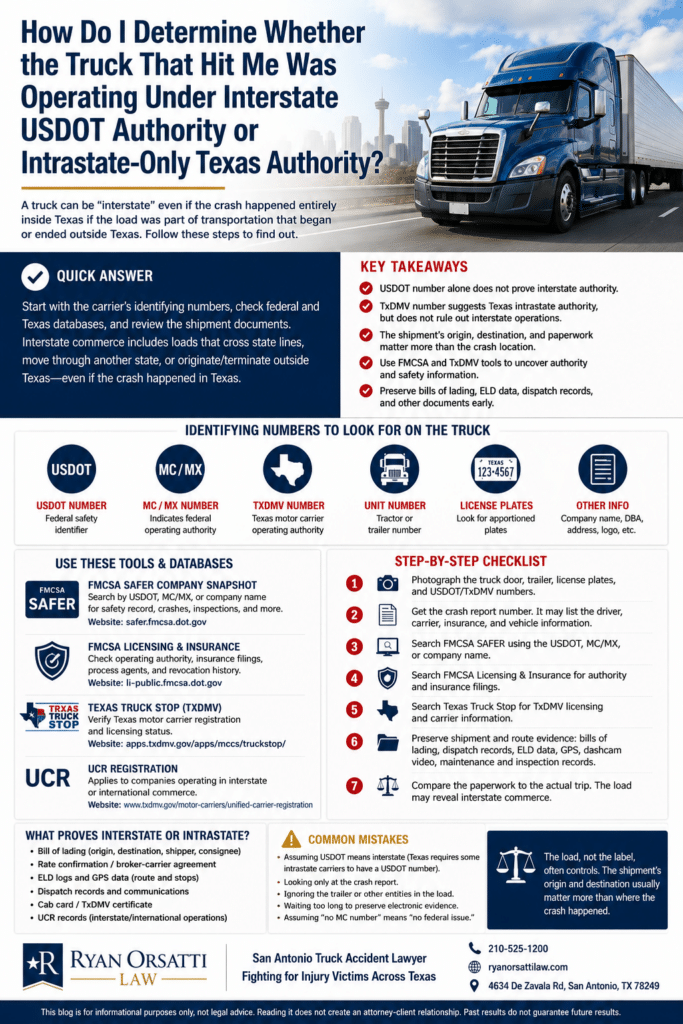
Why Interstate vs. Intrastate Authority Matters After a Texas Truck Crash
After a commercial truck crash, the trucking company and its insurer often know far more than the injured person about the driver, carrier, route, cargo, and regulatory status. One of the first investigation questions is whether the truck was operating in interstate commerce or only intrastate Texas commerce.
Interstate commerce means trade, traffic, or transportation crossing state lines, moving through another state, or moving within one state as part of a shipment that began or will end outside that state. FMCSA’s USDOT guidance uses that same three-part concept. (fmcsa.dot.gov)
Intrastate commerce means the commercial transportation stayed within Texas and was not part of a broader out-of-state shipment or passenger movement.
This matters because interstate carriers may have FMCSA operating authority, MC/MX numbers, federal insurance filings, UCR registration, process-agent filings, and federal safety records. Texas intrastate carriers may instead be operating under TxDMV motor carrier registration, Texas insurance filings, and Texas-specific cab card requirements. TxDMV says intrastate commercial motor vehicle carriers operating on Texas roads must register with the Texas Department of Motor Vehicles Motor Carrier Division. (TXDMV)
The distinction does not decide the whole injury case by itself. Negligence, causation, medical proof, damages, and Texas proportionate responsibility still matter. But authority status helps identify which records to request and which regulatory duties may apply.
The First Clue: Look at the Truck Door and Trailer
Most commercial trucks display identifying information on the cab door. Photograph it immediately if you can do so safely.
Look for:
- Legal name or DBA of the motor carrier.
- USDOT number.
- MC or MX number.
- TxDMV number.
- Unit number on the tractor or trailer.
- License plates, especially apportioned plates.
- Hazardous material placards, if present.
- Company logo, address, phone number, or website.
- Trailer owner name, which may differ from the tractor owner.
A USDOT number is a federal safety identifier. FMCSA says the USDOT number is used to collect and monitor a company’s safety information from audits, compliance reviews, crash investigations, and inspections. (fmcsa.dot.gov)
A MC/MX number usually points toward federal operating authority for for-hire interstate or international transportation. A TxDMV number points toward Texas motor carrier operating authority for intrastate operations. TxDMV’s motor carrier page specifically says Texas Truck Stop can be used to find out whether a motor carrier business is properly licensed in Texas, and the lookup permits searching by company name, DBA, USDOT number, TxDMV number, VIN, city, ZIP, and carrier type. (apps.txdmv.gov)
Do Not Assume “Texas Crash” Means “Texas-Only Carrier”
A crash on I-35 in San Antonio may involve a load moving from Laredo to Dallas. That sounds intrastate at first. But if the freight came from Mexico before Laredo or is headed to Oklahoma after Dallas, the trip may still be interstate or international commerce.
FMCSA’s USDOT guidance says interstate commerce includes transportation between a place in one state and a place outside that state, between two places in one state through another state, or between two places in one state as part of transportation originating or terminating outside the state or United States. (fmcsa.dot.gov)
That is the key nuance. The driver’s current road segment is not the entire analysis. The shipment’s origin, destination, shipper instructions, broker paperwork, and bills of lading may matter more than the crash location.
Records That Help Prove Interstate or Intrastate Status
| Record or Source | What It May Show | Why It Matters |
|---|---|---|
| FMCSA SAFER Company Snapshot | USDOT number, company identity, size, commodity information, and safety record | FMCSA says the Company Snapshot is a free public record searchable by DOT number, MC/MX number, or company name. (SAFER Web) |
| FMCSA Licensing & Insurance database | Operating authority, insurance filings, process agent filings, revocation/reinstatement history | FMCSA warns database entries may lag mailed filings by several working days, so timing matters. (li-public.fmcsa.dot.gov) |
| TxDMV Texas Truck Stop | TxDMV number, Texas carrier licensing status, carrier type | Useful for intrastate Texas authority and Texas motor carrier registration checks. (apps.txdmv.gov) |
| Bill of lading | Shipper, consignee, origin, destination, commodity | Often the strongest proof of whether the shipment crossed state lines or was part of interstate transportation. |
| Rate confirmation / broker-carrier agreement | Broker, carrier, pickup, delivery, load number | May identify additional defendants or entities controlling the load. |
| ELD and driver logs | Route, duty status, hours, stops | Helps match the driver’s claimed trip to the freight paperwork. |
| Cab card / TxDMV certificate | Texas motor carrier registration and insurance information | TxDMV says the cab card must be kept in the commercial vehicle and available to law enforcement on request. (TXDMV) |
| UCR records | Interstate or international commercial operation registration | TxDMV states UCR applies to companies operating commercial motor vehicles in interstate or international commerce. (TXDMV) |
Step-by-Step Checklist After a Texas Truck Crash
After a commercial truck crash, do these seven things as soon as safely possible:
- Photograph the truck door, trailer, license plates, and USDOT/TxDMV numbers. Get wide shots and close-ups.
- Get the crash report number. The Texas crash report may identify the driver, owner, carrier, insurance company, and vehicle information.
- Search FMCSA SAFER. Use the USDOT number, MC/MX number, or carrier name to locate the Company Snapshot. FMCSA says SAFER is searchable by DOT number, MC/MX number, or company name. (SAFER Web)
- Search FMCSA Licensing & Insurance. Look for active authority, insurance filings, process agents, and revocation or reinstatement history.
- Search Texas Truck Stop. Use company name, DBA, USDOT number, TxDMV number, or VIN to check Texas motor carrier licensing.
- Preserve shipment and route evidence. Send a written preservation request for bills of lading, dispatch records, ELD data, GPS, dashcam video, maintenance records, inspection records, and driver qualification files.
- Compare the paperwork to the actual trip. A carrier may call itself intrastate, but the bill of lading, broker load sheet, or shipper records may show interstate freight.
For crashes involving serious injuries, brain injury symptoms, or a death, the authority analysis should be done quickly because some records can be overwritten, deleted, or “lost” if they are not preserved. Ryan Orsatti Law also handles claims involving traumatic brain injuries and wrongful death after Texas crashes.
What SAFER Can and Cannot Tell You
The SAFER Company Snapshot is a starting point, not the whole investigation. FMCSA describes it as a concise electronic record of a company’s identification, size, commodity information, safety rating if any, roadside out-of-service inspection summary, and crash information. (SAFER Web)
That is helpful, but it does not answer every case-specific question. A carrier profile may say “interstate,” but the load involved in your crash still needs to be matched to its route and paperwork. A carrier may also have a USDOT number because Texas requires certain intrastate commercial motor vehicle registrants to obtain one. FMCSA lists Texas among the states that require some intrastate commercial motor vehicle registrants to obtain a USDOT number. (fmcsa.dot.gov)
So the safest approach is to treat SAFER as a lead generator. It helps identify the company and regulatory footprint. It does not replace discovery.
What Texas Truck Stop Can and Cannot Tell You
Texas Truck Stop is useful when the truck appears to be a Texas intrastate carrier. The tool allows searches by company name, DBA, USDOT number, TxDMV number, VIN, city, ZIP code, and carrier type. (apps.txdmv.gov)
TxDMV says motor carriers operating intrastate commercial motor vehicles on Texas roads must register their operations with the TxDMV Motor Carrier Division. TxDMV also warns intrastate carriers to register with USDOT as intrastate, not interstate. (TXDMV)
That said, a TxDMV number does not prove the truck was not involved in interstate transportation. Some carriers have both state and federal regulatory footprints. The load paperwork is usually the deciding evidence.
Attorney Insight: The Load, Not the Label, Often Controls
In truck crash matters, we routinely see carriers describe themselves in shorthand: “local,” “Texas-only,” “dedicated route,” or “intrastate.” Those labels may be incomplete. The better question is: what was this truck doing on this trip, for this shipper, under this load number?
For example, a tractor-trailer may be driving from a warehouse in San Antonio to a delivery site in Austin. If the goods arrived from another state and the Texas leg was part of a continuous movement to the consignee, the interstate analysis may not stop at the Texas border. The paperwork, not the carrier’s casual description, usually tells the story.
That is why a preservation letter should request the bill of lading, rate confirmation, dispatch sheet, shipper instructions, broker records, ELD data, GPS data, fuel receipts, toll data, inspection reports, and communications about the load.
Common Mistakes When Checking Trucking Authority
Mistake 1: Treating USDOT as Proof of Interstate Authority
A USDOT number is important, but it is not conclusive. FMCSA requires companies operating commercial vehicles in interstate commerce to register with FMCSA and have a USDOT number, but Texas is also listed as a state requiring some intrastate registrants to obtain USDOT numbers. (fmcsa.dot.gov)
Mistake 2: Ignoring the Trailer
The tractor, trailer, freight, shipper, broker, and motor carrier may involve different entities. The trailer may reveal a separate owner or leasing arrangement.
Mistake 3: Looking Only at the Crash Report
Crash reports are helpful, but they may not contain the full carrier structure or shipment chain. They also may contain mistakes. Treat the report as a starting point.
Mistake 4: Waiting Too Long to Preserve Electronic Evidence
ELD records, GPS data, dashcam video, in-cab camera footage, dispatch messages, and telematics data can be time-sensitive. Preservation should happen quickly, especially after a severe injury crash.
Mistake 5: Assuming “No MC Number” Means “No Federal Issue”
Private interstate carriers may not always look the same as for-hire carriers in public databases. The presence, absence, or status of an MC/MX number should be evaluated with the carrier’s business model and the specific trip documents.
Why This Issue Comes Up Often in San Antonio Truck Crashes
San Antonio sits at the crossroads of I-35, I-10, Loop 410, Loop 1604, U.S. 281, and major freight routes tied to Laredo, Austin, Dallas-Fort Worth, Houston, and the Rio Grande Valley. A truck crash in Bexar County may involve local delivery, oilfield supply work, construction hauling, warehouse distribution, cross-border freight, or interstate brokerage.
That is why the investigation should not stop at the license plate or the carrier logo. The carrier may be local, but the load may not be. The driver may live in Texas, but the shipment may be interstate. The truck may display a TxDMV number, but the company may still participate in interstate commerce.
For related injury information, see Ryan Orsatti Law’s pages on car accident claims, commercial vehicle crashes, and truck accident cases.
FAQ
Does a USDOT number mean the truck was operating interstate?
No. A USDOT number is strong evidence that the carrier is in a regulated commercial motor vehicle system, but it does not automatically prove interstate authority. FMCSA requires USDOT registration for interstate commercial vehicle operations, but it also lists Texas among the states requiring certain intrastate commercial motor vehicle registrants to obtain USDOT numbers. (fmcsa.dot.gov)
What is the difference between a USDOT number and an MC number?
A USDOT number is a federal safety identification number used to track carrier safety information. An MC or MX number generally relates to federal operating authority, often for for-hire interstate or international transportation. In a crash investigation, both numbers should be searched because they may reveal different records, insurance filings, or authority status.
Can a Texas-only route still count as interstate commerce?
Yes. A trip that happens entirely inside Texas may still be part of interstate commerce if the freight originated outside Texas or is ultimately headed outside Texas. FMCSA’s interstate-commerce guidance includes transportation between two places in one state when it is part of transportation originating or terminating outside that state or the United States. (fmcsa.dot.gov)
How do I check whether a carrier is properly licensed in Texas?
Use TxDMV’s Texas Truck Stop lookup. It allows searches by company name, DBA, USDOT number, TxDMV number, VIN, city, ZIP code, and carrier type. TxDMV describes the tool as a way to determine whether a moving, trucking, or bus company is properly licensed in Texas. (apps.txdmv.gov)
What documents best prove whether a shipment was interstate?
The most useful documents are usually the bill of lading, broker rate confirmation, dispatch records, shipper instructions, ELD logs, GPS data, fuel receipts, and delivery paperwork. Those records can show where the load came from, where it was going, who arranged it, and whether the Texas leg was part of a larger interstate movement.
Does intrastate-only authority reduce the value of my Texas truck accident case?
Not necessarily. Authority status is only one part of the case. Injury severity, negligence, driver conduct, company safety practices, insurance coverage, medical proof, lost income, and Texas liability rules still matter. Intrastate cases can involve serious injuries and significant insurance issues, especially when the carrier failed to register or maintain proper coverage.
Why should I preserve trucking records quickly?
Trucking cases often involve electronic and business records that can change or disappear. ELD data, dashcam footage, GPS records, dispatch messages, inspection records, and maintenance records may be overwritten or difficult to obtain later. A prompt preservation letter helps protect evidence before the carrier or insurer controls the narrative.
Ryan Orsatti Law
4634 De Zavala Rd, San Antonio, TX 78249
Phone: 210-525-1200
ryanorsattilaw.com
This blog is for informational purposes only, not legal advice. Reading it does not create an attorney-client relationship. Past results do not guarantee future results.
Hurt in an accident in San Antonio? Learn how a San Antonio personal injury lawyer can help with your claim. Call 210-525-1200 or request a free consultation.
The firm works on a contingency fee. You pay nothing unless the firm recovers money for you, and that covers case expenses as well as the fee: if there is no recovery, you owe no attorney's fee and no case expenses. Ask for the fee agreement and read the fee and expense section before you sign anything.
Related San Antonio legal resources
Primary legal and public-data sources
- Texas Civil Practice and Remedies Code Chapter 16: limitations
- Texas Civil Practice and Remedies Code Chapter 33: proportionate responsibility
Ryan Orsatti Law
4634 De Zavala Road, San Antonio, TX 78249
General reference links. Consult each source for its current text.