
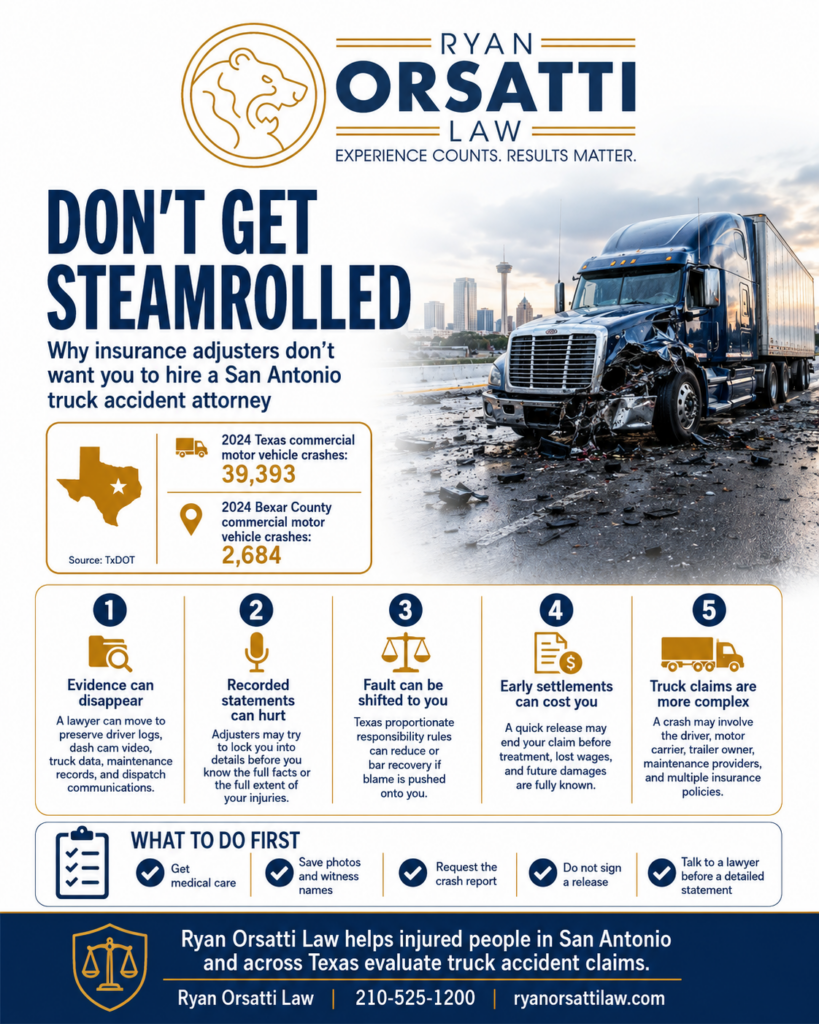
Quick Answer: Insurance adjusters in truck accident claims often prefer that you do not hire a San Antonio personal injury attorney because an attorney can preserve trucking evidence, challenge fault-shifting, identify insurance coverage, and review any release before you sign it. In 2024, TxDOT reported 39,393 commercial motor vehicle involved crashes in Texas, including 2,684 in Bexar County, so insurers handle these claims with trained claim processes, not casual conversations. Ryan Orsatti Law helps injured people in San Antonio and across Texas evaluate truck crash evidence, insurance issues, medical bills, and deadlines before decisions become permanent. (Texas Department of Transportation)
Key Takeaways
- A trucking insurer’s adjuster does not represent you. The adjuster’s job is to evaluate and resolve the claim for the insurance company.
- Truck accident claims can involve driver logs, electronic data, maintenance records, dispatch records, cargo issues, and multiple companies.
- Texas proportionate responsibility can reduce a claim by your percentage of fault and may bar recovery if you are found more than 50% responsible. (Texas Statutes)
- An early settlement release can permanently end your injury claim before you know the full medical picture.
- Important deadlines include the Texas two-year lawsuit deadline, the crash report process, and trucking record-retention issues. (Texas Legislature Online)
Why do insurance adjusters prefer that you handle a San Antonio truck accident claim without a lawyer?
Insurance adjusters often prefer unrepresented truck accident claimants because it gives the insurer direct access to your statements, medical timeline, and settlement decisions before you understand the full claim. Texas OPIC explains that a third-party claim is harder because the other driver’s insurance company is on that driver’s side and must agree its insured was at fault before paying. (Office of Public Insurance Counsel)
That does not mean every adjuster is dishonest. It means the adjuster’s role is different from yours. You are trying to recover physically, financially, and practically after a crash. The adjuster is evaluating risk, coverage, liability, medical proof, and settlement cost.
In a truck accident case, that information gap matters. A trucking company or commercial insurer may understand driver qualification files, FMCSA rules, electronic logging device data, dash-camera footage, repair records, and policy layers. Most injured people do not know those issues exist until evidence has already been lost or a release has already been signed.
That is the real reason lawyer involvement changes the claim. A San Antonio personal injury attorney can move the case from a one-sided insurance conversation to an evidence-based claim evaluation.
What makes a truck accident claim different from a regular car accident claim in Texas?
A truck accident claim is different from a regular car accident claim because the crash may involve federal trucking rules, commercial insurance, company safety records, electronic data, and more than one responsible party. FMCSA hours-of-service rules limit many property-carrying truck drivers to 11 hours of driving after 10 consecutive hours off duty, and motor carriers must retain certain driver duty records and supporting documents for at least six months. (FMCSA)
A normal car crash may involve two drivers and two personal auto policies. A truck accident on I-35, I-10, Loop 410, Loop 1604, or US-281 may involve:
- The truck driver
- The motor carrier
- The trailer owner
- A broker or shipper
- A cargo loader
- A maintenance company
- A leased vehicle arrangement
- A commercial insurer
- Excess or umbrella coverage
Federal insurance rules can also change the stakes. FMCSA materials list minimum financial responsibility requirements for certain for-hire property carriers, including $750,000 for non-hazardous property carriers with a gross vehicle weight rating of 10,001 pounds or more, with higher minimums for certain hazardous materials. Actual available coverage depends on the carrier, cargo, route, policies, endorsements, exclusions, and facts of the crash. (FMCSA)
Ryan Orsatti Law’s San Antonio truck accident lawyer resource discusses how commercial truck crashes can require a different investigation than ordinary car wrecks. (Ryan Orsatti Law)
What truck evidence can disappear if no one preserves it?
Truck evidence can disappear quickly if no one sends a preservation request, obtains the right records, or identifies the right companies. A spoliation letter is a written notice asking a person or company to preserve relevant evidence, and in truck cases it often needs to address electronic data, logs, cameras, maintenance files, inspection records, and dispatch communications.
Important truck evidence may include:
- Electronic logging device data
- Driver records of duty status
- Engine control module or event data recorder information
- Dash-camera or inward-facing camera video
- Driver qualification file
- Drug and alcohol testing records
- Pre-trip and post-trip inspection records
- Maintenance and repair history
- Dispatch messages
- Bills of lading and cargo records
- GPS and telematics data
- Cell phone records
- Photos of the truck, trailer, load, and damage pattern
The timing matters because some records are retained for set periods, while other data may be overwritten sooner depending on the device, company policy, and vendor. FMCSA rules require motor carriers to systematically inspect, repair, and maintain commercial motor vehicles, so maintenance records can become a central part of the claim when brake, tire, lighting, steering, or mechanical issues are involved. (eCFR)
What tactics do insurance adjusters use after a truck accident?
Insurance adjusters may use early contact, recorded statements, broad medical authorizations, quick settlement offers, shared-fault arguments, and release language to control the claim before the injured person understands the full facts. OPIC warns that when an insurance company pays a claim, it may require a release, and once that release is signed, the injured person should not expect more money for that injury claim. (Office of Public Insurance Counsel)
| Adjuster move | Why it matters in a Texas truck claim | Practical response |
|---|---|---|
| Calling quickly after the crash | Early statements can lock you into facts before you have the crash report, photos, or medical diagnosis. | Keep the conversation basic and ask for communications in writing. |
| Asking for a recorded statement | A recorded statement can be used to challenge symptoms, timing, speed, visibility, lane position, or fault. | Do not guess. Consider legal advice before giving a detailed statement to the trucking insurer. |
| Sending broad medical authorizations | A broad authorization may let the insurer search old medical history that has little to do with the truck crash. | Provide relevant medical proof in a controlled way. |
| Making an early settlement offer | Early offers may arrive before future treatment, wage loss, impairment, liens, or subrogation are understood. | Do not sign a release before the claim is fully evaluated. |
| Blaming you for the crash | Texas fault rules can reduce or bar recovery depending on the percentage assigned to each party. | Preserve scene evidence, witness information, truck data, and photos. |
| Treating the case like a normal car wreck | Truck cases may involve carrier policies, driver logs, maintenance, cargo, and commercial coverage. | Identify all potentially responsible parties and insurance layers. |
Key takeaway: The adjuster’s goal is to resolve the claim on the insurer’s terms, while your goal is to understand liability, medical damages, insurance coverage, and release consequences before making a permanent decision.
Should you give a recorded statement after a truck accident in Texas?
You should be cautious about giving a recorded statement to the trucking company’s insurer before you understand who the adjuster represents, what evidence exists, and whether your injuries are still developing. Your own insurance policy may require cooperation, but a third-party trucking insurer is not your insurance company and does not owe you the same contractual duties.
A recorded statement can sound harmless. The adjuster may ask about speed, pain levels, seatbelt use, traffic signals, lane position, and what body parts hurt. Those answers can later be compared against medical records, crash photos, vehicle damage, witnesses, and the police report.
The danger is not only saying something false. The danger is guessing, minimizing symptoms, leaving out body parts that hurt later, or agreeing to wording that makes the crash sound less serious. If an adjuster needs information, you can ask for the request in writing and avoid speculation.
Attorney Insight: In serious truck claims, adjusters often study gaps and inconsistencies more closely than the injured person expects. A delayed diagnosis, a casual “I’m okay” at the scene, or a recorded statement that leaves out neck, back, head, or shoulder symptoms can become a defense theme. That does not mean the claim is lost. It means documentation must be careful, timely, and consistent.
How can fault-shifting hurt a Texas truck accident claim?
Fault-shifting can seriously hurt a Texas truck accident claim because Texas proportionate responsibility rules can reduce a recovery by the injured person’s percentage of fault and can bar recovery if that percentage is greater than 50%. Comparative responsibility means Texas looks at how much fault is assigned to each person or company involved in the crash. (Texas Statutes)
In truck accident claims, insurers may argue that you:
- Cut off the truck
- Stopped suddenly
- Were in a blind spot
- Failed to maintain a proper lookout
- Changed lanes unsafely
- Were speeding
- Delayed medical care
- Had preexisting medical problems
- Caused or worsened your own injuries
These arguments can matter even when the truck driver received a citation or the crash report appears favorable. A Texas truck accident claim should be built with evidence, not assumptions. That may include witness statements, scene photos, dash-camera footage, truck data, roadway geometry, damage patterns, cell phone records, and medical documentation.
Ryan Orsatti Law’s article on the differences between car and truck accident claims explains why truck claims often require a broader liability investigation than ordinary car crashes. (Ryan Orsatti Law)
What deadlines matter after a truck accident in San Antonio?
Several deadlines matter after a truck accident in San Antonio, and some arrive long before the Texas lawsuit deadline. Texas law generally gives two years to file a personal injury lawsuit, but crash reports, truck records, camera footage, and medical documentation should be addressed much sooner. (Texas Legislature Online)
Texas Transportation Code § 550.062 requires an officer’s written crash report for an investigated collision involving injury, death, or apparent property damage of at least $1,000, and the report must be filed electronically with TxDOT by the 10th day after the crash. TxDOT also explains that it is the custodian of crash reports, but not the custodian of dash-camera video, field notes, photographs, or other investigative materials held by the investigating agency. (Texas Legislature Online)
| Time issue | Why it matters | What to do |
|---|---|---|
| Same day or next day | Injuries, scene evidence, vehicle damage, and witness memory can change quickly. | Get medical care, photograph injuries and damage, and save names of witnesses. |
| First few days | Trucking companies and insurers may begin their own investigation immediately. | Avoid detailed recorded statements and preserve all documents. |
| By the 10th day after the crash | A qualifying officer’s crash report should be filed with TxDOT. | Track the crash report number and request the CR-3 when available. |
| Early evidence window | Camera footage, telematics, and company data may be overwritten or become harder to obtain. | Send preservation requests to the correct companies and agencies. |
| Six-month trucking record issue | FMCSA rules require carriers to retain certain driver duty records and supporting documents for at least six months. | Identify the motor carrier and request preservation of logs and supporting records. |
| Two-year Texas lawsuit deadline | Most Texas personal injury suits must be filed within two years, subject to case-specific issues. | Do not wait until the deadline to evaluate liability, coverage, and damages. |
Key takeaway: The lawsuit deadline is important, but the evidence deadline is often the real danger in a truck accident claim because video, data, logs, and witness information can become harder to secure with time.
What should you do before talking to the trucking insurance adjuster?
Before talking in detail with the trucking insurance adjuster, you should protect your health, preserve evidence, avoid guessing, and understand whether the adjuster represents your interests or the trucking company’s insurer. Texas Department of Insurance guidance recommends collecting insurance information, photographing documents, notifying your own insurer, and getting the police report if law enforcement responded. (Texas Department of Insurance)
Use this checklist before a detailed adjuster conversation:
- Get medical care and follow the treatment plan. Do not wait to document pain, concussion symptoms, numbness, weakness, or limited mobility.
- Save the crash report information. Keep the report number, investigating agency, officer name, and location.
- Photograph everything you can. Include vehicle damage, the truck, trailer, company markings, license plates, roadway debris, skid marks, injuries, and traffic signs.
- Write down what you remember. Include lanes, speed, weather, traffic signals, construction zones, and any statements made at the scene.
- Get witness information. Names, phone numbers, and short notes can matter if the truck driver later gives a different version.
- Do not sign a release. A release is a document that gives up claims in exchange for payment.
- Do not give a broad medical authorization without review. Relevant records can be provided without opening your entire medical history.
- Ask the adjuster to put requests in writing. This reduces confusion and helps you avoid guessing on recorded calls.
- Talk with a San Antonio truck accident attorney if injuries are serious, fault is disputed, or the vehicle was commercial. The earlier the evidence is preserved, the cleaner the claim evaluation can be.
How can a San Antonio personal injury attorney help with a truck accident claim?
A San Antonio personal injury attorney can help with a truck accident claim by identifying liable parties, preserving evidence, evaluating insurance coverage, documenting damages, and handling insurer communications. In a commercial vehicle case, that work may include investigating the driver, motor carrier, maintenance history, cargo, dispatch records, and available insurance layers.
A lawyer can also help with medical bill issues. Subrogation means a health insurer may claim a right to be paid back from a personal injury recovery. A hospital lien is a legal claim a hospital may assert against part of a personal injury recovery. Those issues can affect the client’s net recovery and should usually be reviewed before a settlement release is signed.
Ryan Orsatti Law helps injured people in San Antonio and across Texas evaluate these issues in serious truck and commercial vehicle crashes. The firm’s commercial vehicle accident lawyer in San Antonio page covers claims involving business vehicles, company drivers, and commercial insurance issues. (Ryan Orsatti Law)
When should you call Ryan Orsatti Law after a truck accident?
You should consider calling Ryan Orsatti Law after a truck accident if you were injured, fault is disputed, the crash involved an 18-wheeler or commercial vehicle, an adjuster wants a recorded statement, or you are being asked to sign a release. Early legal review can help identify evidence, insurance coverage, medical bill issues, and deadlines before the insurer frames the claim.
This is especially important after crashes on major San Antonio and Bexar County corridors such as I-35, I-10, Loop 410, Loop 1604, US-281, and commercial delivery routes. Serious truck claims may also involve out-of-state carriers, leased equipment, company safety procedures, and records that are not obvious from the crash report.
For a deeper explanation of timing, see Ryan Orsatti Law’s guide on when to hire a truck accident lawyer in San Antonio. You can also contact Ryan Orsatti Law to discuss a truck accident claim in San Antonio or elsewhere in Texas. (Ryan Orsatti Law)
FAQ
Do I have to talk to the trucking insurance adjuster after a San Antonio truck accident?
You usually should report basic information, but you should be careful about detailed statements to the trucking company’s insurer. A third-party adjuster represents the insurer, not you. If the adjuster asks for a recorded statement, broad medical authorization, or release, consider getting legal advice before answering in detail or signing documents.
What if the adjuster says I do not need a lawyer for my truck accident claim?
An adjuster may say a lawyer is unnecessary because the insurer wants to deal with you directly. That statement is not legal advice. Truck accident claims may involve commercial coverage, driver logs, maintenance records, comparative responsibility, medical liens, and release language, so the safer question is whether you understand the claim well enough to make permanent decisions.
How soon should evidence be preserved after an 18-wheeler crash in Texas?
Evidence should be preserved as soon as possible after an 18-wheeler crash. Driver logs, dash-camera video, telematics, maintenance records, dispatch messages, and witness information can become harder to obtain over time. FMCSA rules require carriers to keep certain driver duty records and supporting documents for at least six months, but some video or electronic data may disappear sooner. (eCFR)
Can the trucking company blame me even if the truck hit me?
Yes. A trucking company or insurer can still argue that you share fault based on speed, lane position, braking, blind spots, distraction, or delayed medical care. Under Texas proportionate responsibility rules, your recovery can be reduced by your percentage of fault and barred if your responsibility is greater than 50%. (Texas Statutes)
What if the insurance company offers money before I finish medical treatment?
Be careful with an early settlement offer before you finish treatment or understand your diagnosis. A release can end your injury claim, even if future symptoms, procedures, wage loss, or liens appear later. OPIC warns that once a release is signed, the injured person should not expect more money for that injury claim. (Office of Public Insurance Counsel)
How long do I have to file a truck accident lawsuit in Texas?
Texas personal injury lawsuits generally must be filed within two years of the injury, subject to case-specific issues. That deadline is important, but truck crash evidence should be addressed much earlier. The crash report, witness information, truck data, camera footage, inspection records, and medical documentation can shape the claim long before a lawsuit deadline arrives. (Texas Legislature Online)
What if the crash happened in San Antonio but the trucking company is from another state?
A Texas truck accident can still involve an out-of-state trucking company if the crash happened in San Antonio, Bexar County, or another Texas location. The claim may require identifying the motor carrier, insurer, driver, equipment owner, and applicable federal or Texas rules. Jurisdiction, venue, and coverage should be reviewed before assuming which company is responsible.
Ryan Orsatti Law
4634 De Zavala Rd, San Antonio, TX 78249
Phone: 210-525-1200
ryanorsattilaw.com
This blog is for informational purposes only, not legal advice. Reading it does not create an attorney-client relationship. Past results do not guarantee future results.
Hurt in an accident in San Antonio? Learn how a San Antonio car accident lawyer can help with your claim. Call 210-525-1200 or request a free consultation.
The firm works on a contingency fee. You pay nothing unless the firm recovers money for you, and that covers case expenses as well as the fee: if there is no recovery, you owe no attorney's fee and no case expenses. Ask for the fee agreement and read the fee and expense section before you sign anything.
Related San Antonio legal resources
Primary legal and public-data sources
Ryan Orsatti Law
4634 De Zavala Road, San Antonio, TX 78249
General reference links. Consult each source for its current text.