
Quick Answer
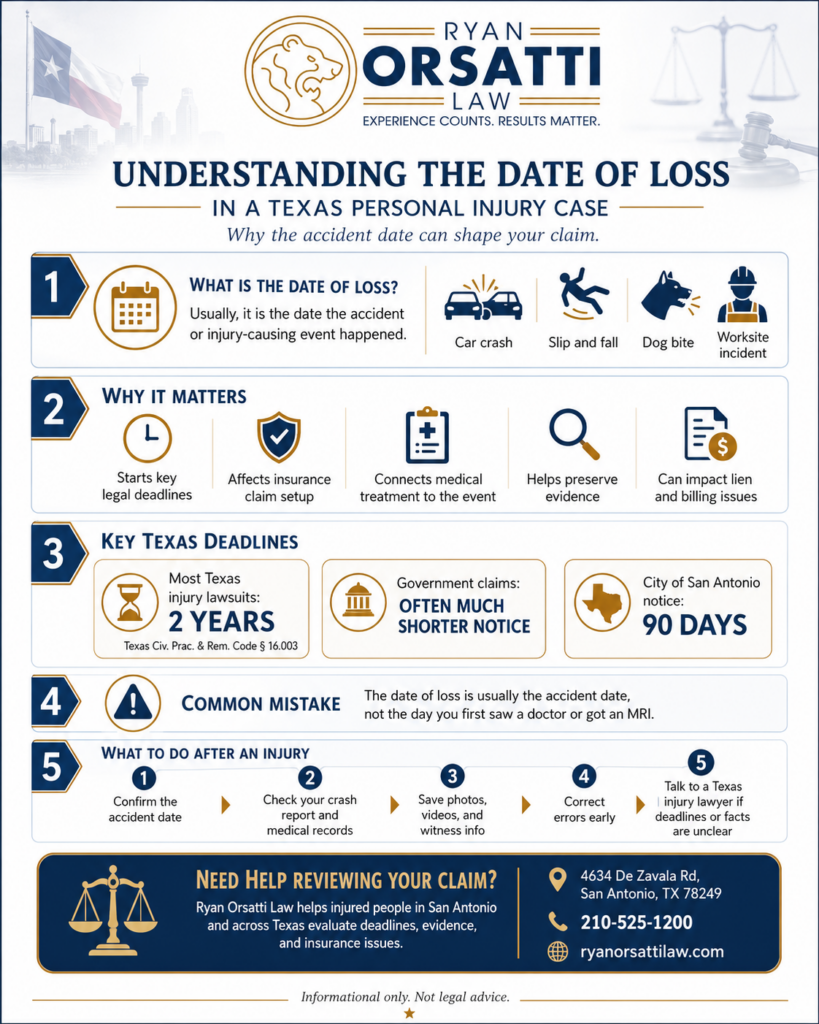
The date of loss in a Texas personal injury case is usually the day the accident or injury-causing event happened, such as the crash date, fall date, dog bite date, or worksite incident date. It matters because Texas deadlines, insurance claim setup, medical causation, hospital lien timing, and evidence preservation often run from that date. Under Texas Civil Practice and Remedies Code § 16.003, most Texas personal injury lawsuits must be filed within two years after the claim accrues, and Ryan Orsatti Law helps injured people in San Antonio and across Texas verify the correct date of loss before deadline and evidence problems grow. (Texas Statutes)
Key Takeaways
- The date of loss is usually the accident date, not the date you called insurance, hired a lawyer, or received a diagnosis.
- In most Texas injury cases, the two-year lawsuit deadline is tied to when the claim accrues, which is often the date of loss.
- Government claims can have much shorter notice deadlines. The Texas Tort Claims Act generally requires notice within six months, and the City of San Antonio notice page states a 90-day written notice requirement. (Texas Legislative Council)
- The date of loss affects medical causation, PIP, MedPay, UM/UIM, hospital liens, crash reports, and insurance coverage.
- If the wrong date appears in a medical record, claim form, or crash document, correct it early and preserve proof of the accurate date.
What does “date of loss” mean in a Texas personal injury case?
The date of loss means the date the injury-causing event happened. In a Texas car crash, it is normally the collision date; in a slip-and-fall case, it is normally the fall date; in a dog bite case, it is normally the bite date.
Insurance companies often abbreviate date of loss as “DOL.” Lawyers, adjusters, medical providers, billing departments, and lien holders use that date to connect the injury to a specific event. The date of loss is not always the same as the date you first felt severe pain, the date you went to the doctor, or the date an MRI confirmed the injury.
For example, if you were rear-ended on Loop 1604 on March 1 but did not get an MRI until April 10, the date of loss is usually March 1. The MRI date may help prove the injury, but it does not usually replace the accident date.
Why is the date of loss so important in a Texas injury claim?
The date of loss is important because it anchors deadlines, evidence, medical timelines, and insurance coverage. In Texas, a wrong date can create confusion about whether a claim was timely reported, whether treatment relates to the accident, whether a hospital lien applies, and whether a lawsuit was filed on time.
The date also matters because injury events are common and documentation must be specific. TxDOT reported that, based on reportable crashes in 2024, one reportable crash occurred every 57 seconds in Texas and 251,977 people were injured in motor vehicle traffic crashes. Those statistics come from TxDOT’s Texas Motor Vehicle Traffic Crash Facts, which are based on Texas Peace Officer’s Crash Reports, also called CR-3 reports. (Texas Department of Transportation)
A clean date of loss helps your lawyer match the crash report, medical records, photos, witness statements, insurance claim number, repair estimate, and billing records to the same event.
Is the date of loss the same as the statute of limitations?
No. The date of loss is the factual date of the event, while the statute of limitations is the legal deadline to file a lawsuit. In many Texas accident cases, the date of loss starts the practical countdown, but the legal deadline depends on when the claim accrues and whether any special rule applies.
A statute of limitations is the deadline for filing suit in court. For many Texas personal injury cases, Texas Civil Practice and Remedies Code § 16.003 gives a two-year limitations period for personal injury and injury to property claims. Wrongful death claims are different because § 16.003(b) states that the cause of action accrues on the death of the injured person. (Texas Statutes)
That distinction matters. A person may be injured in a crash on one date and die later from those injuries. The injury claim, estate claim, and wrongful death claim may involve related facts, but the operative dates can differ.
What Texas deadlines can run from the date of loss?
Several Texas deadlines and claim triggers can run from the date of loss or from a closely related event date. The table below gives common examples, but every case should be reviewed individually because defendants, insurance policies, government entities, minors, death claims, and workplace injuries can change the analysis.
| Situation | Date that usually matters | Why it matters |
|---|---|---|
| Most Texas personal injury lawsuits | Date the claim accrues, often the date of loss | Most must be filed within two years under Texas Civil Practice and Remedies Code § 16.003. (Texas Statutes) |
| Texas wrongful death claim | Date of death | § 16.003(b) states the wrongful death cause of action accrues on the death of the injured person. (Justia Law) |
| Claim against a Texas governmental unit | Date of the incident | Texas Tort Claims Act notice is generally due within six months of the incident. (Texas Legislative Council) |
| Claim involving the City of San Antonio | Date death, injury, or property damage was sustained | The City’s notice page states written notice must be given within 90 days. (San Antonio Web App) |
| Texas workers’ compensation injury | Date hurt or date worker knew injury was work-related | TDI says injured employees generally must report the injury to the employer within 30 days and file DWC Form-041 within one year. (Texas Department of Insurance) |
| Hospital lien issue | Accident date and admission or emergency services timing | Texas Property Code § 55.002 ties lien attachment to hospital admission or emergency medical services within 72 hours after the accident, depending on the provider and county. (Texas Statutes) |
| Texas crash report | Collision date | Texas Transportation Code § 550.062 requires an officer’s collision report for qualifying crashes and says the report must be filed electronically with TxDOT by the 10th day after the collision. (Texas Statutes) |
Key takeaway: The date of loss is not just an insurance label. It can control legal deadlines, government notice, workers’ compensation reporting, hospital lien analysis, and the timing of key crash documents.
What if my symptoms started days or weeks after the accident?
Delayed symptoms do not usually change the date of loss. If the crash, fall, or incident happened on a specific day, that day is usually still the date of loss, even if pain, headaches, radiating symptoms, or diagnosis came later.
This issue comes up often in San Antonio crash cases. A person may feel “shaken up” after a collision on I-35, Loop 410, US-281, or Loop 1604, then notice worse pain after the adrenaline wears off. Delayed medical treatment does not automatically defeat a claim, but it gives the insurance company room to argue that something else caused the injury.
The discovery rule is a legal doctrine that can sometimes delay when a claim accrues if an injury or its cause could not reasonably have been discovered earlier. It is not automatic. In ordinary crash and fall cases where the incident was known, injured people should assume the date of loss matters immediately unless a Texas injury lawyer reviews the facts and says otherwise.
Attorney Insight: In a Texas crash claim, adjusters often compare the date of loss against first treatment, prior claims, pharmacy histories, and gaps in care. A three-week delay does not automatically defeat a claim, but it gives the insurer a simple causation argument. Clear medical history, early evaluation, and consistent documentation help keep the date from being used unfairly.
Can the date of loss be different from the date of death?
Yes. In a Texas wrongful death case, the date of death can be legally important even if the injury happened earlier. Texas Civil Practice and Remedies Code § 16.003(b) says the wrongful death cause of action accrues on the death of the injured person. (Justia Law)
This is one reason serious injury and fatal accident cases require careful date review. A survival claim is a claim that belongs to the injured person’s estate for harm suffered before death. A wrongful death claim belongs to certain surviving family members for their own losses caused by the death. The date of loss, date of death, medical timeline, and estate documents may all matter.
Ryan Orsatti Law handles San Antonio wrongful death claims and reviews these dates early because a missed deadline, unclear medical timeline, or delayed evidence request can create avoidable disputes.
What documents should show the date of loss?
The date of loss should appear consistently across the crash report, medical records, insurance claim, billing records, photos, and witness documentation. If the dates do not match, the inconsistency should be corrected or explained before an adjuster uses it to challenge the claim.
Use this checklist after an accident:
- Crash report or incident report: For Texas car crashes, request the Texas Peace Officer’s Crash Report, also called a CR-3, when available through TxDOT. TxDOT states that a regular copy costs $6 and a certified copy costs $8. (Texas Department of Transportation)
- Medical intake records: Make sure the accident date, location, and mechanism of injury are accurate.
- Photos and videos: Save originals because metadata may help confirm timing.
- 911 records and police call slip: These can help confirm the time and location of the event.
- Insurance claim documents: Save the claim number, assigned adjuster, and date reported.
- Employer report if you were working: If the injury happened on the job, preserve the employer report and any DWC paperwork.
- Bills and lien notices: Check whether hospital, ambulance, or emergency provider records list the correct accident date.
- Text messages and calendar entries: Save communications that show where you were, when the incident happened, and what symptoms started afterward.
- Witness names and contact information: Memories fade quickly, especially after busy traffic crashes in Bexar County.
A lawyer can compare these documents and identify conflicts before they become larger claim problems.
How do insurance companies use the date of loss?
Insurance companies use the date of loss to decide coverage, causation, claim timing, and whether your medical treatment appears connected to the accident. The date helps the insurer determine which policy was active, which adjuster handles the claim, whether PIP or MedPay may apply, and whether treatment occurred close enough in time to support causation.
PIP means personal injury protection. It is auto insurance coverage that can pay medical bills and certain other losses regardless of fault. The Texas Department of Insurance states that all Texas auto policies include PIP unless the insured rejects it in writing, and TDI also explains that uninsured and underinsured motorist coverage must be offered. (Texas Department of Insurance)
MedPay means medical payments coverage. It usually pays medical bills without deciding who caused the crash, but it is different from PIP. UM/UIM means uninsured or underinsured motorist coverage, which can apply when the at-fault driver has no insurance or not enough insurance.
The date of loss helps determine whether those coverages were in force and whether the bills relate to the covered event.
What if the date of loss is wrong on an insurance claim or medical record?
If the date of loss is wrong, correct it as soon as possible in writing. A wrong date can create coverage issues, medical causation disputes, billing delays, lien confusion, and statute of limitations problems.
Do not guess at the date just to complete an online form. If you are unsure, say you are confirming the exact date and preserve supporting documents. If a provider records the wrong date, ask the provider’s office how to submit a correction or addendum. If an insurance adjuster opens the claim under the wrong date, send a short written correction and keep a copy.
A clean correction should usually include:
- The wrong date listed.
- The correct date of loss.
- The source supporting the correct date, such as a crash report, photo timestamp, police call record, medical note, or insurance email.
- A request that the claim file, medical bill, or intake record be updated.
When should a San Antonio personal injury lawyer review the date of loss?
A San Antonio personal injury lawyer should review the date of loss early when there are injuries, medical treatment, disputed fault, delayed symptoms, government involvement, commercial vehicles, workplace facts, minors, death, or more than one accident. Early review helps identify short deadlines and preserve evidence before records disappear.
This is especially important in cases involving city vehicles, VIA buses, road defects, police or emergency response vehicles, construction zones, trucking companies, rideshare vehicles, or serious injuries. Government notice, commercial insurance, event data recorders, surveillance video, and medical documentation can all be time-sensitive.
Ryan Orsatti Law helps injured people in San Antonio, Bexar County, and across Texas evaluate date-of-loss issues in car crash, truck accident, motorcycle, premises, workplace-related third-party, catastrophic injury, and wrongful death cases. The firm’s role is practical: identify the correct date, preserve evidence, review insurance coverage, track deadlines, and help the client avoid preventable claim mistakes.
How does Ryan Orsatti Law use the date of loss to evaluate a claim?
Ryan Orsatti Law uses the date of loss as the starting point for a structured injury claim review. That review typically includes the incident date, treatment timeline, police or incident documentation, insurance coverage, responsible parties, lien issues, prior and later medical history, and any urgent deadline.
The goal is not to rush a demand before the facts are ready. It is to make sure the claim is protected while the medical picture develops. In many cases, the firm reviews whether the date of loss triggers government notice, PIP or MedPay benefits, UM/UIM issues, preservation letters, repair documentation, hospital lien review, or early witness follow-up.
For more on Texas injury deadlines, see Ryan Orsatti Law’s guide to Texas statute of limitations exceptions. To ask about a specific accident date or claim deadline, you can contact Ryan Orsatti Law.
FAQ
Is the date of loss the accident date or the date I first went to the doctor?
The date of loss is usually the accident date, not the first doctor visit. If you were hit on March 1 and went to urgent care on March 3, March 1 is usually the date of loss. The treatment date still matters because insurers use it to evaluate whether your symptoms and medical care connect to the accident.
Does the two-year Texas deadline always run from the date of loss?
Not always, but in many accident cases the date of loss is the practical starting point. Texas Civil Practice and Remedies Code § 16.003 generally gives two years after the claim accrues for many personal injury claims. Minors, wrongful death, government claims, hidden injuries, and other special facts can change the analysis, so the date should be reviewed early.
What if I do not know the exact date of my injury?
If you do not know the exact date, do not guess without checking records. Look for texts, photos, calendar entries, work schedules, medical intake forms, police reports, receipts, or insurance emails. For repeated exposure or unclear injury timing, a lawyer may need to analyze when the injury occurred, when it was discovered, and what deadlines apply.
Can an insurance company deny a claim because the date of loss is wrong?
A wrong date of loss can cause an insurer to delay, dispute, or deny parts of a claim, especially if the mistake affects coverage, policy period, causation, or claim reporting. The mistake should be corrected in writing as soon as possible. Keep proof of the correct date and ask that the claim file or record be updated.
How does the date of loss affect a San Antonio claim against the city?
A claim involving the City of San Antonio can involve a much shorter notice deadline than the ordinary two-year lawsuit deadline. The City’s notice page states that written notice of death, injury, or property damage must be given within 90 days after it was sustained. Government claims should be reviewed quickly because notice rules can be case-specific.
Does the date of loss matter if my injury got worse over time?
Yes. The date of loss still matters even if the injury worsened over time. The later worsening may affect damages, treatment planning, impairment, and medical proof, but the original event date usually remains central to deadlines and causation. Medical records should clearly explain how symptoms developed from the accident to later diagnosis or treatment.
Ryan Orsatti Law
4634 De Zavala Rd, San Antonio, TX 78249
Phone: 210-525-1200
ryanorsattilaw.com
This blog is for informational purposes only, not legal advice. Reading it does not create an attorney-client relationship. Past results do not guarantee future results.
Hurt in an accident in San Antonio? Learn how a San Antonio car accident lawyer can help with your claim. Call 210-525-1200 or request a free consultation.
The firm works on a contingency fee. You pay nothing unless the firm recovers money for you, and that covers case expenses as well as the fee: if there is no recovery, you owe no attorney's fee and no case expenses. Ask for the fee agreement and read the fee and expense section before you sign anything.
Related San Antonio legal resources
Primary legal and public-data sources
- TxDOT: Texas crash reports, data, and statistics
- Texas Civil Practice and Remedies Code Chapter 33: proportionate responsibility
Ryan Orsatti Law
4634 De Zavala Road, San Antonio, TX 78249
General reference links. Consult each source for its current text.