
Quick Answer
The safest answer is: law enforcement first, then a trained truck-crash investigator, attorney-hired photographer, or reconstruction professional as soon as access is legally available. An injured person or family member should not climb into the truck’s cab, sleeper berth, or dashboard area at the scene.
Interior truck photos matter because they can show the ELD device, dashboard warnings, loose objects, food or drink containers, phone mounts, sleeper berth condition, and signs of driver distraction or fatigue before the truck is moved, cleaned, repaired, or inspected by the trucking company.
Key Takeaways
- The injured person should photograph only from a safe, lawful location and should not enter the truck.
- Police, DPS troopers, or crash investigators may document the truck at the scene, but their photos may not capture every detail needed for a civil injury claim.
- A lawyer should quickly send a preservation letter asking the trucking company, tow yard, insurer, and any maintenance vendor to preserve the truck, ELD data, dash camera footage, ECM data, driver logs, inspection records, and scene photographs.
- The ELD device itself should be photographed, but no one should unplug, move, reset, or manipulate it without legal authority and proper forensic handling.
- In Bexar County, TxDOT reported 2,684 commercial motor vehicle involved crashes in 2024, including 18 fatal crashes and 34 suspected serious injury crashes, according to TxDOT’s 2024 CMV crash report by county.
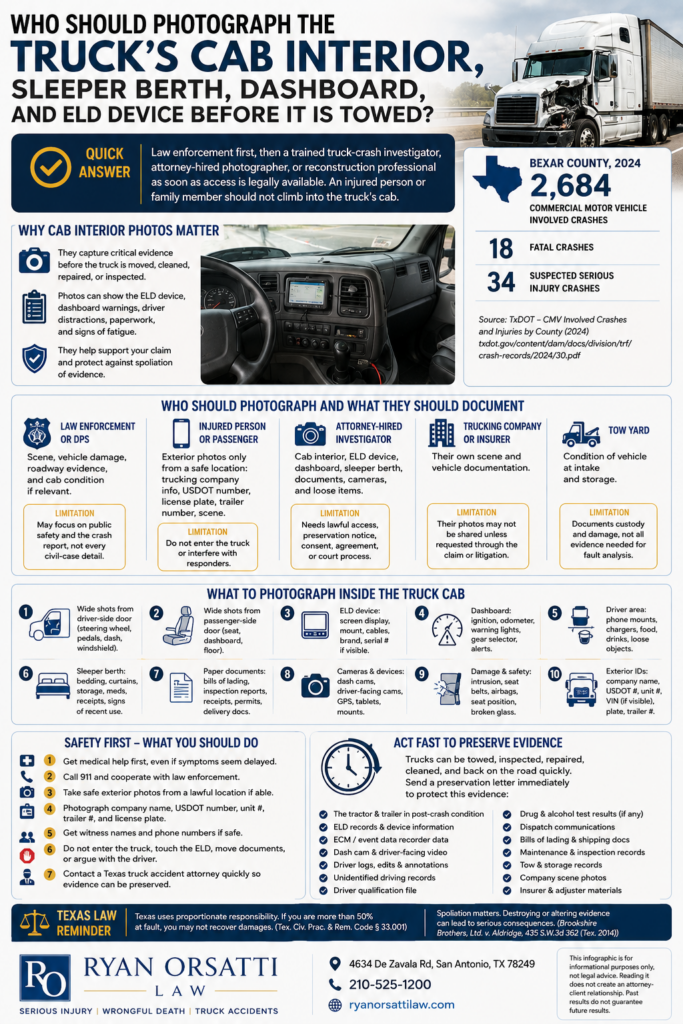
Who should photograph the truck cab before it is towed?
The truck cab should be photographed by law enforcement at the scene when possible, and then by a qualified investigator or photographer working for the injured person’s attorney as soon as lawful access can be obtained. The injured person should focus on safety, medical care, and basic exterior photos from a safe place.
A serious truck crash on I-35, I-10, Loop 410, Loop 1604, US-281, or another San Antonio corridor can turn chaotic within minutes. EMS is treating injuries. Police are trying to reopen lanes. The tow operator is waiting to clear the tractor and trailer. The trucking company may already be contacting its driver, insurer, safety department, and response team.
That is why the cab interior matters. Once the tractor is towed, evidence can change. The driver may remove personal items. The company may download or review electronic data. The vehicle may be stored in a tow yard, moved to a terminal, inspected, repaired, or cleaned. Photos taken before those changes can become a neutral record of what the cab looked like immediately after the crash.
A safe order of priority usually looks like this:
| Person or group | What they should photograph | Main limitation |
|---|---|---|
| Law enforcement or DPS | Scene position, vehicle damage, roadway evidence, cab condition if relevant | They may focus on the crash report and public safety, not every civil-case detail |
| Injured person or passenger | Exterior photos from a safe location, license plate, USDOT number, company markings, trailer number | Should not enter the truck or interfere with responders |
| Attorney-hired investigator | Cab interior, ELD device, dashboard, sleeper berth, driver area, visible paperwork, camera systems | Needs lawful access, preservation notice, consent, agreement, or court process |
| Trucking company or insurer | Their own scene and vehicle documentation | Their photos may not be shared unless requested through the claim or litigation process |
| Tow yard | Condition of vehicle at intake and storage | Usually documents custody and damage, not all evidence needed for fault analysis |
For more on the broader investigation process, see Ryan Orsatti Law’s guide to San Antonio truck accident claims and the firm’s discussion of black box data and electronic logging devices in 18-wheeler cases.
Why are cab interior photos so important after an 18-wheeler crash?
Cab interior photos are important because they can show whether the truck driver was distracted, fatigued, out of compliance, or operating with warning signs before impact. They also preserve physical context that electronic records alone may not explain.
The Federal Motor Carrier Safety Administration’s ELD rules matter here. Under 49 C.F.R. Part 395, Subpart B, many commercial drivers must use electronic logging devices to record hours-of-service information. The ELD can record date, time, location, engine hours, vehicle miles, driver identification data, vehicle identification data, and motor carrier identification data.
That does not mean a crash victim can simply take the device or download the data at the scene. It means the device, its mounting location, its screen, its connection, and its surrounding dashboard area should be documented before anyone changes the condition of the cab.
A cab photo can help answer practical questions:
- Was the ELD mounted where the driver could see it?
- Was the driver logged in?
- Was the device showing a malfunction, unidentified driving time, or a duty status issue?
- Were there paper logs, bills of lading, fuel receipts, inspection forms, or delivery documents visible?
- Were there phones, tablets, headsets, food containers, drink bottles, or other distraction indicators near the driver?
- Was the sleeper berth being used, and did it appear consistent with the driver’s claimed rest period?
- Were dashboard warning lights, airbag indicators, brake warnings, or safety system alerts visible?
- Was there a forward-facing or driver-facing camera, and where was it pointed?
A photo of the ELD device is not the same thing as a forensic download. The photo preserves what was visible. The data itself should be preserved through a formal legal process, including a preservation letter, requests for production, subpoenas where appropriate, inspection agreements, or court orders.
What should be photographed inside the truck cab?
The truck cab should be photographed in a systematic way: wide shots first, then dashboard, ELD, driver area, passenger area, sleeper berth, visible documents, camera systems, and any loose items that may relate to distraction, fatigue, or equipment condition.
A good truck-cab photo set usually includes:
- Wide photos from the driver-side door showing the steering wheel, seat, pedals, dash, windshield, and floorboard.
- Wide photos from the passenger-side door showing the passenger seat, center console, dashboard, and floor.
- Close photos of the ELD device, including screen display, mount, cables, brand, serial number if visible, and connection point.
- Photos of the dashboard with ignition position, odometer, warning lights, gear selector, brake controls, and any displayed alerts.
- Photos of the steering wheel, hand controls, cup holders, phone mounts, chargers, headsets, food, drinks, and loose objects.
- Photos of the sleeper berth, bedding, curtains, storage compartments, medication bottles, receipts, bags, and visible signs of recent use.
- Photos of paper documents such as bills of lading, inspection reports, trip sheets, permits, fuel receipts, toll receipts, and delivery paperwork, without disturbing them.
- Photos of dash cameras, driver-facing cameras, GPS units, tablets, dispatch devices, and camera mounts.
- Photos showing damage intrusion into the cab, seat belt condition, airbag deployment, seat position, and broken glass.
- Photos of the tractor’s exterior identifying information, including company name, USDOT number, unit number, VIN plate if lawfully visible, license plate, and trailer number.
In truck crash matters, the most useful interior photographs are often plain, boring, and methodical. A close photo of an ELD screen, a loose phone by the pedals, a sleeper berth that appears unused, or a dash warning light may matter more than a dramatic image of crushed metal.
Should the injured person take photos of the cab interior?
The injured person should not enter the truck cab, open compartments, touch the ELD, move papers, or interfere with the driver, police, EMS, fire crews, or tow operators. If the person can safely do so from a lawful location, exterior photos of the truck are usually safer and still useful.
After a crash, your first job is medical safety. If you are injured, disoriented, bleeding, dizzy, or in pain, let EMS evaluate you. Do not walk into traffic lanes on I-35, Loop 410, Loop 1604, or any shoulder where traffic is still moving.
Safe photos may include:
- The truck’s company name.
- The USDOT number.
- The license plate.
- The trailer number.
- The crash scene from a safe distance.
- Skid marks, debris, gouges, cargo spill, or final resting positions.
- The other driver, witnesses, responding agencies, and tow company name if visible.
- Your own vehicle before it is towed.
Do not photograph private documents by reaching into the truck. Do not take the driver’s paperwork. Do not unplug a dash camera or ELD. Do not climb into the sleeper berth. Those actions can create safety risks, evidence disputes, trespass issues, and admissibility fights.
What does the ELD rule have to do with scene photographs?
The ELD rule matters because the device can connect the visible cab condition to the driver’s official hours-of-service record. Under 49 C.F.R. § 395.24, a driver must produce and transfer ELD hours-of-service records to an authorized safety official on request.
For property-carrying drivers, federal hours-of-service rules generally include an 11-hour driving limit after 10 consecutive hours off duty and a 14-hour driving window after coming on duty, as summarized by FMCSA’s hours-of-service regulations. Those rules are often central in fatigue investigations.
The ELD can help show time, location, engine hours, vehicle miles, duty status, login activity, power-up events, and other required data. But a photo adds something different. It shows what the device looked like in the cab at the scene. It may also show whether the device was mounted, visible, powered, damaged, disconnected, or paired with other dashboard technology.
Under 49 C.F.R. § 395.8(k), motor carriers must retain records of duty status and supporting documents for at least six months. That retention rule is not a reason to wait. It is a reason to send preservation demands quickly, because related evidence such as camera footage, dispatch messages, repair records, and scene photos may follow different retention practices.
How fast should a lawyer act to preserve truck cab and ELD evidence?
A lawyer should act as soon as possible, preferably within hours or days, because the truck may be towed, inspected, repaired, cleaned, or returned to service quickly. The first legal step is usually a preservation letter, which is a written demand that relevant evidence not be destroyed, altered, overwritten, repaired, or discarded.
Texas courts treat spoliation as an evidence issue. In Brookshire Brothers, Ltd. v. Aldridge, the Supreme Court of Texas explained that a trial court decides whether a party had a duty to preserve evidence and whether that duty was breached. In plain English, spoliation means the loss, destruction, or material alteration of evidence when a party should have preserved it.
A truck-cab preservation letter should usually demand preservation of:
- The tractor and trailer in their post-crash condition.
- Cab interior photographs.
- ELD records and the ELD device information.
- ECM or event data recorder information.
- Dash camera and driver-facing camera video.
- Driver logs, annotations, and edits.
- Unidentified driving records.
- Driver qualification file.
- Post-crash drug and alcohol testing records, if applicable.
- Dispatch communications.
- Bills of lading and shipping documents.
- Maintenance, inspection, and repair records.
- Tow records and storage records.
- Company scene investigation photos.
- Insurer, adjuster, and rapid-response photographs.
The timing matters because Texas personal injury cases are also subject to filing deadlines. Under Texas Civil Practice & Remedies Code § 16.003, many personal injury and wrongful death claims must be filed within two years, but evidence preservation cannot wait two years.
How can cab photos affect fault disputes in Texas?
Cab photos can affect fault disputes because Texas uses proportionate responsibility, which means fault can be divided among the parties. Under Texas Civil Practice & Remedies Code § 33.001, a claimant may not recover damages if the claimant’s percentage of responsibility is greater than 50 percent.
That rule makes evidence preservation practical, not academic. If the trucking company argues that the injured driver cut off the truck, stopped suddenly, failed to keep a lookout, or caused the crash, cab evidence may help test that defense. A driver’s ELD status, dashboard warnings, phone placement, camera system, and sleeper berth condition can all become part of the fault analysis.
Cab photos can also help identify other responsible parties. A crash may involve the driver, motor carrier, broker, maintenance company, cargo loader, equipment owner, trailer owner, or another vehicle. For related liability issues, see Ryan Orsatti Law’s guide on when the trucking company may be liable after a truck accident in Texas.
What should happen before the truck leaves the scene or tow yard?
Before the truck leaves the scene or tow yard, the key goal is to identify, preserve, and document evidence without creating safety risks or legal problems. Not every case allows a full cab inspection at the roadside, but fast preservation can prevent avoidable evidence loss.
After a truck crash, do these 7 things
- Get medical help first, even if symptoms seem delayed.
- Call 911 and cooperate with law enforcement.
- Take safe exterior photos from a lawful location if you are able.
- Photograph the truck’s company name, USDOT number, unit number, trailer number, and license plate if visible.
- Get witness names and phone numbers if it is safe to do so.
- Do not enter the truck cab, touch the ELD, move documents, or argue with the truck driver.
- Contact a Texas truck accident attorney quickly so preservation letters and inspection requests can be sent before the vehicle condition changes.
Attorney Insight: In serious 18-wheeler cases, the defense often has access to the truck, driver, insurer, safety department, and electronic systems before the injured person even leaves the emergency room. The most practical move is not for the client to investigate the cab personally. It is to preserve the truck and demand a controlled inspection before the cab is cleaned, repaired, or put back in service.
How does this play out in San Antonio and Bexar County truck crashes?
In San Antonio and Bexar County truck crashes, the practical problem is speed: major corridors need to be cleared, and commercial trucks are expensive assets that companies want back in service. That is why evidence preservation should start quickly after crashes on I-35, I-10, Loop 410, Loop 1604, US-281, and major freight routes.
TxDOT’s 2024 county data shows why this issue matters locally. Bexar County had 2,684 commercial motor vehicle involved crashes in 2024, including 18 fatal crashes and 34 suspected serious injury crashes, according to TxDOT’s CMV involved crashes and injuries by county report. Those numbers place Bexar County among the major Texas counties for commercial vehicle crash volume.
For more local context, Ryan Orsatti Law has also published a data-focused guide to truck accident trends in San Antonio and a broader resource for commercial vehicle accident cases in San Antonio.
FAQ
Can I photograph the inside of the truck cab myself after an 18-wheeler crash?
Usually, you should not photograph the truck cab interior yourself unless you can do so safely from outside the vehicle and without touching anything. Do not climb into the cab, open doors, move papers, or handle the ELD device. Focus on medical care, safe exterior photos, and identifying information such as company name, USDOT number, plate, and trailer number.
What is an ELD in a truck accident case?
An ELD, or electronic logging device, records a commercial driver’s hours-of-service information. Under FMCSA rules, ELDs can record data such as time, location, engine hours, vehicle miles, driver identification, vehicle identification, and motor carrier identification. In a crash case, ELD evidence may help evaluate fatigue, route, timing, and duty status.
Should police photograph the sleeper berth after a truck crash?
Police or DPS may photograph the sleeper berth if it appears relevant to the crash investigation, but they may not document every detail needed for a civil injury claim. A sleeper berth can matter when fatigue, rest periods, team driving, or hours-of-service compliance is disputed. A lawyer may later request inspection access and related records.
What if the trucking company tows the truck before anyone photographs the cab?
If the truck is towed before cab photos are taken, the next step is to preserve the vehicle, identify the tow yard, and request inspection access quickly. A preservation letter should tell the motor carrier, insurer, tow yard, and repair facility not to clean, repair, alter, move, download, overwrite, or discard relevant evidence.
Can the trucking company delete ELD data after a crash?
A motor carrier has federal record-retention duties for driver records of duty status and supporting documents, but related data can still become difficult to obtain if preservation is delayed. The safer approach is to send a preservation letter immediately requesting ELD records, edits, annotations, unidentified driving events, dispatch records, camera footage, and any internal investigation materials.
Why does the dashboard matter in a truck accident investigation?
The dashboard can show warning lights, odometer readings, brake system alerts, ELD placement, camera systems, GPS units, phone mounts, and other evidence tied to driver conduct or vehicle condition. A clean ELD download may not show how the cab physically looked at the scene. Photos help connect electronic data to real-world context.
Do cab interior photos prove the truck driver was at fault?
Cab interior photos do not prove fault by themselves. They are one piece of the evidence picture. They may support or challenge claims involving distraction, fatigue, equipment issues, hours-of-service violations, or post-crash changes. Fault in Texas truck cases depends on the full record, including witnesses, electronic data, scene evidence, medical evidence, and applicable law.
How soon should I contact a lawyer after a truck crash in San Antonio?
You should contact a lawyer as soon as practical after getting medical care, especially if an 18-wheeler or commercial vehicle caused serious injury. Early legal action can help preserve the truck, ELD data, dash camera footage, driver logs, dispatch records, and tow yard evidence before the vehicle is repaired, cleaned, moved, or returned to service.
Ryan Orsatti Law
4634 De Zavala Rd, San Antonio, TX 78249
Phone: 210-525-1200
ryanorsattilaw.com
This blog is for informational purposes only, not legal advice. Reading it does not create an attorney-client relationship. Past results do not guarantee future results.
Hurt in an accident in San Antonio? Learn how a San Antonio personal injury lawyer can help with your claim. Call 210-525-1200 or request a free consultation.
The firm works on a contingency fee. You pay nothing unless the firm recovers money for you, and that covers case expenses as well as the fee: if there is no recovery, you owe no attorney's fee and no case expenses. Ask for the fee agreement and read the fee and expense section before you sign anything.
Related San Antonio legal resources
Primary legal and public-data sources
- Texas Civil Practice and Remedies Code Chapter 16: limitations
- Texas Civil Practice and Remedies Code Chapter 33: proportionate responsibility
Ryan Orsatti Law
4634 De Zavala Road, San Antonio, TX 78249
General reference links. Consult each source for its current text.