
Quick Answer
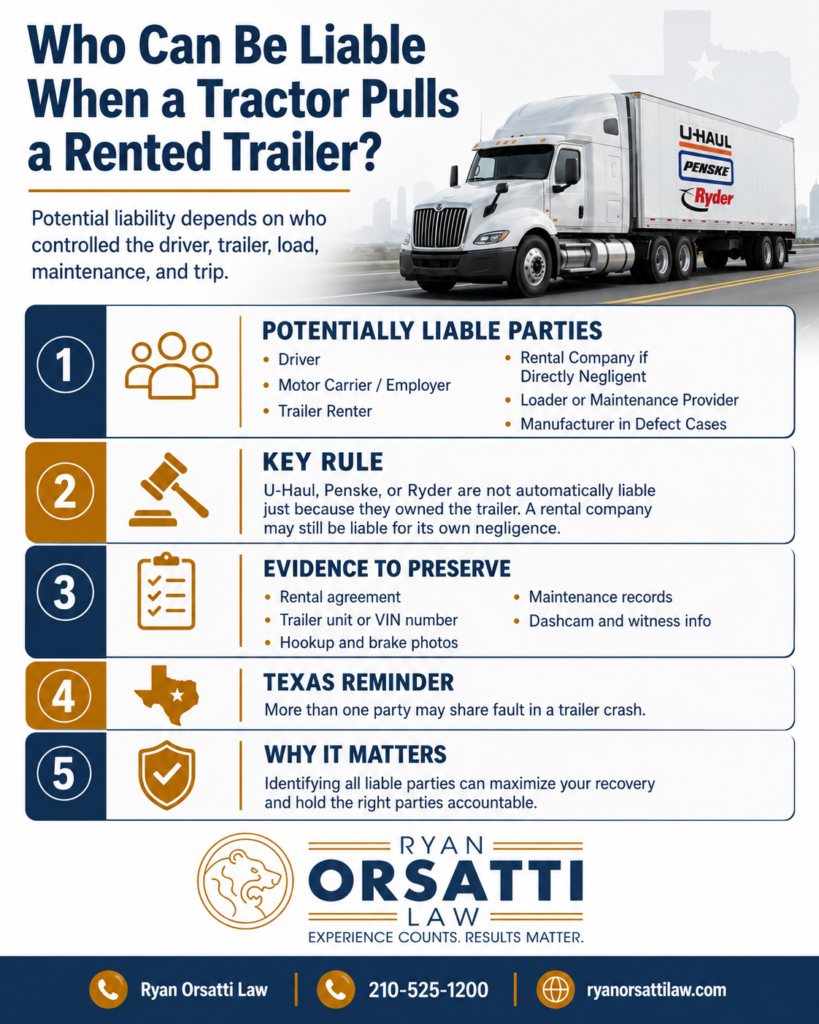
If the tractor was pulling a rented U-Haul, Penske, or Ryder trailer, potential liability usually starts with the negligent driver and may extend to the trucking company, employer, tractor owner, trailer renter, loader, maintenance provider, or trailer manufacturer. The rental company is not automatically liable just because it owned the trailer. The federal Graves Amendment, 49 U.S.C. § 30106, generally blocks ownership-only claims against rental and leasing companies, but it does not protect them from claims based on their own negligence. (U.S. Code)
Key Takeaways
- A rented trailer changes the investigation because different companies may control the tractor, trailer, driver, cargo, maintenance, and route.
- U-Haul, Penske, Ryder, or another rental company is usually not liable just because its name was on the trailer, but it can still be liable for its own unsafe conduct.
- In a commercial motor vehicle case, FMCSA inspection and maintenance rules can become central evidence.
- Texas proportionate responsibility rules can divide fault among multiple parties, including a driver, motor carrier, trailer renter, loader, mechanic, or responsible third party.
- Preserve the rental agreement, trailer VIN or unit number, hookup photos, safety-chain evidence, brake connections, maintenance records, dispatch records, ELD data, dashcam video, and witness information quickly.
Why does a rented trailer change liability after a tractor-trailer crash?
A rented trailer changes liability because the tractor, trailer, driver, renter, motor carrier, cargo loader, and maintenance provider may each have controlled a different safety decision before the crash. In a normal two-car wreck, the main question may be who violated the rules of the road. In a tractor-and-rented-trailer crash, the better question is: who had the duty and ability to prevent the dangerous condition?
This matters in San Antonio and across Texas because trailer-involved crashes are not rare. TxDOT’s 2024 Trailer Involved Crashes and Injuries report recorded 42,146 trailer-involved crashes in Texas, including 486 fatal crashes and 1,257 suspected serious-injury crashes.
For this article, “tractor” means the power unit pulling the trailer. “Negligence” means failing to use reasonable care under the circumstances. “Vicarious liability” means one party may be legally responsible for another person’s negligence, such as an employer being responsible for an employee acting within the course and scope of employment.
Who is potentially liable if the tractor was pulling a rented U-Haul, Penske, or Ryder trailer?
Potentially liable parties may include the driver, the driver’s employer, the motor carrier, the tractor owner, the trailer renter, the rental company, the loader, a maintenance vendor, or a product manufacturer, depending on what caused the crash. The name on the trailer is only one clue. It is not the whole case.
| Potential party | Why that party may matter | Evidence to preserve |
|---|---|---|
| Tractor driver | Unsafe speed, distraction, fatigue, bad lane change, following too closely, poor inspection, or improper hookup | Crash report, phone records, dashcam, driver statement, photos, citations, driver inspection records |
| Employer or motor carrier | Driver was working, dispatch pressured the trip, company failed to train, supervise, maintain, or inspect | USDOT number, driver file, ELD data, dispatch records, trip sheets, maintenance files |
| Tractor owner or lessor | Tractor maintenance, brake defects, tire problems, improper equipment, or unsafe condition | Tractor title, lease, repair records, inspection records, ECM data |
| Trailer renter | Chose the trailer, overloaded it, loaded it incorrectly, failed to inspect it, or allowed an unsafe operator to use it | Rental contract, receipt, loading photos, weight tickets, communications |
| U-Haul, Penske, Ryder, or rental affiliate | Direct negligence, such as unsafe maintenance, defective equipment, improper hookup assistance, or negligent rental process | Trailer maintenance records, inspection records, employee notes, photos, recall history |
| Loader, shipper, or jobsite | Improper cargo securement, bad weight distribution, excess weight, or unsafe loading instructions | Bills of lading, scale tickets, load photos, forklift records, witness statements |
| Maintenance shop or hitch installer | Faulty repair, wrong hitch, bad brake controller, defective coupler, unsafe tires, or bad wiring | Invoices, parts records, work orders, inspection photos |
| Manufacturer or parts seller | Defective trailer component, tire, coupler, brake system, lighting system, or hitch part | Trailer component photos, recall research, expert inspection, preserved parts |
| Another driver | Unsafe maneuver that caused the tractor to brake, swerve, jackknife, or lose the trailer | Video, witness statements, crash reconstruction evidence |
Texas law recognizes that an employer may be vicariously liable for an employee’s negligent acts when the employee is acting in the course and scope of employment. The Texas Supreme Court has described that inquiry as requiring evidence that the worker was an employee and was acting within the general authority given by the employer, in furtherance of the employer’s business, and for the object for which the employee was hired. (Texas Courts)
Can you sue U-Haul, Penske, or Ryder just because they owned the trailer?
Usually, no, you generally cannot sue a rental company just because it owned the rented trailer. The federal Graves Amendment, 49 U.S.C. § 30106, protects an owner engaged in the business of renting or leasing motor vehicles from liability based only on ownership, so long as there is no negligence or criminal wrongdoing by the owner. (U.S. Code)
Under 49 U.S.C. § 30106, a U-Haul, Penske, Ryder, or similar rental company is usually protected from ownership-only liability when it rented or leased a highway trailer and did not commit negligence or criminal wrongdoing. The same statute leaves room for claims based on the rental company’s own unsafe conduct.
That distinction is critical. A rented trailer may fall within federal motor-vehicle concepts because federal law defines a motor vehicle as a vehicle driven or drawn by mechanical power and manufactured primarily for public road use. (U.S. Code) But the Graves Amendment is not a blanket immunity rule for everything a rental company does. It addresses ownership-only liability. Direct negligence is different.
When can the rental company still be liable for its own negligence?
The rental company can still be a potential defendant when evidence shows its own conduct helped cause the crash. The strongest rental-company claims usually focus on what the company did or failed to do before the trailer left the lot.
Examples may include:
- Renting out a trailer with unsafe brakes, tires, lights, wiring, coupler, hitch components, or safety equipment.
- Failing to follow its own inspection or maintenance procedures.
- Providing the wrong hitch equipment or allowing an unsafe hookup.
- Having an employee assist with a bad trailer connection.
- Renting equipment despite known defects, repeated complaints, or unresolved repair issues.
- Failing to give necessary warnings or instructions about loading, braking, tongue weight, or trailer sway.
- Entrusting the trailer to someone the company knew or should have known was unsafe, depending on the facts.
Negligent entrustment is a fact-specific Texas claim. The Texas Supreme Court has described negligent entrustment elements as including entrustment of a vehicle, an unlicensed, incompetent, or reckless operator, knowledge or reason to know of that condition, negligence by the operator, and proximate cause. (Texas Courts)
What if the tractor was a commercial motor vehicle?
If the tractor was operating as a commercial motor vehicle, FMCSA rules can make inspection, maintenance, driver qualification, and motor-carrier control central to liability. The case may involve more than the rental receipt. It may involve driver logs, ELD data, maintenance files, annual inspection proof, dispatch instructions, and motor-carrier safety policies.
Federal regulation 49 C.F.R. § 396.3 requires motor carriers and intermodal equipment providers to systematically inspect, repair, and maintain vehicles subject to their control. The rule also requires records identifying the vehicle, the person furnishing it, inspection and maintenance due dates, and inspection, repair, and maintenance history. (eCFR)
Federal regulation 49 C.F.R. § 396.17 requires commercial motor vehicles, including combination vehicles such as a tractor and trailer, to pass periodic inspection at least once during the preceding 12 months, with documentation kept on the vehicle. (eCFR)
In a commercial tractor-and-rented-trailer case, the key question is not only who owned the trailer. The stronger question is who controlled safety before the trip: who inspected the coupler, brakes, tires, lights, load, maintenance records, driver qualifications, and dispatch instructions.
FMCSA rules also place safety responsibility on the driver before operation. Under 49 C.F.R. § 396.13, a driver must be satisfied that the motor vehicle is in safe operating condition before driving. Under 49 C.F.R. § 392.7, a commercial motor vehicle cannot be driven unless the driver is satisfied that listed parts and accessories, including service brakes, trailer brake connections, tires, coupling devices, wheels and rims, and emergency equipment, are in good working order. (eCFR)
What if the trailer detached, jackknifed, swayed, or shed cargo?
Trailer detachment, jackknife, sway, and cargo-loss cases usually turn on the physical mechanics of the connection and load. A jury may need to know whether the trailer was properly coupled, whether the load was balanced, whether the brakes worked, whether the trailer tires were safe, and whether the driver had warning signs before the crash.
Key physical evidence may include:
- Coupler, kingpin, fifth wheel, hitch ball, or pintle-hook condition.
- Safety chains or breakaway cable, when applicable.
- Trailer brake controller, electrical plug, brake lights, and turn signals.
- Tire tread, tire age, tire pressure, and blowout evidence.
- Load placement, cargo securement, and tongue weight.
- Skid marks, yaw marks, gouge marks, debris fields, and impact points.
- Trailer VIN, serial number, unit number, rental decals, and maintenance stickers.
- Dashcam, nearby business cameras, traffic cameras, and witness cellphone video.
For consumer-style trailers pulled by a passenger car or light truck, Texas Transportation Code § 545.410 addresses safety chains, with an exception for trailers operated in compliance with federal motor carrier safety regulations. (Texas Legislature Online) In a commercial tractor case, the details may look different, but the core safety question remains the same: was the connection safe before the trailer entered traffic?
After a trailer-detachment crash on I-35, I-10, Loop 410, Loop 1604, or US-281, the most important evidence may be gone quickly unless preservation letters are sent to the driver, motor carrier, rental company, maintenance vendor, and loader. Photos alone rarely prove who had control before departure.
How do Texas proportionate responsibility rules affect rented-trailer crashes?
Texas law allows fault to be divided among multiple people and entities, even when only one vehicle hit you. This matters because every defendant has an incentive to blame someone else: the driver blames the rental company, the rental company blames the renter, the renter blames the loader, and the motor carrier blames a maintenance shop.
“Proportionate responsibility” means a jury can assign percentages of fault. Under Texas Civil Practice & Remedies Code § 33.001, a claimant may not recover damages if the claimant’s percentage of responsibility is greater than 50 percent. (Texas Statutes) Under § 33.003, the trier of fact determines percentages of responsibility for the people and entities submitted. (Texas Statutes)
Texas Civil Practice & Remedies Code Chapter 33 matters in rented-trailer crashes because a defendant can try to place responsibility on a driver, motor carrier, trailer renter, loader, mechanic, or responsible third party. The injured person’s job is to build evidence before percentages are assigned.
A “responsible third party” is someone a defendant may try to blame even if that person is not formally sued as a defendant. Texas Civil Practice & Remedies Code § 33.004 allows a defendant to seek designation of a responsible third party by motion. (Texas Statutes) That can change settlement discussions, discovery strategy, and trial preparation.
What insurance may apply when the trailer was rented?
Several insurance layers may matter, but coverage depends on the rental contract, the tractor’s policy, the driver’s status, and whether a motor carrier was involved. Do not assume the rental company’s logo means its insurance is the only available coverage.
Possible insurance sources include:
- The tractor’s commercial auto policy.
- The motor carrier’s liability coverage.
- The driver’s personal auto policy, if this was not a commercial trip and the policy applies.
- Coverage purchased through the trailer rental agreement.
- The trailer owner’s liability or self-insurance program, if direct negligence or financial responsibility issues are present.
- Cargo or contractor coverage, depending on the trip.
- Uninsured or underinsured motorist coverage, called UM/UIM, if the responsible parties lack enough insurance and the injured person’s policy applies.
- Personal injury protection, called PIP, medical payments coverage, or health insurance, depending on the claimant’s own policies.
Insurance is only part of the analysis. Subrogation means a health insurer or benefit plan may claim repayment from a settlement. A hospital lien is a statutory claim a hospital may assert against certain injury recoveries if legal requirements are met. An ERISA plan is an employer-sponsored benefit plan that may have federal reimbursement language. These issues affect the net recovery, not just the gross settlement number.
After a crash with a tractor pulling a rented trailer, do these 7 things
After a crash with a tractor pulling a rented trailer, your first priority is medical care, then evidence preservation. The trailer may be returned, repaired, rented again, or moved out of Texas before anyone inspects it.
- Get medical care and report symptoms clearly. Neck pain, back pain, head symptoms, shoulder pain, numbness, dizziness, and anxiety should be documented early if they are present.
- Photograph the entire scene. Get the tractor, trailer, hitch or fifth wheel area, safety chains, brake connections, tires, lights, cargo, skid marks, debris, road signs, and final resting positions.
- Identify the driver, employer, and equipment. Capture the driver’s license, insurance card, USDOT number, company name, license plates, VINs, trailer unit number, and rental markings.
- Preserve rental and trip documents. Keep rental agreements, receipts, text messages, delivery documents, bills of lading, dispatch notes, jobsite records, and photos of what was being hauled.
- Avoid recorded statements that guess at fault. It is fine to report basic facts, but do not speculate about speed, distance, equipment condition, injury severity, or who you think is legally responsible.
- Send preservation letters quickly. The driver, motor carrier, rental company, maintenance provider, loader, shipper, and any nearby businesses with video may each need a written preservation request.
- Track bills, wage loss, and liens. Keep medical bills, insurance explanations of benefits, missed-work records, out-of-pocket receipts, PIP or MedPay documents, health-plan letters, and any hospital lien notices.
Attorney Insight
Attorney Insight: In rented-trailer cases, we do not start with a slogan like “the rental company is liable” or “the driver is liable.” We start with a control map: who selected the trailer, inspected it, hooked it, loaded it, dispatched the trip, maintained the brakes, and had the authority to stop the load before it entered I-35, I-10, Loop 410, Loop 1604, or US-281?
How long do you have to bring a Texas rented-trailer injury claim?
Most Texas personal injury claims must be filed within two years, but deadline analysis should happen immediately. Texas Civil Practice & Remedies Code § 16.003 provides a two-year limitations period for personal injury claims, subject to legal exceptions and case-specific issues. (Texas Statutes)
The court deadline is not the only deadline that matters. Video may be overwritten. Rental equipment may be put back into service. Maintenance records may be harder to obtain. Witness memories fade. If a government vehicle, public employee, public road defect, or government contractor is involved, shorter notice requirements may apply. Those issues should be checked early.
How Ryan Orsatti Law evaluates a San Antonio rented-trailer crash
Ryan Orsatti Law evaluates a rented-trailer crash by identifying every safety decision before the crash and every insurance layer after it. In San Antonio and Bexar County, that often means looking beyond the police report and building a timeline from trailer rental to hookup, loading, dispatch, route, crash, repairs, and post-crash communications.
A careful case review may include:
- Crash report and officer narrative.
- Scene photos and measurements.
- Trailer rental agreement and return documents.
- Tractor and trailer maintenance records.
- FMCSA inspection and driver qualification documents, when applicable.
- ELD, GPS, dashcam, ECM, or telematics data.
- Cargo records, weight tickets, and loading instructions.
- Insurance policies, reservations of rights, and coverage denials.
- Medical records, billing, subrogation claims, and lien issues.
For related information, see Ryan Orsatti Law’s pages on San Antonio truck accident claims, commercial vehicle accident cases, and car accident claims. You can also read more about when a trucking company may be liable after a Texas truck accident.
If you were injured in a crash involving a tractor pulling a rented U-Haul, Penske, Ryder, or similar trailer, you can contact Ryan Orsatti Law to discuss the facts, the evidence that needs to be preserved, and the potential liability issues.
FAQ
Can I sue U-Haul if its rented trailer hit me in Texas?
You may be able to sue U-Haul if evidence shows U-Haul’s own negligence helped cause the crash, such as unsafe maintenance, defective equipment, improper hookup assistance, or a negligent rental process. You generally cannot sue only because U-Haul owned the trailer, due to the Graves Amendment. (U.S. Code)
Is Penske or Ryder liable when a tractor pulls one of their trailers?
Penske or Ryder may be liable only if the facts support a valid legal theory, such as direct negligence, unsafe maintenance, negligent repair, defective equipment, or another company-specific failure. If the company merely rented or leased the trailer and did not act negligently, the Graves Amendment may block ownership-only liability.
Who pays if a rented trailer detaches from a truck?
Potentially responsible parties may include the driver, employer, motor carrier, trailer renter, rental company, maintenance provider, hitch installer, loader, or manufacturer. A detachment case usually requires inspection of the coupler, fifth wheel, kingpin, hitch, safety chains, breakaway cable, brakes, lights, tires, load placement, and repair history.
Does the trucking company still matter if the trailer was rented?
Yes. The trucking company may still control the driver, tractor, route, dispatch, inspection process, maintenance decisions, and load acceptance. If the driver was working within the course and scope of employment, the employer or motor carrier may face liability even when the trailer itself was rented from another company. (Texas Courts)
What evidence should be preserved after a rented-trailer crash?
Preserve the rental agreement, trailer VIN, unit number, photos of the hookup, safety-chain or fifth-wheel evidence, brake connections, tires, lights, maintenance records, inspection reports, driver inspection records, dashcam video, ELD or GPS data, dispatch records, loading records, and witness videos. The trailer should be inspected before repair or re-rental whenever possible.
What is the deadline to file a Texas rented-trailer accident lawsuit?
Most Texas personal injury claims must be filed within two years under Texas Civil Practice & Remedies Code § 16.003, but deadline analysis depends on the facts. Government-related claims may involve shorter notice requirements. Evidence preservation should begin long before the lawsuit deadline. (Texas Statutes)
Can my own UM/UIM coverage apply if the rented trailer company is not liable?
Your uninsured or underinsured motorist coverage may apply if a legally responsible party has no insurance or not enough insurance, and your policy requirements are met. UM/UIM analysis depends on liability proof, policy language, offsets, notice duties, and consent provisions. PIP, MedPay, health insurance, subrogation, and liens should also be reviewed.
Ryan Orsatti Law
4634 De Zavala Rd, San Antonio, TX 78249
Phone: 210-525-1200
ryanorsattilaw.com
This blog is for informational purposes only, not legal advice. Reading it does not create an attorney-client relationship. Past results do not guarantee future results.
Hurt in an accident in San Antonio? Learn how a San Antonio personal injury lawyer can help with your claim. Call 210-525-1200 or request a free consultation.
The firm works on a contingency fee. You pay nothing unless the firm recovers money for you, and that covers case expenses as well as the fee: if there is no recovery, you owe no attorney's fee and no case expenses. Ask for the fee agreement and read the fee and expense section before you sign anything.
Related San Antonio legal resources
Primary legal and public-data sources
- Texas Civil Practice and Remedies Code Chapter 16: limitations
- Texas Civil Practice and Remedies Code Chapter 33: proportionate responsibility
Ryan Orsatti Law
4634 De Zavala Road, San Antonio, TX 78249
General reference links. Consult each source for its current text.