
Quick Answer
When a semi-truck causes a wreck in Texas, liability may fall on more than one party: the truck driver, the trucking company or motor carrier, the owner of the tractor or trailer, a maintenance company, a cargo loader, a shipper, or sometimes a freight broker.
The driver may be liable for unsafe driving, such as speeding, distraction, fatigue, unsafe lane changes, or following too closely. The trucking company may be liable if the driver was working within the scope of the job, if the company hired or kept an unsafe driver, pressured the driver to meet an unrealistic schedule, failed to maintain the truck, or violated federal trucking safety rules.
A freight broker—the company that arranged the shipment but usually did not own the truck or employ the driver—can be harder to sue. Broker liability is fact-specific and legally contested, especially in interstate freight cases because of federal preemption issues now before the U.S. Supreme Court in Montgomery v. Caribe Transport II, LLC, which concerns whether federal law preempts negligent-selection claims against freight brokers. (Supreme Court)
In Texas, fault can be divided among multiple people and companies under proportionate responsibility rules. That is why a serious 18-wheeler crash investigation should not stop with the driver alone.
Why Semi-Truck Liability Is Different From a Regular Car Wreck
A regular car crash usually focuses on two drivers and two insurance policies. A semi-truck wreck is different because the truck may be part of a larger commercial operation involving:
- A driver
- A motor carrier operating under a USDOT number
- A separate owner of the tractor
- A separate owner of the trailer
- A freight broker
- A shipper
- A cargo loader
- A maintenance vendor
- A safety director or dispatch operation
- Excess or umbrella insurance carriers
In San Antonio and across Bexar County, these cases often involve freight moving through I-10, I-35, Loop 1604, I-37, and other high-volume commercial corridors. The key question is not just “Who hit me?” It is “Who had control, who created the risk, who ignored warning signs, and who had the legal responsibility to prevent the wreck?”
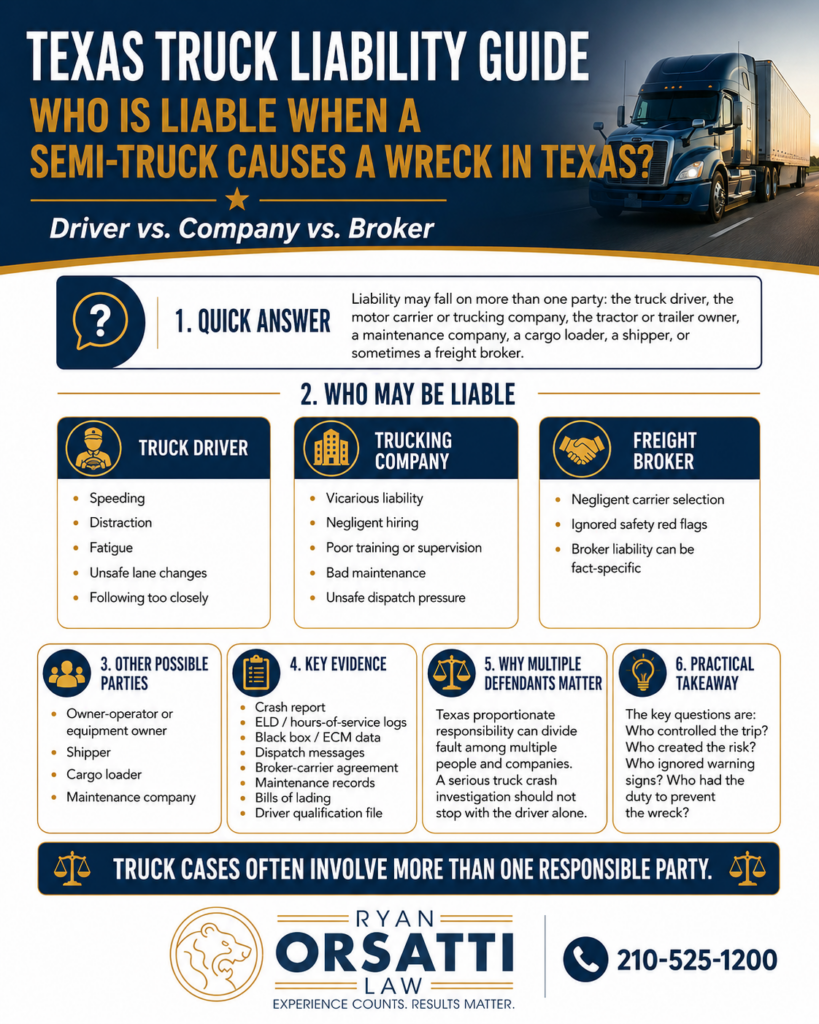
The Main Parties That May Be Liable After an 18-Wheeler Crash
| Potentially Liable Party | When They May Be Responsible | Evidence That Often Matters |
|---|---|---|
| Truck driver | Speeding, distraction, fatigue, unsafe lane change, failure to keep proper lookout, tailgating, impaired driving | Crash report, witness statements, dashcam, phone records, ELD logs, drug/alcohol testing |
| Motor carrier / trucking company | Driver was working for the company; negligent hiring, training, supervision, retention, dispatch, or maintenance | Driver qualification file, safety policies, dispatch messages, prior violations, maintenance records |
| Owner-operator / equipment owner | Owns the tractor or trailer and contributed to unsafe operation or maintenance | Lease documents, inspection records, ownership records, repair invoices |
| Freight broker | Negligent carrier selection, ignored safety red flags, or acted more like a motor carrier than a broker | Broker-carrier agreement, vetting records, rate confirmation, emails, safety-screening process |
| Shipper | Controlled loading, loading schedule, securement, or gave unsafe instructions | Bills of lading, loading dock records, communications, contracts |
| Cargo loader | Improperly loaded or secured cargo caused rollover, jackknife, brake problems, or loss of control | Weight tickets, cargo photos, seal records, loading logs |
| Maintenance company | Faulty brakes, tires, lights, steering, coupling, or inspection failures contributed to the crash | Repair orders, inspection reports, maintenance schedules, prior complaints |
When Is the Truck Driver Personally Liable?
The truck driver may be liable if careless driving caused the wreck. Common examples include:
- Driving too fast for traffic or weather
- Failing to maintain a safe following distance
- Unsafe lane changes or wide turns
- Driving while distracted
- Driving while fatigued
- Ignoring blind spots
- Failing to inspect the truck before a trip
- Driving with defective brakes, tires, or lights
- Violating hours-of-service rules
- Driving under the influence of alcohol, drugs, or impairing medications
Federal hours-of-service rules limit property-carrying commercial drivers in several important ways. A driver generally may not drive without first taking 10 consecutive hours off duty, may not drive beyond the 14-hour on-duty window, and may drive only 11 hours within that window. The rules also restrict driving after 60 hours on duty in 7 days or 70 hours in 8 days, depending on the carrier’s schedule. (eCFR)
That matters because fatigue is often disputed. A driver may say, “I was fine,” while the electronic logging device, fuel receipts, GPS data, toll records, phone records, and dispatch messages tell a different story.
When Is the Trucking Company Liable?
The trucking company, often called the motor carrier, is frequently the most important defendant in a semi-truck injury case.
A motor carrier may be liable in two broad ways:
1. Vicarious Liability for the Driver’s Negligence
If the driver was an employee acting in the course and scope of employment, the company may be responsible for the driver’s negligence. In plain English: if the driver was doing the company’s work when the crash happened, the company may be legally accountable.
This can become disputed when the company says the driver was an “independent contractor,” off duty, bobtailing, driving home, or doing something outside the assigned route. Those facts need to be tested against dispatch records, trip documents, lease agreements, GPS data, driver pay records, and communications.
2. Direct Liability for the Company’s Own Conduct
A trucking company may also be liable for its own negligence, separate from the driver’s conduct. Examples include:
- Hiring a driver with a bad safety history
- Failing to verify qualifications
- Failing to train the driver
- Ignoring prior crashes or violations
- Keeping an unsafe driver on the road
- Pressuring the driver to meet an unrealistic delivery deadline
- Failing to inspect, repair, or maintain the truck
- Allowing a driver to operate while fatigued
- Failing to enforce safety policies
- Poor supervision by dispatch or safety management
Federal rules require commercial drivers to meet minimum qualification standards, and motor carriers may not require or permit an unqualified person to drive a commercial motor vehicle. Those qualifications include age, ability to safely operate the type of vehicle, physical qualification, a valid commercial motor vehicle operator’s license, and other requirements. (eCFR)
Federal maintenance rules also require motor carriers and intermodal equipment providers to systematically inspect, repair, and maintain vehicles under their control, keep parts and accessories in safe operating condition, and retain certain maintenance records. (eCFR)
What If the Driver Was an Owner-Operator?
Many semi-truck drivers are owner-operators. That does not automatically let the trucking company off the hook.
In interstate trucking, an authorized motor carrier may lease equipment from an owner-operator. Federal leasing rules require certain written lease terms, including provisions that the authorized carrier has exclusive possession, control, and use of the equipment during the lease and assumes complete responsibility for operation of the equipment during the lease. (eCFR)
That does not mean every owner-operator crash has a simple answer. The investigation still needs to determine:
- Whose USDOT number was displayed
- Whether the truck was under dispatch
- Whether the load was being hauled for the carrier
- Whether a written lease applied
- Whether the carrier controlled the route, load, schedule, or driver
- Whether the driver was bobtailing or hauling a trailer
- Whether the crash happened during a covered trip
- What insurance policies applied
The “independent contractor” label is not the end of the analysis. In truck wreck cases, contracts, dispatch records, federal leasing rules, and operational control often matter more than the label a company chooses.
Can the Freight Broker Be Liable?
Sometimes, but broker liability is one of the most contested issues in modern trucking litigation.
A freight broker usually arranges transportation between a shipper and a motor carrier. The broker typically does not own the truck, employ the driver, maintain the tractor, or directly operate the vehicle. Because of that, brokers often argue they are not responsible for what the carrier or driver did on the road.
A broker may still become a target of investigation if there is evidence that it:
- Selected a motor carrier with obvious safety problems
- Failed to check basic carrier authority or insurance
- Ignored an unsatisfactory or out-of-service safety history
- Used a carrier it knew or should have known was unsafe
- Exercised control beyond ordinary brokerage
- Held itself out as the carrier
- Controlled the driver, route, timing, or operational details
- Created unsafe delivery pressure
The legal fight is often whether the claim is a state-law negligent-selection claim against a broker, or whether federal law preempts that claim because it relates to broker services. As of this writing, the U.S. Supreme Court docket in Montgomery v. Caribe Transport II, LLC shows the case was argued on March 4, 2026. The issue presented is whether 49 U.S.C. § 14501(c) preempts a state common-law claim against a broker for negligently selecting a motor carrier or driver. (Supreme Court)
Practical Takeaway on Broker Liability
Do not assume the broker is liable. Do not assume the broker is immune either.
The broker’s role should be investigated early because documents disappear, memories fade, and carrier-vetting evidence can become central to the case.
What About the Shipper or Cargo Loader?
The shipper or cargo loader may be liable when the wreck was caused by unsafe loading, unsafe instructions, or control over the transportation process.
Examples include:
- Cargo loaded too heavy
- Cargo loaded unevenly
- Cargo not properly secured
- Load shift causing rollover or jackknife
- Sealed trailer preventing the driver from inspecting the load
- Pressure to leave before a safe inspection
- Unsafe pickup or delivery rules at the dock
- Instructions that force unsafe timing or routing
These claims are fact-specific. A shipper that merely hired a carrier may not be responsible. A shipper or loader that controlled the loading process, created a dangerous condition, or gave unsafe operational instructions may be a different story.
What Evidence Shows Who Is Responsible?
A serious truck crash investigation should begin quickly. Many of the most important records are controlled by trucking companies, brokers, shippers, or third-party vendors.
Important evidence may include:
- Police crash report
- Photos and videos from the scene
- Dashcam or inward-facing camera footage
- Electronic logging device data
- Engine control module or “black box” data
- GPS and telematics data
- Driver qualification file
- Driver application and safety history
- CDL and medical qualification records
- Hours-of-service logs
- Dispatch notes and text messages
- Bills of lading
- Rate confirmations
- Broker-carrier agreement
- Shipper-broker agreement
- Carrier vetting records
- Maintenance and repair records
- Annual inspection records
- Pre-trip and post-trip inspection reports
- Tire and brake records
- Drug and alcohol testing records
- Prior crash and violation history
- FMCSA SAFER and SMS data
FMCSA’s SAFER Company Snapshot provides public information about a motor carrier’s identification, size, commodity information, safety rating if any, roadside out-of-service inspection summary, and crash information. (SAFER Web) FMCSA’s Safety Measurement System also includes public inspection and crash data, investigation results, and certain BASIC measures, though some property-carrier data is not publicly displayed. (A&I Online)
Why Multiple Defendants Matter in Texas
Texas uses proportionate responsibility. In many injury cases, the factfinder can assign percentages of responsibility to claimants, defendants, settling persons, and responsible third parties. (Texas Statutes)
That matters in truck wreck cases because defendants often blame each other. The trucking company may blame the driver. The driver may blame the loader. The broker may blame the motor carrier. The shipper may blame everyone else. A maintenance company may blame the driver for not reporting a defect.
Texas law also has a 51% bar for claimants. If a claimant is found more than 50% responsible, recovery can be barred. (Texas Statutes) If a defendant is found more than 50% responsible, joint and several liability may become important under Texas Civil Practice and Remedies Code § 33.013. (Texas Statutes)
In plain English: fault allocation can affect both whether you recover and from whom a judgment can be collected.
How Insurance Works in a Semi-Truck Crash
Commercial truck insurance is usually more complex than regular auto insurance.
Depending on the facts, there may be:
- Motor carrier public liability coverage
- Excess or umbrella coverage
- Trailer interchange coverage
- Bobtail or non-trucking liability coverage
- Cargo coverage
- Broker liability coverage
- Shipper policies
- Maintenance contractor policies
- UM/UIM coverage on the injured person’s own policy
- Medical payments or PIP coverage, if available
Federal financial-responsibility rules require certain minimum coverage levels for many motor carriers. For example, for-hire interstate carriers transporting nonhazardous property in vehicles with a gross vehicle weight rating of 10,001 pounds or more generally must carry at least $750,000 in public liability coverage. Some hazardous-material loads require $1,000,000 or $5,000,000 depending on the cargo. (eCFR)
Those are minimums, not guaranteed recoveries. The available insurance depends on the type of carrier, cargo, route, policy language, exclusions, additional insured provisions, and whether excess policies apply.
Common Defense Arguments in Semi-Truck Liability Cases
Truck crash defendants and insurers often raise predictable arguments:
“The driver is an independent contractor.”
This may or may not matter. The investigation should examine operating authority, lease agreements, dispatch control, insurance, who benefited from the trip, and whether the motor carrier assumed responsibility for the equipment.
“The broker only arranged the load.”
That may be true, but the broker’s actual role must be examined. Did it only connect shipper and carrier, or did it control key operational details? Did it ignore obvious safety red flags when selecting the carrier?
“The crash was unavoidable.”
That defense should be tested against speed, following distance, perception-reaction time, dashcam footage, braking data, weather, lighting, and vehicle condition.
“The injured person caused the crash.”
Texas proportionate responsibility allows defendants to blame the claimant or other parties. Early evidence preservation is critical to push back against unsupported blame-shifting.
“The company had all the right policies.”
Written policies are only part of the story. The real question is whether the company enforced them.
What Should You Do After a Semi-Truck Wreck in San Antonio?
After medical needs are addressed, these steps can help protect the claim:
- Get medical care and follow treatment recommendations. Delays are often used by insurers to dispute injury causation.
- Preserve photos, videos, and vehicle damage evidence. Do not rely only on the crash report.
- Do not give a recorded statement to the trucking insurer without legal advice.
- Identify every company involved. Look for names on the tractor, trailer, cab door, bill of lading, and insurance paperwork.
- Save all documents. Medical bills, discharge papers, work notes, repair estimates, rental receipts, and insurance letters matter.
- Avoid posting about the crash on social media. Defense teams may review public posts.
- Act quickly to preserve trucking records. ELD data, dashcam video, ECM data, and dispatch records should be requested before they are overwritten or lost.
How Long Do You Have to File a Truck Accident Lawsuit in Texas?
For most Texas personal injury claims, the general statute of limitations is two years. Texas Civil Practice and Remedies Code § 16.003 also provides a two-year deadline for wrongful death claims, measured from the date of death. (Texas Statutes)
There can be exceptions and shorter notice issues in some cases, especially if a governmental entity is involved. Do not wait until the deadline is close. Trucking cases need time for investigation, expert review, insurance analysis, and preservation of evidence.
Attorney Insight: The Driver Is Usually Only the Starting Point
In many serious truck wrecks, the unsafe act on the road is only the final link in the chain.
A fatigued driver may have been pushed by dispatch. A brake failure may trace back to poor maintenance. A jackknife may involve speed, cargo weight, weather, and training. A dangerous carrier may have been selected despite publicly available safety concerns. A driver who should not have been behind the wheel may have passed through a weak hiring process.
That is why the early investigation should ask:
- Who put this driver on the road?
- Who selected this carrier?
- Who owned the equipment?
- Who maintained it?
- Who loaded it?
- Who set the schedule?
- Who had the power to prevent the wreck?
The answer is often more than one party.
FAQs About Semi-Truck Liability in Texas
Is the truck driver always liable after a semi-truck crash?
No. The driver may be liable if negligent driving caused the wreck, but other parties may also share responsibility. The trucking company, broker, shipper, loader, equipment owner, or maintenance company may also be involved depending on the facts.
Can I sue the trucking company even if the driver was an independent contractor?
Possibly. The independent-contractor label does not end the analysis. The key facts include operating authority, lease agreements, dispatch control, whether the driver was hauling under the company’s authority, and whether the company’s own negligence contributed to the crash.
Can a freight broker be sued after an 18-wheeler crash?
Sometimes, but broker claims are heavily contested. A broker may be investigated for negligent carrier selection or for acting more like a motor carrier. Federal preemption is a major issue in these cases, and the U.S. Supreme Court has considered the question in Montgomery v. Caribe Transport II, LLC.
What if the trucking company blames the cargo loader?
That can happen. If improperly loaded or unsecured cargo contributed to the wreck, the loader, shipper, or another party involved in loading may share fault. Weight tickets, bills of lading, loading records, photos, and expert analysis may be important.
What if multiple companies are at fault?
Texas law allows responsibility to be allocated among multiple parties. That can include defendants, settling parties, responsible third parties, and sometimes the claimant. This is why identifying every potentially responsible party early is important.
How much insurance do trucking companies have?
It depends. Many interstate for-hire motor carriers must carry at least $750,000 for nonhazardous property transportation, while certain hazardous cargo may require $1,000,000 or $5,000,000. Some companies carry more through excess or umbrella policies. The actual available coverage depends on the facts and policy language.
How long does a semi-truck injury case take?
It depends on injury severity, treatment duration, liability disputes, available insurance, and whether litigation is necessary. Serious truck cases often take longer than ordinary car wreck claims because they require deeper investigation and more records.
Should I talk to the trucking company’s insurance adjuster?
Be careful. Adjusters may ask questions designed to limit the claim or shift blame. Before giving a recorded statement or signing forms, it is usually wise to understand your rights and what information the insurer is seeking.
Talk With a San Antonio Truck Accident Lawyer
Semi-truck wrecks require a fast, focused investigation. The driver may be only one part of the case. The trucking company, broker, shipper, loader, maintenance contractor, and insurers may all need to be examined.
Ryan Orsatti Law
4634 De Zavala Rd, San Antonio, TX 78249
Phone: 210-525-1200
This blog is for informational purposes only, not legal advice. Reading it does not create an attorney-client relationship. Past results do not guarantee future results.
Injured in a truck crash? See our San Antonio 18-wheeler accident lawyer page, or call (210) 525-1200 – calls answered 24/7.
Hurt in an accident in San Antonio? Learn how a San Antonio truck accident lawyer can help with your claim. Call 210-525-1200 or request a free consultation.
The firm works on a contingency fee. You pay nothing unless the firm recovers money for you, and that covers case expenses as well as the fee: if there is no recovery, you owe no attorney's fee and no case expenses. Ask for the fee agreement and read the fee and expense section before you sign anything.
Related San Antonio legal resources
Primary legal and public-data sources
Ryan Orsatti Law
4634 De Zavala Road, San Antonio, TX 78249
General reference links. Consult each source for its current text.