
Quick Answer
Within the first 72 hours after a serious Texas truck or commercial-vehicle crash, demand the Texas DPS Motor Carrier Bureau inspection file, the roadside Driver Vehicle Examination Report, out-of-service notices, violation records, inspection photos, trooper notes, and any post-crash commercial-vehicle inspection records. At the same time, send a preservation demand to the carrier for DVIRs, repair records, ELD data, supporting documents, drug and alcohol testing records, and the accident register. DPS records usually require a Texas Public Information Act request, while private carrier records usually require a preservation letter, subpoena, or formal discovery. (Texas Department of Public Safety)
Key Takeaways
- The first 72 hours matter because the truck may be repaired, moved, downloaded, cleaned, sold, or returned to service before your side inspects it.
- The DPS inspection file is different from the TxDOT CR-3 crash report. You often need both.
- The most urgent records are the Driver Vehicle Examination Report, out-of-service documentation, defect notes, inspection photographs, and citations or warnings.
- Federal rules create short practical evidence windows, including 24-hour, 15-day, 3-month, 6-month, 12-month, and 3-year record periods.
- A Texas Public Information Act request to DPS does not preserve the trucking company’s internal records. Send both requests.
- In San Antonio truck cases, inspection records can affect fault, insurance negotiations, proportionate responsibility, and whether a maintenance or safety-policy claim exists.
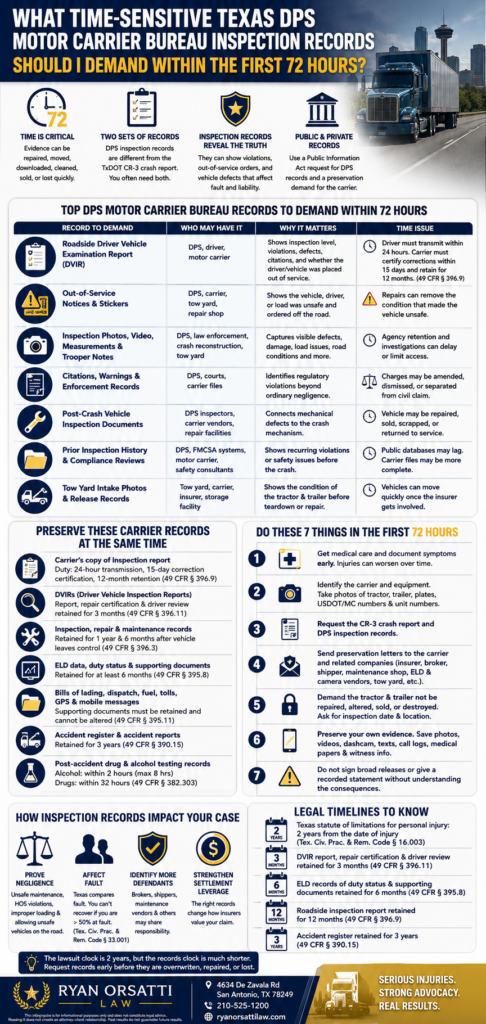
Why do Texas DPS Motor Carrier Bureau inspection records matter in the first 72 hours?
Texas DPS Motor Carrier Bureau inspection records matter in the first 72 hours because they may be the earliest official evidence showing whether a commercial vehicle had brake, tire, lighting, load-securement, logbook, registration, or out-of-service problems near the time of the crash.
The Texas Department of Public Safety says the Motor Carrier Bureau trains inspectors throughout the state, assists companies with New Entrant Evaluations and Compliance Reviews, and handles enforcement cases. That makes DPS inspection records especially important after a crash involving an 18-wheeler, dump truck, box truck, oilfield truck, delivery truck, or other commercial motor vehicle. (Texas Department of Public Safety)
In San Antonio and Bexar County, these issues often arise on I-35, I-10, Loop 410, Loop 1604, US-281, and industrial routes serving warehouses, construction sites, oilfield traffic, and regional freight. The crash scene may look like an ordinary lane-change or rear-end collision, but the inspection file may show whether the truck should have been on the road in that condition.
According to TxDOT’s crash statistics archive, Texas publishes separate Commercial Motor Vehicle involved crash reports by county. TxDOT’s detailed 2024 county CMV report recorded 3,857 CMV-involved crashes in Dallas County alone, which shows why commercial-vehicle inspection evidence is not a niche issue in Texas crash litigation. (Texas Department of Transportation)
A Texas Public Information Act request to DPS does not replace a preservation letter to the motor carrier. DPS may have the inspection file, but 49 CFR § 396.11 gives the carrier the driver vehicle inspection report and repair certifications, and those records may have a three-month retention period. (Texas Department of Public Safety)
Which Texas DPS Motor Carrier Bureau inspection records should I demand first?
You should first demand the records that identify safety violations, vehicle defects, out-of-service findings, enforcement action, inspection photographs, and the condition of the truck before repairs changed the evidence.
| Record to demand within 72 hours | Who may have it | Why it matters | Time issue |
|---|---|---|---|
| Roadside Driver Vehicle Examination Report | DPS, the issuing agency, the driver, and the motor carrier | Shows inspection level, violations, defects, citations, and whether the truck or driver was placed out of service | Under 49 CFR § 396.9, the driver must get the report to the carrier promptly, and the carrier has correction and retention duties |
| Out-of-service notices and stickers | DPS, the carrier, tow yard, repair shop, and sometimes photographs from the scene | Shows that the truck, trailer, driver, or cargo condition was considered unsafe to continue | Repairs may remove the condition that made the vehicle unsafe |
| Inspection photos, video, measurements, and trooper notes | DPS, local law enforcement, crash reconstruction units, and sometimes the tow yard | Shows brake condition, tire condition, lighting, underride damage, cargo securement, weather, road position, and visible defects | Agency retention and pending-investigation issues can delay or limit production |
| Citations, warnings, and enforcement records | DPS, municipal court, justice court, county court, and carrier files | Helps identify regulatory violations separate from ordinary negligence | Charges may later be amended, dismissed, or separated from the civil claim |
| Post-crash Level I or vehicle inspection documents | DPS Commercial Vehicle Enforcement, certified inspectors, carrier vendors, and repair facilities | Can connect a mechanical defect to the crash mechanism | The vehicle may be repaired, sold, scrapped, or returned to service |
| Prior roadside inspection history and compliance review records | DPS, FMCSA systems, the motor carrier, and safety consultants | May show whether the carrier had recurring violations before the crash | Public databases may lag, while internal carrier files may be more complete |
| Tow yard intake photos and release records | Tow yard, carrier, insurer, storage facility, and repair vendor | Shows the condition of the tractor and trailer before teardown or repair | Vehicles can move quickly after the insurer becomes involved |
Under 49 CFR § 396.9, a Driver Vehicle Examination Report is used to record roadside inspection results, and an authorized official may declare a driver or vehicle out of service when the condition or loading is likely to cause an accident or breakdown. If a driver receives the report, the driver must deliver it to the carrier at the next terminal or facility, or transmit it if the driver is not scheduled to arrive there within 24 hours. The carrier then has 15 days to certify correction of listed violations and must retain a copy for 12 months. (eCFR)
That 24-hour and 15-day sequence matters. If the carrier says it does not have the inspection report, the lawyer should ask why, who received it, when it was transmitted, what corrections were certified, and which repair vendor performed the work.
How should I request DPS inspection records without losing time?
You should request DPS inspection records through a specific Texas Public Information Act request and separately request the TxDOT CR-3 crash report because the inspection file and crash report are not the same record.
The Texas Department of Public Safety public information page explains that DPS accepts public information requests through its online Public Information Center, by email at publicrecords@dps.texas.gov, and by mail or in person. DPS also says requests should include enough specific information to help locate the records. (Texas Department of Public Safety)
A focused DPS request should include:
- Crash date and time.
- Crash location, including road, direction of travel, mile marker, exit, intersection, or GPS if available.
- City and county, such as San Antonio, Bexar County.
- Carrier name, USDOT number, MC number, and company address if known.
- Tractor number, trailer number, license plates, VINs, and unit numbers if known.
- Driver name and date of birth if available.
- DPS case number, crash report number, or officer name if known.
- A specific request for Motor Carrier Bureau, Commercial Vehicle Enforcement, roadside inspection, post-crash inspection, out-of-service, citation, photograph, video, and enforcement records.
Useful request language:
Please produce all records maintained by the Texas Department of Public Safety, Commercial Vehicle Enforcement, the Motor Carrier Bureau, any responding trooper, or any DPS commercial-vehicle inspector concerning the crash on [date] at [location] involving [carrier, USDOT number, driver, tractor, trailer, license plates, and VINs if known]. This request includes Driver Vehicle Examination Reports, post-crash inspection reports, out-of-service documentation, violation records, citations, warnings, inspection photographs, video, measurements, notes, communications, repair-certification documents, and enforcement records.
The TxDOT crash report page is a separate step. Texas Transportation Code § 550.062 requires an officer who investigates a crash involving injury, death, or apparent property damage of $1,000 or more to submit a written crash report to TxDOT not later than the tenth day after the crash. TxDOT also says crash reports are confidential and are released only to people with a proper interest under Texas Transportation Code § 550.065. (Texas Department of Transportation)
Do not wait for the CR-3 before preserving inspection evidence. The CR-3 may tell you who was involved, but the inspection records may tell you whether the truck, trailer, driver, load, or company safety practices contributed to the crash.
What carrier records should be preserved at the same time as the DPS request?
You should preserve carrier records at the same time because many of the most important truck-crash records are held by the trucking company, not DPS.
A preservation letter should go to the motor carrier, driver, insurer, broker, shipper, trailer owner, maintenance vendor, tow yard, and any company that may control ELD, camera, telematics, dispatch, or repair data. This is especially important in San Antonio truck accident cases, commercial vehicle accident claims, and cases involving black box and electronic logging data in 18-wheeler accidents.
| Carrier record to preserve | Federal rule or timing issue | Why it belongs in the first 72-hour demand |
|---|---|---|
| Carrier’s copy of the roadside inspection report | 49 CFR § 396.9 includes 24-hour transmission duties, 15-day correction certification, and 12-month retention | Shows what the carrier knew and what it claimed was fixed |
| Driver Vehicle Inspection Reports, called DVIRs | 49 CFR § 396.11 requires DVIRs for listed safety components and three-month retention for the report, repair certification, and driver review | Shows pre-trip or post-trip defect reporting, including brakes, tires, lights, steering, mirrors, wheels, coupling devices, and emergency equipment |
| Inspection, repair, and maintenance records | 49 CFR § 396.3 requires records for vehicles controlled for 30 consecutive days, generally retained for one year and for six months after the vehicle leaves the carrier’s control | Shows whether defects were known, ignored, or repeatedly repaired |
| ELD data, records of duty status, and supporting documents | 49 CFR § 395.8 requires retention of records of duty status and supporting documents for at least six months | Shows hours of service, route timing, driver fatigue, edits, annotations, and possible log inconsistencies |
| Bills of lading, dispatch records, fuel receipts, toll records, GPS, and mobile messages | 49 CFR § 395.11 describes supporting documents and prohibits obscuring, defacing, destroying, mutilating, or altering existing information | Helps test whether the driver’s timeline matches the ELD and crash facts |
| Accident register and accident reports | 49 CFR § 390.15 requires a motor carrier to maintain an accident register for three years after each qualifying accident | Shows the carrier’s internal accident record and related reports |
| Post-accident drug and alcohol testing records | 49 CFR § 382.303 contains 2-hour, 8-hour, and 32-hour testing rules depending on the crash facts | Delayed testing can become an issue if the crash involved a fatality, injury with citation, or disabling vehicle damage with citation |
Under 49 CFR § 396.11, a DVIR may identify defects in service brakes, parking brakes, steering, lighting, tires, horn, windshield wipers, mirrors, coupling devices, wheels and rims, and emergency equipment. If a defect is likely to affect safe operation or cause a mechanical breakdown, the carrier must repair it before the vehicle is operated again. (eCFR)
Inspection, repair, and maintenance files are a separate category. Under 49 CFR § 396.3, a motor carrier must keep required identifying and maintenance records for vehicles it controls for 30 consecutive days. Those records generally must be retained for one year and for six months after the vehicle leaves the carrier’s control. (eCFR)
ELD and duty-status evidence should be preserved immediately. Federal rules require motor carriers to retain records of duty status and supporting documents for each driver for at least six months from receipt, and supporting documents can include information showing driver identity, date, time, and location. (eCFR)
Post-accident testing is even more time-sensitive. Under 49 CFR § 382.303, alcohol testing should occur within two hours when required, with additional documentation if it does not occur within two hours, and testing efforts generally stop after eight hours for alcohol and 32 hours for controlled substances. (eCFR)
After a Texas commercial-vehicle crash, do these 7 things in the first 72 hours
After a Texas commercial-vehicle crash, the safest approach is to preserve agency records, carrier records, vehicle evidence, medical documentation, and witness information before the evidence moves.
- Get medical care and document symptoms early. Neck pain, back pain, concussion symptoms, numbness, headaches, and radiating pain may develop after the scene clears. Medical records help connect the injury timeline to the crash.
- Identify the carrier and equipment. Photograph the tractor, trailer, license plates, USDOT number, MC number, company name, unit numbers, trailer numbers, placards, and any logos on the cab or trailer.
- Request the CR-3 and DPS inspection records. The CR-3 helps identify parties, insurers, witnesses, and the officer’s crash narrative. The DPS inspection file may identify safety violations, out-of-service findings, or post-crash commercial-vehicle inspection details.
- Send preservation letters to the carrier and related companies. Include the motor carrier, driver, insurer, broker, shipper, trailer owner, maintenance shop, tow yard, ELD provider, camera vendor, and telematics vendor when the facts support it.
- Demand that the tractor and trailer not be repaired, altered, sold, or destroyed. Ask for an inspection date, storage location, chain of custody, and notice before any teardown or repair work.
- Preserve your own evidence. Save photos, videos, dashcam clips, location data, call logs, text messages, medical discharge papers, witness names, insurance letters, and tow documents.
- Do not sign broad releases or give a recorded statement without understanding the effect. Insurance paperwork may affect property damage, injury claims, medical authorizations, subrogation, or the right to inspect the truck.
What mistakes can weaken a DPS inspection-record demand?
The biggest mistake is requesting only the crash report and assuming it includes the commercial-vehicle inspection file.
The CR-3 is important, but it is not the complete truck-safety record. A strong demand separates the TxDOT crash report, DPS Motor Carrier Bureau records, roadside inspection records, carrier safety files, ELD data, maintenance files, repair records, and post-accident testing records.
Common mistakes include:
- Asking for “all records” without identifying the crash, carrier, driver, USDOT number, tractor, trailer, and location.
- Waiting for the insurance adjuster to decide what records matter.
- Failing to request out-of-service notices, repair certifications, and inspection photographs.
- Preserving the tractor but forgetting the trailer, load, tires, brakes, lights, coupling devices, and underride damage.
- Forgetting that brokers, shippers, repair vendors, tow yards, camera vendors, and ELD vendors may control evidence.
- Accepting a repair invoice without asking for photos, technician notes, diagnostic data, metadata, and replaced parts.
- Missing post-accident drug and alcohol testing timelines.
- Ignoring intrastate commercial vehicles, oilfield trucks, construction trucks, delivery vehicles, and local fleet vehicles.
A narrow, specific request is usually better than a vague one. It tells the agency or company what to search for and makes later disputes easier to frame.
How do inspection records affect fault, insurance, and settlement leverage in Texas?
Inspection records affect Texas truck cases because they may show negligence, defeat blame-shifting, identify additional defendants, and change how insurers evaluate fault.
Negligence means failing to use reasonable care under the circumstances. In a truck case, negligence may involve unsafe driving, unsafe maintenance, hours-of-service violations, poor hiring or supervision, improper loading, or allowing an unsafe vehicle on the road.
Proportionate responsibility means Texas compares fault among responsible parties. Under Texas Civil Practice & Remedies Code § 33.001, a claimant may not recover damages if the claimant’s percentage of responsibility is greater than 50 percent. That is why inspection records matter when a trucking company claims the injured driver caused or contributed to the crash. (Texas Statutes)
For example, the defense may argue that a San Antonio driver stopped too fast on Loop 410 or merged improperly on I-35. But if the DPS inspection file shows defective brakes, unsafe tires, missing lights, a load-securement problem, or an out-of-service condition, the fault analysis changes.
Inspection records may also affect insurance issues. Liability coverage is the insurance that may apply when the truck driver, carrier, or another insured party is legally responsible. UM/UIM coverage means uninsured or underinsured motorist coverage, which may matter if the available commercial coverage is disputed, denied, or inadequate.
Medical bills can raise separate issues. MedPay, health insurance, hospital liens, ERISA reimbursement claims, and subrogation all involve who gets paid back from a recovery. Subrogation means a health insurer or benefit plan may claim repayment from a settlement. A letter of protection, called an LOP, is an agreement that a medical provider may wait for payment from the case, but it does not replace the need to prove fault and damages.
Spoliation means loss or destruction of evidence that should have been preserved. A truck that is repaired before inspection, an overwritten camera file, or altered ELD data can create major disputes. The best way to reduce that risk is to send targeted preservation demands before the carrier can claim it did not know what evidence mattered.
For more on company responsibility, see our guide on when a trucking company may be liable after a Texas truck accident.
Attorney Insight: In serious Bexar County truck cases, the first useful clue is often not a dramatic admission. It is a mismatch: the roadside inspection shows brake, tire, lighting, securement, or logbook issues, while the insurer frames the crash as ordinary driver error. Early demands should force those records into the file before repairs and routing data make the story harder to test.
How long do I have to file a Texas truck accident lawsuit?
In most Texas personal-injury cases, Texas Civil Practice & Remedies Code § 16.003 gives an injured person two years from the injury date to file suit, but the evidence-preservation clock is much shorter.
That two-year limitations period does not mean you should wait to request truck records. Some key federal record periods are measured in months, not years. DVIR records may have a three-month retention period, ELD and supporting documents generally have a six-month retention period, roadside inspection reports may have a 12-month retention period, and accident registers have a three-year retention period. (Texas Statutes)
In Texas truck cases, the records clock often moves faster than the lawsuit clock. Texas Civil Practice & Remedies Code § 16.003 generally gives two years to file a personal-injury lawsuit, but FMCSA rules allow some key inspection and duty-status records to be retained for three, six, or twelve months. (Texas Statutes)
FAQ
Is the DPS Motor Carrier Bureau inspection report the same as the TxDOT CR-3 crash report?
No. The TxDOT CR-3 is the officer’s crash report, while a DPS Motor Carrier Bureau or Commercial Vehicle Enforcement inspection record focuses on the commercial vehicle, driver, violations, defects, and possible out-of-service conditions. A serious truck crash may require both sets of records because the CR-3 may identify the parties, while inspection records may identify safety-rule violations.
Can I get DPS inspection records while the crash investigation is still open?
You can request them, but production may be limited or delayed if DPS believes an exception applies under the Texas Public Information Act. The better approach is to make the request early, describe the records precisely, and follow up. If some information is withheld, other non-confidential records or later supplements may still become available.
What if the trucking company says it does not have the inspection report yet?
Ask when the driver transmitted it, who received it, and whether the carrier certified any corrections. Under 49 CFR § 396.9, a driver who receives a roadside inspection report has prompt transmission duties, and the motor carrier has certification and retention duties. A vague answer should trigger a more specific preservation demand.
Should I demand ELD data and black box data in the same 72-hour letter?
Yes. ELD data, records of duty status, supporting documents, GPS, dash cameras, engine control module data, and telematics should be preserved immediately. These records may show speed, braking, hours of service, route timing, stops, edits, and driver fatigue issues. They are separate from the DPS inspection file but often connect to the same liability questions.
Are DVIRs required if the driver found no defects?
Not always in the same way. Under 49 CFR § 396.11, a DVIR is required for certain passenger-carrying CMVs, and for property-carrying CMVs when a defect or deficiency is discovered or reported. If no defect was reported, the absence of a DVIR can still become relevant when later inspection evidence shows a serious defect existed.
What if the truck was repaired before my side inspected it?
Repair before inspection can create a spoliation issue if the carrier, insurer, or vendor knew the evidence should be preserved. The practical response is to demand repair invoices, photos, replaced parts, technician notes, diagnostic downloads, tow records, storage records, and communications about the repair. The goal is to reconstruct what changed and who authorized it.
Do I need a lawyer to request Texas DPS inspection records?
You can submit a Texas Public Information Act request yourself, but serious truck cases usually require more than a public-records request. A lawyer can send preservation letters, identify all record holders, inspect the truck, address withheld records, and use subpoenas or discovery if suit becomes necessary. The need depends on injury severity, liability disputes, and available evidence.
Ryan Orsatti Law
4634 De Zavala Rd, San Antonio, TX 78249
Phone: 210-525-1200
ryanorsattilaw.com
This blog is for informational purposes only, not legal advice. Reading it does not create an attorney-client relationship. Past results do not guarantee future results.
Hurt in an accident in San Antonio? Learn how a San Antonio personal injury lawyer can help with your claim. Call 210-525-1200 or request a free consultation.
The firm works on a contingency fee. You pay nothing unless the firm recovers money for you, and that covers case expenses as well as the fee: if there is no recovery, you owe no attorney's fee and no case expenses. Ask for the fee agreement and read the fee and expense section before you sign anything.
Related San Antonio legal resources
Primary legal and public-data sources
- Texas Civil Practice and Remedies Code Chapter 16: limitations
- Texas Civil Practice and Remedies Code Chapter 33: proportionate responsibility
Ryan Orsatti Law
4634 De Zavala Road, San Antonio, TX 78249
General reference links. Consult each source for its current text.