
Quick Answer
To preserve cell-phone metadata from your own device, stop deleting anything, keep the phone, avoid factory resets or major software changes, and have a qualified mobile-forensics examiner create a documented extraction as soon as possible. Screenshots alone are not enough.
In a Texas crash claim, the strongest preservation plan usually combines three things: the physical phone, a forensic extraction, and outside records from your wireless carrier or cloud account that can confirm timing.
Key Takeaways
- Cell-phone metadata means data about activity, such as timestamps, call logs, message logs, app activity, screen activity, location signals, and system records.
- Do not delete texts, call logs, apps, photos, location history, or crash-related communications.
- Do not hand your unlocked phone directly to an insurance adjuster without controlling the scope of review.
- A forensic extraction is stronger than screenshots because it can preserve metadata, chain of custody, and file integrity.
- Texas discovery rules treat electronic data differently, and requests should identify the data and production format.
- The goal is not to “prove everything” from one phone. The goal is to preserve clean, defensible evidence before routine overwriting occurs.
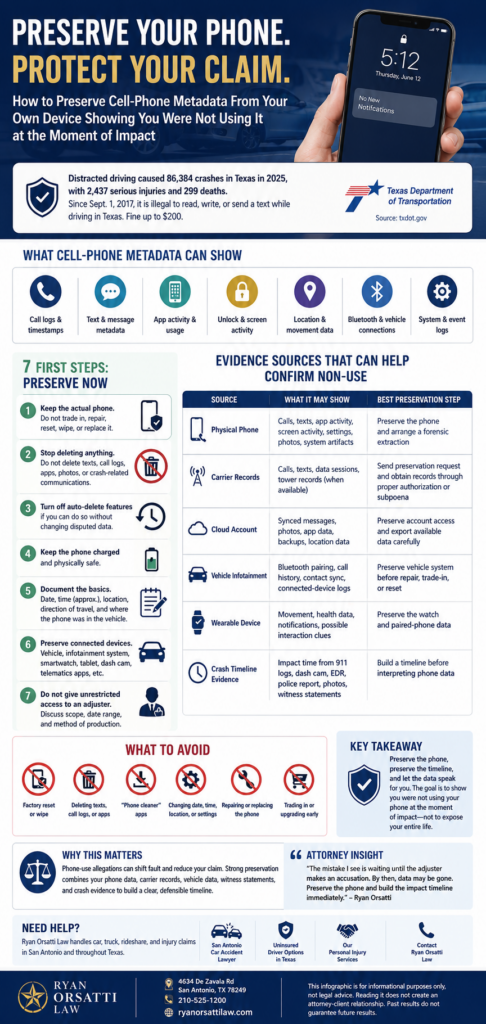
Why does preserving cell-phone metadata matter after a Texas crash?
Preserving cell-phone metadata matters because a distracted-driving accusation can shift fault, reduce claim value, or create a credibility fight even when you were not using your phone.
TxDOT reports that in 2025, distracted driving was responsible for 86,384 crashes on Texas roads, with more than 2,437 people seriously injured and 299 people killed. TxDOT also states that since September 1, 2017, Texas has made it illegal to read, write, or send a text while driving, with violators facing a fine of up to $200. (Texas Department of Transportation)
In San Antonio and Bexar County crash claims, phone-use allegations often come up in rear-end crashes, lane-change crashes, intersection collisions, rideshare crashes, and commercial-vehicle cases. Sometimes the allegation starts with a police report note. Sometimes it comes from the other driver saying, “I saw them looking down.” Sometimes it is just an adjuster looking for a way to reduce fault.
In a Texas crash case, cell-phone metadata can help answer a narrow question: was the phone being used at the moment of impact? The answer usually requires more than a screenshot. A defensible review may need device data, carrier records, cloud records, vehicle data, witness statements, dash-camera footage, and the crash timeline.
What cell-phone metadata can show you were not using your phone?
Cell-phone metadata can show whether your phone had calls, texts, app activity, unlock events, screen activity, data sessions, location movement, or other user interactions near the moment of impact.
“Metadata” means information about a file, message, call, app event, or device activity. It is not always the content of a text message. It may be the time a message was sent, received, opened, or synced. It may be the time a phone connected to Bluetooth, paired with a vehicle, changed location, received a notification, or logged a system event.
The most useful metadata depends on the phone, operating system, apps, settings, carrier, and whether the data has already been overwritten. For example, one phone may preserve useful call-log and message timestamps but very little app-use detail. Another may have cloud, vehicle, wearable, or location records that help confirm the user was not actively interacting with the phone.
| Evidence source | What it may help show | Best preservation step | Common mistake |
|---|---|---|---|
| Physical phone | Device condition, call logs, messages, app activity, photos, settings, system artifacts | Preserve the phone and arrange a forensic extraction | Deleting messages or resetting the device |
| Carrier records | Calls, text-message metadata, data sessions, tower-related records when available | Send a preservation request and obtain records through proper authorization or subpoena | Waiting until routine retention periods expire |
| Cloud account | Synced messages, photos, app data, backups, location-related records when enabled | Preserve account access and export available data carefully | Changing settings before preservation |
| Vehicle infotainment | Bluetooth pairing, call history, contact sync, connected-device logs | Preserve the vehicle system before repair, trade-in, or reset | Selling or repairing the vehicle before download |
| Wearable device | Movement, health data, notifications, possible device interaction clues | Preserve the watch and paired-phone data | Unpairing or replacing the device |
| Crash timeline evidence | Impact time from 911 logs, dash cam, EDR, police report, photos, and witness statements | Build a timeline before interpreting phone data | Looking at phone data without a precise impact time |
What should I do first if I need to preserve cell-phone metadata from my own device?
The first step is to preserve the phone in its current condition and avoid any action that changes, deletes, overwrites, or “cleans up” data.
Do these 7 things as soon as possible:
- Keep the actual phone. Do not trade it in, repair it, reset it, wipe it, or replace it before preservation.
- Stop deleting anything. Do not delete texts, call logs, voicemails, apps, photos, browser history, location data, or crash-related communications.
- Turn off auto-delete features if you can do so without changing disputed data. If you are unsure, wait for a forensic examiner or attorney guidance.
- Keep the phone charged and physically safe. A dead, damaged, or lost phone can create avoidable proof problems.
- Document the basics. Write down the crash date, approximate impact time, road, direction of travel, and where the phone was located in the vehicle.
- Preserve connected devices. Keep the vehicle, infotainment system, smartwatch, tablet, and any dash camera or telematics app data.
- Do not give unrestricted access to an adjuster. If your insurer asks for phone data, discuss the scope, date range, and method of production before handing over the device.
A Texas crash victim who wants to prove non-use should preserve the original phone, not just screenshots. Screenshots can help explain what you saw on the screen, but they usually do not preserve the deeper metadata, device logs, file properties, or chain-of-custody information needed to make phone evidence persuasive in litigation.
Is a screenshot enough to prove I was not texting at impact?
A screenshot is usually not enough because screenshots are easy to challenge and may not preserve the underlying metadata.
A screenshot of your call log, text list, Screen Time page, or app-usage page can be useful as a quick reference. It can also help your attorney identify what to preserve. But a screenshot does not prove the phone was untouched. It may not show deleted data, background activity, time-zone issues, app-level logs, system events, or whether the screenshot was captured before or after settings changed.
Texas Rule of Evidence 901 requires the proponent of evidence to produce enough evidence to support a finding that the item is what the proponent claims it is. The rule also recognizes authentication through a witness with knowledge and through evidence describing a process or system that produces an accurate result.
In plain English, you need to be able to show where the evidence came from, how it was collected, and why the court or insurer should trust it. That is why a forensic extraction, a custodian affidavit, or a properly documented production can matter.
Should I download my own phone data or hire a forensic examiner?
You should avoid do-it-yourself downloads if the phone data may become disputed evidence, because a self-export can miss data and create authentication problems.
A mobile-forensics examiner can often perform a logical, file-system, or other device-specific extraction depending on the phone model, operating system, lock status, and available tools. The examiner should document the device, date, time, method, software, hash values where applicable, limitations, and chain of custody. Chain of custody means the record of who had the evidence, when they had it, and what was done with it.
Texas Rule of Civil Procedure 196.4 addresses electronic or magnetic data. It requires a party seeking electronic data to specifically request it and specify the form of production. It also recognizes limits when the data is not reasonably available in the ordinary course of business or requires extraordinary retrieval steps.
For your own device, that same idea matters practically. The preservation should be targeted. It should capture the time window that matters, protect private information outside the dispute when possible, and avoid unnecessary exposure of unrelated personal data.
Can the insurance company demand my entire phone?
An insurance company may ask for phone records, but you should not assume it is entitled to unrestricted access to your entire device.
There is a difference between cooperating with a reasonable claim investigation and giving an adjuster open-ended access to your private life. Your phone may contain privileged communications, financial information, family photos, health data, location history, confidential work information, and communications that have nothing to do with the crash.
In Texas litigation, broad cell-phone discovery can be challenged if it is not tied to the actual issue. In an official Texas Supreme Court case summary for In re Kuraray America, Inc., the court staff summarized that a party seeking cell-phone data must first allege or provide some evidence of cell-phone use at a time when it could have contributed to the incident. If that burden is met, production may be limited to the relevant time period.
A targeted approach is usually safer: identify the impact time, preserve the phone, obtain a forensic extraction, and produce only the relevant categories needed to address the accusation. If the crash involved serious injuries, a commercial vehicle, a disputed light, or a disputed lane change, talk with a lawyer before responding to a broad phone-data request. For related injury-claim issues, see Ryan Orsatti Law’s San Antonio car accident lawyer resource.
How does the exact moment of impact get established?
The exact moment of impact is established by comparing multiple sources, not by guessing from the police report alone.
The phone evidence is only useful if you know the relevant window. In a San Antonio crash on I-10, I-35, Loop 410, Loop 1604, or US-281, the impact time may be refined through 911 records, dispatch logs, dash-camera footage, traffic-camera footage if preserved, vehicle event data, airbag deployment records, witness photos, tow records, medical records, and the CR-3 crash report.
For phone metadata, a one-minute error can matter. If the crash happened at 5:12:38 p.m., the question may be whether the phone shows user activity at 5:12 p.m., 5:13 p.m., or only background activity before or after impact. Background activity means the phone or an app did something automatically without the user touching the device. A forensic examiner may need to distinguish user activity from automated syncing, notifications, app refreshes, or Bluetooth connections.
The best phone-use analysis starts with a crash timeline. Without a reliable impact time, phone metadata can be misunderstood.
What if my phone shows data usage near the crash?
Data usage near the crash does not automatically mean you were using the phone.
Phones constantly generate background activity. Apps refresh. Maps may continue running. Streaming apps may buffer. Messages may arrive. Cloud services may sync. A vehicle may reconnect to Bluetooth. A phone may log movement, notifications, or network changes without the driver touching it.
This is where adjusters sometimes overreach. A carrier record showing a data session near the crash is not the same thing as proof of texting. A notification arriving is not the same thing as reading it. A phone connecting to the vehicle is not the same thing as manual use. The analysis should separate human interaction from automated device activity.
In a Bexar County injury claim, the strongest response is usually not, “Trust me, I was not on my phone.” The stronger response is a documented timeline supported by phone extraction data, carrier metadata, vehicle records, and witness evidence.
What should I avoid doing before the phone is preserved?
You should avoid anything that changes the device, deletes data, or creates the appearance that evidence was altered.
Do not factory reset the phone. Do not delete texts with the other driver, passengers, witnesses, family members, your insurer, or medical providers. Do not uninstall apps. Do not clean out call logs. Do not install “phone cleaner” apps. Do not change date, time, location, cloud-sync, or message-retention settings without guidance. Do not repair or replace the phone before the data is preserved.
Texas Rule of Civil Procedure 196.5 states that testing, sampling, or examination of an item may not destroy or materially alter the item unless the court previously authorizes it. That rule is a litigation rule, but the practical lesson is simple: do not let the preservation process damage the evidence.
If your phone is already damaged, keep it anyway. A damaged phone may still contain recoverable data, and the damage itself may help explain why some data is missing.
Attorney Insight
In distracted-driving disputes, the mistake I see is waiting until the adjuster makes a formal accusation. By then, the client may have upgraded the phone, deleted messages, repaired the vehicle, or lost connected-device data. If phone use is even mentioned at the scene, preserve the phone and build the impact timeline immediately.
How can a lawyer help preserve my own phone metadata?
A lawyer can help preserve phone metadata by controlling the scope, coordinating forensic collection, protecting private information, and matching the phone data to the liability timeline.
In a Texas personal injury case, the phone is only one part of the evidence map. A lawyer may also look for dash-camera footage, 911 records, witness statements, crash-scene photos, vehicle event data, rideshare app records, employer records in commercial cases, and insurance-policy issues such as UM/UIM coverage. UM/UIM means uninsured or underinsured motorist coverage, which may apply when the at-fault driver has no insurance or not enough insurance.
Ryan Orsatti Law handles Texas injury claims involving car crashes, truck crashes, rideshare crashes, serious injuries, and disputed insurance issues. You can review the firm’s personal injury services, read about uninsured driver options in Texas, or contact Ryan Orsatti Law if a phone-use allegation is affecting your claim.
FAQ
Can my own phone help prove I was not texting when the crash happened?
Yes, your own phone may help prove you were not texting, but only if the data is preserved correctly. Useful evidence may include call logs, message metadata, app activity, screen activity, system records, Bluetooth connections, and carrier records. The key is matching those records to a reliable impact time.
Should I give my phone to the other driver’s insurance company?
Do not give your unlocked phone to the other driver’s insurance company without setting limits. A phone contains far more private information than a crash claim requires. A safer approach is to preserve the phone, use a qualified forensic examiner, and produce targeted data for the relevant time window.
Can data usage prove I was on my phone?
No, data usage alone usually does not prove you were manually using your phone. Phones create background data from app refreshes, notifications, syncing, maps, Bluetooth, and system activity. The important question is whether the record shows human interaction at a time when phone use could have contributed to the crash.
What if I already replaced my phone after the crash?
If you already replaced your phone, keep the old phone, SIM card, cloud account, backups, receipts, and carrier records. Do not wipe or trade in the old device. Some information may still be recoverable from the old phone, cloud backups, wireless-carrier records, vehicle systems, or connected devices.
How fast should I preserve cell-phone metadata after a crash?
Preserve cell-phone metadata as soon as possible, ideally before repairs, phone upgrades, resets, app deletions, or insurance disputes. Some data is overwritten through ordinary use. Even if a Texas injury claim may have a longer filing deadline, digital evidence can disappear much sooner than the lawsuit deadline.
Can the other side get all my texts after a Texas crash?
Not automatically. In Texas, cell-phone discovery should be tied to relevance, the actual issues in the case, and the time period when phone use could have contributed to the incident. A targeted production is different from handing over every personal text, photo, app, and location record on the device.
Are screenshots of Screen Time or call logs useful?
Screenshots can be useful as a starting point, but they are usually not enough by themselves. They may help identify what exists, but they do not reliably preserve deeper metadata or prove the collection process. A forensic extraction and proper authentication are stronger when phone use is disputed.
What if the crash was in San Antonio but my phone carrier is national?
The preservation issue is still handled through Texas claim and discovery strategy, even if the phone carrier is national. Your attorney may preserve the physical phone, request carrier records, subpoena records if litigation is filed, and compare the records to Bexar County crash evidence such as 911 logs, witness statements, and vehicle data.
Ryan Orsatti Law
4634 De Zavala Rd, San Antonio, TX 78249
Phone: 210-525-1200
ryanorsattilaw.com
This blog is for informational purposes only, not legal advice. Reading it does not create an attorney-client relationship. Past results do not guarantee future results.
Hurt in an accident in San Antonio? Learn how a San Antonio personal injury lawyer can help with your claim. Call 210-525-1200 or request a free consultation.
The firm works on a contingency fee. You pay nothing unless the firm recovers money for you, and that covers case expenses as well as the fee: if there is no recovery, you owe no attorney's fee and no case expenses. Ask for the fee agreement and read the fee and expense section before you sign anything.
Related San Antonio legal resources
Primary legal and public-data sources
- Texas Civil Practice and Remedies Code Chapter 16: limitations
- Texas Civil Practice and Remedies Code Chapter 33: proportionate responsibility
Ryan Orsatti Law
4634 De Zavala Road, San Antonio, TX 78249
General reference links. Consult each source for its current text.