

Quick Answer
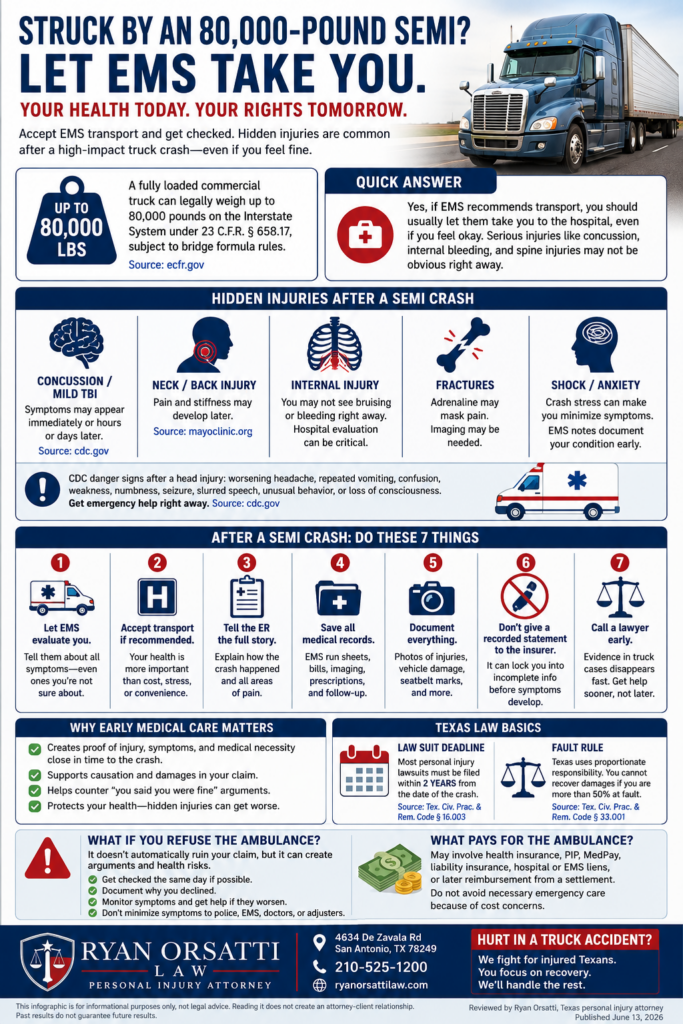
Yes, if EMS recommends transport after you were struck by an 80,000-pound semi, you should usually let them take you to the hospital, even if you feel okay. A semi crash can cause concussion, internal injury, spine injury, or soft-tissue trauma that may not feel obvious at the scene.
Refusing EMS does not automatically ruin a Texas injury claim, but it can create health risks and give the insurance company an argument that you were not really hurt. Your first priority is medical safety, not the claim.
Key Takeaways
- A fully loaded commercial truck can legally weigh up to 80,000 pounds on the Interstate System under 23 C.F.R. § 658.17, subject to bridge formula rules. (eCFR)
- Feeling “fine” after a semi crash is not reliable. CDC notes that mild traumatic brain injury and concussion symptoms may appear right away or hours or days later. (CDC)
- EMS records, ER records, vitals, imaging orders, discharge instructions, and follow-up referrals can become important evidence in a Texas truck accident claim.
- If you decline an ambulance, get checked the same day if possible, monitor danger signs, and do not minimize symptoms to police, EMS, doctors, or adjusters.
- In Texas, most personal injury lawsuits must be filed within two years under Texas Civil Practice and Remedies Code § 16.003, but evidence in commercial truck cases can disappear much faster. (Texas Statutes)
Should I let EMS transport me after being struck by an 80,000-pound semi?
You should usually accept EMS transport after being struck by an 80,000-pound semi if EMS believes hospital evaluation is appropriate. Emergency medical services, or EMS, are trained to assess crash-scene risk, not just visible bleeding or obvious broken bones.
The size difference matters. A commercial truck impact on I-35, I-10, Loop 410, Loop 1604, US-281, or another Texas roadway can transmit force through your body even when your vehicle looks drivable and you can walk around. Under federal truck weight rules, the maximum gross vehicle weight on the Interstate System is generally 80,000 pounds, with axle and bridge formula limits. (eCFR)
A hospital evaluation does two things. First, it protects your health. Second, it creates a time-stamped medical record showing what happened, what you reported, what EMS observed, and what the hospital ruled in or ruled out.
That record can matter later if a trucking insurer argues, “You said you were fine at the scene.”
Why can you feel okay after a semi truck crash and still be injured?
You can feel okay after a semi truck crash because adrenaline, shock, confusion, and delayed inflammation can mask symptoms for hours or days. This is common in serious crashes, especially when the injured person is focused on children, passengers, the vehicle, police, or getting out of traffic.
The CDC states that mild TBI and concussion symptoms may appear immediately, or may not appear for hours or days after the injury. Those symptoms can affect how you feel, think, act, and sleep. (CDC)
Mayo Clinic also notes that whiplash symptoms often start within days of the injury, and may include neck pain, stiffness, headaches, shoulder pain, tingling, dizziness, fatigue, vision issues, sleep problems, trouble focusing, and memory problems. (Mayo Clinic)
In a Texas truck accident claim, the issue is not whether you were tough enough to stand at the scene. The issue is whether the collision caused injuries, whether those injuries were documented, and whether the medical timeline makes sense.
What injuries can EMS and the ER check for after a semi crash?
EMS and the emergency room can check for serious crash injuries that may not be obvious without medical evaluation. These include head injury, internal bleeding, spinal trauma, fractures, chest injury, abdominal injury, and neurological symptoms.
| Possible injury after semi impact | Why it may be missed at the scene | Why EMS or ER evaluation matters |
|---|---|---|
| Concussion or mild TBI | You may not lose consciousness and may sound normal at first | EMS can document confusion, memory gaps, nausea, headache, dizziness, and neurological concerns |
| Neck or back injury | Pain and stiffness may develop later | ER records can document mechanism of injury, pain location, range of motion, and need for imaging or referral |
| Internal injury | You may not see bruising or bleeding right away | Hospital evaluation can assess abdominal pain, chest pain, blood pressure, oxygen levels, and worsening symptoms |
| Fracture | Adrenaline may mask pain, especially in hands, ribs, feet, and spine | Imaging may be ordered when symptoms or mechanism justify it |
| Anxiety, shock, or disorientation | Crash stress can make you minimize symptoms | EMS notes may document your condition before you have time to “explain it away” |
This is not medical advice. Follow EMS instructions and the advice of your treating medical professionals.
What if I refuse the ambulance because I feel fine?
Refusing the ambulance does not automatically destroy your Texas injury claim, but it can make both your medical care and your legal proof harder. If you decline transport, the safer course is to get a same-day medical evaluation and carefully document why you declined.
Sometimes people refuse EMS because they are worried about cost, children at the scene, work, transportation, pets, or the vehicle. Those reasons are understandable. The problem is that insurance adjusters often turn a refusal into a liability argument: “If this was serious, why did you refuse the ambulance?”
A “gap in treatment” means a delay between the crash and medical care. Adjusters use gaps to argue that the injury came from something else, got worse because you waited, or was not serious. That argument is not always fair, but it is common.
If you refuse EMS, do not say “I am not hurt” unless that is exactly true. A more accurate statement may be: “I am shaken up and not sure yet. I do not want ambulance transport right now, but I will get checked if symptoms continue or worsen.”
After a semi crash, do these 7 things before dealing with insurance
After a semi crash, focus first on medical safety, then documentation, then insurance. Do not try to handle a commercial trucking claim like a minor fender-bender.
- Let EMS evaluate you. Tell them about head impact, loss of memory, dizziness, nausea, chest pain, neck pain, back pain, numbness, tingling, anxiety, or confusion.
- Accept transport if EMS recommends it. Do not let embarrassment, cost concerns, or “I think I’m okay” override a safety recommendation after an 18-wheeler impact.
- Tell the ER the full mechanism of injury. Explain that you were struck by a semi, tractor-trailer, 18-wheeler, box truck, dump truck, or other commercial vehicle.
- Save every medical document. Keep EMS run sheets if available, hospital discharge papers, imaging reports, prescriptions, work notes, referral sheets, and follow-up instructions.
- Photograph visible injuries and vehicle damage. Bruising, swelling, seatbelt marks, airbag burns, broken glass, child seats, cargo damage, and intrusion into the vehicle can matter.
- Do not give a recorded statement to the trucking insurer before getting advice. A recorded statement can lock you into incomplete symptom descriptions before delayed injuries develop.
- Speak with a Texas truck accident lawyer early if injuries, commercial vehicles, disputed fault, or serious medical care are involved. A truck accident lawyer in San Antonio can help identify the trucking company, insurance layers, driver logs, vehicle data, and preservation needs.
How does EMS transport affect a Texas truck accident claim?
EMS transport affects a Texas truck accident claim by creating early proof of injury, mechanism, symptoms, and medical necessity. Medical necessity means the care was reasonable and related to the crash, not exaggerated or unrelated.
A negligence claim requires proof that another party failed to use reasonable care and caused damages. “Damages” means losses and harms, such as medical bills, lost income, physical pain, impairment, and life disruption. “Causation” means the link between the truck crash and the injury.
EMS records can support causation because they are created immediately after the crash. They may show your vital signs, pain complaints, mental status, location of injury, safety concerns, and whether transport was recommended.
In matters we have handled, early medical documentation often becomes more important than clients expect. The trucking insurer may not care that you were trying to be calm, polite, or tough at the scene. They may focus on what the records say.
What if the ambulance bill is expensive?
The ambulance bill may become part of your claimed medical damages, but billing, liens, health insurance, PIP, MedPay, and subrogation need to be handled carefully. Do not refuse necessary emergency care solely because you are worried about the bill.
Texas auto policies include Personal Injury Protection, called PIP, unless rejected in writing. PIP can pay medical bills and certain nonmedical costs, such as lost wages, depending on the policy. Medical Payments coverage, called MedPay, generally pays medical bills. The Texas Department of Insurance explains that PIP and MedPay are different coverages, and that PIP is included unless rejected in writing. (Texas Department of Insurance)
Subrogation means a health insurer, ERISA benefit plan, Medicare, Medicaid, workers’ compensation carrier, or other payer may claim a right to be repaid from a settlement. A hospital lien is a legal claim by a hospital against settlement proceeds. Under Texas Property Code Chapter 55, hospital and emergency medical services lien rules can turn on timing, including a 72-hour accident-related treatment concept. (Texas Statutes)
A letter of protection, or LOP, is an agreement where a medical provider treats now and waits for payment from a future settlement. An LOP can help in some follow-up care situations, but it is not a substitute for emergency evaluation after a major truck crash.
What should I tell EMS and hospital staff?
Tell EMS and hospital staff the truth, including symptoms you are unsure about. Do not exaggerate, but do not minimize.
Useful details include:
- The crash involved a semi, tractor-trailer, 18-wheeler, commercial truck, or company vehicle.
- Whether you hit your head, blacked out, felt dazed, or have memory gaps.
- Whether airbags deployed or your vehicle spun, rolled, was pushed, or was crushed.
- Any pain, stiffness, numbness, tingling, headache, dizziness, nausea, vision issue, chest pain, abdominal pain, or shortness of breath.
- Any prior injuries or conditions, because accurate history helps doctors and prevents the insurer from claiming you hid something.
Do not guess at medical conclusions. Say what you feel and what happened. Let the medical professionals diagnose.
How do Texas fault rules affect a semi truck injury claim?
Texas fault rules can affect whether and how much an injured person may recover after a semi truck crash. Texas Civil Practice and Remedies Code § 33.001 uses proportionate responsibility, meaning a claimant may not recover damages if the claimant’s percentage of responsibility is greater than 50 percent. (Texas Statutes)
This matters because trucking insurers often investigate fault immediately. They may argue unsafe lane change, sudden stop, speeding, distraction, failure to keep a proper lookout, or failure to mitigate damages. “Mitigation” means taking reasonable steps to reduce harm after an injury.
Medical treatment is not just about damages. It can also affect fault arguments. If you refuse EMS and wait weeks for care, an adjuster may argue you failed to mitigate your damages. That does not mean they are right, but it gives them something to use.
Why does evidence move faster in a commercial truck case?
Evidence moves faster in a commercial truck case because trucking companies, insurers, drivers, brokers, shippers, and maintenance vendors may all have separate records. Some evidence can be overwritten, repaired, lost, or destroyed if no one acts quickly.
Spoliation means the destruction, alteration, or loss of relevant evidence. In a truck case, important evidence may include the driver’s electronic logging device, dash camera footage, event data recorder, GPS records, dispatch records, inspection reports, maintenance records, drug and alcohol testing records, bills of lading, load documents, and post-crash repair files.
TxDOT reports that it maintains a statewide crash database based on Texas Peace Officer’s Crash Reports, also called CR-3 reports. (Texas Department of Transportation) In 2024, TxDOT reported 39,393 commercial motor vehicle involved crashes statewide, including 546 fatal crashes and 1,261 suspected serious injury crashes. Bexar County alone had 2,684 commercial motor vehicle involved crashes, including 18 fatal crashes and 34 suspected serious injury crashes. (Texas Department of Transportation)
If you were injured in San Antonio, Bexar County, Comal County, Guadalupe County, Kendall County, Wilson County, Atascosa County, or Medina County, early investigation may include the crash scene, nearby business cameras, TransGuide footage when applicable, 911 audio, body cam, vehicle photos, and truck company records.
Attorney Insight
In Bexar County truck cases, one of the first things I look at is whether the medical timeline matches the crash mechanics. A client who accepted EMS transport after an 18-wheeler impact usually has cleaner proof of early symptoms, vitals, and medical concern. Refusing transport is not fatal to a claim, but it creates avoidable arguments.
When should I call a lawyer after EMS takes me to the hospital?
You should call a lawyer soon after emergency care if a commercial truck hit you, you have ongoing symptoms, the trucking company disputes fault, or an adjuster contacts you quickly. Truck cases are evidence-heavy, and early preservation can matter.
A commercial vehicle accident lawyer in San Antonio can help determine who owned the truck, who employed the driver, whether the driver was on the clock, what insurance may apply, and whether evidence preservation letters should be sent.
If you have head symptoms, cognitive issues, dizziness, memory problems, or worsening headaches, a San Antonio traumatic brain injury lawyer can help coordinate the legal side while you follow your medical plan.
You can also contact Ryan Orsatti Law if you have questions after EMS transport, ER discharge, or a delayed symptom after a semi crash.
FAQ
Should I take an ambulance after an 18-wheeler crash if I can walk?
Yes, you should usually take the ambulance if EMS recommends transport after an 18-wheeler crash, even if you can walk. Walking does not rule out concussion, internal injury, spinal trauma, or delayed symptoms. The safer choice is to let medical professionals evaluate you and document your condition close in time to the crash.
Does refusing EMS hurt my Texas truck accident claim?
Refusing EMS can hurt the claim if the insurer uses it to argue you were not injured or did not need care. It does not automatically end the claim. If you refused transport, get medical care as soon as possible, explain why you declined, document all symptoms, and avoid giving the adjuster an incomplete recorded statement.
What symptoms after a semi crash mean I should go to the ER?
Go to the ER or call 911 for worsening headache, repeated vomiting, confusion, weakness, numbness, seizure, slurred speech, unusual behavior, one pupil larger than the other, chest pain, abdominal pain, shortness of breath, severe neck or back pain, or loss of consciousness. CDC identifies several of these as concussion danger signs requiring emergency care. (CDC)
Who pays for the ambulance after a semi truck crash in Texas?
Payment may involve health insurance, PIP, MedPay, liability insurance, a hospital or EMS lien, or later reimbursement from a settlement. The answer depends on your policies, the trucking company’s coverage, fault disputes, and billing rules. Do not avoid necessary emergency care solely because payment may be complicated.
Can I go to urgent care instead of the ER after a truck crash?
Urgent care may be appropriate for some minor symptoms, but an ER is safer when there is head impact, loss of consciousness, severe pain, neurological symptoms, chest pain, abdominal pain, shortness of breath, or high-force impact. If EMS recommends hospital transport after a semi crash, treat that recommendation seriously and follow medical advice.
How soon should I follow up after the ER?
Follow the ER discharge instructions exactly, including primary care, orthopedic, neurological, concussion, imaging, or physical therapy referrals. If symptoms worsen, return for urgent evaluation. From a claim perspective, consistent follow-up helps show the medical timeline and reduces “gap in treatment” arguments by the trucking insurer.
What if the truck driver’s insurance calls while I am still sore?
Do not give a recorded statement while symptoms are developing and before you understand your medical condition. You can report the claim and get basic insurance information, but detailed questions about speed, pain level, prior injuries, and fault can be used later. Consider getting legal advice before a recorded interview.
How long do I have to file a Texas injury lawsuit after a semi crash?
Most Texas personal injury lawsuits must be filed within two years from the date the claim accrues under Texas Civil Practice and Remedies Code § 16.003. Some exceptions and special notice rules may apply, especially with government vehicles or minors. The lawsuit deadline is not the evidence deadline, so act much earlier. (Texas Statutes)
Ryan Orsatti Law
4634 De Zavala Rd, San Antonio, TX 78249
Phone: 210-525-1200
ryanorsattilaw.com
This blog is for informational purposes only, not legal advice. Reading it does not create an attorney-client relationship. Past results do not guarantee future results.
Hurt in an accident in San Antonio? Learn how a San Antonio personal injury lawyer can help with your claim. Call 210-525-1200 or request a free consultation.
The firm works on a contingency fee. You pay nothing unless the firm recovers money for you, and that covers case expenses as well as the fee: if there is no recovery, you owe no attorney's fee and no case expenses. Ask for the fee agreement and read the fee and expense section before you sign anything.
Related San Antonio legal resources
Primary legal and public-data sources
- Texas Civil Practice and Remedies Code Chapter 16: limitations
- Texas Civil Practice and Remedies Code Chapter 33: proportionate responsibility
Ryan Orsatti Law
4634 De Zavala Road, San Antonio, TX 78249
General reference links. Consult each source for its current text.