
Quick Answer
To preserve TxDOT TransGuide camera footage after a crash on Loop 410, US-281, or I-10, act immediately — but understand the key limitation: TxDOT says its live traffic camera footage is not recorded and is used for real-time monitoring only. That means there may be no TxDOT video file to save after the crash. (Texas Department of Transportation)
Still, you should send a written Texas Public Information Act request to TxDOT right away asking for any responsive records, screenshots, incident logs, operator notes, lane-closure records, dynamic message sign logs, and confirmation of whether video exists. At the same time, preserve nearby business video, dashcam footage, 911 audio, SAPD records, vehicle data, and witness evidence before those sources are deleted.
Key Takeaways
- TxDOT states that its live traffic camera footage is not recorded, so TransGuide may not have crash video to produce.
- Do not wait on the police report before starting evidence preservation.
- A Texas Public Information Act request must be written and should describe the crash location, date, time, direction of travel, lanes, and camera area with precision.
- Nearby private video is often more valuable than the highway camera feed.
- In Texas injury claims, missing video can affect liability disputes, comparative fault, and insurance negotiations.
- Preservation letters should go to every likely evidence holder: TxDOT, the City of San Antonio, nearby businesses, trucking companies, rideshare companies, insurers, and vehicle owners.
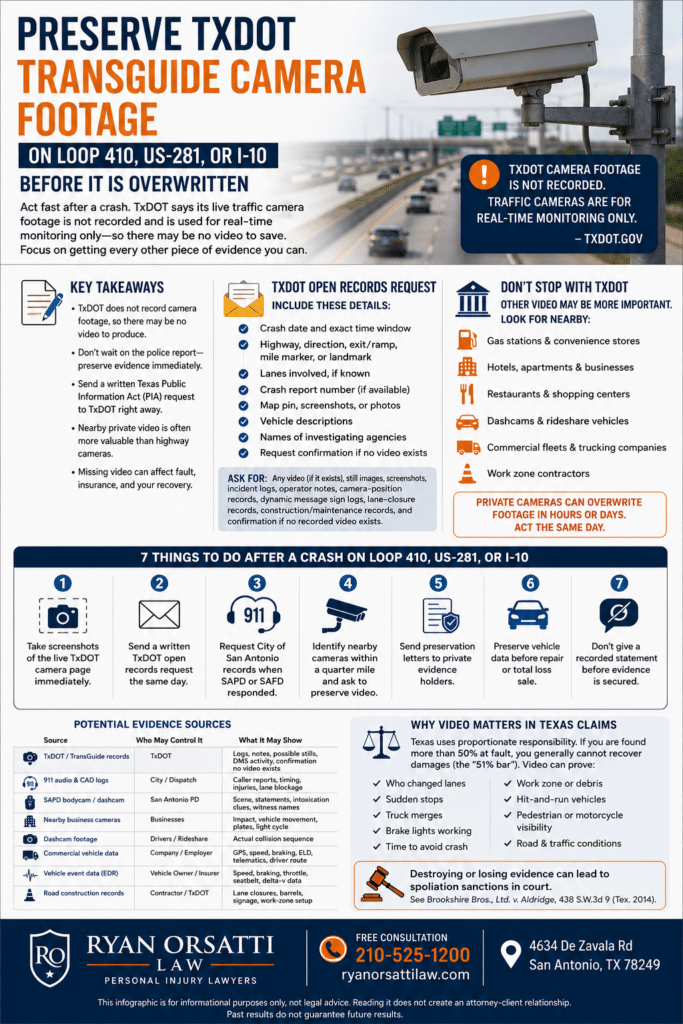
Can You Preserve TxDOT TransGuide Camera Footage After a San Antonio Crash?
The phrase “preserve TxDOT TransGuide camera footage” is common after a serious San Antonio highway crash, but it can be misleading. TransGuide cameras on Loop 410, US-281, I-10, and other major corridors are designed mainly for traffic management, congestion monitoring, and incident response.
TxDOT’s current public notice says: “TxDOT camera footage is not recorded. Traffic cameras are for real-time monitoring only.” (Texas Department of Transportation)
That matters because an open records request can only obtain records that exist. It usually cannot force TxDOT to create video, recreate a livestream, or produce footage that was never stored.
But that does not mean the evidence trail is dead. In matters involving highway crashes in Bexar County, the most useful video often comes from sources near the highway, not the highway camera itself: gas stations, hotels, apartments, commercial fleets, dashcams, nearby work-zone contractors, rideshare vehicles, and private traffic-camera archiving services.
What Is TransGuide?
TransGuide is the San Antonio-area traffic management system connected to TxDOT’s live traffic camera network. These cameras may show traffic flow, disabled vehicles, lane closures, congestion, crash scenes, and emergency response activity.
The important distinction is this:
- Live view means the camera can show what is happening now.
- Recorded footage means a saved video file exists after the fact.
- Archived image or log means a still image, incident entry, operator note, message board log, or related record may exist even if no video exists.
For injury claims, do not assume “camera nearby” equals “video saved.” The preservation plan should cover both public records and private evidence.
First Step: Send a Written TxDOT Open Records Request
A Texas Public Information Act request is a written request asking a government body for existing public information. TxDOT states that open records requests must be made in writing, must include contact information, and must clearly describe the records requested. TxDOT also states that it accepts email requests through TxDOT_ORR@txdot.gov and no longer accepts open records requests by fax. (Texas Department of Transportation)
TxDOT’s San Antonio District covers Bexar County and surrounding counties including Atascosa, Comal, Guadalupe, Kendall, Medina, and Wilson. (Texas Department of Transportation) That is the relevant district for many crashes on Loop 410, US-281, I-10, I-35, and Loop 1604 in the San Antonio area.
Your request should be narrow enough that the agency can identify the records quickly.
Include These Details in the TxDOT Request
- Crash date and exact time window.
- Highway and direction of travel, such as “eastbound I-10” or “southbound US-281.”
- Nearest exit, intersection, mile marker, ramp, overpass, or landmark.
- Lanes involved, if known.
- Crash report number, if available.
- Map pin, screenshots, or photos of the location.
- Vehicle descriptions.
- Names of investigating agencies, such as SAPD, Bexar County Sheriff’s Office, or DPS.
- Request for confirmation if no video exists.
Sample TxDOT Request Language
Use clear language like this:
I am requesting all public records relating to a motor vehicle crash that occurred on [date] at approximately [time] on [highway], [direction], near [exit/intersection/ramp] in San Antonio, Bexar County, Texas. Please search the San Antonio TransGuide / ITS system and produce any existing recorded video, still images, screenshots, incident logs, operator notes, camera-position records, dynamic message sign logs, lane-closure records, traffic incident entries, maintenance records, and communications relating to this incident. If TxDOT does not record or retain camera footage for this location, please provide written confirmation that no responsive recorded video exists.
This wording does two things. First, it asks for video if video exists. Second, it asks for surrounding records that may prove timing, lane blockage, emergency response, congestion, or incident classification.
Do Not Stop With TxDOT: Other Video May Be More Important
If the crash happened on Loop 410, US-281, or I-10, nearby private cameras may capture the actual impact better than TransGuide. Highway cameras often show wide-angle traffic conditions. A nearby business camera may show the light cycle, lane change, rear-end impact, truck merge, pedestrian movement, or hit-and-run vehicle.
Here is where to look.
| Evidence Source | Who May Control It | What It May Show | Urgency |
|---|---|---|---|
| TxDOT / TransGuide records | TxDOT | Live-camera logs, incident notes, possible stills, DMS activity, confirmation no video exists | Same day |
| 911 audio and CAD logs | City of San Antonio / dispatch agency | Caller reports, timing, vehicle descriptions, injuries, lane blockage | Same day |
| SAPD bodycam / dashcam | San Antonio Police Department | Scene conditions, party statements, intoxication clues, witness names | Same week |
| Nearby business cameras | Gas stations, restaurants, hotels, apartments, repair shops | Impact, vehicle movement, hit-and-run plates, traffic-light approach | Same day |
| Dashcam footage | Drivers, rideshare vehicles, commercial fleets | Actual collision sequence | Same day |
| Commercial vehicle data | Trucking company, delivery company, employer | GPS, speed, braking, ELD, telematics, driver route | Same day |
| Vehicle event data recorder | Vehicle owner / insurer / storage yard | Speed, braking, throttle, seatbelt, delta-v data | Before repair or salvage |
| Road construction records | Contractor / TxDOT / project manager | Lane closures, barrels, signage, work-zone setup | Same week |
For related guidance, see our guide on how to pull 911 audio, traffic-cam, TxDOT, VIA, and City video in San Antonio.
After a Crash on Loop 410, US-281, or I-10, Do These 7 Things
- Take screenshots of the live TxDOT camera page immediately.
If you or someone you trust can safely view the live camera after the crash, save screenshots or screen recordings showing the traffic backup, lane blockage, emergency vehicles, or disabled vehicles. - Send a written TxDOT open records request the same day.
Ask for video if it exists, but also ask for logs, screenshots, notes, incident entries, and confirmation if no recording exists. - Request City of San Antonio records when SAPD or SAFD responded.
The City’s open government page lists police reports, incident reports, 911 calls, towing records, and body/dash camera footage as police-related request categories. (San Antonio) - Identify nearby cameras within a quarter mile.
Look for gas stations, hotels, convenience stores, apartments, shopping centers, warehouses, dealerships, and restaurants. Ask them to preserve footage for at least two hours before and after the crash. - Send preservation letters to private evidence holders.
A preservation letter is a written demand telling a person or company to keep evidence because a claim or lawsuit is reasonably anticipated. - Preserve vehicle data before repair or total loss sale.
If the vehicle is towed, repaired, inspected, or sold for salvage, electronic data and physical evidence may disappear. This is especially important in serious-injury, trucking, motorcycle, pedestrian, and rideshare crashes. - Do not give a recorded statement before the evidence is secured.
Insurance adjusters may ask you to commit to a version of events before video, 911 audio, and witness evidence are gathered. That can create avoidable problems if later evidence is incomplete.
Why Timing Matters Even If TxDOT Does Not Record the Video
The risk is not only that TxDOT video disappears. The bigger risk is that private evidence gets overwritten.
Many private camera systems automatically overwrite footage within days or even hours. Some businesses save footage longer, but front-line employees may not know how to export it. By the time an insurance adjuster “investigates,” the system may already have recorded over the crash.
In Texas litigation, spoliation means the loss, destruction, or failure to preserve relevant evidence. The Texas Supreme Court has explained that courts decide spoliation issues and may consider whether a party had a duty to preserve evidence, breached that duty, and caused prejudice. In serious cases, spoliation can affect sanctions and trial remedies. See Brookshire Bros., Ltd. v. Aldridge, 438 S.W.3d 9 (Tex. 2014). (Justia Law)
A preservation letter is not magic. It does not guarantee the evidence will survive. But it helps document notice, timing, the specific evidence requested, and why the evidence matters.
What Records Should You Request From TxDOT?
When a crash happens near a TransGuide camera, request more than “the video.” A better request asks for every record that could show what TxDOT knew, when it knew it, and how the incident affected traffic.
Ask for:
- Any recorded video, if it exists.
- Still images or screenshots.
- Incident logs.
- Operator notes.
- Camera location and camera ID.
- Camera-position records, if available.
- Dynamic message sign logs.
- Lane-closure records.
- Construction or maintenance activity records.
- Traffic incident management records.
- Communications about the crash.
- Any records showing when the crash was detected, verified, cleared, or closed.
- Written confirmation if no recorded camera footage exists.
TxDOT’s open records page also notes that Texas Peace Officer’s Crash Reports, often called CR-3 reports, are purchased through TxDOT’s Crash Report Online Purchase System rather than through a regular open records request. (Texas Department of Transportation)
For crash-report guidance, see our related article on San Antonio crash reports and Texas accident documentation.
What Should You Request From the City of San Antonio?
If the crash was inside San Antonio city limits and SAPD, SAFD, or EMS responded, send a separate request to the City of San Antonio. Do not assume TxDOT and the City share all responsive records.
The City says successful requests should include as much information as possible, including date ranges and subject matter, and that public information includes data collected, assembled, or maintained in connection with official business. (San Antonio)
Ask the City for:
- 911 audio.
- CAD logs.
- SAPD incident report.
- Crash report information.
- Officer bodycam footage.
- Dashcam footage.
- Towing records.
- Fire/EMS response records.
- Scene photographs.
- Supplemental reports.
- Witness information, if releasable.
Some records may be withheld, redacted, delayed, or subject to privacy, law-enforcement, or litigation exceptions. But the request should still be made early.
How Long Does a Texas Public Information Act Request Take?
Under the Texas Public Information Act, government bodies must respond promptly. The Texas Attorney General explains that if a governmental body will take longer than ten business days to produce requested information, it must notify the requestor when the information will be released. If the governmental body withholds requested information, it usually must request a ruling from the Office of the Attorney General. (Texas Attorney General)
Do not confuse the response timeline with evidence preservation. A public agency may take time to process the request, while a private business camera may overwrite footage the next day. That is why public-record requests and private preservation letters should go out at the same time.
Why Video Matters in Texas Highway Injury Claims
Texas uses proportionate responsibility, meaning fault can be divided among multiple people or entities. Under Texas Civil Practice & Remedies Code Chapter 33, a claimant who is found more than 50% responsible generally cannot recover damages. That is often called the 51% bar.
Video can matter because adjusters and defense lawyers may dispute:
- Which driver changed lanes.
- Whether a vehicle stopped suddenly.
- Whether the crash was caused by traffic congestion.
- Whether a truck entered from a ramp unsafely.
- Whether brake lights were working.
- Whether a driver had time to avoid the collision.
- Whether a work zone, lane closure, or debris contributed.
- Whether a hit-and-run vehicle caused the crash.
- Whether a pedestrian or motorcyclist was visible.
For related claim issues, see our pages on San Antonio car accident claims, San Antonio truck accident cases, and Texas UM/UIM coverage after a wreck.
Attorney Insight: The Best Request Is Not Always the Broadest Request
In highway crash matters, we routinely see people make one of two mistakes. They either ask only for “camera footage,” or they send a request so broad that the agency has trouble identifying the records.
The better approach is targeted and layered. Identify the camera corridor, crash time, direction of travel, nearest ramp, responding agency, and exact record types. Ask TxDOT for confirmation if no recorded video exists. Then immediately work outward: 911 audio, business cameras, dashcams, EDR data, tow-yard photos, and commercial vehicle telematics.
The goal is not just to find one video. The goal is to build a timeline that an adjuster, defense lawyer, judge, or jury can understand.
What If the Crash Involved an 18-Wheeler or Commercial Vehicle?
If the crash involved an 18-wheeler, delivery van, company truck, bus, rideshare vehicle, or construction vehicle, the preservation work becomes more urgent.
Commercial cases may involve evidence such as:
- Driver qualification files.
- Hours-of-service records.
- Electronic logging device data.
- GPS and dispatch records.
- Dashcam or inward-facing camera footage.
- Maintenance records.
- Post-crash drug and alcohol testing records.
- Load records.
- Inspection reports.
- Company safety policies.
- Cell phone records.
For trucking cases, see our guide to San Antonio 18-wheeler accident claims and our article on evidence to save after construction-zone crashes in San Antonio.
Can a Lawyer Get the Footage Faster?
A lawyer cannot make TxDOT produce video that does not exist. But a lawyer can move quickly to identify who may have evidence, send preservation letters, draft narrow public-record requests, follow up with agencies, and use formal discovery tools once litigation is filed.
In some Texas cases, lawyers may use discovery tools such as requests for production, subpoenas, nonparty discovery, or, in limited circumstances, pre-suit depositions under the Texas Rules of Civil Procedure. (Texas Courts) The right tool depends on whether a lawsuit has been filed, who controls the evidence, whether the evidence is public or private, and how quickly it may be lost.
FAQ
Does TxDOT TransGuide record traffic camera footage in San Antonio?
TxDOT currently says its traffic-camera footage is not recorded and that traffic cameras are for real-time monitoring only. That means there may be no saved TransGuide video after a crash on Loop 410, US-281, I-10, or another San Antonio highway. You should still request any related records, logs, images, or written confirmation that no recorded video exists.
How do I request TxDOT camera records after a crash?
Send a written Texas Public Information Act request to TxDOT. Include the crash date, time, highway, direction of travel, nearest exit or ramp, lanes involved, vehicle descriptions, and crash report number if available. Ask for video if it exists, plus screenshots, incident logs, operator notes, dynamic message sign records, lane-closure records, and confirmation if no video exists.
Should I wait for the police report before requesting video?
No. Do not wait for the CR-3 crash report before preserving evidence. Police reports can take time to become available, while private camera footage may be overwritten quickly. Start with the crash location, date, time, vehicles, and responding agency. You can supplement the request later when the crash report number is available.
What if a nearby business has video of my crash?
Send a written preservation request immediately. Identify the exact date, time window, camera location, and crash area. Ask the business to save all exterior and parking-lot footage before it is overwritten. If the business will not voluntarily provide the video, a lawyer may need to use subpoena or discovery procedures after a lawsuit is filed.
Can I get SAPD bodycam or dashcam footage after a San Antonio crash?
Possibly. The City of San Antonio lists police reports, incident reports, 911 calls, towing records, and body/dash camera footage among police-related request categories. Some materials may be redacted, withheld, or delayed depending on privacy rules, law-enforcement exceptions, or pending investigations, but the request should be made early.
Why does video matter if the other driver was clearly at fault?
Insurance companies may still dispute fault, injuries, speed, lane position, visibility, sudden stops, or whether another vehicle contributed. In Texas, fault percentages can affect recovery under proportionate responsibility. Video can also confirm the number of vehicles involved, crash severity, road conditions, and whether a hit-and-run vehicle or commercial vehicle played a role.
What if TxDOT says no responsive video exists?
Ask for written confirmation and request related records. Then focus on other evidence: 911 audio, CAD logs, bodycam, dashcam, nearby businesses, tow-yard photos, vehicle data, witness statements, roadway debris photos, and commercial vehicle records. A “no video” response from TxDOT does not mean there is no useful evidence.
How fast should I act after a crash on Loop 410, US-281, or I-10?
Act the same day if possible. The first 24 to 72 hours are often critical for locating private video, identifying witnesses, documenting road conditions, and preserving vehicle data. Even if TxDOT does not record live camera footage, other evidence may exist briefly before it is deleted, overwritten, repaired, moved, or forgotten.
Talk to Ryan Orsatti Law About Preserving Crash Evidence
Highway crashes on Loop 410, US-281, I-10, I-35, and Loop 1604 can turn into evidence disputes quickly. The sooner the preservation work starts, the better chance you have of finding the records, video, witnesses, and vehicle data needed to evaluate liability.
Ryan Orsatti Law
4634 De Zavala Rd, San Antonio, TX 78249
Phone: 210-525-1200
ryanorsattilaw.com
This blog is for informational purposes only, not legal advice. Reading it does not create an attorney-client relationship. Past results do not guarantee future results.
Hurt in an accident in San Antonio? Learn how a San Antonio personal injury lawyer can help with your claim. Call 210-525-1200 or request a free consultation.
The firm works on a contingency fee. You pay nothing unless the firm recovers money for you, and that covers case expenses as well as the fee: if there is no recovery, you owe no attorney's fee and no case expenses. Ask for the fee agreement and read the fee and expense section before you sign anything.
Related San Antonio legal resources
Primary legal and public-data sources
- Texas Civil Practice and Remedies Code Chapter 16: limitations
- Texas Civil Practice and Remedies Code Chapter 33: proportionate responsibility
Ryan Orsatti Law
4634 De Zavala Road, San Antonio, TX 78249
General reference links. Consult each source for its current text.