
When people say “Mansfield bar,” they usually mean the rear underride guard mounted under the back of many trailers and semitrailers. The nickname comes from actress Jayne Mansfield, who died on June 29, 1967, in Louisiana when the car she was riding in struck the rear of a trailer truck. Her driver and lawyer were also killed, while three of her children riding in the back survived. Over time, the public started associating rear underride guards with that crash, and the nickname stuck.
Legally and technically, though, “Mansfield bar” is not the official term. Federal law refers to the device as a rear impact guard or rear underride guard. NHTSA issued the governing federal rear-impact-guard standards in 1996, and those rules became effective on January 26, 1998.
Quick Answer
A Mansfield bar is the steel guard at the rear of many trailers designed to help keep a car from sliding underneath the trailer in a rear-end collision. That matters because underride crashes can cause catastrophic head, neck, and upper-body injuries even when the passenger compartment initially appears intact. Federal law has required rear-impact protection on many new trailers and semitrailers with a GVWR of 10,000 pounds or more since the 1996 rule, effective in 1998.
But a Mansfield bar is not a complete safety solution. Some trailers are exempt. Rear guards do not solve side underride problems. And in real-world cases, the key questions are often whether the guard was required, compliant, damaged, corroded, poorly repaired, improperly mounted, or missing altogether.
In Texas, a serious underride case is rarely just about whether a passenger car hit the back of a truck. The legal analysis usually turns on equipment rules, maintenance history, visibility, fault allocation, insurance coverage, and evidence preservation. Texas proportionate-responsibility law can reduce or bar recovery depending on how fault is assigned, so early investigation matters.
Why Is It Called a Mansfield Bar?
Jayne Mansfield was a well-known actress and public figure of the 1950s and 1960s. On June 29, 1967, she died in a Louisiana crash when the Buick she was riding in struck the rear of a trailer truck. Her driver, Ronnie Harrison, and her lawyer, Sam Brody, were also killed. Three of her children in the back seat survived. That crash helped cement public attention on underride hazards, and the phrase “Mansfield bar” became a common nickname for the rear guard under trailers.
That history matters, but it should be stated carefully. The crash did not mean rear-impact-guard law was created overnight or under that nickname. The modern federal standards were adopted much later. NHTSA’s 1996 final rule created FMVSS No. 223 (the equipment standard for the guard itself) and FMVSS No. 224 (the vehicle standard requiring many trailers and semitrailers to be equipped with one), with an effective date of January 26, 1998.
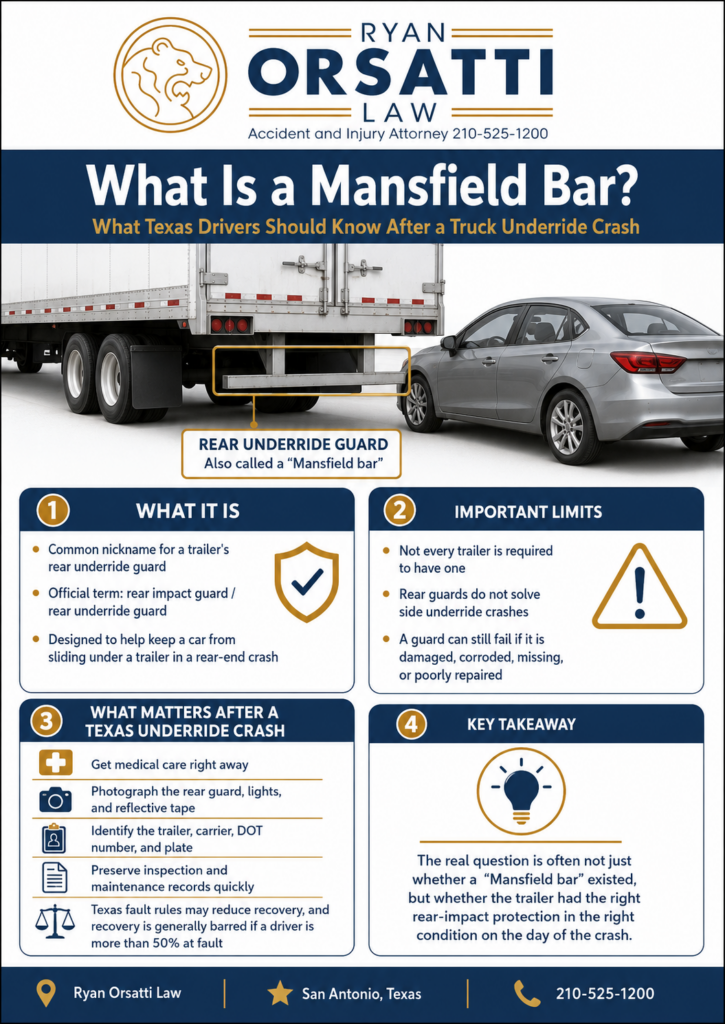
What a Mansfield Bar Actually Does
A rear underride guard is designed to reduce the risk that a passenger vehicle will slide under the rear of a trailer in a rear-end collision. Under the federal rules, the system is supposed to provide enough structure and energy absorption to reduce deaths and serious injuries in certain rear-impact scenarios. NHTSA later upgraded the standards again, and the current framework requires stronger protection for qualifying new trailers and semitrailers in specified 35 mph rear-impact conditions.
That does not mean every underride crash becomes survivable or every trailer is equally protected. Rear guards are aimed at rear impacts. They do not create a universal federal side-guard requirement, and they do not eliminate the risk posed by poor visibility, offset impacts, road conditions, speed, or damaged equipment.
Which Trailers Are Supposed to Have One?
Under the federal scheme, rear-impact-protection rules apply to many trailers and semitrailers with a GVWR of 10,000 pounds or more, but not all of them. The current rule excludes categories such as pole trailers, pulpwood trailers, low-chassis vehicles, road-construction-controlled horizontal discharge trailers, special-purpose vehicles, wheels-back vehicles, and temporary living quarters.
That exemption issue matters in litigation. A missing or damaged rear guard is not automatically proof of negligence unless the trailer was actually required to have one and the applicable standard is identified correctly. In other words, the right first question is usually not “Was there a Mansfield bar?” but “What was this trailer legally required to have on its date of manufacture and on the date of the crash?”
Mansfield Bar Basics at a Glance
| Issue | Why It Matters |
|---|---|
| Was the trailer required to have a rear guard? | Some trailers are exempt, so the equipment rule has to be matched to the trailer type. |
| Was the guard compliant when the trailer was built? | Federal standards distinguish between the guard itself and how it must be installed. |
| Was the guard damaged, missing, corroded, or badly repaired? | A guard can exist on paper and still fail in the real world. |
| Was visibility part of the problem? | Lighting, reflectors, conspicuity tape, weather, and roadway conditions often affect fault arguments. |
| Is this a rear underride case or a side underride case? | Rear guards do not solve every underride mechanism. |
| Who controlled the trailer? | The driver, motor carrier, trailer owner, maintenance contractor, and sometimes a manufacturer may all matter. |
The point is practical: presence is not the same as compliance, and compliance is not the same as safe performance in the crash at issue.
How Texas Truck Underride Cases Usually Play Out
In Texas, an underride case may involve multiple liability theories at once. Depending on the facts, the claim may focus on driver negligence, motor-carrier negligence, trailer-owner negligence, negligent maintenance, negligent inspection, poor conspicuity, or product-related issues involving the guard or trailer design. That is one reason these cases tend to be more technical than an ordinary rear-end collision claim.
Texas also applies proportionate responsibility. A claimant generally cannot recover if the claimant’s percentage of responsibility is greater than 50 percent. In an underride case, that often means the defense will argue the passenger vehicle was speeding, following too closely, distracted, fatigued, or driving in conditions where the trailer should have been seen sooner.
For a San Antonio or Bexar County case, that is why the early evidence often matters more than the initial insurance narrative. The crash report may be important, but it usually does not answer whether the trailer was exempt, whether the guard met the applicable standard, or whether poor maintenance or visibility contributed to the underride. Those questions usually have to be built from records, measurements, photos, and inspections.
What Evidence Usually Matters Most
If a rear-underride crash happened in San Antonio, on I-10, Loop 1604, I-35, or elsewhere in Texas, evidence can disappear quickly once the trailer goes back into service. A strong investigation often starts with preserving:
- the trailer number, VIN, plate, DOT number, and carrier identity,
- photographs of the rear guard, mounting points, lighting, and reflective tape,
- bodycam, dashcam, and nearby surveillance footage,
- driver logs, dispatch records, and trip records,
- annual inspection records and maintenance records,
- repair history for the trailer and rear guard,
- post-crash measurements of guard height, width, placement, welds, and deformation,
- load information and trailer classification to evaluate exemptions.
That inspection history matters even more now because FMCSA amended the federal rules to include rear impact guards on the list of items that must be examined as part of the required annual inspection for each commercial motor vehicle. If the guard should have been inspected and was not, or if it was inspected but left in a noncompliant condition, that can become an important liability issue.
How Insurance Usually Fits In
Many underride cases involve more than one policy. There may be a motor-carrier liability policy, excess coverage, a trailer-owner policy, or other coverage tied to maintenance or equipment responsibility. On the injured person’s side, first-party coverages can matter too. Texas requires at least 30/60/25 liability coverage for personal auto policies, includes PIP unless rejected in writing, and requires insurers to offer UM/UIM coverage unless it is rejected in writing.
In practice, adjusters usually evaluate four buckets first:
- Liability
- Causation
- Injury severity
- Available coverage
In a catastrophic underride case, the damages are often obvious. The harder fight is usually over why the underride happened, whether the trailer was compliant, and who actually controlled the risk-creating condition.
How Long Do You Have To Act in Texas?
Texas generally imposes a two-year limitations period for personal injury and wrongful death claims, although exceptions and claim-specific issues can change the analysis. In underride cases, waiting is especially risky because the trailer may be repaired, moved, sold, or returned to service before the key physical evidence is documented.
That is why the better practical question is not just “How long do I have to sue?” It is “How quickly can critical evidence be preserved before it changes?”
Common Mistakes After a Suspected Underride Crash
1. Assuming the police report answers the equipment question
It usually does not. A crash report may identify the vehicles, the scene, and the initial narrative, but it often does not answer whether the rear guard was required, compliant, damaged, or properly mounted.
2. Letting the trailer go back into service without preservation
Once a trailer is repaired or reused, the most important physical evidence may be gone.
3. Focusing only on the truck driver
The motor carrier, trailer owner, maintenance contractor, and other entities may matter too.
4. Ignoring exemption and build-date issues
A rear-guard analysis has to be tied to the trailer type and the applicable regulatory standard.
5. Overlooking first-party coverage
PIP, Med Pay, and UM/UIM can matter early, especially where medical bills and wage loss start immediately.
Attorney Insight
In a serious underride case, one of the most important early questions is not whether there was “a Mansfield bar.” It is whether the trailer had the right rear-impact protection for that unit, on that build date, in that condition, on the day of the crash.
That distinction changes case value and case strategy. A guard may exist but still be bent, corroded, cracked, badly repaired, or installed in a way that defeats the protection the rule was supposed to provide. On the other hand, some trailers are exempt, and some crashes turn more on visibility, stopping distance, offset impact mechanics, or side-underride dynamics than on the rear guard alone. In real Texas trucking cases, careful identification and preservation usually matter more than assumptions.
FAQs
Is “Mansfield bar” the official legal term?
No. The official federal terminology is rear impact guard or rear underride guard. “Mansfield bar” is a common nickname tied to Jayne Mansfield’s 1967 fatal crash.
Was the Mansfield bar officially required in 1998?
More precisely, NHTSA issued the final federal rules in 1996, and they became effective on January 26, 1998.
Are Mansfield bars required on all trailers?
No. Federal rules apply to many trailers and semitrailers, but there are listed exemptions.
Can I still have a case if the truck had a rear guard?
Yes. A case may still turn on whether the guard was compliant, maintained, visible, properly mounted, or adequate for the crash circumstances.
What if the insurance company says I was partly at fault?
Texas uses proportionate responsibility. Your recovery may be reduced by your percentage of fault, and recovery is generally barred if you are found more than 50% responsible.
What should I do first after a suspected underride crash?
Get medical care, preserve photographs, identify the trailer and carrier, and make sure the trailer and its inspection/maintenance evidence are preserved quickly.
What To Do Next
If you or a family member was hurt in a rear-underride crash in San Antonio, Bexar County, or elsewhere in Texas, the most important early step is usually preserving the trailer, the rear guard, and the inspection and maintenance evidence before anything changes. In many of these cases, the physical equipment and records explain far more than the initial insurance position.
Ryan Orsatti Law
4634 De Zavala Rd, San Antonio, TX 78249
Phone: 210-525-1200
This blog is for informational purposes only, not legal advice. Reading it does not create an attorney-client relationship. Past results do not guarantee future results.
Hurt in an accident in San Antonio? Learn how a San Antonio truck accident lawyer can help with your claim. Call 210-525-1200 or request a free consultation.
The firm works on a contingency fee. You pay nothing unless the firm recovers money for you, and that covers case expenses as well as the fee: if there is no recovery, you owe no attorney's fee and no case expenses. Ask for the fee agreement and read the fee and expense section before you sign anything.
Related San Antonio legal resources
Primary legal and public-data sources
Ryan Orsatti Law
4634 De Zavala Road, San Antonio, TX 78249
General reference links. Consult each source for its current text.