
Quick Answer
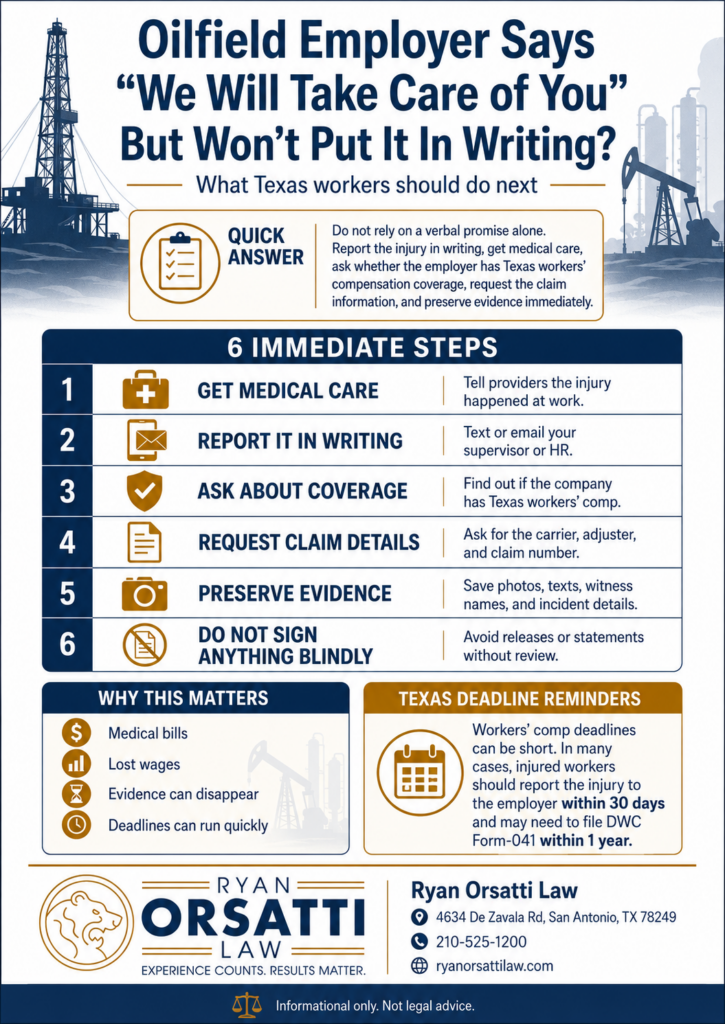
If your oilfield employer says “we will take care of you” but will not put it in writing, do not rely on the verbal assurance alone. Ask for written confirmation of what they will pay, report the injury in writing, get medical care, preserve evidence, and find out whether the employer has Texas workers’ compensation coverage or is a non-subscriber.
A verbal promise may disappear once medical bills, lost wages, OSHA reporting, workers’ compensation deadlines, subrogation, and liability questions become real.
Key Takeaways
- A verbal “we will take care of you” is not the same as a written claim number, written coverage confirmation, or signed payment agreement.
- Texas private employers can choose whether to carry workers’ compensation coverage in most cases, and employers without coverage are called non-subscribers. (Texas Department of Insurance)
- If workers’ compensation applies, Texas deadlines can be short: report the injury to the employer within 30 days and file DWC Form-041 within one year. (Texas Department of Insurance)
- If a third party caused or contributed to the oilfield injury, Texas Labor Code § 417.001 may allow a separate third-party claim while the worker also pursues workers’ compensation benefits. (Texas Statutes)
- In serious oilfield injuries, early evidence preservation matters because equipment, logs, electronic data, photos, witness access, and incident reports can change quickly.
Why is “we will take care of you” risky after an oilfield injury?
“We will take care of you” is risky because it usually does not identify who will pay, what will be paid, how long payments will continue, or whether you are giving up any rights. In an oilfield injury case, those missing details matter.
Oilfield employers and contractors may use that phrase in different ways. Sometimes it means they will help you get to a clinic. Sometimes it means they will turn the claim over to workers’ compensation. Sometimes it means they want to keep the incident quiet, avoid paperwork, or stop you from calling a lawyer.
The problem is simple: your medical providers, mortgage company, health insurer, and family cannot deposit a vague verbal assurance.
In Texas, some agreements must be in writing to be enforceable, including certain promises by one person to answer for another person’s debt under Texas Business and Commerce Code § 26.01. Whether that statute applies to a particular employer promise is fact-dependent, but the practical point is clear: get the promise in writing before you rely on it. (Texas Statutes)
A Texas oilfield worker should treat “we will take care of you” as a starting point, not a solution. The worker still needs written injury reporting, medical documentation, coverage information, wage-loss proof, and evidence preservation.
What should you ask the employer to put in writing?
You should ask the employer to put the payment promise, coverage status, claim information, and injury report details in writing. If the employer refuses, send your own written confirmation by text or email so there is a dated record.
Ask for written answers to these questions:
| Question to ask | Why it matters |
|---|---|
| Do you have Texas workers’ compensation coverage? | This determines whether the claim likely goes through the Texas Division of Workers’ Compensation or may involve a non-subscriber claim. |
| What is the claim number? | A real claim usually has a carrier, adjuster, claim number, and written instructions. |
| Who is paying medical bills? | “The company” is too vague. You need the carrier, plan administrator, third-party administrator, or written employer agreement. |
| Will lost wages be paid? | Wage promises should identify amount, timing, duration, and whether payments are advances, benefits, payroll, or settlement-related. |
| Are you asking me to sign anything? | Releases, waivers, resignation papers, light-duty forms, and recorded statements can affect your rights. |
| Was OSHA notified if the injury was reportable? | Employers must report work-related fatalities within 8 hours and in-patient hospitalizations, amputations, or eye loss within 24 hours. (OSHA) |
| May I have a copy of the incident report? | Incident reports often become important evidence if the facts are later disputed. |
A good written confirmation does not need fancy language. It needs names, dates, claim numbers, coverage details, and a clear statement of what the employer is agreeing to do.
How do you protect yourself when the employer refuses to write it down?
You protect yourself by creating your own written record and keeping it factual. Do not argue, exaggerate, threaten, or speculate. Write down what happened, who said what, and what you are asking the employer to confirm.
Here is a practical message:
“Today, after my injury at [location], [name/title] told me the company would ‘take care of me.’ Please confirm in writing whether that means the company or its insurer will pay my medical bills, lost wages, prescriptions, follow-up care, and any time off work. Please also send the workers’ compensation carrier name, claim number, and adjuster contact information, or confirm in writing if the company does not carry Texas workers’ compensation coverage.”
Send it by text or email. Keep screenshots. Save the response, even if the response is evasive.
Do not let the lack of a written promise stop you from getting medical care. Tell each doctor exactly how the injury happened, where it happened, and that it was work-related. Medical records created close in time to the incident are often more reliable than later memory.
What if the employer has Texas workers’ compensation coverage?
If the employer has Texas workers’ compensation coverage, the claim usually moves through the Texas Division of Workers’ Compensation system, and the verbal promise should not replace statutory reporting steps. Workers’ compensation may provide medical and income benefits for a covered work injury, but it also comes with deadlines and procedures.
Texas Department of Insurance guidance says injured workers must report the injury to the employer within 30 days from the date they were hurt or knew the injury was job-related, and must send DWC Form-041 within one year to protect rights. (Texas Department of Insurance)
Texas Labor Code § 408.001 generally makes workers’ compensation benefits the exclusive remedy against a covered employer for a covered work injury or death, subject to narrow exceptions. (Texas Statutes) That means the worker may have benefits through comp, but suing the employer directly is often barred.
That does not end the analysis. Texas Labor Code § 417.001 allows an employee or legal beneficiary to seek damages from a liable third party for a compensable injury or death while also pursuing workers’ compensation benefits. (Texas Statutes) On an oilfield site, a third party may be another contractor, trucking company, equipment manufacturer, property owner, maintenance vendor, or safety contractor.
What if the employer is a Texas non-subscriber?
If the employer is a Texas non-subscriber, the worker may have a negligence claim against the employer, but the worker still must prove the employer or its agent was negligent. A non-subscriber is a private employer that chooses not to provide Texas workers’ compensation coverage. (Texas Department of Insurance)
Texas non-subscriber cases are different from ordinary workers’ compensation claims. The employer does not get the same workers’ compensation exclusive-remedy protection. The worker may be able to pursue damages through a civil claim if unsafe conduct, unsafe equipment, inadequate training, improper supervision, or another negligent act caused the injury.
The details matter. A contractor may call itself “self-insured,” but Texas DWC warns that private employers without workers’ compensation coverage are referred to as non-subscribers, not certified self-insurers, unless they have the required certificate of authority. (Texas Department of Insurance)
For South Texas oilfield workers in the Eagle Ford Shale, Permian Basin, Bexar County, Atascosa County, Karnes County, La Salle County, Midland, Odessa, and surrounding areas, the coverage question should be answered early. A vague promise can hide the most important issue in the case: whether the employer has workers’ compensation coverage at all.
Can you still have a claim against someone besides your employer?
Yes, you may still have a claim against a third party if someone besides your employer caused or contributed to the oilfield injury. This is common on multi-company job sites.
A single well site may involve:
- The lease operator
- A drilling contractor
- A casing crew
- A trucking company
- A water hauler
- A sand hauler
- A crane or rigging contractor
- A tool or equipment vendor
- A maintenance company
- A safety consultant
- A property owner
A third-party claim is a personal injury claim against someone other than the direct employer. In plain English, it means another company may be legally responsible for unsafe conduct that hurt you.
Third-party claims can matter because workers’ compensation does not usually pay for every category of loss available in a civil injury case. But third-party cases also create subrogation issues. Subrogation means an insurance carrier or benefit plan may claim a right to be reimbursed from part of a recovery.
That is why oilfield injury claims should be evaluated as a system, not as one isolated form. Workers’ compensation, non-subscriber liability, third-party liability, health insurance reimbursement, ERISA plan reimbursement, MedPay, hospital liens, and letters of protection can all affect the net result.
How can medical bills become a problem if the employer said it would pay?
Medical bills become a problem when the employer does not actually pay them, pays only part of them, delays payment, or claims later that the treatment was not authorized. The worker may then face collections, lien claims, insurance denials, or pressure to return to work too early.
In Texas, hospital lien issues can arise after accident-related treatment. Texas Property Code Chapter 55 provides that a hospital may have a lien on certain claims of an individual who receives hospital services for accident injuries attributed to another person’s negligence. (Texas Statutes)
That does not mean every medical provider has a valid lien. It does mean you should not assume “the company is handling it” unless you see payment records, explanation of benefits documents, claim correspondence, or written authorization.
If you use health insurance, the health plan may later assert reimbursement rights. If you treat on a letter of protection, the provider may expect payment from a future settlement. If workers’ compensation applies, medical billing should generally run through that system. Each path has tradeoffs.
What should you do after an oilfield employer refuses to put the promise in writing?
After an oilfield employer refuses to put the promise in writing, take these steps immediately:
- Get medical care now. Tell the provider the injury happened at work, where it happened, and how it happened.
- Report the injury in writing. Send a dated text or email to your supervisor, safety manager, HR, or the person designated to receive injury reports.
- Ask for coverage information. Request the workers’ compensation carrier, claim number, adjuster, or written confirmation that the employer does not carry Texas workers’ compensation coverage.
- Save every communication. Keep texts, emails, voicemails, call logs, payroll messages, safety messages, and app communications.
- Photograph evidence. If safe and allowed, preserve photos of equipment, warning labels, guards, valves, hose connections, ladders, fall protection, PPE, vehicle damage, fluid spills, and the work area.
- Write down witness names. Include coworkers, company men, contractors, drivers, medics, supervisors, and anyone who heard the employer say it would “take care of you.”
- Do not sign a release without review. A release is a document that may give up legal rights. Do not assume it is harmless because someone says it is “just paperwork.”
- Track wage loss. Save pay stubs, per diem records, overtime history, rig schedules, dispatch records, and missed-work notes.
- Ask whether OSHA reporting was required. OSHA reporting is the employer’s duty, but the presence or absence of a report can become important.
- Talk to a Texas injury attorney before relying on the verbal promise. The earlier the coverage and evidence issues are sorted out, the less room there is for confusion later.
For a broader evidence checklist, see Ryan Orsatti Law’s guide on what to do immediately after an oilfield accident in Texas.
How long do you have to act in Texas?
You should act immediately because different deadlines may apply at the same time. Some deadlines are measured in hours, some in days, and some in years.
| Issue | Common Texas or federal deadline | Why it matters |
|---|---|---|
| OSHA fatality report by employer | 8 hours | Required for work-related deaths reported to OSHA. (OSHA) |
| OSHA in-patient hospitalization, amputation, or eye loss report by employer | 24 hours | Required for certain severe work-related injuries. (OSHA) |
| Workers’ compensation notice to employer | 30 days | Late notice may threaten workers’ compensation benefits. (Texas Department of Insurance) |
| DWC Form-041 employee claim | 1 year | Needed to protect Texas workers’ compensation rights. (Texas Department of Insurance) |
| Texas personal injury lawsuit | Usually 2 years | Texas Civil Practice and Remedies Code § 16.003 includes a two-year limitations period for personal injury claims. (Texas Statutes) |
These deadlines can overlap. For example, an injured oilfield worker may need to report the injury to the employer within 30 days, file DWC Form-041 within one year, and file a third-party lawsuit within two years. A verbal promise from the employer does not usually stop these clocks.
What evidence matters most when the employer keeps everything verbal?
The most important evidence is the evidence that proves what happened before the employer controlled the paper trail. In oilfield cases, the company often has the incident report, safety records, job safety analysis, training files, maintenance logs, driver logs, dispatch records, equipment manuals, inspection records, and witness access.
Preserve what you can legally and safely preserve:
- Photos and videos from the scene
- PPE involved in the incident
- Damaged tools or equipment
- Time sheets and job assignments
- Safety meeting notes
- Job safety analysis documents
- Texts from supervisors
- Names and phone numbers of witnesses
- Clinic paperwork
- Discharge instructions
- Work restrictions
- Mileage to medical appointments
- Prescription receipts
- Pay stubs showing overtime and per diem
According to the Bureau of Labor Statistics, oil and gas extraction industries had 65 fatal work injuries in 2024, part of the private-sector mining, quarrying, and oil and gas extraction category. (Bureau of Labor Statistics) That number is a reminder that oilfield injury claims are not ordinary paperwork disputes. They often involve dangerous systems, heavy equipment, pressure, transportation, and multiple companies.
What should you avoid saying or signing?
You should avoid signing anything that releases claims, limits treatment, changes your job status, or says you are “fine” before you understand the document. You should also avoid giving a recorded statement without knowing who is taking it and why.
Be careful with documents labeled:
- Waiver
- Release
- Settlement
- Resignation
- Independent contractor acknowledgment
- Full duty release
- Light duty refusal
- Medical authorization
- Incident statement
- Employee benefit election
- Loan or advance agreement
Also be careful with short statements such as “I’m okay,” “it was my fault,” or “I do not need treatment.” Pain, concussion symptoms, spine injuries, internal injuries, burns, chemical exposure symptoms, and nerve symptoms can develop or worsen after the first day.
Attorney Insight: In oilfield files, the danger is often not the first verbal promise. The danger is the quiet shift that happens later: the employer stops paying, the clinic records are incomplete, the incident report favors the company, and the worker has not preserved the names of contractors who were actually responsible. Written confirmation early can prevent that shift from controlling the case.
When should you call a lawyer after this happens?
You should call a lawyer when the employer will not put the promise in writing, when medical bills are not being paid, when you are asked to sign documents, when your injury is serious, or when multiple companies were on the job site. You do not need to wait until the employer formally denies help.
A lawyer can help identify whether the employer is a workers’ compensation subscriber, a non-subscriber, or part of a contractor arrangement that creates additional coverage questions. A lawyer can also send preservation letters, request insurance information, evaluate third-party liability, and protect deadlines.
Ryan Orsatti Law handles oilfield injury matters in San Antonio, Bexar County, South Texas, and across Texas. You can also review the firm’s San Antonio oil field accident page, commercial vehicle accident information, and traumatic brain injury case page if the incident involved trucking, heavy equipment, falls, or head trauma.
FAQ
Is a verbal promise from my oilfield employer legally enough in Texas?
A verbal promise may be evidence, but it is not the same as a written agreement, workers’ compensation claim, insurance confirmation, or payment record. Texas law requires certain promises to be in writing, including some promises to answer for another person’s debt. Because enforceability is fact-specific, get the employer’s promise in writing before relying on it.
What if my supervisor told me not to file an injury report?
You should still create a written record that you were hurt at work. In a Texas workers’ compensation claim, TDI says an injured worker must report the injury to the employer within 30 days and file DWC Form-041 within one year. A supervisor’s verbal instruction should not replace your own dated written notice.
Can my employer pay my medical bills without workers’ compensation?
Possibly, but you need to know what legal arrangement is being used. The employer might be a non-subscriber with a private occupational injury plan, might be paying voluntarily, or might be trying to avoid formal reporting. Ask for the plan documents, written payment terms, claim administrator, and confirmation that you are not waiving rights.
What if the employer starts paying but then stops?
If the employer starts paying and then stops, gather every bill, payment record, text, email, and explanation of benefits. Then confirm whether a workers’ compensation claim exists, whether a private benefit plan exists, and whether any third-party claim is available. Do not assume the verbal promise extended your legal deadlines.
Can I sue my oilfield employer if it has workers’ compensation?
Usually, Texas workers’ compensation benefits are the exclusive remedy against a covered employer for a covered work injury, subject to narrow exceptions. But you may still have a third-party claim against another company that caused or contributed to the injury, such as a trucking company, subcontractor, equipment vendor, or site operator.
Can I sue my oilfield employer if it is a non-subscriber?
You may be able to sue a Texas non-subscriber employer if employer negligence caused the injury. A non-subscriber is an employer that does not provide Texas workers’ compensation coverage. These cases are fact-specific and usually turn on unsafe conditions, training, supervision, equipment, maintenance, and whether the employer’s conduct caused the harm.
Should I use my health insurance if the employer says it will pay?
Do not delay needed medical care while waiting on the employer. Whether to use health insurance, workers’ compensation, a private occupational injury plan, or a letter of protection depends on coverage and billing facts. Keep all bills and insurance paperwork because subrogation, ERISA reimbursement, hospital liens, and provider balances may affect the final accounting.
What should I text my employer if they refuse to put it in writing?
Send a calm written confirmation: “Please confirm what you meant when you said the company would take care of me after my work injury on [date]. Please send the workers’ compensation carrier, claim number, adjuster, and written confirmation of what medical bills and lost wages will be paid.” Save the message and response.
Ryan Orsatti Law
4634 De Zavala Rd, San Antonio, TX 78249
Phone: 210-525-1200
ryanorsattilaw.com
This blog is for informational purposes only, not legal advice. Reading it does not create an attorney-client relationship. Past results do not guarantee future results.
Hurt in an accident in San Antonio? Learn how a San Antonio personal injury lawyer can help with your claim. Call 210-525-1200 or request a free consultation.
The firm works on a contingency fee. You pay nothing unless the firm recovers money for you, and that covers case expenses as well as the fee: if there is no recovery, you owe no attorney's fee and no case expenses. Ask for the fee agreement and read the fee and expense section before you sign anything.
Related San Antonio legal resources
- San Antonio construction-accident representation
- Texas personal-injury services
- Contact Ryan Orsatti Law
Primary legal and public-data sources
- Texas Civil Practice and Remedies Code Chapter 16: limitations
- Texas Civil Practice and Remedies Code Chapter 33: proportionate responsibility
Ryan Orsatti Law
4634 De Zavala Road, San Antonio, TX 78249
General reference links. Consult each source for its current text.