
Quick Answer
Yes. An adjuster can use your recorded statement about the oilfield accident against you later to dispute fault, injury severity, timing, credibility, or whether another company was responsible. In a Texas lawsuit, your own words may also matter because Texas Rule of Evidence 801(e)(2) treats certain opposing-party statements as not hearsay when offered against that party. (Texas Judicial Branch)
The risk is higher in oilfield accident claims because several companies may be involved: your employer, a lease operator, a drilling contractor, a trucking company, a service company, an equipment company, or a workers’ compensation carrier.
Key Takeaways
- A recorded statement is not just a “quick call.” It can become claim-file evidence.
- Adjusters may use early answers to challenge your later medical history, work restrictions, pain complaints, or fault position.
- Texas proportionate responsibility rules make wording about fault especially important.
- Oilfield cases often involve overlapping claims, including workers’ compensation, third-party liability, subrogation, and evidence preservation.
- You can usually provide basic identifying facts without guessing, estimating, or giving a detailed recorded statement before legal review.
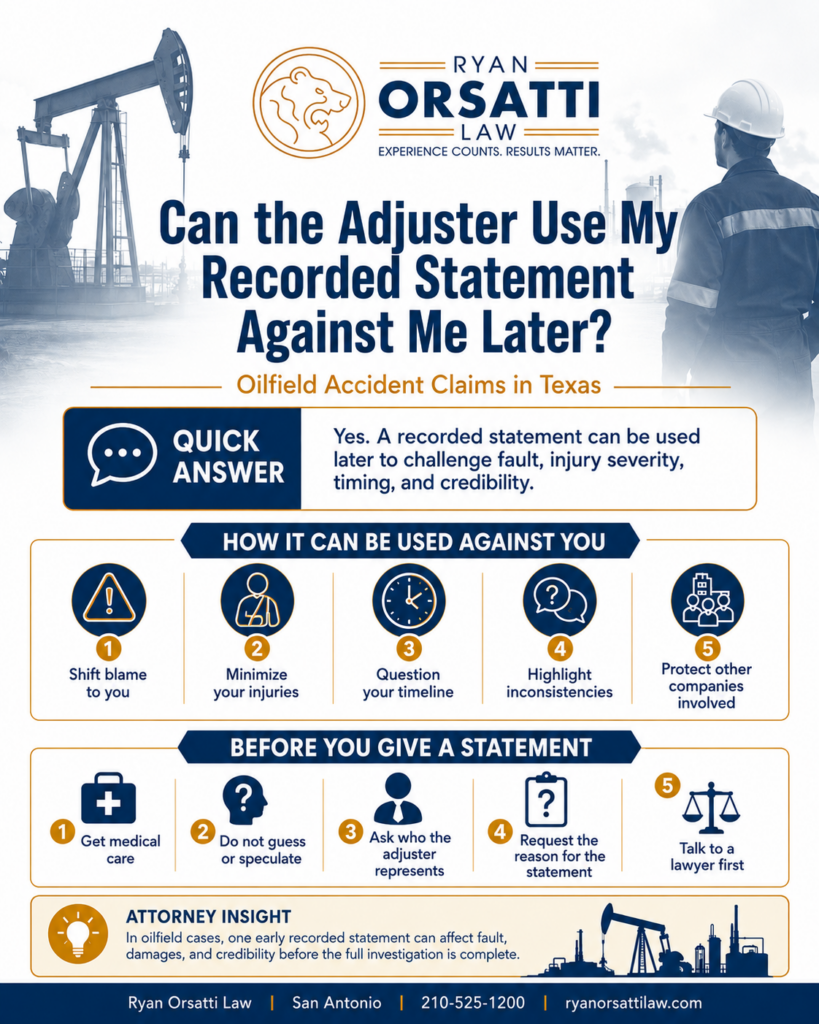
Can the adjuster use my recorded statement about the oilfield accident against me later?
Yes, the adjuster can use your recorded statement later in the insurance claim and, depending on the facts and evidence rules, it may also be used in litigation.
A “recorded statement” is an audio or video-recorded interview where an adjuster asks questions about how the oilfield accident happened, what you saw, what hurt, who was present, what safety rules applied, and what medical care you have received. An “adjuster” is the insurance representative evaluating the claim for an insurance company, employer, contractor, or other covered entity.
The dangerous part is timing. Many statements are requested before the injured worker has reviewed the incident report, OSHA documents, witness names, safety policies, maintenance records, job safety analysis, photos, video, or medical diagnosis.
In Texas, a recorded statement about an oilfield accident may become more than an insurance file note. Texas Rule of Evidence 801(e)(2) says an opposing party’s statement can be treated as not hearsay when offered against that party, including a statement made by the party in an individual capacity. (Texas Judicial Branch)
That does not mean every recording automatically comes into evidence. Foundation, relevance, context, objections, and the purpose for offering the statement still matter. But it does mean you should treat a recorded statement as something that may follow the claim.
Why are recorded statements risky after an oilfield accident?
Recorded statements are risky because oilfield injuries often develop medically and legally before the full picture is known.
An injured worker may know that something exploded, slipped, failed, struck, collapsed, leaked, or rolled over. But that worker may not yet know why it happened. Was there a maintenance issue? A defective valve? A failed lockout-tagout procedure? A rushed crew? A subcontractor problem? A lease-road trucking issue? A missing spotter? A supervisor order? A failed hose, winch, pump, or pressure-control component?
Those details matter because oilfield claims are rarely simple. According to the U.S. Bureau of Labor Statistics, oil and gas extraction industries had 65 fatal occupational injuries in 2024, and the category includes oil and gas extraction, drilling oil and gas wells, and support activities for oil and gas operations. (Bureau of Labor Statistics) The Texas Department of Insurance, Division of Workers’ Compensation reported 557 fatal occupational injuries in Texas in 2024, with mining, quarrying, and oil and gas extraction accounting for 36 fatalities and support activities for oil and gas operations accounting for 26. (Texas Department of Insurance)
That safety context matters. A serious oilfield accident near San Antonio, the Eagle Ford Shale, West Texas, or a lease road can involve heavy equipment, multiple contractors, pressure systems, commercial vehicles, and missing evidence. A fast recorded statement can freeze your account before the investigation catches up.
How can an adjuster use a recorded statement against an injured oilfield worker?
An adjuster can use a recorded statement to find inconsistencies, assign partial fault, dispute injury causation, narrow the timeline, or separate one company from responsibility.
Common examples include:
- “I’m okay” being used later to question delayed pain or worsening symptoms.
- “I think I slipped” being used to imply the worker caused the accident.
- “I did not see what hit me” being used to dispute liability.
- “My back hurt before” being used to blame a preexisting condition.
- A rough time estimate being compared against dispatch logs, gate logs, electronic data, or supervisor notes.
- A guess about who controlled the worksite being used to protect the lease operator or general contractor.
A recorded statement after an oilfield accident can become a credibility document. If your statement says one thing on day three and your deposition says something more complete eight months later, the defense may argue that your story changed, even when the real issue is that you learned more facts later.
Texas Rule of Evidence 613 also allows a witness to be examined about a prior inconsistent statement, with rules about identifying the contents, time, place, and person involved. In plain English, if your later testimony differs from your earlier recorded statement, the earlier recording may become a tool to challenge your credibility.
What parts of an oilfield recorded statement usually create the biggest problems?
The most dangerous recorded statement topics are fault, injury severity, preexisting conditions, work restrictions, and company control.
| Topic the adjuster asks about | Why it can hurt later | Safer approach before legal review |
|---|---|---|
| “How did the accident happen?” | You may guess before equipment logs, safety reports, or witness accounts are reviewed. | Give only basic facts you personally know. Do not speculate. |
| “Were you partly at fault?” | Texas proportionate responsibility can reduce or bar recovery depending on the fault percentage. | Do not accept blame without evidence. |
| “What injuries do you have?” | Pain may evolve after adrenaline wears off, imaging is completed, or specialists evaluate you. | Say you are still being evaluated if that is true. |
| “Did you have prior back, neck, knee, or shoulder problems?” | A partial medical history may be used to dispute causation. | Do not guess. Medical records should be reviewed carefully. |
| “Who was in charge?” | Oilfield control issues can affect whether an employer, contractor, lease operator, or service company is responsible. | Identify who you directly worked with, not legal responsibility. |
| “Did you violate any safety rule?” | The answer may be used to shift blame to the injured worker. | Ask to review the written policy before answering. |
| “Can we close the claim if we pay your bills?” | A fast settlement may ignore future care, wage loss, liens, or third-party claims. | Do not discuss settlement value before medical and lien issues are clear. |
Does Texas proportionate responsibility make recorded statements more important?
Yes, Texas proportionate responsibility makes recorded statements especially important because statements about fault can affect claim value and recovery rights.
“Proportionate responsibility” means fault can be divided among the people and companies involved. Under Texas Civil Practice and Remedies Code § 33.001, a claimant may not recover damages if the claimant’s percentage of responsibility is greater than 50 percent. (Texas Statutes) If the claimant is not barred, § 33.012 generally reduces damages by the claimant’s percentage of responsibility. (Texas Statutes)
This is why wording matters. If an adjuster gets an injured worker to say, “I should have watched closer,” “I was moving too fast,” or “I probably should have stopped the job,” the carrier may later argue the worker accepted partial fault. That may happen even when the real evidence shows missing safety equipment, poor supervision, defective machinery, inadequate training, or pressure to keep working.
In a Bexar County or South Texas oilfield case, fault may turn on details that are not obvious on the first phone call: who owned the equipment, who maintained it, who trained the crew, who controlled the lease road, who wrote the job safety analysis, who had stop-work authority, and who preserved the incident evidence.
Is a workers’ compensation statement different from a liability adjuster statement?
Yes, a workers’ compensation statement can be different from a liability adjuster statement, but both should be handled carefully.
Workers’ compensation is a benefit system for covered work injuries. In Texas, if an employer carries workers’ compensation insurance, recovery of workers’ compensation benefits is generally the exclusive remedy against that covered employer under Texas Labor Code § 408.001. (Texas Statutes) But that does not always end the case. Texas Labor Code § 417.001 allows an injured employee or legal beneficiary to seek damages from a liable third party while also pursuing workers’ compensation benefits. (Justia Law)
A “third-party claim” means a claim against someone other than the employer, such as a subcontractor, trucking company, equipment manufacturer, lease operator, or maintenance contractor. “Subrogation” means a workers’ compensation carrier, health insurer, or certain benefit plan may claim a right to be repaid from a later recovery. An ERISA plan is a type of employee benefit plan governed by federal law, and it may have reimbursement language that affects the net recovery.
The problem is that a statement given for one purpose can be requested, summarized, subpoenaed, or used in another setting. That is why you should know who is asking, who they represent, whether the statement is recorded, whether counsel is involved, and whether the request relates to benefits, liability, or settlement.
Who may ask for a statement after an oilfield accident?
Several different people may ask for a statement after an oilfield accident, and each request carries a different risk.
| Person asking | What they may want | Main risk |
|---|---|---|
| Employer or supervisor | Internal incident report, safety investigation, return-to-work documentation | The statement may frame the accident as worker error. |
| Workers’ compensation adjuster | Benefits eligibility, wage information, medical status | Incomplete medical details may affect benefit decisions. |
| Third-party liability adjuster | Fault, damages, witness details, settlement exposure | The recording may be used to reduce or deny the third-party claim. |
| Lease operator or contractor investigator | Control, safety procedures, equipment use | The statement may help a company distance itself from responsibility. |
| Company lawyer or risk manager | Litigation defense and evidence development | The questioning may be strategic, not neutral. |
| OSHA or government investigator | Workplace safety facts | Truthful cooperation matters, but legal guidance may still be important. |
If you do not understand who is asking, pause. It is reasonable to ask for the person’s name, company, role, claim number, who they represent, whether the call is being recorded, and whether they will provide a copy of the recording or transcript.
What if the adjuster says the recorded statement is required?
If the adjuster says a recorded statement is required, ask required by whom, under what policy, and for what claim.
A third-party liability carrier usually wants your statement to evaluate its insured’s exposure. That is different from your own policy duties or a workers’ compensation benefits process. Your own insurance policy, employment documents, or benefit claim may require some level of cooperation, but cooperation does not always mean an immediate broad recorded interview while you are medicated, in pain, or missing key documents.
A safer response is direct and calm:
“I am not refusing to cooperate. I am not ready to give a recorded statement today. Please send your questions, your role, the claim number, and the reason you believe a recorded statement is required. I will respond after I understand the request.”
Do not lie, exaggerate, or hide facts. The goal is accuracy. The goal is not silence for its own sake. The goal is to avoid guessing into a recording that may later be used without the full context.
What evidence should be preserved before giving a detailed statement?
Important evidence should be preserved before a detailed recorded statement because oilfield proof can disappear quickly.
Evidence preservation should often include a spoliation letter. A spoliation letter is a written notice demanding preservation of relevant evidence, such as:
- Incident reports
- Job safety analysis documents
- Tailgate meeting notes
- Maintenance records
- Equipment inspection forms
- Photos and videos
- Gate logs
- Dispatch records
- Driver logs
- Electronic control module data
- Cell-phone photos or messages
- Training records
- Witness statements
- Contractor agreements
- Safety policies
- Lease-road records
- Pressure testing documents
- Lockout-tagout records
Ryan Orsatti Law has additional guidance on what to do immediately after an oilfield accident in Texas and on oil field accidents in San Antonio. If the injury involved a company truck, water hauler, sand truck, vacuum truck, or commercial vehicle, the firm’s San Antonio truck accident lawyer page explains why commercial-vehicle evidence can matter.
Attorney Insight: In oilfield matters, the most damaging recorded statement is often not a single bad answer. It is a chain of small, uncertain answers that lets the carrier build a defense theme: unclear mechanism, delayed symptoms, prior condition, worker error, and no third-party control. The better practice is to identify documents first, then speak from facts instead of stress, pain, or guesswork.
What should I do before giving any recorded statement about an oilfield accident?
Before giving any recorded statement, protect your health, documents, timeline, and wording.
- Get medical care and follow the treatment plan.
- Write down the date, time, location, company names, witness names, and equipment involved.
- Photograph visible injuries, equipment, scene conditions, vehicles, warning signs, and footwear or PPE if available.
- Save texts, call logs, dispatch messages, work orders, and photos from the job.
- Ask who wants the statement, who they represent, and whether the recording will be shared.
- Do not guess about speed, distance, pressure, fault, safety rules, equipment defects, or medical diagnosis.
- Talk to a Texas injury lawyer before giving a detailed recorded statement to a liability adjuster.
If you already gave a statement, ask for a copy. Also write down what you remember being asked, what you answered, who was on the call, the date and time, and whether you were medicated, in pain, hospitalized, or still waiting on imaging or a diagnosis.
How long do I have to act after a Texas oilfield accident?
In many Texas personal injury cases, Texas Civil Practice and Remedies Code § 16.003 provides a two-year limitations period, but deadlines can vary by claim type and facts. (Texas Statutes)
Do not treat two years as a safe waiting period. Evidence can disappear in days. A lease-road crash may involve trucking evidence. A defective product claim may require inspection of the equipment. A worksite fall may require photos before the site changes. A serious injury may involve hospital liens, workers’ compensation subrogation, ERISA reimbursement, letters of protection, lost wages, and future care opinions.
Ryan Orsatti Law also has a page explaining why recorded statements to insurance adjusters can be risky. For help discussing a specific statement request, you can use the firm’s contact page.
FAQ
Can an adjuster use my recorded statement if I was honest?
Yes. Honesty does not eliminate risk. A truthful but incomplete answer can still be used against you if later records add detail, correct your timeline, or show injuries were worse than you first understood. The issue is not whether you lied. The issue is whether the recording captures a full, accurate, medically informed version of what happened.
Should I refuse every recorded statement after an oilfield accident?
Not always. The safer rule is to pause before giving a detailed recorded statement, identify who is asking, and get legal guidance. Some benefit claims may require cooperation. A third-party liability adjuster’s request is different. You can usually provide basic identifying information without guessing about fault, injury diagnosis, company control, or settlement value.
What if I already gave a recorded statement about the oilfield accident?
If you already gave a recorded statement, ask for a copy of the audio and transcript. Then write down the circumstances of the call, including your pain level, medication, location, and what documents you had not seen yet. A lawyer can compare the statement against medical records, incident reports, witness accounts, and preserved evidence.
Can the adjuster use my statement to blame me for the accident?
Yes. In Texas, statements about speed, attention, safety procedures, PPE, training, or stop-work authority may be used to argue you share responsibility. That matters because Texas proportionate responsibility rules can reduce recovery by a claimant’s percentage of responsibility, and a claimant may be barred if found more than 50 percent responsible.
Is a statement to my employer the same as a statement to the insurance company?
No. A statement to your employer may be part of an internal safety or workers’ compensation process, while a statement to a liability carrier may be aimed at defending a claim. But overlap is possible. Internal reports, supervisor summaries, and recorded interviews may later be requested or used in disputes involving contractors, insurers, or third parties.
What should I say when the adjuster calls right after the accident?
Keep it short and factual. You can confirm your name, contact information, accident date, and that you are getting medical care. Do not guess about fault, machinery defects, company control, or your final medical condition. Ask the adjuster to send questions in writing and explain why a recorded statement is being requested.
Does workers’ compensation prevent a lawsuit after an oilfield injury?
It depends on who the lawsuit is against. Workers’ compensation may limit claims against a covered employer, but Texas law can still allow claims against liable third parties, such as contractors, trucking companies, equipment companies, or lease operators. The recorded statement risk is that early answers may affect both the benefit claim and third-party investigation.
Ryan Orsatti Law
4634 De Zavala Rd, San Antonio, TX 78249
Phone: 210-525-1200
ryanorsattilaw.com
This blog is for informational purposes only, not legal advice. Reading it does not create an attorney-client relationship. Past results do not guarantee future results.
Hurt in an accident in San Antonio? Learn how a San Antonio personal injury lawyer can help with your claim. Call 210-525-1200 or request a free consultation.
The firm works on a contingency fee. You pay nothing unless the firm recovers money for you, and that covers case expenses as well as the fee: if there is no recovery, you owe no attorney's fee and no case expenses. Ask for the fee agreement and read the fee and expense section before you sign anything.
Related San Antonio legal resources
- San Antonio construction-accident representation
- Texas personal-injury services
- Contact Ryan Orsatti Law
Primary legal and public-data sources
- Texas Civil Practice and Remedies Code Chapter 16: limitations
- Texas Civil Practice and Remedies Code Chapter 33: proportionate responsibility
Ryan Orsatti Law
4634 De Zavala Road, San Antonio, TX 78249
General reference links. Consult each source for its current text.