
QUICK ANSWER
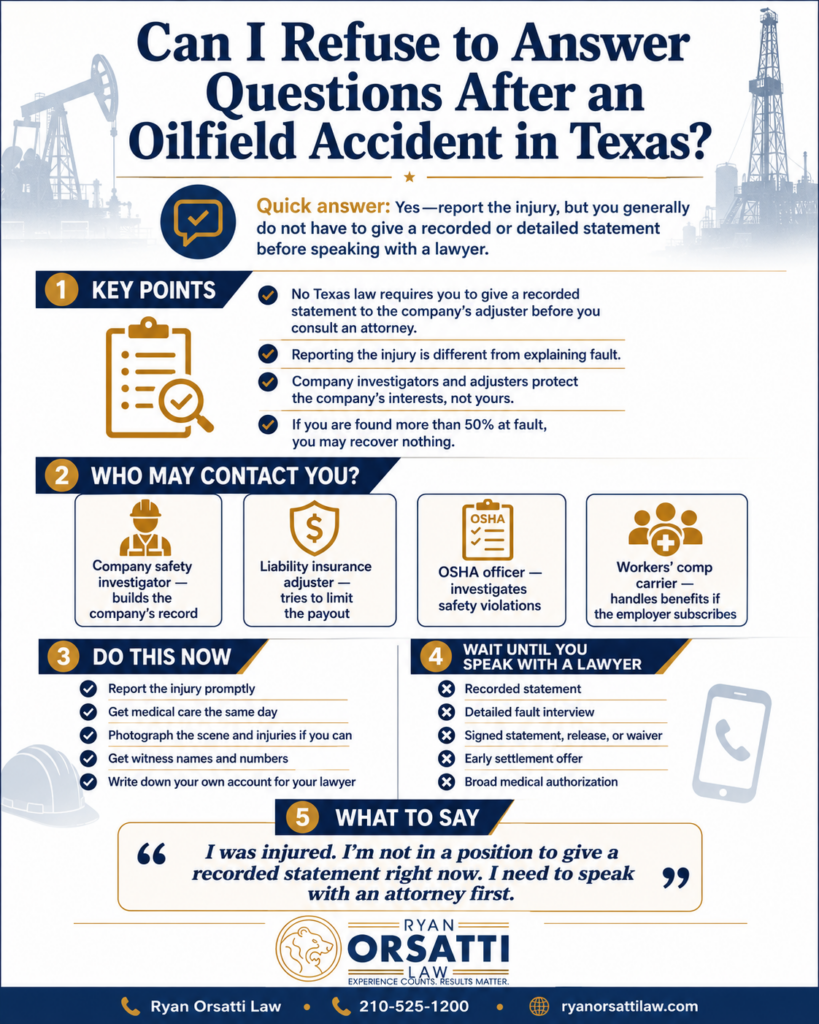
- Yes. No Texas law requires you to give a recorded or narrative statement to the company’s adjuster or its internal investigators before consulting an attorney.
- Reporting that you were hurt is legally different from answering detailed questions about what caused the accident, who was responsible, or how you feel right now.
- The company’s safety investigators and its insurance adjuster both work to protect the company’s interests, not yours.
- Under Texas law, a worker found more than 50% at fault for an oilfield accident recovers nothing. Early, unguarded statements are one of the most common ways that percentage shifts against an injured worker.
KEY TAKEAWAYS
- No Texas statute requires an injured oilfield worker to give a recorded or detailed narrative statement to the company’s insurer or adjuster before retaining an attorney.
- After a Texas oilfield accident, you may face questions from the company’s own internal safety investigator and separately from its liability insurance adjuster. Neither person represents you.
- Texas proportionate responsibility law (Tex. Civ. Prac. & Rem. Code § 33.001) bars all recovery if you are found more than 50% at fault. Unguarded early statements routinely shift that percentage.
- Many Texas oilfield employers are non-subscribers who opted out of the state workers’ comp system. In those cases, your claim proceeds as a regular negligence lawsuit, and no recorded-statement cooperation is required.
- Reporting the injury promptly and giving a detailed account of fault are two separate actions. The first protects your claim. The second, made without an attorney, can end it.
Why the Texas Oilfield Makes This Question Urgent
Texas leads the nation in oilfield worker fatalities. The Centers for Disease Control and Prevention’s Fatalities in Oil and Gas Extraction (FOG) database reports that the oil and gas extraction industry carries a fatality rate approximately seven times higher than the national average for all industries. The Permian Basin, the Eagle Ford Shale, the Gulf Coast refineries, and the fields stretching from Midland to Victoria produce energy and produce injury claims in roughly equal proportion.
When a serious incident happens on a Texas oilfield, the company and its insurer begin their own investigation almost immediately. An HSE supervisor, a third-party safety consultant, or an insurance adjuster can reach an injured worker within hours, sometimes while that worker is still at the scene or in a hospital bed. Understanding who is asking you questions, what they are trying to accomplish, and what you are actually required to say is the first protective step you can take.
Who Is Asking You Questions, and Why It Matters
After a significant oilfield incident in Texas, an injured worker may be approached by several different parties, each with a different motive and a different legal relationship to you. The table below distinguishes the most common.
| Questioner | Who They Represent | Their Goal | Your Obligation Before Consulting an Attorney |
|---|---|---|---|
| Company HSE or safety investigator | The employer or well operator | Build a defense record; identify worker error; satisfy internal protocols and OSHA reporting obligations | Report that you were hurt. No obligation to give a detailed narrative account of fault or the events leading up to the incident. |
| Company’s liability insurance adjuster | The company’s insurer | Evaluate and minimize the payout; lock in your account of events while the facts are still unclear | None. You are not the policyholder. The cooperation clause in the company’s policy runs between the insurer and the company, not between the insurer and you. |
| OSHA compliance officer | Federal government | Enforce workplace safety regulations; determine whether a violation occurred | Workers may participate voluntarily. Section 11(c) of the OSH Act protects workers who cooperate with OSHA from employer retaliation. |
| Workers’ comp carrier (if employer subscribes) | The Texas workers’ comp system | Process the compensation claim and determine benefit eligibility | Cooperate with the claims process, but you still have the right to consult an attorney before giving any formal statement about the facts of the injury. |
The distinction between the company’s liability adjuster and its internal safety investigator is one that most workers do not realize exists. Both are working to protect the company’s legal position. Neither is neutral. And neither has a legal right to a recorded statement from you before you speak with an attorney.
What You Are Required to Do vs. What Is Voluntary
Not everything is optional after an oilfield injury, and this section is worth reading carefully. The distinction between reporting that you were hurt, which is legally significant and must happen promptly, and giving a narrative account of fault, which you are not required to do before consulting a lawyer, is one of the most important practical differences in these cases.
Actions You Should Take Promptly
- Report the injury to your employer. Under Tex. Labor Code § 409.001(a), in a workers’ comp case, you must notify the employer of the injury within 30 days of when it occurs. This is a notice requirement, not a requirement to give a detailed account of causation or fault. “I was injured at the [location] on [date]” is a report of injury. “I slipped because I was not watching where I was going” is a statement about fault. Keep the two separate.
- Seek medical care the same day, even for injuries that feel minor. Adrenaline masks pain. Many oilfield injuries, including TBI (traumatic brain injury), spinal compression, chemical exposure effects, and crush injuries, do not fully present until hours or days after the incident. Gaps in treatment become a defense argument later.
- Document the scene if you are physically able. Photographs of the equipment, the work area, any surface or equipment defect, and your injuries taken before the scene is cleaned up or the equipment is moved may be the most valuable evidence in the case. Well sites get cleaned up fast.
- Collect witness information. Get names and contact numbers from coworkers who saw what happened. Workers on active oilfields rotate, move to other sites, and can be difficult to locate weeks later.
- Write down your own account of events as soon as you are medically stable. Write it down and keep it for your attorney, not for the adjuster.
Actions to Decline Until After Consulting an Attorney
- Giving a recorded statement to the liability insurance adjuster
- Participating in a recorded interview with the company’s HSE or safety investigator about the sequence of events leading up to the accident
- Signing any initial statement, release, or waiver presented by the company or its representatives
- Accepting any early settlement offer
- Authorizing the company or its insurer to access your full medical history
Attorney InsightIn matters we handle involving Texas oilfield injuries, one of the most consistent patterns we see is an injured worker giving a recorded statement within the first 24 to 72 hours. The adjuster calls, explains they just need “a brief account to open the file,” and the worker, wanting to cooperate, talks. What the worker does not know is that adjusters in these cases are specifically trained to ask questions in a sequence designed to accomplish three things: get the worker to underestimate their current injuries (“so you’re feeling okay overall?”), establish that the worker was already aware of the hazard (“had you worked around that equipment before?”), and introduce comparative fault (“where were you looking at the moment of the incident?”). None of these questions feel loaded when you are still in pain or still processing what happened. All of them can be used to reduce or eliminate your recovery under Texas proportionate responsibility law.
How Texas Proportionate Responsibility Law Connects to Your Statement
Texas follows a proportionate responsibility system under Tex. Civ. Prac. & Rem. Code § 33.001. Under this framework, a claimant’s recovery is reduced by their own percentage of fault. If you are found more than 50% responsible for the incident, you recover nothing, regardless of how negligent the company or other parties were. This is sometimes called the 51% bar rule.
That rule is the reason an offhand comment in a recorded statement carries real financial consequences. A worker who says “I knew the floor was slippery but I was in a hurry” has just handed the company’s defense counsel a comparative-fault argument. A worker who says “I’m doing okay, nothing feels too bad” in an early conversation with an adjuster has potentially undermined the extent-of-injury element of their claim.
Early statements create a fixed version of events before you have had the chance to gather physical evidence, understand the full extent of your injuries, or identify every party who contributed to the incident. On a Texas oilfield, those parties can include the well operator, the drilling contractor, one or more service companies, an equipment manufacturer, and multiple subcontractors. A recorded statement that offers a single, simple explanation of what happened can close off those avenues before they have been examined.
Subscriber vs. Non-Subscriber Employers: Does the Type Change Your Rights?
Texas is the only state in the country that allows private employers to opt out of the state workers’ compensation system entirely. An employer that opts out is called a non-subscriber under Tex. Labor Code § 406.034. According to Texas Department of Insurance data, approximately 25% of private-sector Texas employers are non-subscribers, and the rate is particularly high among oilfield contractors and service companies.
The subscriber or non-subscriber status changes how your claim proceeds, but it does not change your right to speak with an attorney before giving any recorded statement.
If your employer carries workers’ comp (subscriber), your primary remedy for the work-related injury flows through the Texas Department of Insurance’s Division of Workers’ Compensation. You will need to cooperate with the claims process. Compensation is subject to statutory benefit limits. But you still have the right to consult an attorney before giving any formal statement about the facts, and workers’ comp claims must be filed with the TDI within one year of the injury under Tex. Labor Code § 409.003.
If your employer is a non-subscriber, your claim proceeds as a regular negligence lawsuit. Non-subscriber employers in Texas lose the right to raise the assumption-of-risk and fellow-servant defenses that subscriber employers can use, which is a significant legal advantage for the injured worker. The two-year statute of limitations for personal injury under Tex. Civ. Prac. & Rem. Code § 16.003 runs from the date of injury, not from the date you retain an attorney.
In either situation, the company’s separate liability insurer, meaning the adjuster who calls you from an unfamiliar number, operates entirely outside the workers’ comp system. They represent the company’s insurer on the liability side of the claim. You have no obligation to speak with them before consulting an attorney.
Attorney InsightThe Texas oilfield is a multi-contractor environment. On a typical well site, you may have the well operator, a drilling contractor, a cementing company, a wireline service company, a water hauler, and a production testing contractor all working simultaneously. When a serious incident happens, each of those companies and their insurers has an interest in pointing responsibility somewhere else. The company’s adjuster is not investigating to find the truth. They are investigating to build a story in which the injured worker bears as much responsibility as possible. In oilfield cases we handle, we routinely find that the incident involved equipment maintained by one contractor, operated under instructions from another, on a site controlled by a third, with a safety protocol failure that runs across multiple layers. None of that gets identified in the first 48 hours. But a statement given in the first 48 hours can lock in a version of events that the other side will rely on for the next two years.
What to Say If Someone Asks for a Statement Today
You do not need to be confrontational or explain yourself at length. A short, clear response covers the situation and does not prejudice your claim in any direction.
- Confirm that you were injured. That satisfies the notice-of-injury requirement.
- Decline further detail: “I am not in a position to give a recorded statement right now. I need to speak with an attorney first.”
- Ask for the caller’s full name, the company they represent, and a callback number.
- Write down the time and date of the call and what was said.
- Contact a Texas oilfield injury attorney before returning the call or agreeing to any meeting.
If you have already spoken with an adjuster or investigator, that does not end your claim. A Texas oilfield injury attorney can review what was said, assess the impact, and in appropriate circumstances take steps to correct or contextualize the record. The important thing at that point is to stop giving additional statements and get counsel involved before any further contact. For more on why recorded statements carry these risks in any personal injury context, our earlier post covers the core issues: why you should not give a recorded statement to an insurance adjuster without your attorney.
Why Ryan Orsatti Law Handles These Cases Across Texas
After a serious oilfield injury in Texas, the investigation that determines your compensation is already running on the company’s side. Ryan Orsatti Law reviews the facts of Texas oilfield accidents, identifies every potentially responsible party among the operators, contractors, and equipment manufacturers present on the site, sends evidence-preservation letters to stop the destruction of equipment data and electronic records, and handles all communications with adjusters and company representatives so that injured workers can focus on recovery rather than navigating a process designed to minimize what they receive.
The firm handles oilfield injury cases for workers in San Antonio, Midland, Odessa, San Angelo, Victoria, and across the Permian Basin, Eagle Ford, and Gulf Coast regions, and serves clients in English and Spanish. Cases are taken on a contingency fee, meaning no attorney’s fee is owed unless the firm recovers for you. For background on the full range of rights and claim types available in a Texas oil field accident, our overview covers the broader landscape.
If you were injured at a Texas oilfield and have questions about what to say or not say, reach out to Ryan Orsatti Law at 210-525-1200 for a free consultation. Deadlines under Texas law, both the 30-day injury notice requirement for workers’ comp cases and the two-year filing deadline for negligence claims, start running from the date of injury, not from when you first speak with a lawyer.
Frequently Asked Questions
Can my employer fire me for refusing to give a statement after an oilfield accident?
Federal law under Section 11(c) of the Occupational Safety and Health Act prohibits employers from retaliating against workers for exercising workplace safety rights, which includes declining to participate in an employer’s internal investigation in a way that would prejudice a legal claim. If your employer threatens your job because you declined to give a recorded statement, document the threat in writing and contact an attorney. Additional protections may apply depending on how the situation was framed.
What if the company says a recorded statement is required as a condition of my employment?
This argument comes up in oilfield cases. There is an important legal distinction between a legitimate internal safety inquiry (which an employer may have a procedural interest in) and a recorded statement about fault and causation that could be used against you in a personal injury or workers’ comp proceeding. An attorney can help you respond appropriately, participate in what is genuinely required, decline what is not, and document any coercive conduct for the record.
What if I already gave a statement before I knew I could refuse?
An early statement does not end your case. A Texas oilfield injury attorney can review what was said, evaluate its impact, and in appropriate circumstances take steps to correct or provide context for the record. Stop giving additional statements immediately and consult an attorney before any further contact with the company or its insurer. The sooner counsel is involved, the more options are available.
How long do I have to file a Texas oilfield injury claim?
The deadlines depend on the path. Workers’ comp claims must be filed with the Texas Department of Insurance within one year of the injury under Tex. Labor Code § 409.003. Personal injury lawsuits against a non-subscriber employer or a third-party defendant generally have a two-year deadline under Tex. Civ. Prac. & Rem. Code § 16.003. Both deadlines run from the date of injury, not from when you retain an attorney. Early consultation matters.
What is a non-subscriber employer in Texas?
A non-subscriber is a Texas employer that opted out of the state workers’ compensation system under Tex. Labor Code § 406.034. Texas is the only state that permits this. Non-subscriber employers cannot raise the assumption-of-risk or fellow-servant defenses in a lawsuit brought by an injured employee, which is a significant advantage for the worker. The case then proceeds as a negligence lawsuit rather than a workers’ comp claim, and is not subject to the benefit caps that apply to workers’ comp.
How is an OSHA investigation different from the company’s investigation?
They are fundamentally different. OSHA compliance officers work for the federal government and are there to determine whether the employer violated federal safety regulations. They do not represent the company and do not share the company’s interest in limiting liability. Workers who cooperate with OSHA are protected from employer retaliation by Section 11(c) of the OSH Act. The company’s internal investigation runs separately, and its investigators do not carry that neutrality.
Should I wait to see a doctor before calling a lawyer?
No. See a doctor first, that day if possible, then contact a Texas oilfield injury attorney as soon as you are medically stable and before anyone from the company asks for a detailed statement. The sooner an attorney is involved, the sooner evidence preservation letters go out and the sooner communications with the company are handled appropriately. Delaying only benefits the other side. Evidence on an active oilfield disappears quickly.
What if multiple contractors were involved in the accident?
Third-party claims against contractors, equipment manufacturers, or other parties beyond your direct employer are available in Texas oilfield cases regardless of whether your employer carries workers’ comp. These claims are not subject to the benefit caps that apply under the workers’ comp system and can include full compensation for pain, suffering, and lost earning capacity. Identifying every responsible party requires a prompt on-site investigation, which is another reason to consult a Texas oilfield injury attorney before giving any statement.
Source Notes
This post relies on the following primary authorities:
- Tex. Labor Code § 409.001 (30-day notice of injury to employer) and § 409.003 (one-year deadline to file workers’ comp claim): statutes.capitol.texas.gov
- Tex. Labor Code § 406.034 (non-subscriber employers): statutes.capitol.texas.gov
- Tex. Civ. Prac. & Rem. Code § 16.003 (two-year statute of limitations for personal injury): statutes.capitol.texas.gov
- Tex. Civ. Prac. & Rem. Code § 33.001 (proportionate responsibility, 51% bar rule): statutes.capitol.texas.gov
- OSHA Section 11(c) whistleblower and worker rights: osha.gov
- CDC Fatalities in Oil and Gas Extraction (FOG) database, MMWR Surveillance Summary (2023): cdc.gov
- Texas Department of Insurance, Division of Workers’ Compensation: tdi.texas.gov
Ryan Orsatti Law4634 De Zavala Rd, San Antonio, TX 78249
Phone: 210-525-1200
ryanorsattilaw.com
This blog is for informational purposes only, not legal advice. Reading it does not create an attorney-client relationship. Past results do not guarantee future results.
Hurt in an accident in San Antonio? Learn how a San Antonio personal injury lawyer can help with your claim. Call 210-525-1200 or request a free consultation. There is no fee unless we win.
Related San Antonio legal resources
- San Antonio construction-accident representation
- Texas personal-injury services
- Contact Ryan Orsatti Law
Primary legal and public-data sources
- Texas Civil Practice and Remedies Code Chapter 16: limitations
- Texas Civil Practice and Remedies Code Chapter 33: proportionate responsibility
Ryan Orsatti Law
4634 De Zavala Road, San Antonio, TX 78249
Source links verified August 7, 2026.