
Quick Answer
A recorded statement about the oilfield accident before hiring a lawyer can damage your claim by locking you into incomplete facts, minimizing injuries before doctors know the diagnosis, creating inconsistencies, and giving the company or insurer language to shift blame onto you. You may still need to report the injury and provide basic claim information, especially in a Texas workers’ compensation claim, but that is different from giving a broad recorded interview to an adjuster, risk manager, trucking insurer, equipment company, or jobsite contractor.
Key Takeaways
- A recorded statement is not “just paperwork.” It can become evidence later.
- Early statements are risky because pain, medication, shock, and incomplete information can make honest answers sound inconsistent later.
- Texas workers’ compensation deadlines still matter. The Texas Department of Insurance says injured workers must report a work injury to the employer within 30 days and send DWC Form-041 within one year to protect their rights. (Texas Department of Insurance)
- In oilfield cases, the claim may involve workers’ compensation, a non-subscriber employer, a third-party contractor, a trucking company, a lease operator, or an equipment manufacturer.
- Before giving a recorded statement, find out who is asking, who they represent, whether they insure your employer, and whether the statement is required by a policy, statute, or claim process.
- Serious oilfield injuries often require immediate evidence preservation, including incident reports, safety manuals, work orders, inspection records, truck data, video, photos, and witness names.
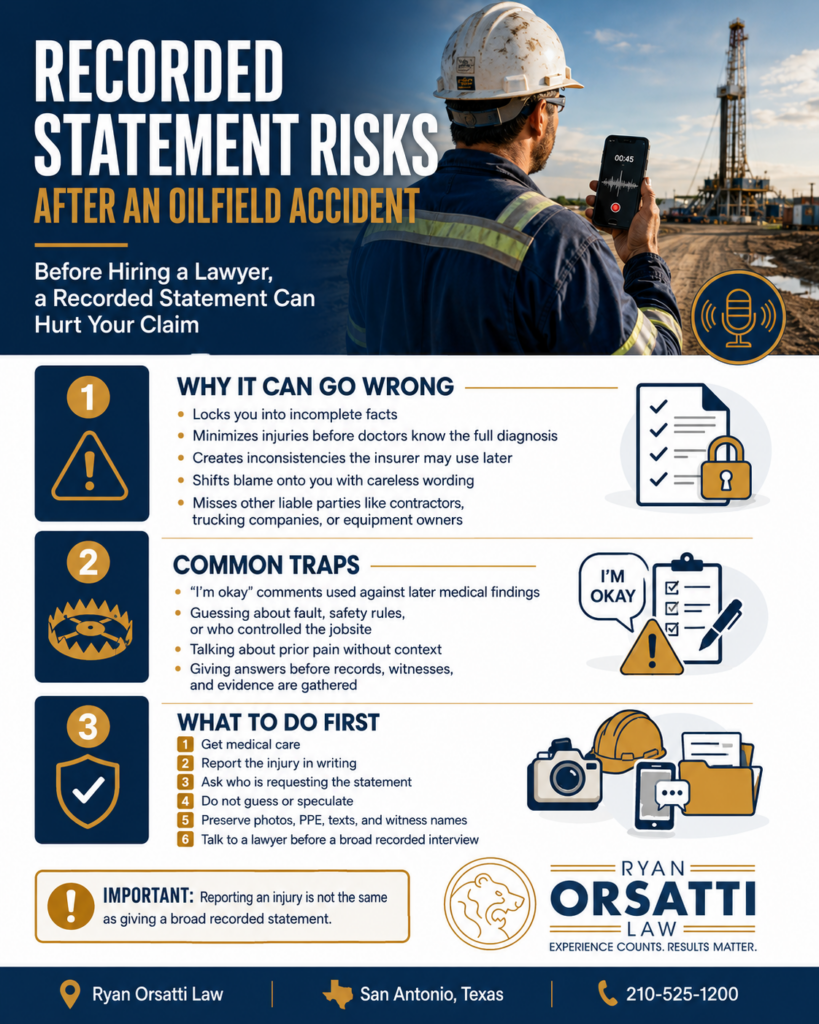
Why Is a Recorded Statement About an Oilfield Accident Risky?
A recorded statement is risky because it captures your words before the facts, injuries, witnesses, and legal issues are fully understood. In an oilfield injury claim, early words can carry weight long after the adjuster’s phone call ends.
Oilfield accidents often happen in chaotic settings: lease roads, drilling sites, rig floors, tank batteries, pipeline jobs, frac locations, and yards where several companies are working at the same time. OSHA identifies major oil and gas hazards that include vehicle accidents, struck-by and caught-between incidents, explosions and fires, falls, confined spaces, and chemical exposures. (OSHA)
That matters because “what happened” is rarely simple. A worker may know that a valve failed, a truck backed up, a tank exploded, or a tool fell, but not know who owned the equipment, who maintained it, who controlled the worksite, or whether safety rules were broken.
In a Texas oilfield injury claim, a recorded statement given before medical evaluation can become a fixed version of events that defense lawyers compare against later testimony. Under Texas Rule of Evidence 613, prior inconsistent statements can be used to challenge credibility, even when the original mistake came from confusion, pain, medication, or incomplete information.
What Can the Insurance Company Use Against Me?
The insurance company can use your recorded statement to dispute fault, injury severity, causation, damages, and credibility. “Causation” means the link between the accident and your injury.
Common problem areas include:
- Injury minimization: “I’m sore, but I think I’m okay” may be used later against a diagnosed disc injury, concussion, shoulder tear, burn injury, or knee injury.
- Fault shifting: “I probably should have seen it” may become an argument that you caused or contributed to the incident.
- Timeline traps: A wrong time, location, weather condition, supervisor name, or work task can make you look unreliable.
- Scope limitation: The adjuster may ask only about the moment of injury, not the unsafe system that caused it.
- Prior condition arguments: Casual answers about back pain, prior injuries, or earlier medical treatment may be used to blame your condition on something else.
- Missing defendants: You may accidentally focus on one company while leaving out contractors, trucking companies, equipment owners, maintenance vendors, or site operators.
Texas Rule of Evidence 801 treats certain opposing party statements as “not hearsay” when offered against that party, including statements made by the party in an individual or representative capacity. In plain English, your own words can sometimes be easier for the other side to use against you than you expect.
Do I Have to Give a Recorded Statement After an Oilfield Accident in Texas?
You may have to provide basic injury and claim information, but whether you must give a recorded statement depends on who is asking and what legal relationship exists. Do not confuse reporting the injury with agreeing to a broad recorded interview.
The Texas Department of Insurance says an injured worker should provide DWC, the insurance carrier, the doctor, and the employer with certain information, such as date of injury, how the injury happened, medical care, work status, and changes in address or phone number. (Texas Department of Insurance) That does not mean every adjuster gets an unlimited recorded interview before you understand the claim.
| Who is asking for the recorded statement? | What you should know before answering | Main risk |
|---|---|---|
| Your employer or supervisor | You should report the injury promptly and accurately. Keep it factual. | Speculation can be written into an incident report as fact. |
| Texas workers’ compensation carrier | You may need to provide claim information and cooperate with the process. Ask what is required and why. | Broad answers may affect compensability, work status, and medical causation. |
| Third-party insurance company | This may be the insurer for a contractor, trucking company, equipment company, or lease operator. | They do not represent you and may be investigating defenses. |
| Your own auto insurer | In a lease-road crash, your policy may contain cooperation duties. | A rushed statement can affect MedPay, PIP, UM/UIM, or coverage issues. |
| Company safety investigator | The goal may be internal risk control, OSHA compliance, or liability defense. | You may not know whether the investigator is gathering facts for the company’s lawyers. |
| Non-subscriber employer representative | A non-subscriber is a Texas employer without workers’ compensation coverage. | Statements may be used in arbitration, a lawsuit, or a waiver dispute. |
How Can a Statement Hurt My Texas Workers’ Compensation Claim?
A statement can hurt a workers’ compensation claim if it creates confusion about whether the injury happened in the course and scope of employment, whether you reported it on time, or whether the condition is related to the accident. “Course and scope” generally means you were doing work for your employer when the injury happened.
Texas workers’ compensation deadlines are separate from third-party injury lawsuit deadlines. The Texas Department of Insurance states that an injured employee must report a work injury to the employer within 30 days and send DWC Form-041 to the Division of Workers’ Compensation within one year to protect rights. (Texas Department of Insurance)
A recorded statement can create problems when the adjuster asks questions like:
- “Were you doing your regular job at the time?”
- “Did you feel pain immediately?”
- “Had you complained about this body part before?”
- “Did anyone tell you to use that tool or truck?”
- “Were you rushing?”
- “Did you violate any safety rule?”
- “Did you report this before the end of the shift?”
The safest approach is not to ignore the claim. The safer approach is to report accurate basic facts, avoid guessing, and get legal advice before agreeing to a recorded question-and-answer session that reaches beyond basic claim information.
What If My Employer Is a Texas Workers’ Compensation Non-Subscriber?
If your employer is a non-subscriber, a recorded statement may affect a direct injury claim against the employer. A non-subscriber is a Texas employer that does not carry Texas workers’ compensation insurance.
Texas Labor Code § 406.033 addresses claims against non-subscriber employers. In those cases, the employee must still prove negligence, but the statute limits certain employer defenses, including contributory negligence, assumption of risk, and co-worker negligence defenses. It also regulates post-injury waivers. (Justia Law)
This is one reason a recorded statement is risky. The employer or its claim administrator may ask questions designed to frame the injury as your intentional act, intoxication, violation of policy, or something unrelated to employer negligence.
A Texas non-subscriber oilfield case often turns on small details: who controlled the work, who trained the crew, whether a job safety analysis was done, whether the tool was defective, whether a supervisor rushed the task, and whether the worker had a realistic ability to stop the job.
Can a Recorded Statement Affect a Third-Party Oilfield Injury Claim?
A recorded statement can affect a third-party claim by helping other companies blame you, your employer, or another contractor. A “third-party claim” is a claim against someone other than your employer, such as a trucking company, lease operator, contractor, property owner, equipment manufacturer, or maintenance company.
This matters in Texas because proportionate responsibility can reduce or bar recovery in many negligence cases. Texas Civil Practice & Remedies Code Chapter 33 provides that a claimant may not recover damages if the claimant’s percentage of responsibility is greater than 50 percent. (Texas Statutes)
Under Texas Civil Practice & Remedies Code Chapter 33, a recorded statement can become a fault-allocation tool. If an injured worker says, “I was in a hurry,” “I did not inspect it,” or “I should have known,” defendants may use those words to argue for a higher percentage of responsibility against the worker.
That is especially dangerous before documents are preserved. The statement may happen before anyone obtains:
- Job safety analysis forms
- Stop-work authority policies
- Rig inspection records
- Maintenance logs
- Driver qualification files
- Dashcam or site video
- Electronic logging device data
- Truck GPS data
- Toolbox talk records
- Incident photographs
- Witness names and contact information
- Safety Data Sheets for chemical exposure cases
- Equipment manuals and repair records
How Do Oilfield Accident Statements Usually Go Wrong?
Oilfield accident statements usually go wrong when the injured person tries to be helpful, polite, or tough while answering questions that are narrower than the real liability picture. The adjuster may sound casual, but the questions are usually strategic.
Common examples:
- You say you are “fine” before symptoms peak. Many neck, back, shoulder, knee, head, and nerve injuries worsen after the first day.
- You guess about a company’s role. You may not know which contractor owned the truck, tool, tank, hose, valve, pump, or trailer.
- You accept a safety-rule premise. The question may assume a rule existed, that you knew it, and that you violated it.
- You leave out pressure from supervisors. Workers often skip over production pressure, rushed jobs, missing spotters, poor lighting, or understaffing.
- You describe only the final event. A dropped pipe, explosion, or crash may be the last link in a long chain of unsafe decisions.
- You discuss prior injuries without context. Prior soreness is not the same as a new traumatic injury.
- You do not know what records already exist. The company may have documents, photos, radio traffic, ELD records, or reports you have never seen.
Attorney Insight: In oilfield cases, the most damaging recorded statements are often not dramatic confessions. They are small, incomplete phrases: “I guess I should have seen him,” “I’m not sure who told us to do it that way,” or “I’ve had back pain before.” Those phrases can be repeated for months by adjusters, defense lawyers, and corporate representatives.
What Should I Do Before Any Recorded Statement?
Before any recorded statement, identify the caller, preserve evidence, get medical care, and understand which claim system applies. Do not let the first phone call become the permanent version of the accident.
After an oilfield accident, do these 7 things:
- Get medical care first. Tell the doctor exactly what happened, what body parts hurt, and when symptoms started.
- Report the injury in writing. Include the date, time, location, supervisor, and basic mechanism of injury.
- Ask who is requesting the statement. Get the person’s name, company, claim number, phone number, and who they represent.
- Do not guess. It is better to say “I do not know yet” than to fill gaps with assumptions.
- Save evidence immediately. Keep photos, videos, boots, hard hat, PPE, text messages, dispatch instructions, and coworker names.
- Do not sign releases or waivers without review. This is especially important in non-subscriber claims.
- Talk with a lawyer before a broad recorded interview. A lawyer can help separate required claim information from avoidable liability questions.
For Texas workers’ compensation claims, the Texas Department of Insurance confirms that injured workers have the right to get help from an attorney at any time. (Texas Department of Insurance) For personal injury claims, early legal review can also help preserve third-party evidence before it disappears.
What If the Adjuster Says the Statement Is Required?
If the adjuster says the statement is required, ask them to identify the legal, policy, or claim provision that requires it. A vague statement like “we need this to move forward” is not the same as a legal duty to give an unlimited recorded interview.
A practical response can be:
“I want to cooperate and provide accurate information. I am still getting medical care and do not want to guess or give incomplete answers. Please send me your request in writing, including who you represent and why a recorded statement is required.”
This response does three things. It shows cooperation. It avoids a rushed interview. It forces the requester to clarify their role.
If the request involves a Texas workers’ compensation claim, you should not ignore deadlines or claim communications. If the request involves a third-party insurer, contractor, trucking company, or equipment company, the risk of a defense-focused interview is usually higher.
How Do Lawyers Protect an Oilfield Injury Claim Before a Statement?
Lawyers protect oilfield injury claims by controlling the order of events: medical documentation first, evidence preservation second, liability investigation third, and claim communications after the facts are better understood. The point is accuracy, not hiding information.
In a serious case, a lawyer may send preservation letters, sometimes called spoliation letters. “Spoliation” means the destruction or failure to preserve relevant evidence. In oilfield cases, that can include site video, ECM or ELD truck data, safety documents, maintenance records, incident reports, phone records, photos, and equipment involved in the accident.
This is critical because oil and gas extraction and support work remains dangerous. BLS data for private sector mining, quarrying, and oil and gas extraction industries reported 65 fatal occupational injuries in oil and gas extraction industries in 2024, including NAICS 211, drilling oil and gas wells, and support activities for oil and gas operations. (Bureau of Labor Statistics) CDC also reported that Texas accounted for 1,134 severe injury reports in the oil and gas extraction industry from January 2015 through July 2022, the highest number among reporting jurisdictions in that study. (CDC)
For more information about oilfield injury issues, see Ryan Orsatti Law’s Texas oil field accident resource. For related commercial vehicle claims, see the firm’s San Antonio truck accident guide. The firm’s contact page also lists the San Antonio office, phone number, and service locations. (Ryan Orsatti Law)
What Is the Deadline to Bring an Oilfield Accident Lawsuit in Texas?
The general Texas deadline for many personal injury and wrongful death lawsuits is two years, but the exact deadline depends on the type of claim and who is being sued. Texas Civil Practice & Remedies Code § 16.003 states a two-year limitations period for personal injury and injury resulting in death. (Texas Statutes)
Do not rely on the two-year rule alone. Shorter notice rules may apply if a governmental entity is involved. Workers’ compensation deadlines are different. Contractual arbitration deadlines may also appear in non-subscriber employment documents.
A recorded statement does not stop the statute of limitations. It also does not preserve evidence. That is why waiting until the company “finishes investigating” can be risky in serious oilfield cases.
How Medical Bills, Liens, and Subrogation Can Complicate the Statement
Medical bills, liens, and subrogation can complicate a statement because adjusters may ask questions that affect who pays and who gets reimbursed later. “Subrogation” means a health plan, workers’ compensation carrier, or benefit provider may seek reimbursement from a later recovery.
A “hospital lien” is a legal claim by a hospital against certain injury claims or recoveries. Texas Property Code Chapter 55 provides that a hospital has a lien on certain claims of an individual who receives hospital services for accident injuries attributed to another person’s negligence. (Texas Statutes)
Why does this matter for a recorded statement? Because careless wording about where, how, and when the injury happened may affect:
- Whether workers’ compensation accepts the injury
- Whether health insurance treats it as accident-related
- Whether a third-party liability insurer disputes causation
- Whether a hospital lien attaches to a personal injury recovery
- Whether an ERISA plan, health plan, or workers’ compensation carrier asserts reimbursement rights
These issues are usually not obvious during the first adjuster call.
FAQ
Can I refuse a recorded statement after an oilfield accident in Texas?
You can usually decline a broad recorded statement to a third-party insurer until you speak with a lawyer, but you should not ignore claim duties or workers’ compensation deadlines. The safer response is to ask who the adjuster represents, request the basis for the statement in writing, and provide required basic claim information accurately.
What should I say if the oilfield company’s insurer calls me?
Tell the caller you want to provide accurate information, but you are still receiving medical care and want any request for a recorded statement in writing. Give basic identifying information if appropriate, but do not guess about fault, safety rules, prior injuries, company responsibility, or the full extent of your injuries.
Will refusing a recorded statement automatically hurt my claim?
Refusing a broad recorded statement to an opposing insurer does not automatically ruin your claim. The risk is different if your own insurer or a workers’ compensation carrier is requesting required claim information. The key is to cooperate where required while avoiding an unprepared, open-ended interview that can be used defensively.
What if I already gave a recorded statement?
If you already gave a recorded statement, write down everything you remember about the call: date, caller, company, questions, answers, and whether you received a copy. Then avoid giving follow-up statements until you get legal advice. A lawyer can compare the statement against medical records, incident reports, witness accounts, and site evidence.
Can my employer make me sign something after an oilfield injury?
Do not sign a release, waiver, resignation, settlement, or medical authorization without review. This is especially important if your employer is a Texas workers’ compensation non-subscriber. Texas Labor Code § 406.033 contains strict rules for certain post-injury waivers in non-subscriber cases, including timing and medical evaluation requirements. (Justia Law)
Is a recorded statement different from reporting the injury?
Yes. Reporting the injury means giving basic information that an injury happened, where it happened, when it happened, and what body parts were hurt. A recorded statement is usually a question-and-answer interview controlled by the adjuster or company representative. The second is much easier to use later in a disputed claim.
What evidence should be preserved before I give a statement?
Preserve photos, videos, PPE, damaged equipment, text messages, dispatch records, job safety analysis forms, coworker names, supervisor names, medical records, and any paperwork you were asked to sign. In lease-road crash cases, preserve truck data, ELD records, dashcam footage, GPS information, driver logs, and maintenance records as soon as possible.
Should I talk to a lawyer before giving a recorded statement about a lease-road crash?
Yes, it is usually wise to talk to a lawyer before giving a recorded statement about a lease-road crash. These cases may involve trucking rules, workers’ compensation, UM/UIM coverage, employer policies, contractor liability, and site-control issues. A short statement about speed, visibility, fatigue, or job duties can affect several claims at once.
Ryan Orsatti Law
4634 De Zavala Rd, San Antonio, TX 78249
Phone: 210-525-1200
ryanorsattilaw.com
This blog is for informational purposes only, not legal advice. Reading it does not create an attorney-client relationship. Past results do not guarantee future results.
Hurt in an accident in San Antonio? Learn how a San Antonio personal injury lawyer can help with your claim. Call 210-525-1200 or request a free consultation.
The firm works on a contingency fee. You pay nothing unless the firm recovers money for you, and that covers case expenses as well as the fee: if there is no recovery, you owe no attorney's fee and no case expenses. Ask for the fee agreement and read the fee and expense section before you sign anything.
Related San Antonio legal resources
- San Antonio construction-accident representation
- Texas personal-injury services
- Contact Ryan Orsatti Law
Primary legal and public-data sources
- Texas Civil Practice and Remedies Code Chapter 16: limitations
- Texas Civil Practice and Remedies Code Chapter 33: proportionate responsibility
Ryan Orsatti Law
4634 De Zavala Road, San Antonio, TX 78249
General reference links. Consult each source for its current text.