
Quick Answer
If the oilfield company wrote the incident report for you and told you to sign it, do not sign unless it is accurate, complete, and clearly says what your signature means. In Texas oilfield injury cases, a signed incident report can later be used by the company, its insurer, or defense lawyers to argue that you accepted their version of what happened. You can ask for corrections, write your own statement, limit your signature to “receipt only,” and request a copy before leaving.
Key Takeaways
- You are not required to sign an inaccurate incident report just because a supervisor, safety manager, company man, or HR representative tells you to.
- A signed incident report may become a prior statement in a Texas personal injury case and can be used to challenge your testimony later.
- Do not guess about fault, timing, equipment condition, training, pressure control, weather, or who gave orders if you do not know.
- Write down your own version while the facts are fresh, including witnesses, photos, equipment involved, and symptoms.
- The company incident report is not the same thing as a Texas workers’ compensation claim, OSHA report, or third-party injury claim.
- Get medical care and legal guidance quickly if the report leaves out hazards, blames you, or says you were “not injured.”
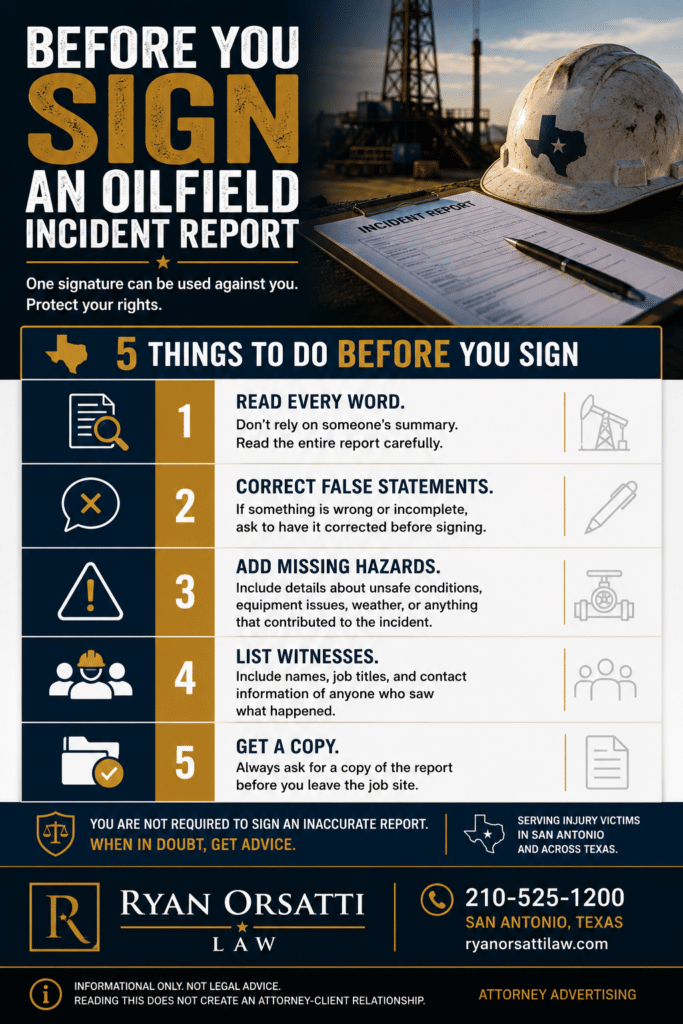
What If the Oilfield Company Wrote the Incident Report for Me and Told Me to Sign It?
If the oilfield company wrote the incident report for you and told you to sign it, treat the document as evidence, not paperwork.
This happens often after oilfield injuries in South Texas, West Texas, the Eagle Ford, the Permian Basin, and service yards around San Antonio. A worker gets hurt during rig-up, pressure testing, trucking, pipe handling, well servicing, casing work, hotshot delivery, frac operations, or equipment maintenance. Before the worker has seen a doctor, a supervisor hands over an incident report and says, “Just sign here.”
That report may look routine. But in a disputed claim, every word can matter.
An incident report is a written record describing what happened, who was involved, where it happened, what injuries were reported, and what the company believes caused the event. The problem is that the report may be written from the company’s perspective, not yours.
In oilfield injury matters we routinely see reports that:
- leave out unsafe instructions;
- say the worker “lost footing” without mentioning mud, oil, poor lighting, or missing mats;
- describe an injury as “minor” before imaging or follow-up care;
- omit the name of the company man, tool pusher, truck driver, subcontractor, or equipment vendor involved;
- say “employee failed to use PPE” without identifying whether the PPE was available, adequate, or required for that task;
- list no witnesses even though several workers saw the incident;
- include conclusions about fault before any real investigation is complete.
That does not mean every incident report is dishonest. Some are accurate and useful. But you should never sign a document that you have not read, do not understand, or know is incomplete.
For more on oilfield injury claims generally, see our guide to oil field accident rights in San Antonio and Texas.
Why the Incident Report Matters in a Texas Oilfield Injury Claim
A signed report can affect several parts of the case.
First, it may affect notice, which means proof that the injury was reported. Texas workers’ compensation is an insurance program that can provide pay and medical benefits for a work-related injury or illness, but not all Texas employers carry workers’ compensation coverage. The Texas Division of Workers’ Compensation tells injured workers to report the injury or illness to the employer and explains that DWC will send a packet with claim documents, including DWC Form-041. (Texas Department of Insurance)
Second, it may affect fault, which means who caused the injury. Texas uses proportionate responsibility in many personal injury cases. Under Texas Civil Practice & Remedies Code Chapter 33, defendants often try to shift percentages of blame to the injured worker, another contractor, an employer, or a responsible third party.
Third, it may affect credibility, which means whether a jury, adjuster, or opposing lawyer believes your version. If the incident report says one thing and your later medical records, deposition, or lawsuit says something different, the defense may argue that your story changed.
Fourth, it may affect preservation of evidence, which means keeping key proof from being lost. Oilfield sites change fast. Equipment is moved. Trucks leave. Tools get repaired. Wellsite personnel rotate out. If the first report leaves out the defective valve, missing guard, failed hose, untrained spotter, or unsafe order, that omission can make the investigation harder.
Can the Company Use a Signed Incident Report Against Me?
Yes. A signed incident report can be used in several ways, depending on the facts and the rules of evidence.
Under the Texas Rules of Evidence, an opposing party’s statement may be treated as not hearsay when offered against that party. Rule 801(e)(2) includes statements made by a party individually, statements the party adopted or believed to be true, and certain statements made by a party’s agent or employee within the scope of that relationship.
In plain English: if you sign a report saying “I slipped because I was not paying attention,” the defense may try to use that statement against you later.
The company may also try to offer the incident report as a business record, which means a record kept in the regular course of business. Texas Rule of Evidence 803(6) covers records of regularly conducted activity, but it also allows an opponent to challenge the record if the source of information or circumstances of preparation indicate a lack of trustworthiness.
That distinction matters. A report written by a safety manager who did not see the incident, based on a rushed interview while you were in pain, may be different from a neutral, detailed report based on witness statements, photos, equipment inspection, and measurements.
What Should You Do Before Signing?
Do not let anyone rush you. A serious oilfield injury can involve pain, shock, medication, fear of losing work, and pressure from supervisors. That is exactly when mistakes happen.
Before signing, do these 7 things:
- Read every word. Do not rely on someone’s summary of what the report says.
- Correct false statements. If the report says you were not injured, but your back, head, shoulder, knee, neck, or hand hurts, say so.
- Add missing hazards. Include mud, oil, poor lighting, weather, equipment failure, missing guards, pressure, chemical exposure, unsafe speed, lack of training, or rushed work.
- List witnesses. Write names, nicknames, job titles, phone numbers, employer names, or crew descriptions.
- Avoid blame language. Do not write “my fault,” “I caused it,” or “I should have known” unless that is truly accurate and fully informed.
- Limit your signature if needed. Write “signature acknowledges receipt only; I do not agree with all statements” if the company will not correct the report.
- Get a copy immediately. Take a photo of the signed version if the company will not give you one.
If the injury happened on a construction-style worksite, many of the same evidence issues also apply in construction accident claims, especially where multiple contractors share control of the jobsite.
What If the Report Is Partly Right but Leaves Things Out?
A partly true report can still be dangerous.
For example, the report may accurately say you slipped near a truck. But if it leaves out that diesel had leaked onto the walking surface, that lighting was poor, that you were carrying equipment because no mechanical assist was provided, or that another contractor parked in the designated walkway, the report tells only half the story.
A better approach is to write additions before signing:
| Situation | Safer Response | Why It Matters |
|---|---|---|
| Report is accurate and complete | Sign and request a copy | Preserves notice and avoids unnecessary dispute |
| Report is mostly accurate but incomplete | Add missing facts before signing | Prevents the company’s version from becoming the only version |
| Report includes false blame | Refuse to sign as written and request corrections | Avoids adopting a statement you disagree with |
| Company says signature is “just procedure” | Write “receipt only” next to signature | Clarifies that you are not agreeing to all facts |
| You are in pain or medicated | Ask to review later and request medical care | Reduces risk of a rushed or unreliable statement |
| You already signed | Send a written correction as soon as possible | Creates a clearer record while facts are still fresh |
Words to Avoid in an Oilfield Incident Report
Do not guess. Do not minimize. Do not accept blame just to keep peace with the crew.
Be careful with words like:
- “fine”
- “minor”
- “my fault”
- “lost balance”
- “not paying attention”
- “no injury”
- “normal job”
- “no witnesses”
- “just sore”
- “I should have known”
- “I was trained,” if the training was incomplete, rushed, outdated, or not specific to the task
Also be careful with technical conclusions. Unless you are the right person to say it, do not guess that a hose “did not fail,” a valve “was working,” a forklift operator “had visibility,” a wellhead “was secure,” or a trucking company “followed procedure.”
A better phrase is: “I do not know yet. This needs investigation.”
Attorney Insight: The Most Important Line Is Often the One They Leave Out
In oilfield cases, the first incident report often focuses on the injured worker’s last movement: “worker stepped backward,” “worker slipped,” “worker lifted pipe,” “worker opened hatch,” or “worker was struck.”
That is rarely the full story.
The real liability question is often what happened before that last movement. Who planned the job? Who controlled the site? Was the work rushed? Was the equipment inspected? Was the crew short-handed? Was the walkway safe? Was the driver trained? Was the pressure bled down? Was the injured worker told to do something unsafe?
When we review an oilfield incident report, we look for missing upstream facts. A report that starts with “worker slipped” may ignore the leaking equipment, poor housekeeping, lack of barricades, or production pressure that set the injury in motion.
Is the Company Incident Report the Same as a Workers’ Comp Claim?
No. The company’s internal incident report is not the same thing as a workers’ compensation claim.
For Texas workers’ compensation, DWC Form-041 is the employee’s claim for compensation for a work-related injury or occupational disease. The form states that the claim must be filed within one year of the date of injury, or within one year from the date the injured employee knew or should have known the injury or disease may be work-related. (Texas Department of Insurance)
That deadline is separate from the company’s internal reporting process.
Also, workers’ compensation is not always the only issue. Many oilfield injuries involve possible claims against third parties, such as:
- trucking companies;
- equipment manufacturers;
- pressure-control contractors;
- crane or forklift operators;
- landowners or premises operators;
- maintenance vendors;
- safety contractors;
- staffing companies;
- other subcontractors on location.
A third-party claim means a claim against someone other than your direct employer. These claims can matter because workers’ compensation benefits may not cover every loss, and Texas oilfield jobs often involve several companies working at the same site.
If your injury involved a commercial truck, hotshot driver, water hauler, sand truck, or equipment transport vehicle, our San Antonio truck accident lawyer page explains how multi-party vehicle claims are investigated.
What If OSHA Is Involved?
OSHA reporting is different from your personal injury claim and different from a workers’ compensation claim.
OSHA states that employers must notify OSHA when an employee is killed on the job or suffers a work-related hospitalization, amputation, or loss of an eye. A fatality must be reported within 8 hours, and an inpatient hospitalization, amputation, or eye loss must be reported within 24 hours. (OSHA)
OSHA also has rules about employee involvement in injury and illness recordkeeping. Employers must establish a reasonable reporting procedure that does not deter accurate reporting, must inform employees of the right to report work-related injuries and illnesses, and must not discriminate against employees for reporting them. Employees and certain representatives also have rights to access OSHA injury and illness records, including OSHA 300 logs and OSHA 301 incident reports in specific circumstances. (OSHA)
An OSHA report may help document a serious safety event, but it does not automatically prove a civil injury claim. The same is true of a company report. Each document must be tested against photos, witnesses, equipment records, medical records, training materials, job safety analyses, and testimony.
What If I Already Signed the Report?
If you already signed, do not panic. A signed incident report is important, but it is not always the end of the claim.
Act quickly:
- Write a dated correction or supplemental statement.
- Identify every statement in the report that is wrong or incomplete.
- Request a copy of the report, photos, witness statements, and any safety investigation materials.
- Save text messages, call logs, job tickets, dispatch records, and names of people present.
- Get medical care and tell the medical provider exactly how the injury happened.
- Do not give a recorded statement to an insurer before understanding your rights.
- Speak with a Texas personal injury attorney familiar with oilfield and workplace injury evidence.
A correction made close in time to the incident can help explain why the first report was incomplete. Maybe you were in pain. Maybe you had not seen the equipment. Maybe the supervisor wrote the report before speaking to all witnesses. Maybe you were told the signature was only to confirm receipt.
Those details matter.
Medical Records Can Confirm or Contradict the Report
After an oilfield injury, your medical records often become just as important as the incident report.
Tell the doctor, urgent care, ER, occupational clinic, or specialist how the injury happened. Be specific. “Back pain after oilfield accident” is less helpful than “felt pop in low back while lifting joint of pipe after supervisor told crew to move it manually because forklift was unavailable.”
Also report all symptoms. If you hit your head, felt dazed, had a headache, became nauseated, experienced memory gaps, or felt confused, say that. Brain injuries are often disputed because early paperwork says “no loss of consciousness” or “no head injury.” For more information, see our San Antonio traumatic brain injury lawyer page.
Do not exaggerate. Do not minimize. Accuracy is the goal.
What a Better Incident Statement Can Say
A useful statement is short, factual, and careful. It should identify what you personally know and avoid speculation.
Example:
“I was injured on [date] at approximately [time] while working at [location]. I was assigned to [task]. During the task, [describe what happened]. The area had [hazard]. The equipment involved was [equipment]. Witnesses included [names]. I felt pain in [body parts]. I am requesting medical care. I have not completed my investigation and reserve the right to supplement this statement if additional facts become available.”
That type of statement gives notice without adopting the company’s conclusions.
FAQ
Do I have to sign the oilfield company’s incident report?
You generally should not sign an incident report that is false, incomplete, or unclear. Ask to read it, correct it, and receive a copy. If the company insists your signature is only procedural, consider writing “receipt only” next to your signature. Do not sign away your version of events just to avoid an uncomfortable conversation.
Can my supervisor write the incident report for me?
A supervisor can prepare the company’s report, but you should not let someone else’s words become your statement unless you agree with them. If the report says things you did not say, did not see, or do not know, ask that those parts be removed or corrected before you sign.
What if the report says I was not hurt but pain got worse later?
Send a written correction as soon as possible and get medical care. Many oilfield injuries worsen after adrenaline wears off, especially back, neck, shoulder, knee, head, and soft-tissue injuries. The correction should explain what symptoms developed, when they developed, and that the earlier report did not capture the full injury picture.
Can I still bring a claim if I signed a bad incident report?
Possibly. A signed report can create problems, but it does not automatically defeat a Texas oilfield injury claim. The strength of the case depends on the full evidence, including medical records, witness testimony, photos, safety documents, equipment records, and whether the report was rushed, incomplete, or written by someone protecting the company.
Should I write my own statement after an oilfield accident?
Yes, a short factual statement can help preserve your memory. Include the date, time, location, task, equipment, hazards, witnesses, body parts injured, and who told you to do the work. Avoid guessing about fault or technical causes. Keep a copy and send corrections promptly if the company report is wrong.
Is an incident report the same as an OSHA report?
No. A company incident report is usually an internal document. OSHA reporting applies to specific serious events, including work-related fatalities, inpatient hospitalizations, amputations, and eye loss. OSHA reporting does not replace your medical care, Texas workers’ compensation paperwork, or a third-party personal injury investigation.
What if the company pressures me or threatens my job?
Document what was said, who said it, when it happened, and who witnessed it. OSHA rules prohibit employers from discharging or discriminating against employees for reporting work-related injuries or illnesses. Pressure to sign an inaccurate report can also become important evidence in a later dispute. Get advice before responding emotionally or quitting.
When should I call a lawyer after an oilfield incident report dispute?
Call as soon as the report blames you, leaves out major facts, denies injury, omits witnesses, involves a serious injury, or includes multiple companies. Early legal review can help preserve evidence before equipment is moved, photos disappear, or witnesses rotate off the job. Waiting can make the investigation harder.
Ryan Orsatti Law
4634 De Zavala Rd, San Antonio, TX 78249
Phone: 210-525-1200
ryanorsattilaw.com
This blog is for informational purposes only, not legal advice. Reading it does not create an attorney-client relationship. Past results do not guarantee future results.
Hurt in an accident in San Antonio? Learn how a San Antonio personal injury lawyer can help with your claim. Call 210-525-1200 or request a free consultation.
The firm works on a contingency fee. You pay nothing unless the firm recovers money for you, and that covers case expenses as well as the fee: if there is no recovery, you owe no attorney's fee and no case expenses. Ask for the fee agreement and read the fee and expense section before you sign anything.
Related San Antonio legal resources
- San Antonio construction-accident representation
- Texas personal-injury services
- Contact Ryan Orsatti Law
Primary legal and public-data sources
- Texas Civil Practice and Remedies Code Chapter 16: limitations
- Texas Civil Practice and Remedies Code Chapter 33: proportionate responsibility
Ryan Orsatti Law
4634 De Zavala Road, San Antonio, TX 78249
General reference links. Consult each source for its current text.