
Quick Answer
If the company tells your family they cannot visit the rig site or hospital after an oilfield injury, separate the two places immediately. A rig site is usually private, dangerous industrial property, so the company may restrict access for safety and security. A hospital is different: the employer does not control hospital visitation, medical decisions, or who receives updates when the patient or legal representative allows it.
A family should contact the hospital directly, ask for the charge nurse or patient advocate, confirm the injured worker’s status, and avoid signing company paperwork just to get information.
Key Takeaways
- The company may be able to keep family members off the rig site, but it should not control hospital visitation.
- Federal hospital rules protect a patient’s right to choose visitors, subject to consent and clinically necessary restrictions. (eCFR)
- HIPAA does not automatically block family updates. Hospitals may share limited information with family members or others involved in the patient’s care when the rule allows it. (HHS.gov)
- If the injury involved hospitalization, amputation, loss of an eye, or death, OSHA reporting deadlines may apply. (eCFR)
- Families should preserve evidence quickly because rig-site conditions, electronic data, photos, inspection records, and witness memories can change fast.
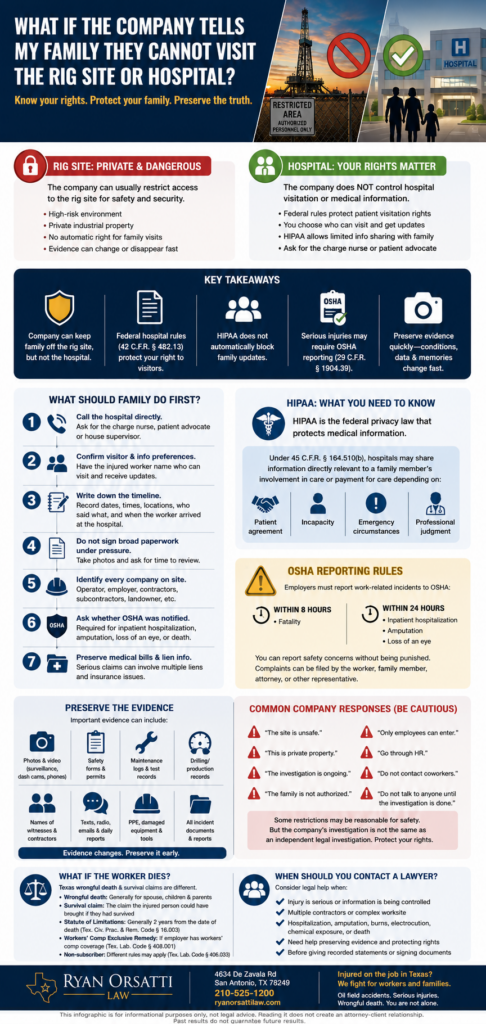
Can the Company Tell My Family They Cannot Visit the Rig Site or Hospital?
The company may restrict access to the rig site, but it generally does not get to decide whether family can visit the injured worker at the hospital. A drilling rig, well pad, yard, refinery site, or oilfield location may involve high-pressure lines, suspended loads, toxic exposure, ignition hazards, moving equipment, and ongoing investigation activity. Family members usually do not have an automatic right to walk onto that property.
The hospital is different. Once an injured worker is transported to a hospital in San Antonio, Bexar County, the Eagle Ford Shale region, West Texas, or anywhere else in Texas, the hospital’s patient-rights policies and federal health care rules matter more than the company’s preference.
A company safety representative does not control hospital visitation after a Texas oilfield injury. Under 42 C.F.R. § 482.13(h), a covered hospital must inform patients of visitation rights and allow designated visitors subject to the patient’s consent and any clinically necessary or reasonable restriction. (eCFR)
That does not mean every family member can enter the ICU at the same time. Hospitals may limit visitors based on surgery, infection control, safety, capacity, patient condition, or disruptive conduct. But the reason should come from hospital policy and medical needs, not from the employer trying to control the story.
What Should Family Do First if They Are Being Blocked at the Hospital?
The family should stop relying on the company as the middleman and contact the hospital directly. Ask for the charge nurse, patient advocate, house supervisor, or social worker. Give the injured worker’s full name, date of birth if known, and your relationship.
Hospitals subject to federal Medicare conditions of participation must protect patient rights, including the patient’s right to have a family member or chosen representative promptly notified of admission. The same rules recognize patient privacy, medical-record confidentiality, and the patient’s right to make informed decisions about care. (eCFR)
Use clear language:
“I am the injured worker’s spouse, parent, adult child, or designated contact. The company told us not to come. I need to know whether the patient can receive visitors, who is listed as the emergency contact, and whether we can speak with the treating team or patient advocate.”
If the patient is awake and has capacity, ask the patient to tell staff, verbally or in writing, who may visit and receive updates. If the patient is sedated, intubated, or unable to communicate, ask the hospital what documentation it needs to recognize the appropriate legal representative or support person.
Does HIPAA Stop the Hospital From Talking to Family?
HIPAA does not automatically stop the hospital from giving family members limited information about the patient’s location, general condition, or care involvement. HIPAA means the Health Insurance Portability and Accountability Act, the federal privacy law that limits how protected health information is used and disclosed.
Under 45 C.F.R. § 164.510(b), a covered health care provider may disclose information directly relevant to a family member’s involvement in the patient’s care or payment for care, depending on the patient’s agreement, opportunity to object, incapacity, emergency circumstances, and professional judgment. (Legal Information Institute)
HIPAA is often misunderstood after oilfield injuries. A hospital may need to protect detailed records, but HIPAA can still allow notice to family about location, general condition, or death, and can allow limited care-related communication when the rule’s conditions are met. (HHS.gov)
What family should avoid is relying on a company safety manager, toolpusher, contractor representative, or insurance adjuster for medical updates. Those people may be involved in incident response, but they are not the patient’s treating team.
Can the Company Keep Family Away From the Rig Site?
The company can usually keep family away from the rig site in the immediate aftermath of an oilfield accident, but that does not give the company permission to destroy, alter, or selectively document evidence. Site access and evidence preservation are separate issues.
A rig site is different from a hospital. Family members may not have a right to enter private industrial property, but a lawyer can send preservation demands, request incident materials, identify contractors, and later seek formal inspection rights. In litigation, Texas Rule of Civil Procedure 196.7 provides a process for requesting entry onto property for inspection, measuring, photographing, testing, or sampling. (Texas Courts)
That distinction matters. You may not be able to walk onto the pad today, but you can still start protecting evidence today.
Examples of evidence that may matter:
- Photos and video from the company, contractors, security cameras, dash cameras, and phones
- Job safety analysis forms, also called JSAs or JHAs
- Permits, hot work permits, lockout/tagout records, and confined-space paperwork
- Tool inspection records, maintenance logs, and pressure-testing documents
- Drilling, completion, or production records
- Names of contractors, subcontractors, company men, supervisors, and witnesses
- Communications by text, radio, email, dispatch, and daily reports
- PPE, damaged equipment, failed parts, harnesses, tools, valves, hoses, and gauges
For more on these cases, see Ryan Orsatti Law’s page on oil field accidents in San Antonio and its Texas oilfield injury resource, Oil Field Accidents in Texas.
What Are the Practical Differences Between Hospital Access and Rig Site Access?
Hospital access is about the patient’s care, consent, privacy, and safety. Rig site access is about private property, industrial safety, evidence control, and legal investigation.
| Issue | Hospital | Rig Site |
|---|---|---|
| Who controls access? | Hospital staff under patient-rights policies and medical restrictions | Property owner, operator, employer, site company, or safety personnel |
| Can the company decide who visits? | Usually no, unless it is also acting through a legally valid patient role | It can usually restrict non-worker access to the site |
| What should family ask for? | Charge nurse, patient advocate, social worker, treating physician update if allowed | Incident number, company contacts, contractors involved, preservation of evidence |
| What law or rule may matter? | 42 C.F.R. § 482.13, HIPAA, hospital policies | OSHA rules, Texas evidence preservation, Texas discovery rules |
| What is the risk? | The company becomes the only source of updates | Evidence changes, equipment is moved, witnesses leave, records get rewritten |
| Best next step | Contact hospital directly | Send preservation requests and document everything |
What OSHA Reporting Rules Matter After a Serious Rig Injury?
If a work-related incident causes death, inpatient hospitalization, amputation, or loss of an eye, OSHA reporting rules may apply. OSHA’s regulation at 29 C.F.R. § 1904.39 requires covered employers to report a work-related fatality within 8 hours and an inpatient hospitalization, amputation, or loss of an eye within 24 hours. (eCFR)
OSHA also explains that workers may report safety concerns without being punished, and that a complaint can be filed on behalf of a worker by an attorney, spouse, family member, or other bona fide representative. (OSHA)
In 2024, the Texas Department of Insurance, Division of Workers’ Compensation reported 557 fatal occupational injuries in Texas, with a fatality incident rate of 3.9 per 100,000 full-time employees. The same Texas report listed 36 fatalities in mining, quarrying, and oil and gas extraction, including 26 in support activities for oil and gas operations. (Texas Department of Insurance)
Nationally, the Bureau of Labor Statistics reported 92 fatal work injuries in mining, quarrying, and oil and gas extraction in 2024, with a fatal injury rate of 13.8 per 100,000 full-time equivalent workers. (Bureau of Labor Statistics)
Should Family Sign Company Papers to Get Access or Updates?
Family should be careful before signing company paperwork, especially after a serious injury. Some documents are routine, but others may be broad medical authorizations, recorded statement acknowledgments, releases, nondisclosure agreements, property receipts, or benefit forms with legal consequences.
A company may ask for basic information, emergency contacts, or HR paperwork. That is different from asking the injured worker or family to sign away rights, approve a one-sided statement, or let the company access all medical records without limits.
Before signing, ask:
- What is the document called?
- Who prepared it?
- What happens if we do not sign today?
- Does it authorize release of medical records?
- Does it release claims?
- Does it limit what we can say?
- Can we take a photo and review it first?
Do not let access to the hospital or information about a loved one become leverage for a signature.
After a Rig Injury, Do These 7 Things
The family should focus on medical access, documentation, evidence preservation, and avoiding preventable mistakes.
- Call the hospital directly. Ask for the charge nurse, patient advocate, or house supervisor. Do not rely only on the company’s version of where the injured worker is or who may visit.
- Confirm the patient’s visitor and information preferences. If the injured worker is awake, ask them to name who can visit and receive updates.
- Write down the timeline. Record the date, time, location, rig name, operator, employer, contractors, who called you, what they said, and when the worker arrived at the hospital.
- Do not sign broad paperwork under pressure. Take photos of documents and ask for time to review them.
- Identify every company on site. Oilfield cases often involve multiple entities: operator, drilling company, wireline contractor, trucking company, pressure-control contractor, equipment manufacturer, staffing company, and landowner.
- Ask whether OSHA was notified. If the incident involved inpatient hospitalization, amputation, loss of an eye, or death, OSHA reporting rules may apply.
- Preserve medical-bill and lien information. Serious injury claims can involve hospital liens, health insurance reimbursement, ERISA plan claims, workers’ compensation, and letters of protection. Ryan Orsatti Law has a separate guide on Texas personal injury liens.
What if the Worker Dies From the Rig Injury?
If the worker dies from the rig injury, the family should treat the situation as both a medical emergency and an evidence emergency. Texas wrongful death and survival claims are legally different, and the available claims can depend on the worker’s family relationships, employer status, workers’ compensation coverage, third-party contractors, and cause of death.
Texas Civil Practice & Remedies Code § 16.003 generally sets a two-year limitations period for personal injury and injury-resulting-in-death claims. The wrongful death limitations period generally runs from the date of death. (Texas Statutes)
Texas wrongful death claims are generally for the surviving spouse, children, and parents of the deceased. A survival claim, in plain English, is the claim the injured person could have brought if they had survived, and it may belong to the estate under Texas law.
If the employer carried Texas workers’ compensation insurance, Texas Labor Code § 408.001 generally makes workers’ compensation benefits the exclusive remedy against the employer for a work-related injury or death, subject to specific exceptions. (Texas Statutes) If the employer was a nonsubscriber, meaning it did not carry Texas workers’ compensation coverage, different rules may apply under Texas Labor Code § 406.033. (Texas Statutes)
For more on family claims after a death, see Ryan Orsatti Law’s San Antonio wrongful death lawyer page.
Attorney Insight: In serious oilfield cases, the first few days are often when the record gets shaped. The incident report may be drafted before the family knows the basic facts. Equipment may be repaired, moved, or returned to service. Witnesses may leave the site. Families should focus less on arguing at the gate and more on preserving the evidence trail.
Why Would a Company Try to Control Access?
A company may restrict access for legitimate safety reasons, but it may also be trying to control communication, paperwork, witness contact, or the first written version of the incident. Both can be true at the same time.
Common company explanations include:
- “The site is unsafe.”
- “This is private property.”
- “The investigation is ongoing.”
- “The family is not authorized.”
- “Only employees can enter.”
- “Go through HR.”
- “Do not contact coworkers.”
- “Do not talk to anyone until the investigation is done.”
Some of those instructions may be reasonable in part. A family member should not enter a dangerous rig site without permission, PPE, training, and escort. But the company’s investigation is not the same as an independent legal investigation. The company’s interests, insurance interests, and the injured worker’s interests may not line up.
When Should a Family Contact a Lawyer?
A family should consider contacting a lawyer quickly when the injury is serious, the company controls the information, multiple contractors were on site, or the worker is hospitalized, intubated, burned, crushed, electrocuted, exposed to chemicals, or unable to communicate.
Legal help may be useful for:
- Sending preservation letters to all involved companies
- Identifying the operator, employer, contractors, and insurers
- Obtaining medical records and billing information properly
- Evaluating workers’ compensation, nonsubscriber, third-party, product liability, and premises theories
- Preventing recorded statements or broad authorizations from causing problems
- Coordinating with family while the worker focuses on treatment
Ryan Orsatti Law represents injured Texans and families in oilfield and serious injury matters. To discuss next steps, you can contact Ryan Orsatti Law.
FAQ
Can my employer’s safety representative sit in the hospital room after a rig accident?
Usually, the patient can ask the safety representative to leave if the patient has capacity and does not want that person present. The hospital controls its rooms, and the patient’s privacy matters. If the worker is unconscious or sedated, family should ask the charge nurse or patient advocate who is authorized to receive updates and who is allowed in the room.
Can the company stop my spouse from visiting me in the ICU?
The company should not control ICU visitation. The hospital may limit visitors based on medical condition, safety, infection control, ICU rules, or patient preference. Federal hospital rules recognize a patient’s right to receive designated visitors, subject to consent and clinically necessary or reasonable restrictions. If the employer is interfering, ask for the hospital patient advocate.
Does HIPAA mean the hospital cannot tell me anything about my injured family member?
No. HIPAA protects medical privacy, but it also allows certain limited disclosures to family members or others involved in care when the rule’s conditions are met. A hospital may be able to share location, general condition, or care-related information. The exact answer depends on patient consent, capacity, emergency circumstances, and hospital judgment.
Can family members go to the rig site to take photos?
Family members generally should not enter a rig site without permission, training, PPE, and escort. That does not mean the company gets a free pass on evidence. The safer approach is to preserve texts, photos, names, and timelines, then have a lawyer send preservation requests and, if litigation is filed, pursue inspection through proper legal channels.
What if the company says the accident was the worker’s fault?
Treat that as a claim, not a conclusion. Oilfield incidents often involve training failures, unsafe procedures, missing lockout/tagout steps, defective equipment, pressure-control problems, poor supervision, or multiple contractors. Do not accept a fault statement before records, witness accounts, equipment evidence, and medical causation are reviewed.
Should we give a recorded statement to the company or insurance adjuster?
Be cautious. A recorded statement can be used later to challenge the worker’s memory, symptoms, timeline, or fault. If the injured worker is medicated, in pain, sedated, or confused, a statement can be especially risky. Ask who wants the statement, why it is needed, whether it is required, and whether you can review your rights first.
What if the company will not tell us where our loved one was taken?
Call 911 dispatch for the county if appropriate, nearby hospitals, and the worker’s emergency contacts. Ask the company for the EMS provider, run sheet number, hospital destination, and incident location. HIPAA can allow notification of family about a patient’s location or general condition in proper circumstances, so do not assume silence is legally required.
Ryan Orsatti Law
4634 De Zavala Rd, San Antonio, TX 78249
Phone: 210-525-1200
ryanorsattilaw.com
This blog is for informational purposes only, not legal advice. Reading it does not create an attorney-client relationship. Past results do not guarantee future results.
Hurt in an accident in San Antonio? Learn how a San Antonio personal injury lawyer can help with your claim. Call 210-525-1200 or request a free consultation.
The firm works on a contingency fee. You pay nothing unless the firm recovers money for you, and that covers case expenses as well as the fee: if there is no recovery, you owe no attorney's fee and no case expenses. Ask for the fee agreement and read the fee and expense section before you sign anything.
Related San Antonio legal resources
Primary legal and public-data sources
- Texas Civil Practice and Remedies Code Chapter 16: limitations
- Texas Civil Practice and Remedies Code Chapter 33: proportionate responsibility
Ryan Orsatti Law
4634 De Zavala Road, San Antonio, TX 78249
General reference links. Consult each source for its current text.