
Quick Answer
If the truck driver appears intoxicated, smells of alcohol, or has bloodshot eyes at the scene, call 911, get medical care, move to safety if you can, and tell the responding officer exactly what you observed. Do not argue with the driver, accuse them directly, or rely on the trucking company to document impairment.
In a Texas commercial truck crash, those observations can affect the police investigation, FMCSA post-accident testing, drug and alcohol records, and later civil liability.
Key Takeaways
- Tell 911 and the officer the specific facts: alcohol odor, bloodshot eyes, slurred speech, stumbling, open containers, admissions, confusion, or witness observations.
- Federal Motor Carrier Safety Administration rules may require alcohol and controlled-substance testing after certain commercial truck crashes.
- Alcohol testing evidence is time-sensitive. Under federal rules, missed alcohol testing deadlines can become a major evidence issue.
- A Texas civil injury claim is separate from any DWI, intoxication assault, or intoxication manslaughter case.
- Do not give a recorded statement to the trucking insurer before you understand how intoxication evidence, medical records, fault, and insurance coverage fit together.
- A preservation letter should be sent quickly for dashcam video, ELD data, ECM data, driver qualification records, dispatch records, and drug and alcohol testing documents.
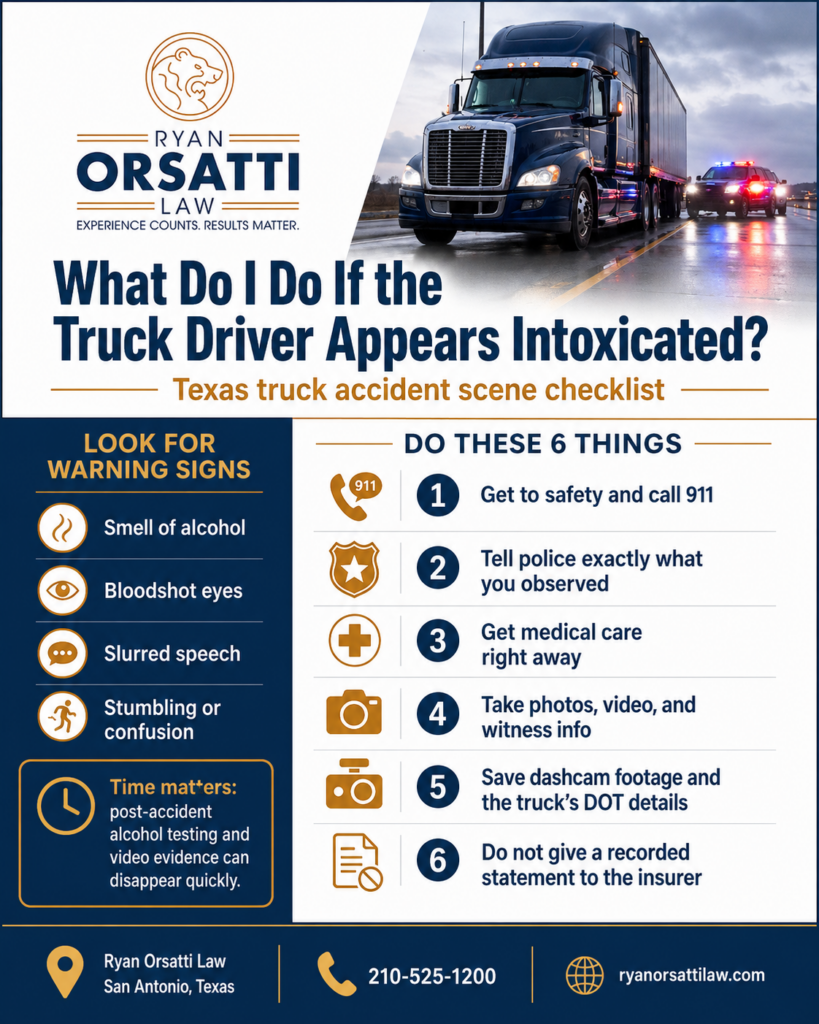
What should I do first if the truck driver appears intoxicated?
Your first step is to protect safety, call 911, and report the specific impairment signs you personally observed. If you are on I-35, I-10, Loop 410, Loop 1604, US-281, or another high-speed road in San Antonio, do not stand in traffic to investigate the driver.
Use simple, factual language with the 911 dispatcher:
“I was hit by an 18-wheeler. The driver smells like alcohol and has bloodshot eyes.”
“The driver is slurring his speech.”
“The driver is stumbling and seems confused.”
“I saw an open beer can in the truck cab.”
Do not exaggerate. Do not say the driver is drunk unless you actually know that. Say what you saw, heard, smelled, and recorded. Those facts help law enforcement decide whether to investigate impairment.
According to TxDOT’s Summer Impaired Driving campaign, 1,254 people died on Texas roads because of impaired driving in 2025, which TxDOT described as three Texans killed each day. (TxDOT)
What should I tell the police officer at the scene?
Tell the officer every concrete sign of impairment before the officer clears the scene. In Texas, the officer’s crash report is commonly called a CR-3, or Texas Peace Officer’s Crash Report. It is not the whole case, but it often becomes one of the first documents reviewed by insurers, lawyers, and investigators.
Useful facts include:
- The exact words the truck driver said
- Whether the driver smelled of alcohol or marijuana
- Whether the driver’s eyes were bloodshot, glassy, or watery
- Whether the driver slurred words, mumbled, or seemed confused
- Whether the driver had trouble standing, walking, or finding documents
- Whether you saw cans, bottles, pills, vape cartridges, or drug paraphernalia
- Whether passengers, bystanders, or first responders noticed the same things
- Whether the driver tried to leave, hide items, or call a supervisor before police arrived
In Texas, suspected intoxication at a truck crash scene should be documented as facts, not conclusions: odor of alcohol, bloodshot eyes, slurred speech, stumbling, open containers, admissions, and witness observations. These details can influence the CR-3 crash report, criminal investigation, FMCSA testing, and later civil liability analysis in Bexar County.
Why do smell of alcohol and bloodshot eyes matter in a Texas truck accident?
Smell of alcohol and bloodshot eyes matter because they can trigger further investigation, preserve time-sensitive testing opportunities, and support a civil negligence claim. Negligence means failing to use reasonable care under the circumstances.
Texas Penal Code § 49.04 makes it an offense to operate a motor vehicle in a public place while intoxicated. Texas Penal Code § 49.01 defines intoxication to include either loss of normal mental or physical faculties because of alcohol, drugs, or similar substances, or an alcohol concentration of 0.08 or more. (Texas Statutes)
Commercial truck drivers face stricter federal alcohol rules. Under 49 CFR § 382.201, a driver may not report for duty or remain on duty in a safety-sensitive function with an alcohol concentration of 0.04 or greater. Under 49 CFR § 392.5, a driver may not use alcohol, be under the influence of alcohol, or have any measured alcohol concentration or detected presence of alcohol while on duty, operating, or in physical control of a commercial motor vehicle. (eCFR)
Texas Penal Code § 49.01 defines intoxication as losing normal mental or physical faculties because of alcohol, drugs, or similar substances, or having an alcohol concentration of 0.08 or more. For commercial drivers, federal rules also bar safety-sensitive duty at an alcohol concentration of 0.04 or greater under 49 CFR § 382.201.
Does the trucking company have to drug or alcohol test the driver after a crash?
The trucking company must conduct FMCSA post-accident testing after some commercial motor vehicle crashes, but not every crash automatically triggers mandatory testing. The Federal Motor Carrier Safety Administration is the federal agency that regulates many interstate commercial motor carriers and drivers.
Under 49 CFR § 382.303, post-accident testing is required after a fatal commercial motor vehicle crash. In injury and tow-away crashes, required testing usually depends on whether the commercial driver receives a moving-violation citation within the applicable time window. (eCFR)
| Crash situation | Alcohol test required? | Controlled-substance test required? | Practical point |
|---|---|---|---|
| Human fatality | Yes | Yes | Testing is required for the surviving driver who was performing safety-sensitive functions. |
| Bodily injury with immediate medical treatment away from the scene | Yes, if the CMV driver receives a moving citation within 8 hours | Yes, if the CMV driver receives a moving citation within 32 hours | Tell police all impairment facts so the investigation is not incomplete. |
| Disabling damage requiring any vehicle to be towed | Yes, if the CMV driver receives a moving citation within 8 hours | Yes, if the CMV driver receives a moving citation within 32 hours | Tow-away damage can matter even if the truck is still drivable. |
| Minor crash with no fatality, no immediate medical treatment away, no tow-away, and no qualifying citation | Not automatically under 49 CFR § 382.303 | Not automatically under 49 CFR § 382.303 | Other testing duties or employer policies may still matter. |
Federal timing rules are strict. If an alcohol test required by 49 CFR § 382.303 is not administered within two hours, the employer must prepare and keep a record explaining why. If it is not administered within eight hours, the employer must stop trying to administer the alcohol test and keep the required record. Controlled-substance testing must stop after 32 hours if not completed, with documentation of the reason. (eCFR)
Under 49 CFR § 382.303, a fatal commercial motor vehicle crash triggers required post-accident alcohol and controlled-substance testing for the surviving driver. Injury and tow-away crashes usually require testing only if the commercial driver receives a qualifying moving-violation citation within the regulation’s 8-hour or 32-hour window.
What evidence should I preserve before it disappears?
You should preserve anything that proves what the truck driver looked like, sounded like, smelled like, did, and said at the scene. Spoliation means destroying, losing, or failing to preserve evidence when litigation is reasonably anticipated.
After a suspected intoxicated truck driver crash, do these 7 things
- Get medical care first. Your health comes before evidence. Also, medical records help connect the crash to your injuries.
- Tell 911 and police what you observed. Use sensory facts: smell, speech, eyes, balance, confusion, admissions, containers, or pills.
- Take photos and video only if safe. Record vehicle positions, license plates, DOT number, company name, trailer number, cab area, debris, skid marks, and road signs.
- Identify witnesses. Ask for names, phone numbers, and what they observed about the truck driver.
- Save your dashcam footage. Many systems overwrite video quickly.
- Do not post the crash on social media. Insurance companies may use posts, comments, photos, and timestamps against you.
- Have a preservation letter sent quickly. A preservation letter is a written demand that the trucking company, insurer, and related parties keep relevant evidence.
In suspected impairment cases, the preservation letter should request drug and alcohol testing records, the Alcohol Testing Form, the Federal Drug Testing Custody and Control Form, post-accident testing logs, supervisor reasonable-suspicion notes, driver qualification files, prior violations, dispatch communications, electronic logging device data, dashcam footage, cab-facing camera footage, ECM data, maintenance records, and load documents.
For related reading, Ryan Orsatti Law has a guide on preserving critical evidence after an 18-wheeler accident in San Antonio and a broader page on what to do after a truck accident.
Attorney Insight: In suspected intoxication truck cases, the most damaging evidence is often not the later police conclusion. It is the first-hour evidence: what witnesses smelled, what the driver said, whether a citation was issued in time to trigger testing, and whether the carrier documented why testing was delayed or missed.
Can I still bring a civil claim if the driver is not arrested for DWI?
Yes, you may still have a civil injury claim even if the truck driver is not arrested, charged, or convicted. A criminal case asks whether the State can prove a crime. A civil injury claim asks whether the driver, trucking company, or another party is legally responsible for your damages.
Damages means the losses caused by the crash. In a truck crash case, damages may include medical bills, future treatment, lost income, reduced earning capacity, pain, impairment, disfigurement, and other losses supported by the evidence.
A DWI arrest can help the civil case, but it is not the only way to prove unsafe driving. Video, witness testimony, testing records, admissions, dispatch records, prior safety violations, and company policies can also matter.
Who can be liable if a truck driver was intoxicated?
More than one person or company may be liable if a truck driver was intoxicated, depending on the facts. Liability means legal responsibility for harm caused by negligent or wrongful conduct.
Possible parties may include:
- The truck driver, if the driver operated while impaired, violated traffic laws, or drove unsafely.
- The motor carrier, if the company employed the driver, controlled the trip, ignored warning signs, failed to follow drug and alcohol rules, or put an unsafe driver on the road.
- The truck owner or equipment owner, if ownership, leasing, maintenance, or control facts support liability.
- A broker, shipper, or contractor, only when the facts show more than ordinary involvement in arranging freight.
- An alcohol provider, in limited Texas dram shop situations.
A dram shop claim is a claim against an alcohol provider. Under Texas Alcoholic Beverage Code § 2.02, a provider may face liability if it was apparent at the time alcohol was provided that the person was obviously intoxicated to the extent the person presented a clear danger to themselves and others, and the intoxication proximately caused the damages. (Justia)
For trucking-company issues, see Ryan Orsatti Law’s guide on when a trucking company may be liable after a Texas truck accident and the firm’s San Antonio commercial vehicle accident claims page.
How does Texas fault law affect a suspected intoxicated truck crash claim?
Texas fault law can reduce or bar recovery depending on each party’s percentage of responsibility. Proportionate responsibility is Texas’s system for assigning fault among people and entities involved in the harm.
Under Texas Civil Practice and Remedies Code § 33.001, a claimant may not recover damages if the claimant’s percentage of responsibility is greater than 50 percent. (Texas Statutes)
That rule matters even when a truck driver appears intoxicated. The defense may still argue you stopped suddenly, changed lanes, failed to avoid the crash, lacked lights, or delayed treatment. Strong scene evidence helps prevent an intoxicated driver’s insurer from shifting blame without support.
How do medical bills and insurance work if intoxication is suspected?
Medical bills and insurance still have to be handled carefully, even when the truck driver appears clearly impaired. An intoxication allegation does not automatically pay emergency bills, repair your vehicle, or resolve liens.
Common insurance and billing issues include:
- Health insurance: Your health plan may pay medical bills first, then claim subrogation. Subrogation means a reimbursement claim from a health plan or insurer after a recovery.
- ERISA plans: Some employer health plans may assert reimbursement rights under federal benefit-plan rules.
- PIP or MedPay: Personal Injury Protection or Medical Payments coverage may help with early medical bills, depending on your own policy.
- Hospital liens: A hospital may claim a lien against a personal injury recovery if statutory requirements are met.
- Letter of protection: A letter of protection is an agreement that a medical provider may wait for payment from a future settlement or judgment.
- UM/UIM coverage: Uninsured or underinsured motorist coverage may matter if available liability insurance is not enough.
Before signing a broad medical authorization from a trucking insurer, understand what it lets the adjuster collect. A narrow, case-related records request is different from a blanket authorization that gives an insurer access to years of unrelated medical history.
How long do I have to act after a suspected drunk truck driver crash in Texas?
Texas generally gives an injured person two years to file a personal injury lawsuit, but intoxication evidence can disappear much faster. Texas Civil Practice and Remedies Code § 16.003 contains the general two-year limitations period for personal injury and wrongful death claims. (Texas Statutes)
That lawsuit deadline is not the same as the evidence deadline. Alcohol testing windows can close within hours. Dashcam and surveillance video may be overwritten. Witness memories fade. Tractor and trailer data may be repaired, replaced, downloaded, or lost if no one demands preservation.
Texas Civil Practice and Remedies Code § 16.003 generally gives an injured person two years to file a personal injury lawsuit, but intoxication evidence can disappear within hours. In suspected drunk truck driver cases, the legal deadline is not the practical evidence deadline.
What mistakes should I avoid after a suspected intoxicated truck crash?
You should avoid anything that gives the trucking insurer an opportunity to weaken the impairment evidence or shift blame. The common mistakes are simple, but they can have lasting consequences.
Avoid these mistakes:
- Leaving the scene without telling police about impairment signs
- Assuming the officer noticed everything you noticed
- Confronting the truck driver
- Recording video in an unsafe location
- Posting photos, jokes, comments, or injury updates online
- Giving a recorded statement before legal advice
- Signing broad medical authorizations
- Delaying medical treatment
- Letting vehicle repairs happen before photos and inspection
- Assuming the criminal case will protect your civil claim
A criminal prosecutor does not represent you in your injury claim. The State’s job is the criminal case. Your civil claim requires proof of liability, damages, insurance coverage, medical causation, and collectible sources of recovery.
How Ryan Orsatti Law approaches suspected intoxication truck crash cases in San Antonio
Ryan Orsatti Law approaches suspected intoxication truck crash cases by focusing early on scene evidence, federal trucking records, medical causation, and insurance coverage. These cases often require fast preservation work before the carrier, insurer, or third-party vendors lose key information.
In matters involving San Antonio, Bexar County, and the I-35 corridor, the early investigation often includes:
- Reviewing the CR-3 crash report and any supplemental police materials
- Sending preservation letters to the carrier, insurer, truck owner, and related companies
- Requesting post-accident drug and alcohol testing documents
- Investigating whether FMCSA testing was required and whether deadlines were met
- Looking for dashcam, cab-facing camera, nearby business video, and TransGuide footage when available
- Identifying witnesses before memories fade
- Reviewing medical records, diagnosis, treatment plan, liens, and reimbursement claims before any demand
- Evaluating all potentially responsible parties, not just the driver
For more context, see Ryan Orsatti Law’s San Antonio truck accident lawyer page and San Antonio drunk driving accident lawyer page.
FAQ
Should I tell the police if the truck driver smells like alcohol?
Yes. Tell the officer the specific facts, such as alcohol odor, bloodshot eyes, slurred speech, open containers, or stumbling. Do not just say “he was drunk” unless you know that. Specific observations give law enforcement better grounds to investigate impairment and may help preserve later civil evidence.
Are commercial truck drivers held to a lower alcohol limit than regular drivers?
Yes. Texas DWI law uses 0.08 as one definition of intoxication, but federal commercial-driver rules are stricter for safety-sensitive work. Under 49 CFR § 382.201, a covered driver may not report for duty or remain on duty with an alcohol concentration of 0.04 or greater. (eCFR)
Does FMCSA require testing after every truck crash?
No. FMCSA post-accident testing is required after fatal crashes and after certain injury or tow-away crashes when the commercial driver receives a qualifying moving-violation citation within the regulatory time window. Even when mandatory post-accident testing is not triggered, reasonable suspicion, company policy, or law enforcement testing may still matter. (eCFR)
What if the truck driver refuses a drug or alcohol test?
A refusal can become important evidence, but the consequences depend on which test was requested, who requested it, and whether federal, state, employer, or law enforcement rules applied. Under 49 CFR § 382.211, a covered driver may not refuse required alcohol or controlled-substance testing. (eCFR)
Are bloodshot eyes enough to prove a truck driver was intoxicated?
Bloodshot eyes alone usually are not enough. They matter more when combined with alcohol odor, slurred speech, poor balance, admissions, open containers, erratic driving, video, witness statements, or chemical testing. In a civil case, the goal is to gather all evidence that explains why the crash happened.
Should I record the truck driver if I think they are intoxicated?
You may record visible scene facts from a safe location, but do not get close to the driver, block officers, enter the truck, or create another hazard. Video of speech, balance, open containers, vehicle positions, DOT numbers, and witness statements may help, but personal safety comes first.
What if the truck driver is not charged with DWI?
A civil claim may still exist even without a DWI charge. Criminal prosecutors make charging decisions under criminal-law standards. A civil truck accident case can rely on unsafe driving, trucking-rule violations, company negligence, witness testimony, video, testing records, and medical evidence, even if no criminal charge is filed.
Could a bar, restaurant, or truck stop be liable if it served the driver alcohol?
Possibly, but only under narrow facts. Texas Alcoholic Beverage Code § 2.02 requires proof that, when alcohol was provided, it was apparent the person was obviously intoxicated to the extent they presented a clear danger, and that the intoxication proximately caused the damages. Scene intoxication alone may not prove overservice. (Justia)
Ryan Orsatti Law
4634 De Zavala Rd, San Antonio, TX 78249
Phone: 210-525-1200
ryanorsattilaw.com
This blog is for informational purposes only, not legal advice. Reading it does not create an attorney-client relationship. Past results do not guarantee future results.
Hurt in an accident in San Antonio? Learn how a San Antonio personal injury lawyer can help with your claim. Call 210-525-1200 or request a free consultation.
The firm works on a contingency fee. You pay nothing unless the firm recovers money for you, and that covers case expenses as well as the fee: if there is no recovery, you owe no attorney's fee and no case expenses. Ask for the fee agreement and read the fee and expense section before you sign anything.
Related San Antonio legal resources
Primary legal and public-data sources
- Texas Civil Practice and Remedies Code Chapter 16: limitations
- Texas Civil Practice and Remedies Code Chapter 33: proportionate responsibility
Ryan Orsatti Law
4634 De Zavala Road, San Antonio, TX 78249
General reference links. Consult each source for its current text.