
Quick Answer
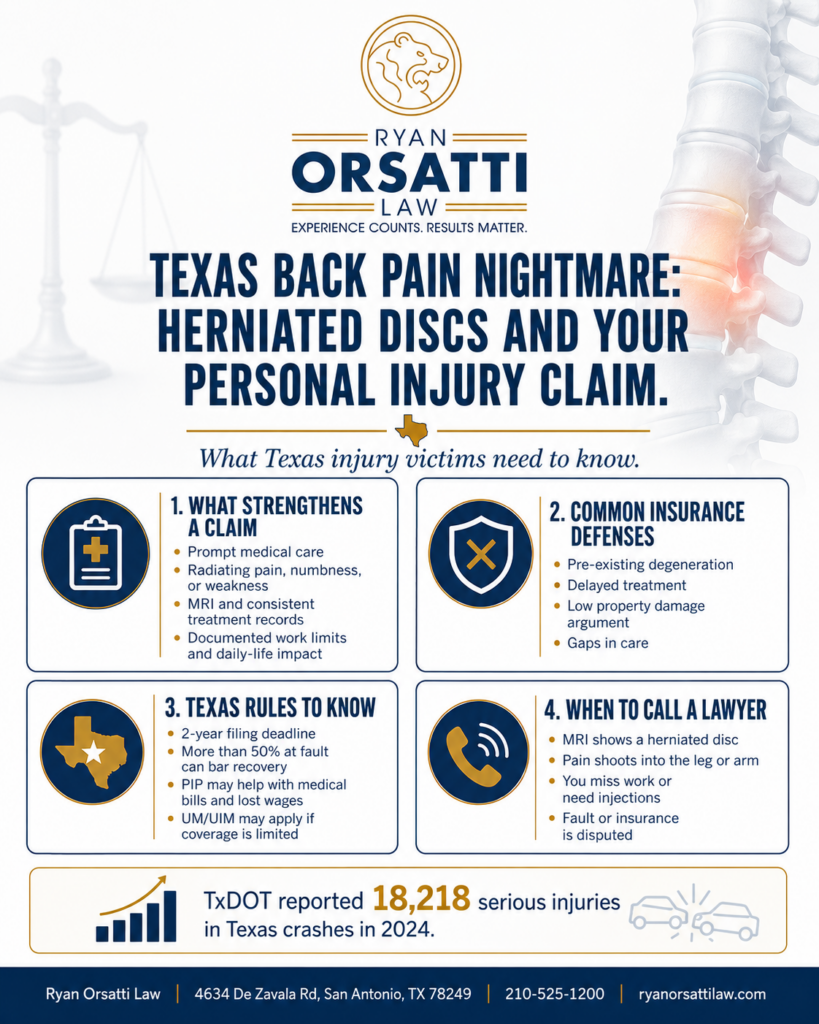
A herniated disc personal injury claim in Texas depends on proof that the accident caused or aggravated the disc injury, not just an MRI finding. Texas generally gives injured people two years to file under Texas Civil Practice and Remedies Code § 16.003. (Texas Constitution and Statutes) TxDOT reported 14,905 serious injury crashes and 18,218 serious injuries in Texas in 2024, so insurers often scrutinize spine claims closely. (Texas Department of Transportation) Ryan Orsatti Law helps injured people in San Antonio and across Texas organize medical, fault, and coverage evidence after serious back injuries.
Key Takeaways
- A herniated disc claim is strongest when the medical timeline connects the accident, symptoms, exam findings, MRI results, treatment, and work limits.
- Back pain alone is often disputed. Radiating pain, numbness, weakness, injections, surgical referrals, and documented activity limits usually receive closer attention.
- Degenerative disc disease does not automatically defeat a Texas claim. The issue is whether the accident caused a new injury or worsened a prior condition.
- Texas proportionate responsibility can reduce or bar recovery if fault is disputed. Under Texas Civil Practice and Remedies Code Chapter 33, a claimant may not recover if more than 50 percent responsible. (Texas Constitution and Statutes)
- Insurance coverage matters. Liability limits, PIP, MedPay, UM/UIM, health insurance, subrogation, and liens can all affect the final claim picture.
What is a herniated disc personal injury claim in Texas?
A herniated disc personal injury claim in Texas is a claim that someone else’s negligence caused or aggravated a disc injury in the spine. Negligence means a person or company failed to use reasonable care, and that failure caused injury and damages. These claims often come from car wrecks, 18-wheeler crashes, commercial vehicle collisions, motorcycle crashes, falls, and work-related third-party incidents.
A herniated disc, sometimes spelled “herniated disk” in medical sources, happens when disc material pushes out and irritates or compresses nearby nerves. Mayo Clinic explains that a herniated disk in the lower back can cause pain in the lower back, buttocks, thigh, calf, and sometimes the foot. (Mayo Clinic)
For injury claims, the MRI is only one piece of proof. A Texas insurer, defense lawyer, or jury usually wants to know what changed after the incident: new symptoms, worse symptoms, radiating pain, numbness, weakness, medical restrictions, missed work, injections, surgery recommendations, or permanent limitations.
Why do insurance companies fight herniated disc claims?
Insurance companies often fight herniated disc claims because back pain is common, disc degeneration is common, and MRI findings do not always prove legal causation by themselves. The CDC’s National Center for Health Statistics reported that 39.0 percent of U.S. adults had back pain in the past three months in 2019, which gives insurers a built-in argument that a claimant’s pain may not be accident-related. (CDC)
In a Texas personal injury claim, the key dispute is often causation. Causation means proving the accident caused the injury, aggravated a prior condition, or made a dormant condition symptomatic. Insurance adjusters may accept that you have a herniated disc while still arguing that the crash did not cause it.
Common insurer arguments include:
- “The MRI shows age-related degeneration.”
- “The property damage was not severe enough.”
- “The injured person delayed treatment.”
- “There was no ambulance or ER visit.”
- “There were prior complaints of back pain.”
- “The symptoms are subjective.”
- “The treatment was too much, too long, or too expensive.”
Attorney Insight: In herniated disc claims, adjusters often separate “MRI proof” from “causation proof.” The MRI may show a real disc problem, but the claim still needs a clean timeline: no major prior symptoms, immediate or reasonably prompt complaints, consistent pain patterns, objective exam findings, and medical records that explain why the crash changed the person’s condition.
What does radiculopathy mean in a back injury claim?
Radiculopathy means a nerve root is irritated or compressed, often causing pain, numbness, tingling, or weakness that travels into an arm or leg. In a lumbar herniated disc claim, this may appear as sciatica or shooting pain down the leg. Mayo Clinic lists numbness, tingling, weakness, and serious symptoms such as difficulty walking or loss of bladder or bowel control as concerns that may require medical attention. (Mayo Clinic)
Radiculopathy can matter because it gives the claim more than “my back hurts.” Medical records that document radiating symptoms, abnormal reflexes, weakness, positive straight-leg raise testing, nerve root impingement, injections, or surgical evaluation can help connect the MRI finding to real functional loss.
What medical evidence helps prove a crash caused or aggravated a herniated disc?
The best medical evidence in a Texas herniated disc claim usually shows a consistent timeline from accident to symptoms to diagnosis to treatment. The stronger records identify what hurt, when it started, whether symptoms radiated, what the MRI showed, what treatment was recommended, and how the injury affected work and daily life.
| Evidence | What it helps prove | Why it matters in a Texas claim |
|---|---|---|
| ER, urgent care, or primary care records | Early complaints of back, neck, leg, or arm symptoms | Reduces the insurer’s argument that symptoms appeared later for unrelated reasons |
| MRI report | Disc herniation, nerve root contact, stenosis, annular tear, or other findings | Shows objective imaging, but must be connected to symptoms and the accident |
| Prior medical records | Whether back pain existed before the incident | Helps separate a new injury from aggravation of an old condition |
| Physical therapy notes | Pain levels, range of motion, functional limits, progress, setbacks | Shows how the injury affected movement and daily activity over time |
| Pain management records | Injections, medication changes, failed conservative care | Shows escalation when basic treatment is not enough |
| Spine surgeon consult | Surgical recommendation, impairment discussion, future care | Often changes case evaluation because future risk and cost become clearer |
| Work restriction notes | Lifting limits, missed work, reduced hours, inability to perform job duties | Supports lost wages and loss of earning capacity |
| Symptom diary and activity limits | Sleep disruption, driving limits, sitting limits, household limits | Helps explain the human impact beyond billing codes |
Key takeaway: A herniated disc claim is rarely won or lost on the MRI alone; the timeline, symptoms, treatment response, and functional limits usually determine how seriously the claim is evaluated.
What should you do in the first 30 days after accident-related back pain?
You should document symptoms early, get appropriate medical care, avoid minimizing back pain, and preserve fault evidence in the first 30 days after an accident. A delay does not always destroy a Texas claim, but it gives the insurer more room to argue that the disc injury is unrelated.
Use this checklist if you have back pain after a crash or fall:
- Get medical care quickly. Tell the provider the accident date, mechanism of injury, and every symptom.
- Report radiating symptoms. Say whether pain travels into the buttock, leg, foot, shoulder, arm, or hand.
- Do not say “I’m fine” if you are not. Casual statements can appear later in claim notes.
- Follow treatment instructions. Missed appointments create gaps that insurers use against you.
- Ask when imaging is appropriate. An MRI is often considered when symptoms persist, worsen, or involve nerve signs.
- Save the crash report information. TxDOT maintains Texas crash data from CR-3 crash reports submitted by law enforcement. (Texas Department of Transportation)
- Photograph vehicle damage, fall hazards, bruising, braces, medications, and home modifications.
- Track missed work and reduced duties. Save pay stubs, employer notes, job descriptions, and leave records.
- Avoid broad medical authorizations. Insurers may request years of unrelated records.
- Talk to a lawyer before signing a release. A “full and final” release can close the claim even if future spine care is needed.
For a deeper discussion of timing, see Ryan Orsatti Law’s guide on waiting to call a lawyer after a wreck.
How does Texas law affect a herniated disc personal injury claim?
Texas law affects a herniated disc claim through filing deadlines, proportionate responsibility, medical bill rules, and insurance coverage. A strong medical case can still be damaged by a missed deadline, disputed fault, low insurance limits, unpaid liens, or poorly handled medical billing evidence.
How long do you have to file a herniated disc personal injury lawsuit in Texas?
You generally have two years from the date the injury claim accrues to file a Texas personal injury lawsuit. The main Texas limitations statute is Texas Civil Practice and Remedies Code § 16.003, which applies to many injury claims. (Texas Constitution and Statutes)
The two-year deadline is the outside legal deadline, not the best time to start building the claim. For a herniated disc, early records matter because the insurer may focus on delays, prior back pain, changing symptoms, and whether treatment was consistent with a crash-related injury.
What if the insurance company says you were partly at fault?
If the insurance company says you were partly at fault, Texas proportionate responsibility rules may reduce or bar recovery. Comparative responsibility means Texas can reduce damages by your percentage of fault, and Chapter 33provides that a claimant may not recover if the claimant’s percentage of responsibility is greater than 50 percent. (Texas Constitution and Statutes)
This matters in back injury claims because insurers often dispute both injury and fault at the same time. For example, after a San Antonio crash on Loop 1604, I-10, I-35, Loop 410, or US-281, the claim may need crash report analysis, photos, witness statements, vehicle damage evidence, traffic signal evidence, dashcam footage, or commercial vehicle records.
How do medical bills affect the value of a Texas herniated disc claim?
Medical bills affect a Texas herniated disc claim, but Texas law does not always treat the sticker price of medical bills as the recoverable amount. Under Texas Civil Practice and Remedies Code § 41.0105, recovery of medical or health care expenses is limited to amounts actually paid or incurred by or on behalf of the claimant. (Texas Constitution and Statutes)
Subrogation means a health insurer or benefit plan may claim a right to be paid back from a settlement. A hospital lien is a legal claim a hospital may assert against part of a personal injury recovery, and Texas hospital lien rules can apply when accident-related hospital care meets the requirements in Texas Property Code Chapter 55. (Texas Constitution and Statutes)
What insurance coverage may help with herniated disc treatment?
Texas auto insurance coverage may include liability coverage, PIP, MedPay, UM/UIM, and sometimes other coverages depending on the policy. The Texas Department of Insurance explains that Texas drivers must carry at least 30/60/25 liability coverage, and that Texas auto policies include PIP unless rejected in writing. (Texas Department of Insurance)
PIP means personal injury protection. It can help pay medical bills and lost wages without waiting for a final fault decision. MedPay means medical payments coverage, which may help pay medical bills but is different from PIP. UM/UIM means uninsured or underinsured motorist coverage, which may apply if the at-fault driver had no insurance or not enough insurance.
Coverage matters in herniated disc cases because treatment can escalate. Physical therapy, MRIs, pain management, injections, specialist visits, surgery evaluations, and time off work may exceed minimum liability limits quickly. A lawyer can review the declarations pages, policy language, health insurance issues, lien claims, and settlement release language before a claim is resolved.
What damages can be part of a Texas herniated disc claim?
A Texas herniated disc claim may include medical expenses, future medical care, lost wages, loss of earning capacity, pain, impairment, and other legally recoverable damages supported by the evidence. Damages means the harms and losses the law allows an injured person to claim when another person or company is legally responsible.
Common damage categories include:
- Emergency care, follow-up care, MRI, therapy, injections, and surgical evaluation
- Future medical care if supported by medical opinion
- Lost income for missed work
- Reduced earning capacity if the injury affects future work ability
- Physical pain
- Physical impairment, which means limits on normal activity
- Mental anguish when supported by evidence
- Out-of-pocket expenses tied to the injury
There is no honest average value for every herniated disc case. A person with a brief course of conservative care, no nerve symptoms, and clear recovery is in a different claim position than a person with nerve compression, failed therapy, injections, surgery recommendations, permanent restrictions, and disputed insurance coverage. For more on case value factors, read Ryan Orsatti Law’s guide to what a herniated disc from a car wreck could be worth in Texas.
What if your MRI shows degenerative disc disease?
An MRI showing degenerative disc disease does not automatically defeat a Texas herniated disc claim. The practical issue is whether the accident caused a new disc injury, aggravated a symptomatic condition, or made a previously quiet condition painful and disabling.
Insurance companies often focus on words like “degenerative,” “chronic,” or “pre-existing.” Those words matter, but they are not the whole analysis. The claim may turn on prior records, pre-accident activity level, post-accident symptom changes, doctor opinions, and whether the pain pattern matches the injured disc level.
Ryan Orsatti Law has a separate resource on insurance companies blaming pre-existing conditions for San Antonio injuries. That issue is especially common in neck and back injury claims.
How long does a herniated disc personal injury claim take in Texas?
A herniated disc personal injury claim in Texas can take months or longer depending on treatment, fault disputes, insurance coverage, and whether litigation becomes necessary. The claim should usually not be valued before the diagnosis, treatment plan, future care risk, billing picture, and lien status are understood.
Spine claims often take longer than simple soft-tissue claims because the injury may evolve. A patient may start with therapy, then need an MRI, then a pain management referral, then injections, then a surgical consult. Resolving too early can create problems if the release is signed before the real medical picture is known.
When should you contact a Texas personal injury lawyer for a herniated disc?
You should consider contacting a Texas personal injury lawyer if you have radiating pain, numbness, weakness, MRI findings, injections, surgery recommendations, missed work, disputed fault, prior back issues, or pressure to give a recorded statement. These are the facts that often make a herniated disc claim more complex.
A lawyer can help preserve evidence, evaluate fault, review medical chronology, identify coverage, address liens, communicate with adjusters, and avoid releases that cut off future claims. Ryan Orsatti Law helps injured people in San Antonio, Bexar County, Comal County, Guadalupe County, Kendall County, Wilson County, Atascosa County, Medina County, and across Texas evaluate serious back injury claims.
How can Ryan Orsatti Law help with a herniated disc claim in San Antonio?
Ryan Orsatti Law can help by organizing the proof that usually decides a San Antonio herniated disc claim: fault evidence, medical history, MRI findings, treatment progression, billing records, lien claims, insurance coverage, and the client’s real-life limitations. The firm focuses on Texas personal injury claims and works with injured people who need practical guidance after serious accidents.
In a back injury claim, the details matter. The claim may need a CR-3 crash report, vehicle photos, scene photos, witness information, body-camera requests, dashcam evidence, commercial vehicle records, medical chronologies, prior medical record review, health insurance analysis, and a plan for proving how the injury affects work and daily life.
For severe spine trauma, permanent restrictions, or surgery-level injuries, Ryan Orsatti Law also handles San Antonio catastrophic injury claims. To discuss a potential claim, you can contact Ryan Orsatti Law.
FAQ
Can I sue for a herniated disc after a car accident in Texas?
Yes, you may be able to bring a Texas personal injury claim if another person’s negligence caused or aggravated your herniated disc. The key proof is not just the MRI. You need evidence connecting the crash to symptoms, treatment, work limits, and damages, along with proof that the other party was legally at fault.
What if my back pain started a few days after the accident?
Delayed back pain does not automatically defeat a herniated disc claim, but it creates a proof issue. You should get medical care, explain when symptoms started, describe whether pain radiates into the leg or arm, and avoid guessing. Insurers often use treatment gaps against injured people, so documentation matters.
Is a bulging disc the same as a herniated disc in a personal injury claim?
No, a bulging disc and a herniated disc are not always treated the same medically or legally. The exact MRI language matters, but symptoms matter too. A claim with nerve compression, radiculopathy, weakness, injections, or surgery evaluation may be viewed differently than a claim with imaging findings but minimal symptoms.
What if the insurance company says my herniated disc is pre-existing?
A pre-existing disc condition does not automatically end a Texas claim. The question is whether the accident caused a new injury or worsened your prior condition. Useful proof includes old records, new records, symptom history, work ability before and after the accident, and medical opinions explaining what changed.
Should I give a recorded statement if I have back pain after a crash?
You should be careful with recorded statements when you have back pain, possible disc injury, or symptoms that are still developing. Adjusters may ask questions before you know your diagnosis. A statement that minimizes pain, guesses about prior injuries, or accepts partial fault can create problems later.
Can PIP help pay for herniated disc treatment in Texas?
PIP may help pay medical bills and lost wages after a Texas auto accident if the policy has PIP coverage. The Texas Department of Insurance explains that Texas auto policies include PIP unless rejected in writing. PIP is separate from the at-fault driver’s liability coverage and may apply before the liability claim resolves. (Texas Department of Insurance)
How much is a herniated disc personal injury claim worth in Texas?
There is no reliable average for every Texas herniated disc claim. Value depends on fault, insurance limits, medical proof, prior spine history, treatment, injections, surgery recommendations, permanent restrictions, lost income, and how the injury affects daily life. A careful evaluation should happen after the medical and billing picture is clearer.
Ryan Orsatti Law
4634 De Zavala Rd, San Antonio, TX 78249
Phone: 210-525-1200
ryanorsattilaw.com
This blog is for informational purposes only, not legal advice. Reading it does not create an attorney-client relationship. Past results do not guarantee future results.
Hurt in an accident in San Antonio? Learn how a San Antonio car accident lawyer can help with your claim. Call 210-525-1200 or request a free consultation. There is no fee unless we win.
Related San Antonio legal resources
Primary legal and public-data sources
- TxDOT: Texas crash reports, data, and statistics
- Texas Civil Practice and Remedies Code Chapter 33: proportionate responsibility
Ryan Orsatti Law
4634 De Zavala Road, San Antonio, TX 78249
Source links verified August 7, 2026.