
Quick Answer
A herniated disc case in Texas does not have a standard payout. Its value usually depends on five things: who caused the wreck, whether the disc injury is well-documented, how much treatment you needed, whether the injury affected your work and daily life, and how much insurance is available.
In many cases, the biggest drivers of value are not the words “herniated disc” alone. What matters is whether the medical records connect the wreck to your symptoms, whether the imaging matches those symptoms, whether you had nerve findings or restrictions, and whether the treatment was conservative, injection-based, or surgical.
Texas law also matters. In most car-wreck injury cases, you generally have two years to file suit. Texas also follows proportionate responsibility: if you are more than 50% responsible, you generally cannot recover; if you are 50% or less responsible, your recovery is reduced by your percentage of fault. Texas minimum liability limits are still often too low for a serious back-injury claim, which is why available coverage can heavily affect case value. (Texas Statutes)
How Much Is a Herniated Disc From a Car Accident Worth in Texas?
There is no honest one-size-fits-all number.
A herniated disc claim can range from a modest soft-tissue-style settlement to a substantial claim if the evidence shows significant pain, radiculopathy, injections, surgery, permanent restrictions, wage loss, or future medical needs. In San Antonio and throughout Texas, two people can both have an MRI showing a herniation and still have very different case values based on the evidence behind the claim.
A realistic case evaluation usually starts with these questions:
- Was liability clear, or is fault disputed?
- Did symptoms begin quickly after the crash?
- Did you get imaging that supports the diagnosis?
- Do the records show nerve complaints, weakness, numbness, or radiating pain?
- Did you miss work or lose earning capacity?
- Did the wreck aggravate a prior back condition?
- Is there enough insurance to cover the claim?
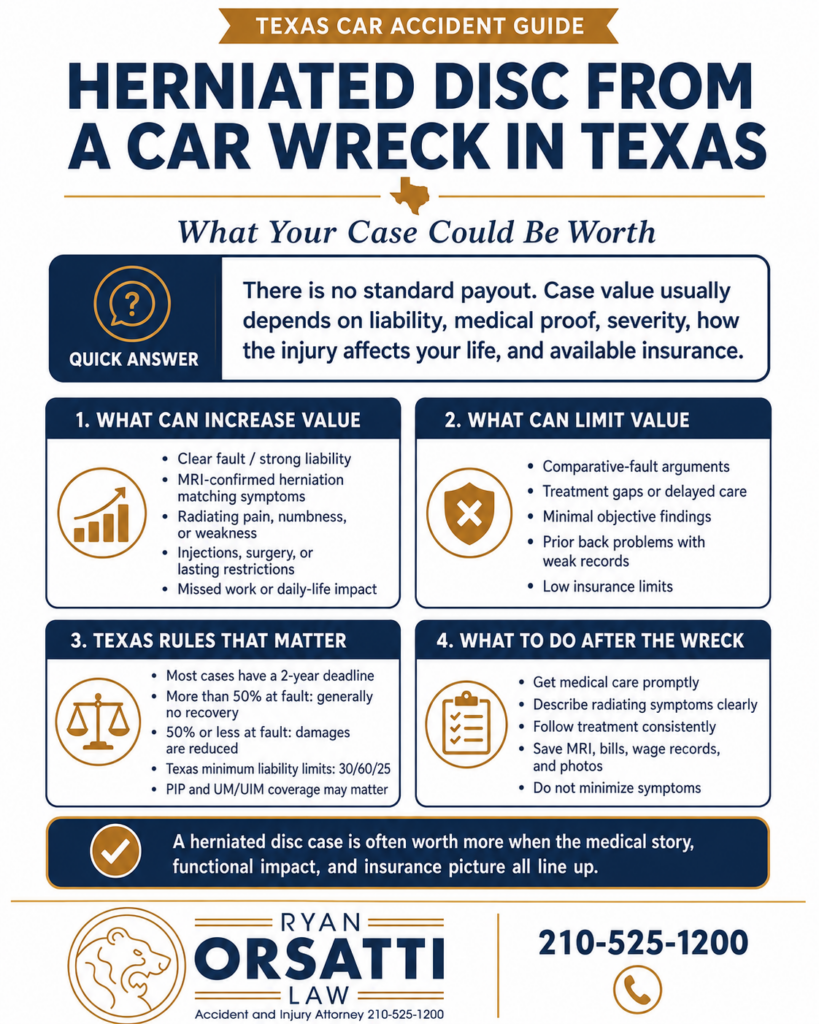
What Usually Increases or Decreases Case Value?
| Case factor | Tends to increase value | Tends to limit value |
|---|---|---|
| Liability | Clear rear-end or obvious fault; strong photos, witness support, crash report | Disputed fault; inconsistent statements; comparative-fault allegations |
| Medical proof | MRI-confirmed herniation matching symptoms; consistent treatment; specialist care | Long treatment gaps; minimal objective findings; weak causation record |
| Severity | Radiculopathy, injections, surgery recommendation or surgery, permanent restrictions | Short-lived pain only; home exercise only; quick discharge |
| Function | Missed work, lifting limits, sleep disruption, inability to drive or care for family normally | Little documented effect on daily activities or work |
| Prior history | No prior similar back complaints, or clear proof of aggravation of a stable condition | Significant prior back treatment with poor records distinguishing old from new |
| Insurance | High liability limits, commercial policy, UM/UIM, PIP/MedPay available | Minimum-limits policy, no UM/UIM, collectability issues |
What Makes a Herniated Disc Claim Strong?
A strong herniated-disc case usually has a clean causation story.
That means the timeline makes sense:
- A crash happened.
- Symptoms started right away or soon after.
- The complaints were documented early.
- Treatment continued consistently.
- Imaging and clinical findings supported the diagnosis.
- The limitations were real and documented.
Insurance carriers often look closely at whether the medical story is internally consistent. They compare:
- EMS and ER records
- primary-care notes
- chiropractic or physical therapy notes
- orthopedic or pain-management records
- MRI findings
- work records
- prior medical history
If those records line up, the claim is usually much easier to present. If they do not, the carrier will often argue the disc issue was degenerative, unrelated, exaggerated, or not serious enough to justify a higher settlement.
Can I Recover If I Had Back Problems Before the Wreck?
Yes—sometimes.
A preexisting back problem does not automatically defeat a Texas car-wreck claim. But it usually makes the case more document-heavy. The key issue becomes whether the wreck caused a new injury or aggravated a preexisting condition.
That is where records matter. If you had old low-back pain but were functioning well before the crash, then after the crash you developed new radiating pain, numbness, weakness, or a need for injections or surgery, that difference matters. The clearer the before-and-after picture, the stronger the claim.
This is also why it is a mistake to hide prior treatment. Insurance companies usually find prior claims and prior imaging. It is far better to address the history directly and explain what changed.
What If the MRI Says “Degenerative Changes”?
That is one of the most common insurance defenses in disc-injury cases.
Many adults have some degenerative findings on imaging, especially in the cervical or lumbar spine. An adjuster may point to those findings and say the wreck did not really cause the problem. But that is not the end of the issue. The real question is whether the crash caused symptoms, worsened a previously stable condition, or made a dormant condition painful and disabling.
What often helps:
- records showing little or no similar symptoms before the wreck
- prompt complaints after the crash
- exam findings that match the MRI level
- specialist opinions tying the wreck to the symptoms
- proof of functional loss, missed work, or ongoing restrictions
In other words, the defense theme may be “degeneration,” but the plaintiff-side response is usually “aggravation with real consequences.”
How Insurance Affects What Your Case Could Be Worth
Insurance limits can matter almost as much as the injury itself.
Texas requires liability coverage, but the minimum limits are still 30/60/25—meaning $30,000 per injured person, $60,000 per accident for bodily injury, and $25,000 for property damage. Texas auto policies must also offer PIP and UM/UIM coverage unless rejected in writing. Medical payments coverage generally pays medical bills; PIPgenerally pays medical bills plus items like lost wages and other nonmedical costs. (Texas Department of Insurance)
Why that matters in a herniated-disc case:
- A minimum-limits policy may be inadequate for a serious lumbar or cervical disc claim.
- PIP can help with early bills and wage loss regardless of fault.
- UM/UIM may become critical if the at-fault driver has no insurance, not enough insurance, or flees the scene. Texas Department of Insurance guidance explains that UM/UIM can apply when the other driver lacks enough coverage and that Texas insurers must offer it unless rejected in writing. (Texas Department of Insurance)
A case can have strong injury facts and still face a practical ceiling because of low policy limits. That is one reason early coverage investigation matters.
How Texas Fault Rules Change Settlement Value
Texas follows a modified comparative-fault system under its proportionate-responsibility rules. If you are more than 50% responsible, you generally cannot recover damages. If you are 50% or less responsible, your damages are reduced by your percentage of responsibility. (Texas Statutes)
That affects value in real-world ways. For example:
- A $100,000 case with no fault dispute is still a $100,000 case before collectability issues.
- A $100,000 case where you are found 20% at fault may functionally become an $80,000 case.
- A serious injury case can lose major value if the defense has a believable seat-belt, speed, lookout, lane-change, or sudden-stop argument.
That is why liability development matters even in “injury-heavy” cases.
What To Do After a Wreck If You Think You Have a Disc Injury
If the wreck caused injury, death, or damage that leaves a vehicle unable to be normally and safely driven, Texas law requires an immediate report to law enforcement by the quickest means of communication. (Texas Statutes)
Practical steps
- Get medical care promptly if you have neck pain, low-back pain, radiating pain, numbness, tingling, or weakness.
- Tell each provider exactly where the pain travels and what activities it affects.
- Follow through with treatment. Long gaps can hurt credibility.
- Keep photos of vehicle damage, bruising, medications, and any visible limitations.
- Save wage records, missed-time records, and employer notes.
- Avoid minimizing symptoms early and then escalating them later without explanation.
- Do not guess about prior injuries. Be accurate.
Documentation that often matters most
- crash report
- ER or urgent-care records
- MRI reports and, when needed, images
- orthopedic, neurosurgical, or pain-management records
- physical therapy records
- wage-loss proof
- prescription history
- prior records if there is a preexisting-condition issue
How Long Does a Herniated Disc Car-Wreck Case Take?
Most herniated-disc cases take longer than minor soft-tissue cases because the value question usually depends on how you progress medically.
A common pattern looks like this:
1. Early treatment phase
The focus is diagnosis, symptom tracking, and deciding whether conservative care is enough.
2. Imaging and specialist phase
MRI findings, pain-management evaluation, orthopedic review, or neurosurgical review often clarify the seriousness of the claim.
3. Maximum-improvement or treatment plateau
At some point, the case becomes easier to evaluate because there is a clearer picture of whether you improved, needed injections, need surgery, or have permanent restrictions.
4. Demand and negotiation
A serious demand package should tie the wreck, the medical evidence, the bills, the functional loss, and the legal theory together.
5. Suit if needed
If liability, causation, or value is seriously disputed—or if policy-limit issues or lien issues complicate the case—filing suit may be necessary.
Texas generally gives personal-injury plaintiffs two years to file suit, but waiting until the deadline is risky because evidence, witnesses, and coverage issues should be addressed much earlier. (Texas Statutes)
Common Mistakes That Can Undervalue a Disc-Injury Claim
1. Waiting too long to get evaluated
If you wait weeks to mention neck or back symptoms, the defense may argue something else caused them.
2. Treating inconsistently
Big gaps in care are often used to argue you recovered or were never seriously hurt.
3. Failing to describe radicular symptoms
A disc case often becomes more credible when the records clearly reflect radiating pain, numbness, tingling, weakness, or specific functional deficits.
4. Focusing only on the MRI label
“Herniated disc” is not enough by itself. The claim gets stronger when imaging, exam findings, symptoms, and treatment all line up.
5. Ignoring insurance issues
A claim can be worth more on paper than is actually collectible without identifying all applicable coverages.
6. Overlooking liens
Texas hospital-lien law can affect the net recovery in some cases. Under Chapter 55, a hospital lien can attach if the person is admitted to a hospital not later than 72 hours after the accident. (Texas Statutes)
Attorney Insight
In real herniated-disc cases, adjusters and defense lawyers often focus less on the MRI headline and more on the story underneath it.
They ask:
- Did the symptoms start when they should have?
- Did the records stay consistent?
- Was there a meaningful mechanism of injury?
- Did the plaintiff keep treating?
- Do the complaints make sense with the imaging level?
- Is there a prior-history explanation?
- Is surgery actually on the table, or is it only mentioned in passing?
That is why strong case presentation matters. A disc case is often won or lost in the details long before trial—through the records, the timeline, the provider impressions, the work-loss proof, and the way the claim is framed.
What Representation Usually Looks Like in a Herniated Disc Case
For many injured people, representation means more than sending a demand letter.
It usually includes:
- investigating fault and preserving evidence
- identifying every possible insurance source
- organizing treatment records and imaging
- analyzing prior-history issues
- documenting lost wages and future damages
- evaluating liens and subrogation issues
- preparing the case for litigation if the carrier undervalues it
That preparation can matter a lot in disc cases because these claims often attract “degenerative,” “gap in treatment,” and “minor impact” defenses.
FAQs
Is a herniated disc worth more than a sprain/strain claim?
Often yes, but not automatically. The value depends on the quality of the proof, how serious the symptoms are, and whether the treatment shows a lasting problem rather than short-term pain.
Can a low-speed crash still cause a herniated disc?
It can be alleged, but low-damage cases are often more heavily disputed. In those cases, the medical timeline and objective findings become even more important.
Do I need surgery to have a strong case?
No. Surgery usually increases value, but a non-surgical case can still be significant if the records show persistent symptoms, injections, work loss, and credible functional limitations.
What if the other driver only has minimum insurance?
That can sharply limit practical recovery unless there is additional coverage, such as UM/UIM, an employer policy, or another responsible party.
Can I recover if I was partly at fault?
Possibly. In Texas, you generally can recover if you are 50% or less at fault, but your damages are reduced by your percentage of responsibility. If you are more than 50% at fault, you generally cannot recover. (Texas Statutes)
How long do I have to file a lawsuit in Texas?
In most Texas personal-injury cases, the limitations period is two years. (Texas Statutes)
When To Talk to a Lawyer About a Disc-Injury Wreck
It is smart to get legal advice sooner rather than later if:
- the MRI shows a herniation or nerve impingement
- you have radiating pain, weakness, or numbness
- injections or surgery are being discussed
- you missed work
- the insurer says your condition is degenerative
- liability is disputed
- the at-fault driver may be underinsured
- a lien or subrogation issue is already showing up
Ryan Orsatti Law
4634 De Zavala Rd, San Antonio, TX 78249
Phone: 210-525-1200
This blog is for informational purposes only, not legal advice. Reading it does not create an attorney-client relationship. Past results do not guarantee future results.
Hurt in an accident in San Antonio? Learn how a San Antonio car accident lawyer can help with your claim. Call 210-525-1200 or request a free consultation.
The firm works on a contingency fee. You pay nothing unless the firm recovers money for you, and that covers case expenses as well as the fee: if there is no recovery, you owe no attorney's fee and no case expenses. Ask for the fee agreement and read the fee and expense section before you sign anything.
Related San Antonio legal resources
Primary legal and public-data sources
- TxDOT: Texas crash reports, data, and statistics
- Texas Civil Practice and Remedies Code Chapter 33: proportionate responsibility
Ryan Orsatti Law
4634 De Zavala Road, San Antonio, TX 78249
General reference links. Consult each source for its current text.