
Quick Answer: Tesla Autopilot and Full Self-Driving (Supervised) are Level 2 driver-assistance systems, not fully autonomous driving. The human driver must remain attentive, but that does not automatically make the driver the only liable party after a Texas crash. A claim may involve the driver, Tesla, or both, depending on vehicle data, driver inputs, warnings, software version, and whether a product defect contributed. Ryan Orsatti Law helps injured Texans preserve and evaluate this evidence.
Key Takeaways
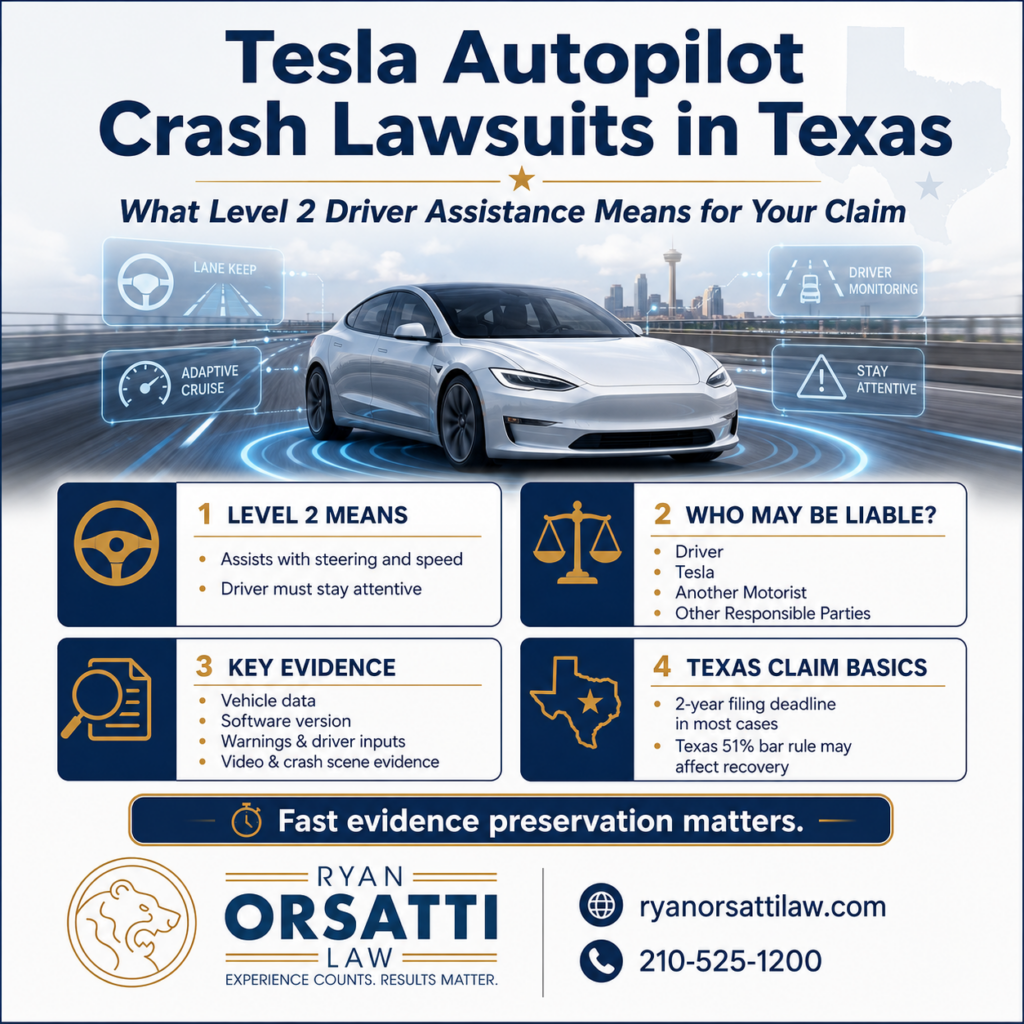
- Level 2 means the system can assist with steering and speed at the same time, but the driver remains responsible for monitoring the road and intervening.
- Autopilot involvement does not automatically prove either driver negligence or a Tesla defect.
- Texas may divide fault among the driver, Tesla, another motorist, and other responsible parties.
- Vehicle data, software records, driver inputs, video, and the physical vehicle should be preserved immediately.
- A Texas design-defect claim generally requires proof of a safer alternative design and a causal connection between the alleged defect and the injuries.
- Most Texas personal injury lawsuits must be filed within two years, but waiting can allow electronic and physical evidence to disappear.
What Does Level 2 Driver Assistance Mean in a Tesla Autopilot Crash?
Level 2 driver assistance means the vehicle can continuously assist with both steering and acceleration or braking, but the driver must remain fully engaged. The National Highway Traffic Safety Administration, or NHTSA, describes Level 2 as assistance rather than autonomous driving. The driver must monitor the roadway and remain ready to take control.
Tesla likewise states that Full Self-Driving (Supervised) does not make the vehicle autonomous or replace the driver. Tesla’s current instructions require the driver to remain attentive and ready to intervene, including at intersections, around pedestrians, and when road or weather conditions may affect system performance.
The name of the feature does not decide legal responsibility. A court or jury must examine what the driver did, what the system did, what warnings appeared, whether the system was being used as intended, and whether an alleged defect contributed to the collision.
| Issue | What Level 2 Means | Why It Matters to a Texas Claim |
|---|---|---|
| Driver responsibility | The driver must supervise the vehicle and remain prepared to intervene | A distracted, impaired, or inattentive driver may be found negligent |
| System operation | The system may control steering and speed simultaneously | Unexpected steering, braking, acceleration, or failure to respond may require technical investigation |
| Autopilot or FSD label | The feature is not fully autonomous | The name alone does not transfer all responsibility to Tesla or eliminate driver responsibility |
| Driver monitoring | The vehicle may use warnings, steering-wheel input, or a cabin camera to evaluate attentiveness | Warning timing, strikeouts, camera status, and driver responses may become evidence |
| Software version | Tesla features change through over-the-air updates | The exact software and hardware configuration at the time of the crash can affect liability analysis |
Key takeaway: Level 2 keeps the driver responsible for supervision, but it does not prevent a claim against Tesla when evidence supports a defect, inadequate warning, or other product-related failure.
Who Can Be Liable in a Tesla Autopilot Crash Lawsuit in Texas?
A Tesla Autopilot crash lawsuit in Texas may involve the Tesla driver, Tesla, another motorist, a vehicle owner, an employer, or another party whose conduct contributed to the collision. Level 2 classification is important evidence, but it does not decide fault by itself.
When Can the Tesla Driver Be Liable?
The Tesla driver may be liable if the driver failed to supervise the system, ignored warnings, used a feature under unsafe conditions, became distracted, drove too fast, or failed to intervene when a reasonably attentive driver could have avoided the crash.
Tesla’s instructions repeatedly state that the driver remains responsible for controlling the vehicle. Those warnings can support a defense argument that the driver misused the system. They do not, however, answer whether the warnings and driver-monitoring controls were reasonably designed or whether the system behaved as intended.
When Can Tesla Potentially Be Liable?
Tesla may potentially be liable if evidence shows that a defect in the vehicle or driver-assistance system caused or contributed to the crash. Possible theories may include defective design, a manufacturing defect, inadequate warnings, or negligence in the development or implementation of a safety-related feature.
Under Texas Civil Practice and Remedies Code Chapter 82, a design-defect claimant generally must prove that a safer alternative design existed and that the defect was a producing cause of the injury, death, or property damage. The safer design must ordinarily have been economically and technologically feasible when the product left the manufacturer’s control.
That usually requires technical evidence addressing questions such as:
- What Autopilot or FSD version was installed?
- What hardware and cameras were operating?
- Was the system engaged during the relevant seconds?
- Did the driver receive an audible or visual warning?
- Did the system detect the roadway, vehicle, pedestrian, or obstacle?
- Did the driver press the accelerator, brake, or steering wheel?
- Would a proposed alternative design have prevented or reduced the crash?
- Was the feature being used within its intended operating conditions?
A recall or government investigation may provide relevant background, but it does not automatically prove that a defect caused a particular Texas crash.
Can Both the Driver and Tesla Share Responsibility?
Yes. Texas law permits responsibility to be divided among people and companies whose negligence, defective product, or other conduct caused or contributed to the harm. A jury may assign percentages to the claimant, defendants, settling persons, and properly designated responsible third parties.
For example, a jury could find that a driver failed to remain attentive while also finding that a defective warning system or permissive system design contributed to the crash. The allocation depends on the evidence, not merely on whether Autopilot was activated.
Texas proportionate responsibility also affects an injured claimant. Under Texas Civil Practice and Remedies Code § 33.001, a claimant cannot recover if found more than 50 percent responsible. If the claimant is 50 percent or less responsible, the recovery is generally reduced by that percentage.
What Evidence Should Be Preserved After a Tesla Autopilot Crash?
The Tesla, its electronic data, the driver’s phone, software information, camera recordings, and outside video should be preserved as soon as possible. Tesla crash cases are unusually dependent on electronic evidence that may change, be overwritten, or become unavailable after repairs, software updates, salvage, or routine data-retention processes.
Take these steps after addressing emergency medical needs:
- Do not authorize destruction or salvage of the Tesla. Tell the tow yard, insurer, repair facility, and vehicle owner that the car must be preserved.
- Photograph the vehicle and crash scene. Capture every side of the Tesla, the interior display, road markings, traffic controls, debris, skid marks, sight lines, and impact points.
- Preserve the Tesla USB drive. Dashcam or Sentry Mode recordings may be stored locally. Handle the drive carefully and document who possesses it.
- Request the police crash report. In Texas, this is generally the CR-3 Peace Officer’s Crash Report.
- Identify the exact feature in use. Autosteer, Traffic-Aware Cruise Control, and Full Self-Driving (Supervised) are not interchangeable.
- Record the software and hardware information. Photograph the vehicle’s software screen and preserve service, repair, subscription, and update records.
- Preserve phone evidence. Calls, messages, app activity, navigation, and screen use may help determine whether the driver was distracted or interacting with the Tesla app.
- Request outside video immediately. Look for residential cameras, business surveillance, traffic cameras, and recordings from other vehicles.
- Send formal preservation notices. Notices may need to go to Tesla, the driver, the owner, insurers, tow yards, repair facilities, and other involved companies.
- Arrange a qualified vehicle inspection. A Tesla inspection may require accident reconstruction, EDR retrieval, software analysis, or another technical discipline.
Tesla states that its vehicles record operational and diagnostic information at regular intervals and may transmit information to company servers. A Tesla account data request may return vehicle usage information, service history, safety events, and other records, but Tesla also warns that some information is retained only briefly or may not be part of a standard request.
Tesla vehicles also contain an event data recorder, or EDR. An EDR records information in certain significant crashes or near-crash events. Tesla states that special equipment and access to the vehicle or EDR are generally required, although Tesla may remotely access EDR information in some crash circumstances.
Attorney Insight: In a Level 2 crash, the driver’s insurer may focus on the final manual input, while a product defendant may focus on warnings and alleged misuse. The claim can turn on a few seconds of evidence: feature status, warning timing, accelerator or brake input, steering torque, software version, and the time available to intervene. Preserve the vehicle before anyone repairs, updates, sells, or salvages it.
Why Is Tesla Crash Data So Important?
Tesla crash data can distinguish between system operation and manual driver input. It may show whether a driver-assistance feature was engaged, whether the driver overrode it, what speed the vehicle reached, and what the vehicle recorded immediately before impact.
A July 2026 preliminary NTSB report concerning a Tesla crash in Katy, Texas illustrates the importance of this evidence. Investigators reported that FSD (Supervised) had been engaged, but electronic data showed the driver manually overrode the system by pressing the accelerator to 100 percent. The vehicle was traveling more than 70 mph before striking a residence. The NTSB cautioned that its information was preliminary and that all aspects of the crash remained under investigation.
That report does not decide other Tesla cases. It shows why witness impressions, dashboard terminology, and initial statements should be tested against the vehicle’s electronic records.
What Has NHTSA Found About Tesla Autopilot Crashes?
NHTSA has found recurring concerns involving driver engagement, system misuse, roadway departures, and collisions where an attentive driver may have had time to respond. In its EA22002 investigation, NHTSA analyzed 956 crashes reported through August 30, 2023. The agency identified 467 crashes within three recurring categories, including 211 frontal-plane collisions, 111 roadway departures after inadvertent Autosteer disengagement, and 145 roadway departures in low-traction conditions.
NHTSA also reported identifying at least 13 crashes involving one or more fatalities in which foreseeable driver misuse appeared to play a role. Tesla issued Recall 23V838, covering an estimated 2,031,220 vehicles, to add controls and alerts intended to encourage continuous driver supervision. NHTSA later opened Recall Query RQ24009 to evaluate the effectiveness of that remedy.
These figures should not be treated as a Tesla crash rate. NHTSA warns that its reporting data may be incomplete, may include multiple reports concerning the same incident, and are not normalized by vehicles in service or miles traveled. NHTSA’s current Standing General Order files contain reported incidents through June 15, 2026.
Does a Tesla Recall Prove That You Have a Product-Liability Case?
No. A Tesla recall or NHTSA investigation may support further inquiry, but it does not prove that the recalled condition existed in your vehicle or caused your crash. A Texas claimant still needs evidence connecting the alleged defect to the specific collision and injuries.
The analysis may require the vehicle identification number, model year, hardware, software version, update history, feature status, roadway conditions, warnings, driver actions, and expert evaluation. Tesla may also argue that the system performed as designed and that driver misuse was the sole cause.
The reverse is also true. Tesla’s warning that a driver must remain attentive does not automatically eliminate a product claim. A warning may be relevant, but the adequacy of the design, monitoring system, warnings, and foreseeable use must be evaluated under the actual facts.
What Insurance May Cover a Tesla Autopilot Crash in Texas?
A Tesla Autopilot crash may involve ordinary auto liability coverage, uninsured or underinsured motorist coverage, personal injury protection, collision coverage, health insurance, and a claim against a product manufacturer. The available sources depend on who was injured, who owned the Tesla, how the crash occurred, and which insurance policies apply.
An injured occupant of another vehicle may begin with the Tesla driver’s liability insurer. If the driver lacks adequate coverage, the injured person’s own uninsured or underinsured motorist coverage may become important. A Tesla occupant alleging a defect may have both insurance claims and a potential product claim.
Recoverable damages may include medical expenses, lost income or earning capacity, physical impairment, pain, property damage, and other legally recognized losses. Fatal crashes may also involve Texas wrongful-death and survival claims. For broader information, see Can I sue after a car accident in Texas? and Ryan Orsatti Law’s San Antonio car accident guide.
How Long Do You Have to File a Tesla Autopilot Crash Lawsuit in Texas?
Most Texas personal injury and product-liability lawsuits arising from a crash must be filed within two years after the claim accrues. Texas Civil Practice and Remedies Code § 16.003 supplies the general two-year limitations period, although specific facts and limited exceptions can affect the calculation.
The limitations deadline is not an evidence-preservation deadline. Vehicle data, video, physical components, and electronically stored information can be lost long before two years pass. Insurance negotiations generally do not stop the limitations period.
Read more about the Texas two-year personal injury deadline and its exceptions and how long a Texas car accident case may take.
How Can Ryan Orsatti Law Help After a Tesla Autopilot Crash?
Ryan Orsatti Law helps injured people in San Antonio and across Texas investigate crashes involving disputed fault, electronic vehicle evidence, serious injuries, and potential product claims. The firm can evaluate insurance coverage, identify responsible parties, send preservation notices, obtain records, and coordinate appropriate technical investigation.
These cases should be evaluated based on evidence rather than assumptions about Tesla technology. Ryan Orsatti Law emphasizes direct attorney involvement and personalized case handling when assessing motor-vehicle injury claims.
A consultation does not establish that Tesla, the driver, or another party is legally responsible. It provides an opportunity to review the crash facts, injuries, available evidence, insurance, and deadlines. To discuss the circumstances, contact Ryan Orsatti Law.
Frequently Asked Questions About Tesla Autopilot Crash Lawsuits in Texas
Is Tesla Autopilot considered self-driving under Texas law?
Tesla Autopilot is generally described as a Level 2 advanced driver-assistance system, not fully autonomous driving. Level 2 can assist with steering and speed at the same time, but the human driver must continually monitor the road and remain prepared to intervene. Tesla gives the same warning for Full Self-Driving (Supervised).
Can I sue Tesla if Autopilot was engaged during the crash?
You may be able to bring a claim against Tesla if evidence supports a defect, inadequate warning, or negligent conduct that caused or contributed to your injuries. Autopilot engagement alone is not enough. The claim usually requires vehicle data, software information, driver inputs, technical analysis, and proof connecting the alleged problem to the collision.
Is the Tesla driver always responsible because Autopilot is Level 2?
No. Level 2 means the driver retains responsibility for supervising the vehicle, but it does not establish that the driver was the only cause. Texas may divide fault among the driver, Tesla, another motorist, and other responsible parties when sufficient evidence shows that multiple acts or defects contributed to the crash.
Can Tesla blame the driver for misusing Autopilot?
Tesla can argue that the driver ignored warnings, became distracted, used the system improperly, or failed to intervene. The strength of that defense depends on vehicle records, warnings, roadway conditions, driver behavior, and the time available to respond. The claimant may still investigate whether the system’s design or warnings contributed to foreseeable misuse.
Can I obtain Tesla’s vehicle and crash data?
Some information may be available through the Tesla account data-request process, EDR retrieval, discovery, subpoenas, or inspection of the vehicle. A standard Tesla privacy request may include vehicle usage information and safety events, but it may not contain every record needed for litigation. Prompt preservation notices remain important.
What if I was a passenger, pedestrian, or occupant of another car?
A passenger, pedestrian, cyclist, or occupant of another vehicle may pursue claims against any party whose negligence or defective product caused the crash. Depending on the evidence, that may include the Tesla driver, Tesla, another motorist, a vehicle owner, or another responsible entity. Available insurance and the claimant’s own conduct must also be evaluated.
How long do I have to sue after a Tesla crash in Texas?
The general Texas deadline is two years after the personal injury claim accrues. Exceptions may affect particular cases, but electronic evidence can disappear much sooner. Preserving the Tesla, EDR information, software records, videos, and driver data should begin promptly rather than waiting until the limitations deadline approaches.
Contact Ryan Orsatti Law
Ryan Orsatti Law
4634 De Zavala Rd, San Antonio, TX 78249
Phone: 210-525-1200
ryanorsattilaw.com
This blog is for informational purposes only, not legal advice. Reading it does not create an attorney-client relationship. Past results do not guarantee future results.
Hurt in an accident in San Antonio? Learn how a San Antonio car accident lawyer can help with your claim. Call 210-525-1200 or request a free consultation.
The firm works on a contingency fee. You pay nothing unless the firm recovers money for you, and that covers case expenses as well as the fee: if there is no recovery, you owe no attorney's fee and no case expenses. Ask for the fee agreement and read the fee and expense section before you sign anything.
Related San Antonio legal resources
Primary legal and public-data sources
- TxDOT: Texas crash reports, data, and statistics
- Texas Civil Practice and Remedies Code Chapter 33: proportionate responsibility
Ryan Orsatti Law
4634 De Zavala Road, San Antonio, TX 78249
General reference links. Consult each source for its current text.