
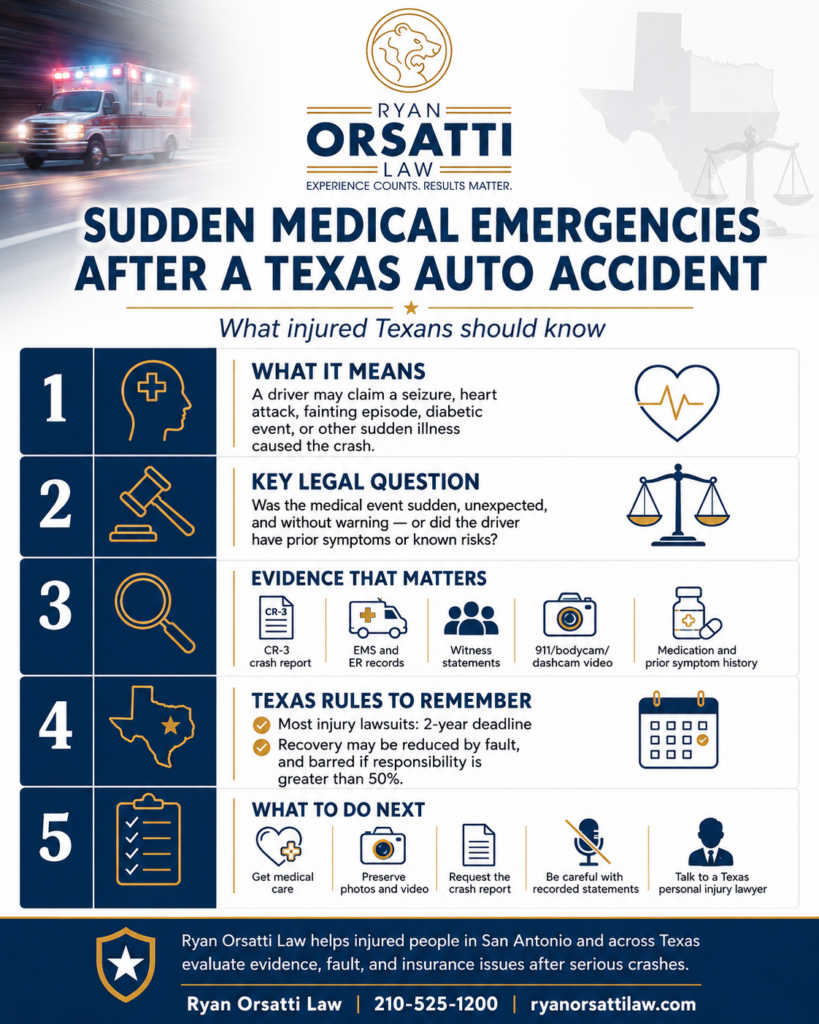
Quick Answer: A sudden medical emergency can affect a Texas auto accident claim, but it does not automatically excuse the driver. The key question is whether the medical event was sudden, unexpected, not caused by the driver’s own negligence, and left no time for reasonable action. Texas courts recognize a sudden emergency instruction in appropriate cases, but the claim usually turns on evidence like the CR-3 crash report, EMS records, witness statements, medication history, and prior symptoms. Ryan Orsatti Law helps injured people in San Antonio and across Texas evaluate these evidence-heavy crash claims.
Key Takeaways
- A driver saying “I had a medical emergency” is not the same as proving one.
- The strongest issue is usually foreseeability, meaning whether the driver had warning signs, prior episodes, medical restrictions, medication issues, or a known condition before driving.
- Texas proportionate responsibility can reduce or bar recovery if fault is assigned to multiple people, and a claimant may not recover if their responsibility is greater than 50 percent under Texas Civil Practice & Remedies Code § 33.001. (Texas Statutes)
- The Texas Peace Officer’s Crash Report, also called a CR-3, may identify illness-related factors, but it is only one part of the evidence.
- Most Texas personal injury lawsuits must be filed within two years under Texas Civil Practice & Remedies Code § 16.003. (Texas Statutes)
- If the other driver’s insurer denies the claim based on a medical emergency, ask for the reason in writing and preserve all crash, medical, vehicle, and witness evidence.
What is a sudden medical emergency in a Texas auto accident claim?
A sudden medical emergency is a health event that allegedly causes a driver to lose control without warning. In a Texas auto accident claim, examples may include a seizure, heart attack, fainting episode, diabetic episode, stroke, loss of consciousness, or medication-related event.
The issue is not simply whether the driver became ill. The legal question is whether the illness was sudden, unexpected, and not brought on by the driver’s own unreasonable choices. Texas courts have described sudden emergency as an emergency that arises suddenly and unexpectedly, is not proximately caused by the person’s negligence, and requires immediate action without time for deliberation. (Texas Courts)
In plain English, the defense is strongest when the driver had no meaningful warning. It is weaker when the driver had symptoms, ignored doctor instructions, skipped medication, drove despite a known risk, mixed sedating medications, or continued driving after feeling dizzy, faint, confused, or impaired.
Can a sudden medical emergency defeat a Texas auto accident claim?
A sudden medical emergency can defeat or reduce a Texas auto accident claim if the evidence shows the crash was not caused by negligence. Negligence means failing to use ordinary care, which is the care a reasonably careful person would use under similar circumstances.
The driver or insurer cannot make the defense real just by saying “medical emergency.” The claim should be tested against the facts: what the driver knew before driving, what happened during the crash, what witnesses saw, what EMS documented, and what the medical records show.
Texas courts have recognized the sudden emergency doctrine as a way to excuse conduct that might otherwise look negligent, but only when the evidence raises the issue. The practical point for injured people is simple: do not accept a denial based only on an adjuster’s label.
What facts make a sudden medical emergency defense stronger or weaker?
A sudden medical emergency defense is stronger when the medical event was truly unforeseeable and weaker when the driver had warning signs before the crash. Prior symptoms, known diagnoses, prescription issues, doctor restrictions, prior crashes, and commercial-driver medical rules can all change the analysis.
| Fact or evidence | Why it matters | What to look for |
|---|---|---|
| No prior symptoms before the crash | Supports the argument that the event was unexpected | EMS notes, ER records, witness statements |
| Dizziness, chest pain, confusion, or blurred vision before driving | May show the driver should not have been driving | Statements at scene, bodycam, 911, medical records |
| Known seizure, fainting, cardiac, diabetic, or neurological history | May make the event foreseeable depending on details | Prior records, medication list, doctor restrictions |
| Missed medication or sedating medication | May support negligence if it affected safe driving | Pharmacy records, prescriptions, toxicology, admissions |
| CR-3 illness code or narrative | Gives an early clue, but does not decide the claim | TxDOT CR-3, officer narrative, supplement reports |
| Commercial vehicle driver medical file | May show whether the driver was medically qualified | DOT medical certificate, FMCSA materials, employer file |
Key takeaway: A medical emergency defense usually turns on what the driver knew or should have known before getting behind the wheel.
What should you do if the other driver claims a medical emergency?
You should treat a medical emergency claim as an evidence problem, not as the end of your case. Start by preserving proof of the crash, your injuries, the other driver’s statements, and the timeline of what happened before impact.
Use this checklist:
- Call 911 if anyone is hurt, the vehicles are blocking traffic, or the crash is serious.
- Get medical care quickly and describe all symptoms accurately.
- Photograph vehicle positions, damage, skid marks, debris, traffic lights, road conditions, and visible injuries.
- Get names and phone numbers for witnesses who heard the other driver’s statements.
- Write down anything the other driver said, such as “I felt dizzy,” “I blacked out,” “I forgot my medicine,” or “this has happened before.”
- Request the Texas Peace Officer’s Crash Report, also called the CR-3.
- Do not give a recorded statement to the other driver’s insurer until you understand the issue.
- Save dashcam video, phone photos, vehicle data, repair estimates, medical bills, and discharge papers.
- Ask the insurer to put any denial or fault position in writing.
- Contact a Texas personal injury lawyer if the crash involved serious injuries, disputed fault, a commercial vehicle, or an insurer blaming a medical event.
TxDOT says a CR-3 crash report can be obtained through its Crash Report Online Purchase System, and Texas Transportation Code § 550.065 controls who may receive an unredacted report. (Texas Department of Transportation) The CR-3 can be especially important when the officer marks an illness-related factor or writes a narrative about what the driver said at the scene.
What does TxDOT Crash Code 47 mean after a Texas crash?
TxDOT Crash Code 47, “Ill (Explain in Narrative),” can indicate that illness was recorded as a possible contributing factor on the Texas crash report. It does not automatically prove the driver was excused, and it does not automatically prove the driver was negligent.
A Code 47 issue should be compared against the officer narrative, EMS timeline, witness statements, medication issues, and the driver’s prior medical history. Ryan Orsatti Law has a separate guide on TxDOT Crash Code 47 and illness-related crash claims.
The practical question is whether the illness was truly unavoidable or whether the driver ignored a known risk. That difference can determine whether the insurer treats the crash as unavoidable, disputed, or preventable.
How does Texas proportionate responsibility apply?
Texas proportionate responsibility can reduce or bar recovery depending on how fault is assigned. Comparative responsibility means Texas can reduce a recovery by a person’s percentage of fault, and a claimant may not recover damages if their percentage of responsibility is greater than 50 percent under Texas Civil Practice & Remedies Code § 33.001. (Texas Statutes)
In a sudden medical emergency case, an insurer may argue that no one was negligent, that the injured person contributed to the crash, or that another party caused or worsened the crash. In multi-vehicle crashes on I-35, Loop 1604, Loop 410, I-10, or US-281, fault may be divided among several drivers.
This is why early evidence matters. A vague medical-emergency claim can distort fault if it is not tested with records, timing, and physical evidence.
What evidence matters most in a sudden medical emergency auto accident claim?
The most important evidence is the proof that shows what happened before the driver lost control. Medical emergency cases usually turn on timing, warning signs, prior history, and whether the driver had a reasonable chance to stop driving safely.
Important evidence may include:
- Texas Peace Officer’s Crash Report, also called the CR-3
- Officer narrative and supplemental report
- EMS and emergency room records
- 911 audio
- Bodycam and dashcam video
- Witness statements
- Vehicle damage photos
- Intersection, business, or roadway camera footage
- Cell phone records, when legally available and relevant
- Pharmacy and medication information, when properly obtained
- Prior medical restrictions or driving warnings
- Employer and driver qualification materials in commercial vehicle cases
Texas Rules of Evidence define relevant evidence as evidence that has any tendency to make a consequential fact more or less probable. Relevant evidence is generally admissible unless another rule, statute, or constitutional provision excludes it. (Texas Courts)
Attorney Insight: In real claim handling, insurers often look for one sentence in the CR-3 or EMS record and then build a denial around it. A strong response usually requires building a timeline: symptoms before driving, conduct during the drive, statements after impact, medication compliance, prior medical warnings, and whether the physical evidence matches the medical explanation.
What if the driver who had the medical emergency was working?
A working driver’s medical emergency can raise additional issues, especially if the crash involved a commercial vehicle, delivery driver, rideshare driver, company car, or 18-wheeler. The question may expand beyond the driver’s health event to include hiring, supervision, medical qualification, scheduling, and vehicle operation.
For interstate commercial motor vehicle drivers, federal rules require medical certification for physical qualification. The federal physical-qualification rule states that a covered driver must not operate a commercial motor vehicle unless medically certified as physically qualified. (eCFR)
That does not mean every medical emergency makes a trucking company liable. It does mean the investigation should include the driver qualification file, DOT medical certificate, employer safety policies, prior incidents, prescription disclosures, and whether the driver or company ignored known risks.
Ryan Orsatti Law discusses related issues on its San Antonio commercial vehicle accident claims page.
Who pays medical bills while the medical emergency defense is being investigated?
Your medical bills may be handled through several sources while fault is being disputed. These may include health insurance, personal injury protection, medical payments coverage, uninsured or underinsured motorist coverage, or later reimbursement from a liability claim if fault is established.
The Texas Department of Insurance explains that PIP, MedPay, and UM/UIM coverage may help pay medical bills after a crash, depending on the policy. TDI also notes that the other driver’s insurer might deny fault, blame both drivers, or say there is not enough insurance. (Texas Department of Insurance)
Subrogation means a health insurer may claim a right to be paid back from a settlement. A hospital lien is a legal claim a hospital may assert against part of a personal injury recovery. These issues matter because the medical-emergency defense can delay liability payments while bills keep arriving.
Should you give the other insurance company a recorded statement?
You should be careful before giving the other driver’s insurance company a recorded statement in a disputed medical emergency case. The adjuster may ask questions designed to support a no-fault argument, shift blame, or narrow your injury claim before the evidence is complete.
You can cooperate with your own insurer under your policy, but the other driver’s insurer does not represent you. If you do speak, keep it factual: date, location, vehicles, visible damage, immediate symptoms, and known witnesses. Avoid guessing about the other driver’s health, speed, phone use, or mental state.
For broader fault and evidence issues, see Ryan Orsatti Law’s guide on the burden of proof in a Texas car accident lawsuit.
How long do you have to file a Texas auto accident lawsuit involving a sudden medical emergency?
Most Texas auto accident injury claims must be filed within two years from the date the claim accrues. Texas Civil Practice & Remedies Code § 16.003 sets a two-year limitations period for personal injury claims and injury-resulting-in-death claims. (Texas Statutes)
A medical emergency investigation does not automatically extend the deadline. Insurance negotiations, delayed medical records, missing crash reports, and unanswered adjuster requests can consume valuable time.
There can be special rules for claims involving minors, government vehicles, public entities, or other unusual facts. If a City of San Antonio vehicle, Bexar County vehicle, school district vehicle, or other governmental unit is involved, separate notice rules may apply and should be reviewed quickly.
How can Ryan Orsatti Law help with sudden medical emergency crash claims?
Ryan Orsatti Law helps injured people in San Antonio and across Texas evaluate whether a sudden medical emergency defense is supported by the evidence. These cases often require early investigation, careful medical-record analysis, insurance coverage review, and a clear theory of fault.
The firm’s role may include reviewing the CR-3, identifying illness-related codes, preserving video, communicating with insurers, obtaining medical documentation, evaluating PIP, MedPay, UM/UIM, health insurance, and lien issues, and preparing the claim for litigation if the facts and strategy support that step.
For related privacy issues, Ryan Orsatti Law also provides guidance on medical privacy when an insurance company overreaches. For car wreck help generally, visit the firm’s San Antonio car accident lawyer page.
FAQ
Can the other driver avoid liability by saying they fainted before the crash?
A driver does not avoid liability just by saying they fainted. In a Texas auto accident claim, the evidence must show whether the fainting episode was sudden, unexpected, and not caused by the driver’s own negligence. Prior dizziness, missed medication, known fainting history, or doctor restrictions can make the defense much weaker.
What if the driver had a seizure and hit me in San Antonio?
A seizure can support a sudden medical emergency argument, but it depends on foreseeability. If the driver had no prior seizure history and no warning, the defense may be stronger. If the driver had a known seizure disorder, ignored medication, or was told not to drive, the claim needs a deeper investigation into medical history and driving decisions.
Does a TxDOT illness code on the crash report prove the other driver is not at fault?
No. A TxDOT illness code or narrative note is an important clue, not the final answer. The CR-3 should be compared with EMS records, witness statements, the driver’s medical history, medication evidence, vehicle damage, and video. Insurance companies may rely heavily on the code, but the full evidence controls the liability analysis.
Can I still use my own insurance if the other driver claims a medical emergency?
Yes, depending on your policy. PIP, MedPay, collision, and UM/UIM coverage may help while the other driver’s insurer disputes fault. TDI explains that PIP, MedPay, and UM/UIM can apply to medical bills in certain situations, and your own insurer may later seek reimbursement from the other driver’s insurer.
Should I sign a medical authorization for the other driver’s insurance company?
Be cautious before signing a broad medical authorization. The other insurer may seek records beyond what is reasonably related to your crash injuries. Medical privacy matters, and relevant records can usually be handled in a narrower, more controlled way. A Texas personal injury lawyer can review the request before you sign.
How quickly should I act after a crash involving a claimed medical emergency?
Act quickly because video, witness memory, vehicle data, and business surveillance can disappear fast. Request the CR-3, save photos, identify witnesses, preserve medical records, and ask the insurer to put its position in writing. The Texas two-year limitations period may apply, but evidence problems begin much earlier.
What if the crash involved an 18-wheeler driver with a medical issue?
An 18-wheeler medical emergency claim should include review of the driver’s DOT medical certification, driver qualification file, employer safety practices, prior symptoms, hours, medications, and crash evidence. Federal rules require covered commercial drivers to be medically certified as physically qualified. That makes the medical timeline especially important in commercial vehicle cases.
Ryan Orsatti Law
4634 De Zavala Rd, San Antonio, TX 78249
Phone: 210-525-1200
ryanorsattilaw.com
This blog is for informational purposes only, not legal advice. Reading it does not create an attorney-client relationship. Past results do not guarantee future results.
Hurt in an accident in San Antonio? Learn how a San Antonio car accident lawyer can help with your claim. Call 210-525-1200 or request a free consultation.
The firm works on a contingency fee. You pay nothing unless the firm recovers money for you, and that covers case expenses as well as the fee: if there is no recovery, you owe no attorney's fee and no case expenses. Ask for the fee agreement and read the fee and expense section before you sign anything.
Related San Antonio legal resources
Primary legal and public-data sources
- TxDOT: Texas crash reports, data, and statistics
- Texas Civil Practice and Remedies Code Chapter 33: proportionate responsibility
Ryan Orsatti Law
4634 De Zavala Road, San Antonio, TX 78249
General reference links. Consult each source for its current text.