
If you were hurt in a car wreck in San Antonio or anywhere else in Texas, one of the biggest misconceptions is that you need airtight proof or something close to a criminal-case standard to win. You do not.
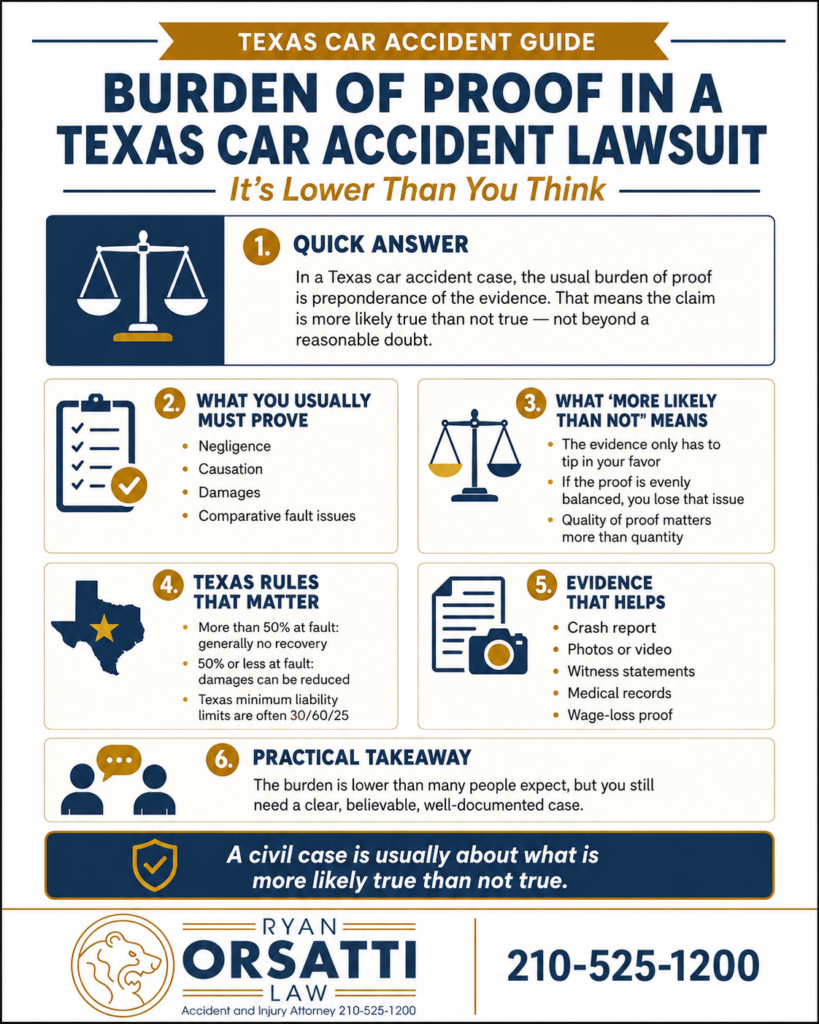
In a Texas car accident lawsuit, the usual burden of proof is preponderance of the evidence. In plain English, that means the jury must believe your version of the key facts is more likely true than not true. Texas civil jury instructions define it that way and also make clear that the standard is not measured by the number of witnesses or the number of documents.
Quick Answer
In a Texas car accident case, the injured person usually does not have to prove the case beyond a reasonable doubt. That is a criminal-law standard. In a civil lawsuit, the question is whether the evidence makes it more likely than notthat the other driver was negligent and caused the crash and your damages.
That lower burden matters, but it does not mean these cases are easy. You still need believable proof on liability, causation, and damages. And Texas proportionate responsibility rules matter: if a claimant’s percentage of responsibility is greater than 50%, the claimant cannot recover damages. Texas law also requires the factfinder to assign percentages of responsibility among the relevant people or entities in the case.
One more practical point: even a strong liability case can run into an insurance problem. Texas minimum liability coverage is still 30/60/25—$30,000 per injured person, $60,000 per accident for bodily injury, and $25,000 for property damage—so available coverage can affect the real-world value of a case.
What does “preponderance of the evidence” actually mean?
It means this: after hearing the testimony, seeing the records, and evaluating credibility, the jury thinks your version is more likely true than not. If the evidence tips even modestly in your favor on a question, that can satisfy the burden. If the evidence is evenly balanced, you lose that issue. Texas civil instructions say a “yes” answer must be based on a preponderance of the evidence, and a fact is proved when it is “more likely true than not true.”
That is why the title of this post is accurate: the burden is often lower than people expect. Many injured drivers assume they need video, an admission of fault, or a completely undisputed police report. Those things help, but they are not required in every case.
Why this matters in a real Texas car wreck claim
Most disputed car accident cases do not turn on some abstract legal burden. They turn on whether the story holds together.
A jury in Bexar County is usually asking questions like:
- Who had the better lane-position, lookout, speed, and right-of-way evidence?
- Do the vehicle-damage photos match what each side says happened?
- Do the medical records line up with the timing and mechanics of the collision?
- Is the plaintiff credible?
- Is there evidence the plaintiff was partly at fault?
So yes, the burden is lower than many people think. But the proof still has to be coherent, documented, and believable.
What do you have to prove in a Texas car accident lawsuit?
Usually, the plaintiff needs to prove four practical building blocks:
| Issue | What it means in plain English | Common proof |
|---|---|---|
| Negligence | The other driver failed to use ordinary care | Crash report, photos, video, witness statements, vehicle data, scene evidence |
| Causation | That failure caused the crash and your injuries | Property damage, medical records, biomechanics-consistent injury history, doctor opinions |
| Damages | You suffered losses because of the crash | Medical bills, records, wage loss proof, pain-and-suffering evidence, future-care evidence |
| Comparative fault | Your own conduct may be assigned a percentage of responsibility | Seatbelt issues, speed, distraction, lookout, lane use, impairment evidence |
Texas proportionate responsibility law is a major part of the analysis. If the jury assigns you more than 50% of the responsibility, you recover nothing. The factfinder also assigns percentages of responsibility among the claimant, defendants, settling persons, and properly designated responsible third parties.
“More likely than not” does not mean “barely say something and win”
This is where a lot of people get confused.
A low burden of proof does not mean:
- the jury has to accept your word just because you were injured;
- the police report automatically decides fault;
- treatment gaps do not matter;
- inconsistent histories do not matter; or
- weak medical proof somehow becomes enough.
Texas civil instructions specifically say preponderance is not measured by the number of witnesses or documents. That is a useful reminder that quality beats quantity. One strong witness, one clean video clip, or one persuasive timeline can matter more than a thick stack of records that do not fit together.
How insurance companies use the burden of proof against you
Even before suit is filed, adjusters think in proof terms.
They do not need to “win at trial” to lower value. They only need to identify weaknesses they can use later, such as:
- delayed treatment;
- prior similar injuries;
- inconsistent complaints;
- missing wage proof;
- liability disputes;
- no independent witnesses;
- social media problems;
- gaps between the crash and specialist care.
That is why a case with a legally manageable burden can still be undervalued. The adjuster is pricing risk: Can the plaintiff actually present a persuasive case to a Texas jury?
What if the other side says you were partly at fault?
That is one of the most common defenses in Texas car wreck litigation.
The defense may argue you were speeding, failed to keep a proper lookout, changed lanes unsafely, braked suddenly, followed too closely, were distracted, or worsened your injuries in some way. Under Texas proportionate responsibility rules, those arguments matter because the jury assigns percentages of responsibility. If your share is greater than 50%, recovery is barred.
Even when the defense cannot push your percentage over 50%, comparative-fault arguments can still affect settlement value because they create risk.
Common evidence that helps meet the burden
In serious Texas car accident cases, the best proof usually comes from a combination of sources, not just one item:
- crash report;
- body-cam or dash-cam footage;
- nearby business or residential video;
- 911 audio;
- scene photographs;
- vehicle photographs;
- black-box or event-data-recorder information when available;
- witness statements taken early;
- EMS and emergency-room records;
- follow-up medical records that document symptoms consistently;
- wage-loss records;
- expert analysis in larger cases.
The sooner this evidence is preserved, the better. Video disappears. Memories fade. Vehicles get repaired or sold. Cell-phone data and onboard data can be lost if nobody moves quickly enough.
Attorney Insight
In real car wreck litigation, plaintiffs rarely lose because the civil burden is “too high.” More often, they lose value—or lose the case—because the proof is fragmented.
Here are the patterns that most often hurt otherwise legitimate claims:
- liability facts were not locked down early;
- the treatment timeline looks irregular;
- the client told different versions of the incident to different providers;
- the medical story does not match the impact;
- the defendant has a credible comparative-fault theme;
- the policy limits are low;
- the lawyer or client waited too long to gather proof.
In other words, the burden is lower than many people think, but presentation still matters a lot.
How the process usually works
1. Investigation
The case starts with gathering liability and damages evidence: reports, photos, witness information, insurance data, and medical records.
2. Claim development
Your lawyer organizes the evidence into a clear theory of fault, causation, and damages. This is where gaps and defenses get identified early.
3. Demand and negotiation
A demand package should not just list injuries. It should explain why the evidence is strong enough to satisfy the Texas civil burden and why likely defense themes do not carry the day.
4. Filing suit
If the insurer will not evaluate the case reasonably, suit may be necessary. Litigation opens the door to discovery, depositions, subpoenas, and expert work.
5. Discovery and depositions
This is where the burden becomes real. Each side tests credibility, medical causation, and comparative fault.
6. Mediation or trial
Most cases resolve before trial, but trial readiness often drives better outcomes. A case with organized proof usually settles differently than a case built on assumptions.
A quick reality check on insurance limits
A strong case and a provable case are not always the same as a collectible case.
Texas requires drivers to show financial responsibility, and the standard minimum liability coverage remains 30/60/25. That means some serious-injury cases quickly outgrow the available bodily injury limits. When that happens, uninsured/underinsured motorist coverage, medical payments coverage, umbrella coverage, and asset checks may become important.
Common mistakes after a Texas car accident
- Waiting too long to get medical care.
- Assuming the crash report alone proves the case.
- Giving a recorded statement without understanding the issues.
- Posting about the wreck or injuries on social media.
- Failing to photograph vehicle damage and the scene.
- Missing follow-up care and creating treatment gaps.
- Underestimating comparative-fault arguments.
- Focusing only on fault and ignoring insurance-limit issues.
What should you do next?
If you think you may have a Texas car accident claim, a good next-step checklist looks like this:
- Get medical care and follow through consistently.
- Preserve photos, video, repair estimates, and witness information.
- Request or obtain the crash report.
- Keep all medical bills, discharge papers, and work-loss records.
- Do not guess or exaggerate when talking about symptoms.
- Find out what liability, UM/UIM, and Med Pay coverage may exist.
- Have a lawyer evaluate liability, comparative fault, causation, and collectability together—not one issue at a time.
FAQs
Is the burden of proof in a Texas car accident case “beyond a reasonable doubt”?
No. That is a criminal standard. Texas civil cases usually use preponderance of the evidence, meaning more likely true than not true.
Do I need a witness or video to win?
No. Those are helpful, but they are not required in every case. What matters is whether the overall evidence is persuasive enough to meet the civil burden.
What if I was partly at fault?
You may still have a claim. But your percentage of responsibility matters. If your percentage is greater than 50%, Texas law bars recovery.
Does the number of records or witnesses automatically make my case stronger?
No. Texas civil instructions specifically say preponderance is not measured by the number of witnesses or the number of documents. Credibility and fit matter more.
Does a good liability case guarantee a large recovery?
No. Insurance limits, comparative fault, medical causation issues, and the quality of damages proof can all affect value. Texas minimum auto liability limits remain 30/60/25.
Final takeaway
The burden of proof in a Texas car accident lawsuit is lower than many people think. Usually, you are not trying to prove your case beyond all doubt. You are trying to prove it is more likely than not that the defendant’s negligence caused the crash and your damages.
But the real-world lesson is this: a manageable burden of proof still requires disciplined case building. In San Antonio car wreck cases, the best results usually come from early evidence preservation, consistent medical documentation, and a clear strategy for handling comparative-fault arguments and insurance-limit realities. Texas law lets juries allocate responsibility among the relevant players, and it bars recovery if the claimant is more than 50% responsible, so details matter.
Ryan Orsatti Law
4634 De Zavala Rd, San Antonio, TX 78249
Phone: 210-525-1200
This blog is for informational purposes only, not legal advice. Reading it does not create an attorney-client relationship. Past results do not guarantee future results.
Hurt in an accident in San Antonio? Learn how a San Antonio car accident lawyer can help with your claim. Call 210-525-1200 or request a free consultation.
The firm works on a contingency fee. You pay nothing unless the firm recovers money for you, and that covers case expenses as well as the fee: if there is no recovery, you owe no attorney's fee and no case expenses. Ask for the fee agreement and read the fee and expense section before you sign anything.
Related San Antonio legal resources
Primary legal and public-data sources
- TxDOT: Texas crash reports, data, and statistics
- Texas Civil Practice and Remedies Code Chapter 33: proportionate responsibility
Ryan Orsatti Law
4634 De Zavala Road, San Antonio, TX 78249
General reference links. Consult each source for its current text.