
Quick Answer
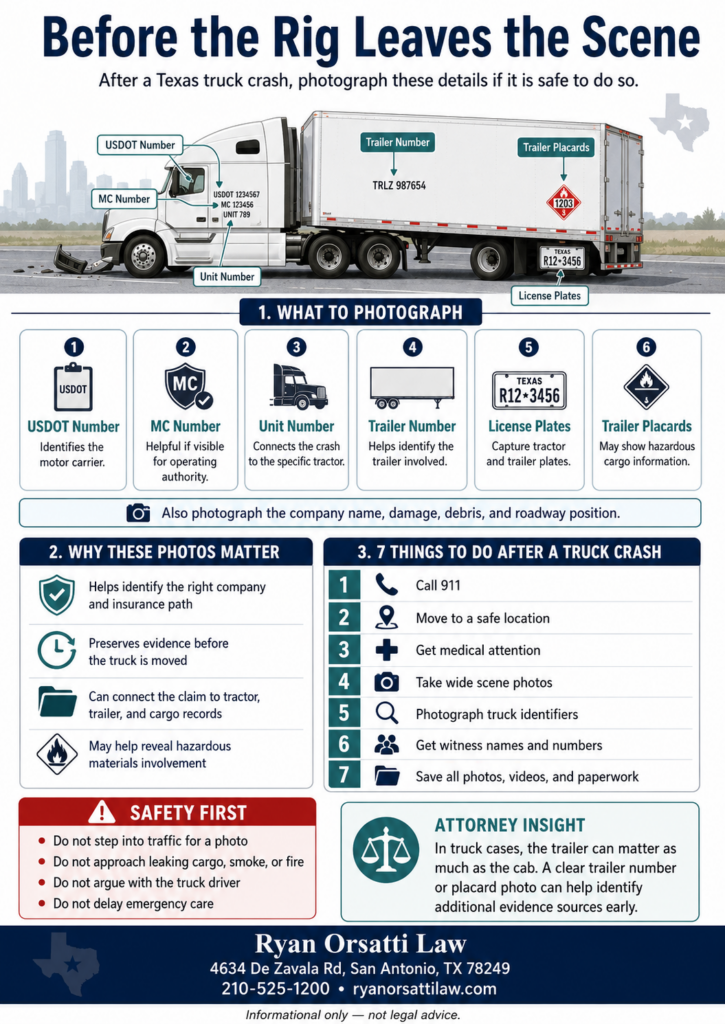
Yes. If you can do it safely, photograph the truck’s USDOT number, MC number, company name, unit number, license plate, trailer number, trailer placards, and any visible logos before the rig leaves the scene. These details can help identify the motor carrier, operating authority, trailer owner, hazardous cargo, insurance path, and evidence that may need to be preserved quickly.
Do not step into traffic, approach an unstable crash scene, argue with the driver, or delay medical care to get photos. Your safety comes first. But in a Texas 18-wheeler crash, a few clear photos taken in the first minutes can prevent weeks of confusion later.
Key Takeaways
- The USDOT number helps identify the motor carrier responsible for operating the commercial vehicle.
- The MC number may help confirm interstate operating authority, but not every truck will display one.
- Unit numbers and trailer numbers can connect the crash to a specific tractor, trailer, maintenance file, inspection history, and driver assignment.
- Trailer placards may show whether hazardous materials were being transported and what type of cargo was involved.
- Texas crash reports are useful, but they may not capture every carrier, trailer, cargo, or leasing detail.
- Take photos only from a safe location and only after calling 911 and checking for injuries.
Why These Photos Matter After a Texas 18-Wheeler Crash
After a collision with a commercial truck, the vehicle that hit you may not be owned by the same company whose name appears on the side of the cab. The driver may work for a motor carrier, owner-operator, brokered load, leased tractor, separate trailer owner, or shipping company. In some crashes, multiple companies are involved before anyone clearly knows who controlled the vehicle, the driver, the cargo, or the route.
That is why the question “Should I photograph the truck’s USDOT number, MC number, unit number, and trailer placards before the rig leaves the scene?” matters so much. These markings can become the roadmap for identifying the correct defendants, insurance carriers, safety records, and evidence sources.
For injured people in San Antonio, Bexar County, Comal County, Guadalupe County, and across Texas, this issue often comes up on highways like I-35, I-10, Loop 410, US 281, I-37, and SH 130. Heavy commercial traffic moves fast. Once the rig is towed, repaired, reassigned, or moved out of state, the investigation becomes harder.
If you were hit by a commercial truck, our page on San Antonio commercial vehicle accident claims explains how these cases differ from regular car wrecks.
What Is a USDOT Number?
A USDOT number is a federal identification number issued by the Federal Motor Carrier Safety Administration, often called FMCSA. Under federal marking rules, certain commercial motor vehicles must display the motor carrier’s legal or trade name and the FMCSA identification number preceded by “USDOT.” The regulation also requires the marking to appear on both sides of the self-propelled commercial motor vehicle, contrast with the background, and be legible from 50 feet during daylight while the vehicle is stationary. (eCFR)
In plain English: the USDOT number is often the fastest way to identify the company operating the truck.
That matters because the driver’s personal name may not be enough. The police report may list the driver, but the legal claim may involve the motor carrier, the owner of the tractor, the owner of the trailer, the broker, the shipper, a maintenance contractor, or another company depending on the facts.
You can also use a USDOT number to search FMCSA’s SAFER Company Snapshot system, which allows searches by USDOT number, MC/MX number, or company name. The Company Snapshot includes identification information, size, commodity information, safety rating if available, out-of-service inspection summary, and crash information. (SAFER Web)
What Is an MC Number?
An MC number is a motor carrier operating authority docket number. FMCSA describes operating authority as “MC,” “FF,” or “MX” authority depending on the type of authority granted, and notes that a company may need multiple operating authorities depending on its operations and cargo. (FMCSA)
The MC number can be useful when a carrier operates in interstate commerce. It may help identify the authority under which the carrier is hauling freight. FMCSA’s own instructions say users can search its Licensing and Insurance system by MC number or USDOT number to review authority information. (FMCSA)
But there is one practical point: do not assume the MC number will always be painted on the truck. USDOT markings are the key marking required under 49 C.F.R. § 390.21 for many covered commercial motor vehicles. An MC number may appear on the cab, paperwork, door decal, or not be visible at all. If you see it, photograph it. If you do not see it, focus on the USDOT number, company name, license plates, unit numbers, trailer numbers, and any cargo or placard information.
What Are Unit Numbers and Trailer Numbers?
A unit number is a company-assigned number used to identify a specific tractor, truck, trailer, or piece of fleet equipment. Unlike a USDOT number, it is not the federal identity of the motor carrier. It is more like the company’s internal tracking number for that particular vehicle.
Unit numbers matter because trucking companies often organize their records by unit number. That can include:
- Maintenance history
- Inspection reports
- Repair orders
- Tire records
- Brake work
- Driver vehicle inspection reports
- Dispatch records
- GPS or telematics data
- Trailer interchange documents
- Post-crash inspection records
A trailer number can be just as important as the tractor number. A tractor may be owned by one company while the trailer is owned, leased, loaded, or controlled by another. In underride crashes, rear-end impacts, falling cargo cases, brake-light disputes, tire failure cases, and hazardous cargo cases, the trailer may be central to the claim.
In matters we have handled, the early photos that seem “minor” at the scene often become important later because they confirm exactly which tractor and trailer were involved before paperwork gets corrected, supplemented, or disputed.
What Are Trailer Placards?
A placard is a diamond-shaped sign or marking used to communicate hazardous material information on a truck, trailer, tank, container, or rail car. Placards may show hazard classes such as flammable liquid, corrosive material, poison, explosive material, oxidizer, radioactive material, or other regulated hazardous materials.
FMCSA’s hazardous materials guidance explains that hazardous materials communication includes shipping papers, marking, labeling, and placarding. It also explains that general placarding requirements are found in 49 C.F.R. Part 172, Subpart F, and that covered hazardous material shipments must comply with applicable placarding requirements. (FMCSA)
If you see a placard, photograph it from a safe distance. Do not get close to a leaking tank, smoking trailer, spilled cargo, chemical odor, or fire scene. Let first responders handle it.
Placards can matter because they may identify:
- The type of hazardous cargo
- Whether emergency response rules apply
- Whether the carrier had hazmat authority
- Whether the driver needed special training or endorsements
- Whether cargo securement, shipping papers, or route restrictions become relevant
- Whether environmental cleanup records may exist
What to Photograph Before the Truck Leaves
Use your phone’s regular photo mode. Take wide shots first, then closer shots if safe. Try to capture context so the photo shows where the truck was positioned, not just a close-up number with no background.
| Photo | Why It Helps | Practical Tip |
|---|---|---|
| USDOT number | Identifies the motor carrier or intermodal equipment provider | Photograph both sides of the cab if safe |
| Company name or logo | Helps match the vehicle to the operating carrier | Capture the full door panel |
| MC/MX/FF number | May help verify operating authority | Photograph if visible, but do not worry if absent |
| Tractor unit number | Connects the crash to the specific power unit | Look on bumper, hood, cab, and door |
| Trailer number | Identifies the trailer involved | Look near front corner, rear doors, side rail, or landing gear |
| License plates | Identifies tractor and trailer registration | Photograph tractor and trailer plates separately |
| VIN plate or door sticker | Useful if safely visible | Do not open doors or touch the truck |
| Placards | Shows hazardous material class or ID numbers | Stay far away if cargo may be dangerous |
| Damage points | Shows impact location and severity | Take wide and close photos |
| Skid marks, debris, gouges | Helps reconstruct the crash | Photograph before vehicles move |
| Driver documents shown voluntarily | May identify carrier or insurer | Do not demand, grab, or photograph private documents without permission |
After a Texas Truck Crash, Do These 7 Things
- Call 911 immediately. Ask for police and medical assistance. If the truck is leaking fluid, carrying hazardous material, blocking traffic, or on fire, say that clearly.
- Move to safety if you can. Do not stand between vehicles, on the shoulder next to fast traffic, or near leaking cargo.
- Get medical attention. Adrenaline can mask injuries. Neck injuries, back injuries, concussions, internal injuries, and shoulder injuries may worsen after the scene clears.
- Photograph identifying information. From a safe place, capture the USDOT number, company name, unit number, trailer number, plates, placards, damage, debris, and roadway conditions.
- Get witness information. A name, phone number, and short note about what the witness saw can be more useful than a long argument with the truck driver.
- Avoid giving recorded statements before you understand the claim. A trucking insurer may call quickly. Anything you say may be compared against medical records, photos, crash data, and later testimony.
- Preserve your own evidence. Save photos, dashcam clips, medical paperwork, repair estimates, tow records, and screenshots of any calls or messages related to the crash.
For more on the value of early evidence in truck wrecks, see our discussion of Texas 18-wheeler accident claims.
Why the Police Report May Not Be Enough
The Texas Peace Officer’s Crash Report, often called the CR-3, is important. TxDOT states that it is the custodian of crash records for Texas and that Texas Transportation Code § 550.062 requires an officer who investigates a crash involving injury, death, or apparent property damage of $1,000 or more to submit a written report to TxDOT within 10 days. (TxDOT)
But a CR-3 is not a full trucking investigation. It may not capture every carrier relationship, trailer owner, broker, shipper, load assignment, maintenance issue, ELD issue, dashcam source, cargo document, or hazardous materials record.
A crash report may list the driver and vehicle, but later investigation may need to answer:
- Who was the motor carrier operating the tractor?
- Was the driver an employee, owner-operator, or leased driver?
- Who owned the trailer?
- Who loaded the cargo?
- Was the cargo secured properly?
- Was the driver within hours-of-service limits?
- Was the truck inspected after the crash?
- Did the carrier preserve electronic control module data?
- Did the truck have dashcam, GPS, or telematics data?
- Did the carrier have prior brake, tire, lighting, or maintenance issues on that unit?
Your photos help prevent the case from depending entirely on a report that may be incomplete or later disputed.
How These Photos Affect Liability in Texas
Texas uses proportionate responsibility, meaning fault can be divided among parties. Under Texas Civil Practice & Remedies Code § 33.001, a claimant may not recover damages if the claimant’s percentage of responsibility is greater than 50 percent. (Texas Constitution and Statutes)
That makes early evidence important. Trucking companies and insurers may argue that the injured person changed lanes, stopped suddenly, entered a blind spot, failed to keep a proper lookout, or caused the crash in some other way. Photos of vehicle positions, impact points, lane markings, debris fields, truck identifiers, and trailer markings can help test those claims.
The photos do not “win” a case by themselves. They help lawyers, investigators, reconstructionists, and insurers identify the right evidence before it disappears.
Attorney Insight: The Trailer Often Tells a Different Story Than the Cab
In commercial truck cases, many people focus only on the driver and tractor. That can miss the point. The trailer may reveal the load, placards, trailer owner, rear underride guard condition, reflective tape, brake-light condition, tire condition, cargo securement issues, or whether another company had control over part of the transportation chain.
A clear photo of the trailer number and placard can help send targeted preservation letters early. A preservation letteris a written notice demanding that a company preserve relevant evidence, such as driver logs, inspection reports, dashcam video, ELD data, maintenance records, dispatch records, cargo documents, and post-crash inspection materials.
The practical goal is not to collect every possible fact at the scene. The goal is to capture enough identifying information so the right companies can be found quickly and placed on notice.
What If the Truck Driver Tells You Not to Take Pictures?
If you are in a public place and can safely photograph the vehicles, roadway, damage, and visible markings, you generally do not need the truck driver’s permission to document the crash scene. Do not trespass, open the truck, reach inside the cab, climb on the trailer, interfere with first responders, or escalate a confrontation.
Stay calm. Take photos from a safe location. If the driver becomes aggressive, step away and tell the responding officer.
You can say: “I’m just documenting the crash scene and vehicle information for insurance.”
Do not accuse the driver of wrongdoing at the scene. Do not argue about who caused the crash. Let the evidence speak later.
What If You Forgot to Take Photos?
All is not lost. A lawyer may still be able to identify the carrier through the CR-3, license plate information, tow records, 911 records, nearby business video, dashcam footage, witness photos, insurance correspondence, or FMCSA records.
But delay can hurt. Some evidence can be overwritten, repaired, moved, or lost. Commercial trucks often return to service quickly. The earlier the carrier and equipment are identified, the easier it is to request preservation of relevant data and records.
If you were injured in a truck crash but did not get photos, write down everything you remember:
- Company name or logo
- Cab color
- Trailer color
- Type of trailer
- Any numbers on the truck
- Any cargo or placard details
- Driver name
- Location and direction of travel
- Time of day
- Police agency that responded
- Tow company if known
- Witness names
- Any nearby cameras or businesses
How Insurance Issues Can Get Complicated
Truck crashes may involve several layers of insurance. There may be liability coverage for the motor carrier, coverage for the tractor, trailer coverage, broker-related coverage, shipper agreements, excess policies, umbrella policies, or separate policies for hazardous cargo or specialized operations.
This is different from a typical two-car crash. If you need background on regular vehicle claims, our San Antonio car accident lawyer guide explains the basic process. Truck cases add more parties, more records, more federal rules, and often more aggressive early defense investigation.
Some injured people also need to look at their own insurance coverage, including PIP and UM/UIM coverage. PIP means personal injury protection, a no-fault coverage that may help with medical bills and lost income depending on the policy. UM/UIM means uninsured or underinsured motorist coverage, which may apply when the available liability coverage is missing or insufficient. For more on that issue, see our guide to UM/UIM coverage in Texas wrecks.
Common Mistakes to Avoid at the Scene
Avoid these errors after a truck crash:
- Standing in traffic to take a photo
- Getting close to leaking cargo or a hazardous materials scene
- Taking only close-up photos with no context
- Photographing only your vehicle and not the truck
- Forgetting the trailer number
- Assuming the company logo identifies every responsible party
- Letting the truck leave without documenting plates or unit numbers if photos are safe
- Posting crash photos or accusations on social media
- Giving a detailed recorded statement before understanding your injuries
- Waiting weeks to request evidence preservation
When to Talk to a Lawyer
Consider talking to a Texas personal injury attorney soon if the crash involved an 18-wheeler, box truck, tanker, dump truck, delivery truck, construction vehicle, oilfield truck, or other commercial vehicle and you were injured.
That is especially true if:
- You went to the ER or urgent care
- You have neck, back, head, shoulder, knee, or nerve symptoms
- A child, older adult, or passenger was hurt
- The crash involved a fatality
- The truck carried hazardous materials
- The trucking insurer is calling early
- The police report is wrong or incomplete
- The carrier denies responsibility
- The truck left before you could get information
Texas generally has a two-year limitations period for personal injury and property damage claims under Texas Civil Practice & Remedies Code § 16.003, though exceptions and special notice rules can apply depending on the parties involved. (Texas Constitution and Statutes)
For serious injuries such as concussions or brain injuries after a commercial crash, our San Antonio traumatic brain injury page covers symptoms and claim issues that often come up after high-force collisions.
FAQ
Should I photograph the truck’s USDOT number after an 18-wheeler crash?
Yes, if you can do it safely. The USDOT number can identify the motor carrier operating the truck and may help locate FMCSA records, insurance information, and safety history. Take the photo from a safe location and try to include the company name on the same side of the cab.
Is the MC number the same as the USDOT number?
No. A USDOT number is a federal identification number for a motor carrier or certain equipment providers. An MC number relates to operating authority for certain carriers. Both can be useful, but the USDOT number is often the most visible and important number to photograph at the crash scene.
Should I photograph hazardous materials placards on the trailer?
Yes, but only from a safe distance. Placards may show the type of hazardous material being transported and can affect emergency response, cargo investigation, and carrier authority issues. Do not approach leaking cargo, smoke, fire, chemical odors, or damaged tanker equipment just to get a better photo.
What if the truck leaves before I get the USDOT number?
Write down everything you remember, including company name, logo, color, trailer type, license plate, direction of travel, and crash location. The number may still be found through the police report, witness photos, dashcam footage, tow records, insurance documents, or FMCSA searches.
Can I rely on the Texas crash report instead of taking photos?
No. The Texas CR-3 crash report is important, but it may not include every trucking detail needed for a claim. It may miss trailer ownership, cargo information, maintenance issues, broker relationships, or electronic data sources. Scene photos provide independent evidence that can support or correct the report.
What photos are most important in a truck accident?
Start with wide photos of the whole scene, then photograph the USDOT number, company name, tractor unit number, trailer number, license plates, placards, vehicle damage, debris, skid marks, traffic signals, lane markings, and visible injuries. Do not risk your safety to get any photo.
Can photos help prove who is responsible in a Texas truck crash?
Photos can help, but they are only one part of the investigation. They may identify the motor carrier, equipment, cargo, point of impact, and roadway conditions. In Texas, where fault can be divided under proportionate responsibility rules, early photos can be valuable when insurers dispute how the crash happened.
Should I send my truck crash photos to the insurance adjuster?
Be careful. Photos can help your claim, but they should be reviewed in context before being sent broadly. An adjuster may focus on photos that appear to help the defense while ignoring what is missing. If you were injured, consider getting legal guidance before giving statements or sending evidence packages.
Ryan Orsatti Law
4634 De Zavala Rd, San Antonio, TX 78249
Phone: 210-525-1200
ryanorsattilaw.com
This blog is for informational purposes only, not legal advice. Reading it does not create an attorney-client relationship. Past results do not guarantee future results.
Hurt in an accident in San Antonio? Learn how a San Antonio personal injury lawyer can help with your claim. Call 210-525-1200 or request a free consultation.
The firm works on a contingency fee. You pay nothing unless the firm recovers money for you, and that covers case expenses as well as the fee: if there is no recovery, you owe no attorney's fee and no case expenses. Ask for the fee agreement and read the fee and expense section before you sign anything.
Related San Antonio legal resources
Primary legal and public-data sources
- Texas Civil Practice and Remedies Code Chapter 16: limitations
- Texas Civil Practice and Remedies Code Chapter 33: proportionate responsibility
Ryan Orsatti Law
4634 De Zavala Road, San Antonio, TX 78249
General reference links. Consult each source for its current text.