
Quick Answer
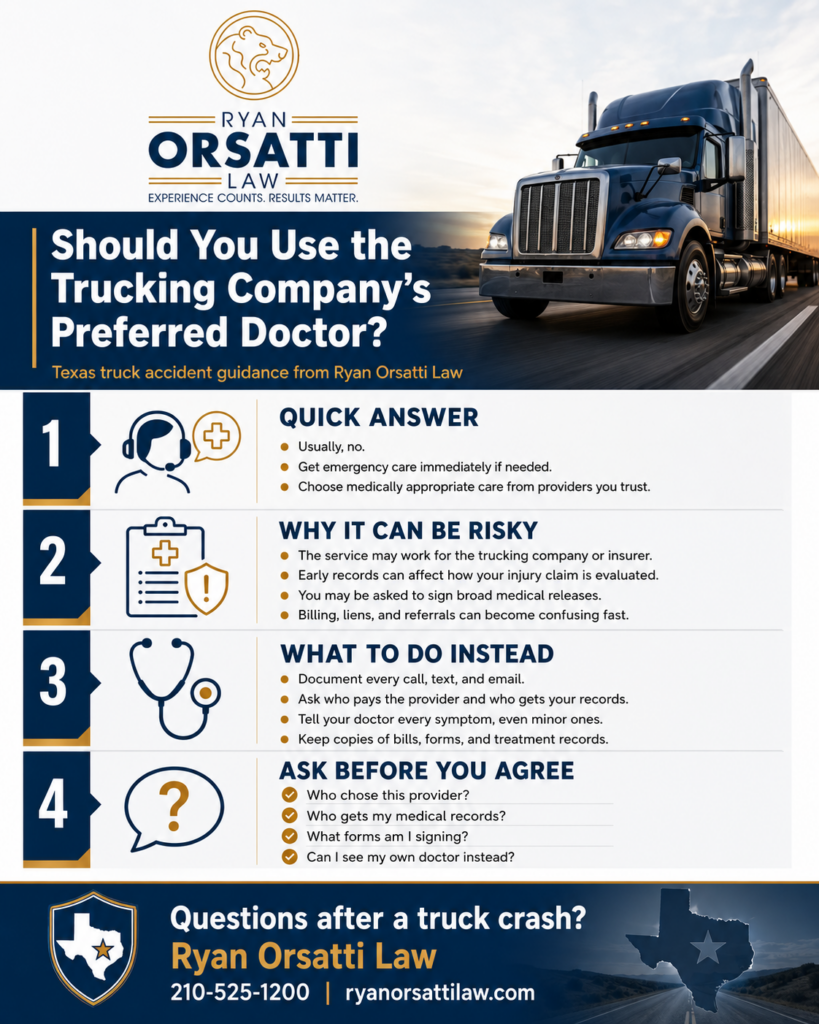
Usually, no. In a Texas truck accident claim, the trucking company’s concierge, nurse-line, or preferred-provider program may sound helpful, but it is still connected to the company or insurer that may later dispute your injuries. Get emergency care wherever needed, keep seeing doctors you trust, and do not sign broad medical releases or provider paperwork without understanding who gets your records and bills.
Key Takeaways
- A trucking company’s nurse-line service is not neutral medical advice just because it sounds helpful.
- In an ordinary Texas third-party liability claim, you usually do not have to use the trucking company’s preferred medical provider.
- The main risks are broad medical authorizations, defense-friendly records, billing confusion, liens, and later disputes over whether the crash caused your injuries.
- Medical records matter because Texas injury claims often turn on prompt treatment, consistent symptoms, reasonable charges, and necessary medical care.
- Before agreeing to preferred-provider care, ask who pays the service, who receives your records, whether your insurance will be billed, and whether you can choose your own doctor.
Should I let the trucking company’s concierge or nurse-line service choose my doctor?
Usually, you should not let the trucking company’s concierge, nurse-line service, or preferred-provider program control where you get treated after a Texas truck crash.
That does not mean you should refuse medical care. If you have emergency symptoms after an 18-wheeler crash, call 911, go to the emergency room, or seek urgent care. Your health comes first. The problem is not treatment. The problem is letting the trucking company, its insurer, or a claims vendor guide your treatment path before you understand who they work for and how the information will be used.
In Texas, the other driver’s insurance may be responsible for certain losses if its insured caused the crash, but the Texas Department of Insurance warns that payment is not guaranteed and that you do not have a contract with the other driver’s insurer. That matters because the trucking insurer’s helpful tone does not make it your advocate. (Texas Department of Insurance)
If you were injured in a commercial vehicle crash in San Antonio, you can read more about how these claims work on our page for a San Antonio truck accident lawyer and our article on the insurance adjuster’s phone call.
What is a trucking company concierge or nurse-line service?
A trucking company concierge or nurse-line service is a claims-side service that may triage symptoms, schedule appointments, suggest clinics, arrange transportation, or direct you to a preferred medical provider after a truck crash.
The service may use nurses, intake coordinators, case managers, or vendor employees. Some may be polite and responsive. Some may help you get seen quickly. But the practical question is simple: who hired them, who pays them, who receives their notes, and what happens to the records they help create?
In a Texas third-party truck accident claim, the trucking company’s nurse-line or concierge service is not your health insurer and does not replace your treating doctor. If the provider relationship creates defense-friendly records, the insurer may later use those notes to argue the crash did not cause all of your symptoms.
This is especially important after crashes involving 18-wheelers, delivery trucks, oilfield vehicles, dump trucks, work vans, and other commercial vehicles. These claims often involve more than one insurance layer, a motor carrier, a driver, a third-party administrator, and sometimes a separate nurse vendor.
Can the trucking company require me to use its preferred doctor in Texas?
In an ordinary Texas third-party liability claim, the trucking company usually cannot require you to use its preferred doctor just because its driver hit you.
A third-party liability claim is a claim against someone else’s insurance. That is different from your own health insurance network, your own medical payments coverage, your own personal injury protection coverage, or a Texas workers’ compensation claim. Different rules can apply if you were working at the time, if your own health plan has network rules, or if you signed paperwork giving someone access to records or control over billing.
There is also a major difference between voluntary preferred-provider steering and a court-ordered medical examination. In a Texas lawsuit, Texas Rule of Civil Procedure 204.1 allows a party to seek a court-ordered physical or mental examination only by motion, generally no later than 30 days before the end of the discovery period. The court must find good cause and that the condition is genuinely in controversy. The order must state the time, place, manner, conditions, scope, and person who will perform the exam.
Texas Civil Practice & Remedies Code § 16.003 generally gives an injured person two years to file a personal injury lawsuit. That filing deadline does not mean you should wait two years to protect treatment records, causation opinions, vehicle evidence, insurance communications, and provider billing documents. (Texas Statutes)
Why can a preferred medical provider hurt a Texas truck accident claim?
A preferred medical provider can hurt the claim if the records understate symptoms, skip important referrals, or create a paper trail that favors the insurer’s causation defense.
“Causation” means the legal and medical link between the crash and the injury. “Damages” means the losses claimed in the case, such as medical bills, lost income, physical pain, impairment, disfigurement, and other legally recoverable harms.
After a truck crash, adjusters and defense lawyers often look closely at:
- How quickly you sought medical care
- Whether your symptoms stayed consistent across providers
- Whether the provider documented all injured body parts
- Whether the provider noted neurological symptoms, headaches, numbness, dizziness, radiating pain, or cognitive issues
- Whether diagnostic testing was ordered when clinically appropriate
- Whether referrals were made to orthopedics, neurology, physical therapy, pain management, or other providers when needed
- Whether the records mention prior injuries or preexisting conditions accurately
- Whether there were unexplained gaps in treatment
- Whether the provider documented work restrictions and functional limits
Texas Civil Practice & Remedies Code § 18.001 makes medical billing documentation important because past medical expenses must be tied to reasonable charges and necessary services. A provider chosen for convenience, not clinical fit, can create thin records that make causation and damages harder to prove. (Texas Statutes)
A preferred-provider referral is not automatically bad. The danger is loss of control. A rushed clinic visit that says “minor soreness, patient improving” can become a defense exhibit later, even if your symptoms worsened the next day or the provider never asked the right questions.
What should I do if the nurse line says their provider will bill the trucking company directly?
Treat “we will bill the trucking company” as a billing arrangement to verify, not a reason to give up control of your medical care.
You need to know whether the provider will bill health insurance, personal injury protection, medical payments coverage, Medicare, Medicaid, or a lien-based account. You also need to know whether you are signing a letter of protection, assignment, lien, arbitration agreement, financial responsibility form, or broad records authorization.
A “letter of protection” means a provider agrees to wait for payment from a future settlement or judgment. It is not free care. “Subrogation” means an insurer or benefit plan may seek reimbursement from a recovery after paying medical bills. A “hospital lien” is a statutory claim that can attach to certain injury claims under Texas Property Code Chapter 55, including time-sensitive rules tied to accident-related hospital or emergency medical services. (Texas Statutes)
Your own coverages may matter too. Texas auto policies can include medical payments coverage, which pays medical bills, and personal injury protection, often called PIP, which can pay medical bills and certain other losses. Texas insurers must offer uninsured and underinsured motorist coverage, often called UM/UIM, and rejection must be in writing. (Texas Department of Insurance)
Medicare, Medicaid, and some employer health plans may also have reimbursement rules. Medicare has a recovery process for liability, no-fault, and workers’ compensation claims. Texas Medicaid third-party liability rules can require assignment of certain payment rights. ERISA, the federal law governing many private employer health plans, sets standards for covered benefit plans and can affect reimbursement issues depending on the plan language. (Centers for Medicare & Medicaid Services)
| Before using a preferred provider, ask this | Why it matters | What to request |
|---|---|---|
| Who selected this clinic or nurse-line service? | It reveals whether the referral is coming from the trucking company, insurer, third-party administrator, or a vendor. | The company name, claim number, and written explanation of the referral. |
| Who will receive my records and call notes? | Medical records and nurse notes can shape the claim before you know what was documented. | A written records-sharing policy and any authorization they want signed. |
| Will my health insurance, PIP, MedPay, Medicare, or Medicaid be billed? | Billing choices can affect liens, reimbursement, deductibles, and your net recovery. | An itemized billing plan before treatment when possible. |
| Am I signing a lien, assignment, letter of protection, or arbitration clause? | These documents can affect who gets paid, who controls disputes, and what you owe later. | A copy of every form before signing. |
| Can I choose my own doctor or get a second opinion? | You should not give up independent medical judgment for the insurer’s convenience. | Written confirmation that you may choose your own provider. |
| Will the provider document referrals, work limits, and future care needs? | Thin records can create later disputes about causation and damages. | A treatment plan, referral notes, and work-status documentation. |
How do adjusters in Bexar County evaluate medical treatment after an 18-wheeler crash?
Adjusters usually evaluate whether your treatment looks prompt, consistent, medically necessary, and tied to the crash rather than to a preexisting condition or unrelated event.
This comes up often in San Antonio truck cases involving I-35, I-10, Loop 410, Loop 1604, and US-281. The bigger the trucking claim, the more scrutiny the medical timeline receives. If the first provider is tied to the trucking company’s claims process, the defense may try to use that early record as the anchor for the whole case.
Large-truck injury crashes are not rare. NHTSA estimated that 161,201 people were injured in crashes involving large trucks in 2024, including 116,475 occupants of other vehicles. TxDOT’s 2024 commercial motor vehicle crash data reported 2,684 CMV-involved crashes in Bexar County, with 18 fatalities and 46 suspected serious injuries. (Crash Stats)
In Texas, fault also matters. Texas Civil Practice & Remedies Code § 33.001 uses a 51% bar rule, meaning a claimant cannot recover damages if that claimant’s percentage of responsibility is greater than 50%. If the trucking company is also arguing you caused or contributed to the crash, your medical records, crash facts, and liability evidence all need to be handled carefully. (Texas Statutes)
Common defense themes include:
- “The patient waited too long to treat.”
- “The first provider documented only minor pain.”
- “The symptoms changed over time.”
- “The imaging shows degeneration, not trauma.”
- “The treatment was excessive.”
- “The patient had prior similar complaints.”
- “The provider was chosen for litigation, not medical need.”
The answer is not to avoid treatment. The answer is to get medically appropriate care from providers who document accurately, bill transparently, and make referrals based on your symptoms and clinical needs.
After a trucking company tries to steer your medical care, what should you do?
If the trucking company tries to steer your care, protect your health first, then protect the independence and accuracy of your medical record.
- Get emergency care immediately for serious symptoms, including chest pain, trouble breathing, loss of consciousness, severe headache, confusion, weakness, numbness, abdominal pain, or worsening neck or back pain.
- Write down the caller’s name, company, phone number, date, time, and what they said.
- Save texts, emails, voicemails, appointment links, and any paperwork from the nurse-line or concierge service.
- Ask whether the service works for the trucking company, the insurer, a third-party administrator, or a separate vendor.
- Do not sign a broad medical authorization, lien, assignment, release, or settlement document without reading it closely.
- Ask whether your own health insurance, PIP, MedPay, Medicare, Medicaid, or UM/UIM coverage should be used.
- Choose a treating provider based on medical need, location, insurance network, injury type, and trust, not the trucking company’s convenience.
- Tell every medical provider about all symptoms, even if they seem minor at first.
- Tell every provider about prior injuries or prior similar pain honestly. Hidden prior issues usually hurt credibility more than documented prior issues.
- Ask for referrals when symptoms persist, including referrals for orthopedic, neurological, concussion, pain management, imaging, or physical therapy evaluation when clinically appropriate.
- Contact a Texas truck accident attorney before giving a recorded statement, signing a full medical release, changing providers based on insurer pressure, or accepting direct payment terms.
For more detail on timing, see our article on when to hire a truck accident lawyer in San Antonio.
What records should I keep if I already went to the preferred provider?
Keep every document showing who referred you, what you were told, what you signed, and what the provider recorded.
Ask for copies of:
- Intake paperwork
- HIPAA authorization forms
- Billing agreements
- Financial responsibility forms
- Lien or assignment documents
- Letter of protection documents
- Appointment confirmations
- Nurse-line notes or call summaries
- Discharge instructions
- Prescriptions
- Work-status notes
- Referral orders
- Radiology reports and images
- Itemized bills
- Explanation of benefits forms
- Patient portal messages
- Complete chart notes
HIPAA, the federal Health Insurance Portability and Accountability Act, gives patients rights over health information and limits who can receive protected health information. HHS explains that patients generally have rights to inspect and copy records, request corrections, and control certain disclosures, but a written authorization can broaden who receives records. (HHS.gov)
HHS also recognizes a “minimum necessary” standard for many uses and disclosures of protected health information, but that standard has exceptions, including disclosures made under a valid authorization. That is why broad records releases should be reviewed carefully before signing. (HHS.gov)
If medical bills are already piling up, our article on who pays medical bills after a car accident explains common payment sources that may also apply in truck crash cases.
When should I contact a San Antonio truck accident lawyer about provider steering?
You should contact a truck accident lawyer quickly if the trucking company’s service is managing appointments, asking for authorizations, offering direct payment, or discouraging you from seeing your own doctors.
Medical steering is only one part of the case. A commercial vehicle claim may also require preservation of the truck, driver qualification file, hours-of-service records, dash camera footage, electronic logging device data, dispatch messages, maintenance records, inspection history, and company safety policies.
Under 49 C.F.R. § 395.8(k), motor carriers must retain driver records of duty status and supporting documents for at least six months. While you are choosing medical care, a lawyer may also need to preserve ELD data, driver logs, dispatch records, maintenance files, and crash-scene evidence. (Federal Register)
You can also learn more about related commercial vehicle claims on our San Antonio commercial vehicle accident lawyer page.
Attorney Insight: In matters involving 18-wheelers on I-35, I-10, Loop 410, Loop 1604, and US-281, the first medical records often become the defense anchor for the rest of the claim. A “helpful” provider referral can become a causation exhibit later. Before you accept preferred-provider care, get the billing terms and record-sharing terms in writing.
FAQ
Is the trucking company’s nurse-line service the same as an independent medical opinion?
No. A trucking company nurse-line service may be staffed by licensed medical personnel, but it is usually part of the claims process for the trucking company, insurer, third-party administrator, or vendor. Treat it as triage information, not as a replacement for your own treating doctor. For emergency symptoms, call 911 or seek emergency care.
Can I switch doctors after seeing the trucking company’s preferred provider?
Yes, in an ordinary Texas third-party injury claim, you can generally switch to a provider you choose. Tell the new provider about the crash, prior treatment, all symptoms, and any prior similar conditions. Keep the first provider’s records. A clear medical reason for switching is better than leaving an unexplained gap.
Should I use my health insurance after an 18-wheeler accident in Texas?
Often, yes, if available, but check reimbursement and subrogation rules first. Health insurance, PIP, MedPay, Medicare, Medicaid, or UM/UIM coverage may help keep treatment moving while the liability claim is pending. Some payors may later seek reimbursement from a settlement or judgment, so billing choices should be tracked from the start.
What if the preferred doctor says I am fine but I still hurt?
Do not ignore ongoing pain, headaches, dizziness, numbness, radiating pain, weakness, confusion, sleep disruption, or worsening mobility. Return for follow-up, ask for a referral, or seek another qualified treating provider. Tell each provider about the truck crash and all symptoms. Silent records and unexplained gaps can create claim disputes later.
Can the trucking company’s insurer get all of my old medical records?
Not automatically. HIPAA generally limits access to protected health information unless the law allows disclosure or you sign a valid authorization. In litigation, relevant prior records may be discoverable, but requests can often be limited by time period, body part, condition, and protective order. Do not sign a broad release without understanding its scope.
Does refusing a preferred medical provider hurt my truck accident claim?
Refusing a preferred provider should not hurt your claim if you still get reasonable, timely, well-documented medical care. What hurts is untreated symptoms, missed appointments, unexplained long gaps, inconsistent medical histories, or paperwork that lets a defense-aligned vendor frame the medical record before your own doctors evaluate you.
What if I do not have health insurance after a truck crash?
You still need appropriate medical care. Options may include emergency treatment, community clinics, payment plans, MedPay, PIP, Medicaid eligibility review, or a letter of protection with a provider who agrees to wait for payment. Each option has billing consequences, so get the terms in writing whenever possible before nonemergency treatment.
Should I talk to the nurse line before talking to a lawyer?
You can seek emergency medical help immediately, but be careful with nonemergency claim-related calls. Before discussing prior medical history, signing authorizations, accepting direct billing, or letting a trucking company vendor schedule your care, consider getting legal guidance. The issue is not being rude. The issue is protecting accurate medical documentation and privacy.
Ryan Orsatti Law
4634 De Zavala Rd, San Antonio, TX 78249
Phone: 210-525-1200
ryanorsattilaw.com
This blog is for informational purposes only, not legal advice. Reading it does not create an attorney-client relationship. Past results do not guarantee future results.
Hurt in an accident in San Antonio? Learn how a San Antonio personal injury lawyer can help with your claim. Call 210-525-1200 or request a free consultation.
The firm works on a contingency fee. You pay nothing unless the firm recovers money for you, and that covers case expenses as well as the fee: if there is no recovery, you owe no attorney's fee and no case expenses. Ask for the fee agreement and read the fee and expense section before you sign anything.
Related San Antonio legal resources
Primary legal and public-data sources
- Texas Civil Practice and Remedies Code Chapter 16: limitations
- Texas Civil Practice and Remedies Code Chapter 33: proportionate responsibility
Ryan Orsatti Law
4634 De Zavala Road, San Antonio, TX 78249
General reference links. Consult each source for its current text.