
Quick Answer
Yes. After a serious Texas truck crash, you may politely ask the responding trooper whether post-accident drug and alcohol testing under 49 C.F.R. § 382.303 appears to be triggered. Do not argue, demand roadside testing, or delay medical care. The employer, not the trooper, has the federal testing duty, but the trooper’s citation decision, injury documentation, tow-away notes, and any law-enforcement alcohol or drug test can become important evidence. (eCFR)
Key Takeaways
- You can ask the trooper a calm, factual question about whether the federal post-accident testing triggers may apply.
- Under 49 C.F.R. § 382.303, a fatality involving a covered commercial motor vehicle triggers testing for the surviving driver performing safety-sensitive functions.
- In many injury or tow-away cases, the federal testing trigger depends on whether the commercial driver receives a moving-violation citation within 8 hours for alcohol testing or within 32 hours for controlled-substance testing.
- The motor carrier employer has the DOT testing duty. The trooper investigates the crash, documents facts, issues citations when appropriate, and may conduct a separate law-enforcement DWI investigation.
- Preserve the crash report number, agency name, trooper name, EMS records, tow information, citations, photos, and any notes about what the trooper said.
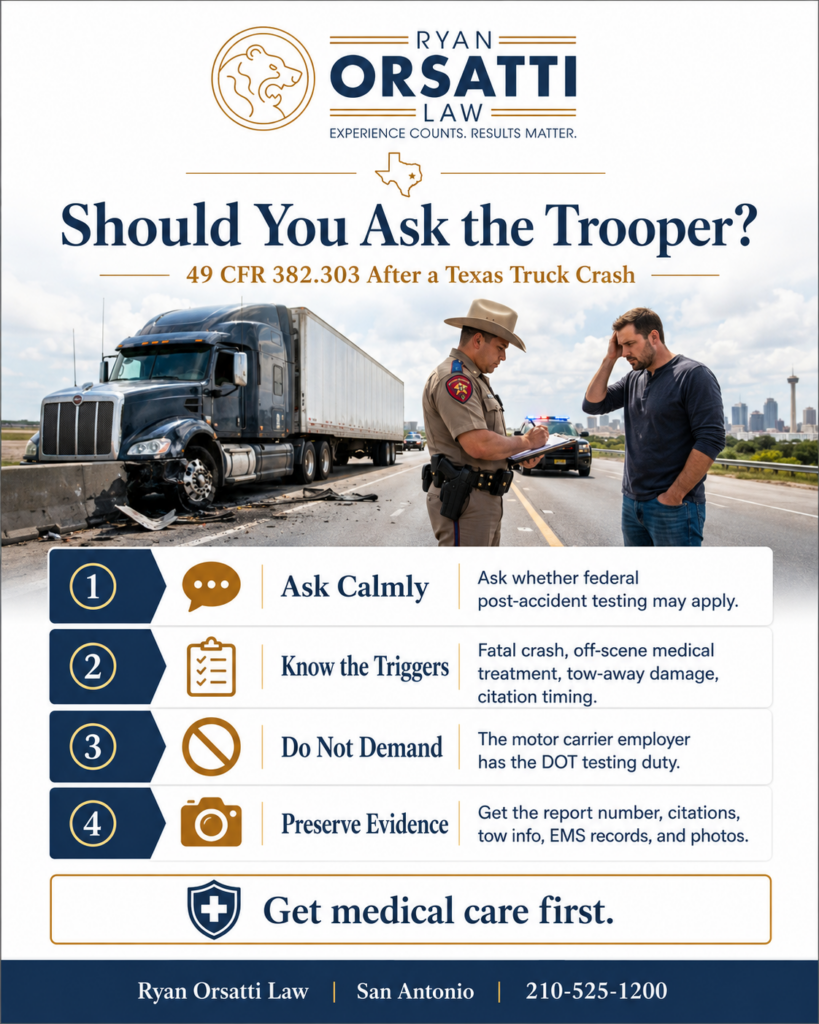
Why does 49 CFR 382.303 matter after a Texas truck crash?
49 C.F.R. § 382.303 matters because it creates short federal evidence windows after certain commercial motor vehicle crashes. In a truck crash, impairment evidence can affect liability, negligent hiring or retention issues, punitive-damages allegations, insurance evaluation, and whether the motor carrier followed federal safety rules.
According to TxDOT’s 2024 Commercial Motor Vehicle county crash report, Bexar County had 2,684 CMV-involved crashes in 2024, including 18 fatal crashes and 34 suspected-serious-injury crashes. Statewide, TxDOT reported 39,393 CMV-involved crashes in 2024. TxDOT explains that these reports are generated from Texas Peace Officer’s Crash Reports, also called CR-3 reports, received and processed by TxDOT. (Texas Department of Transportation)
A “commercial motor vehicle” under Part 382 generally means a vehicle used in commerce to transport passengers or property that meets certain weight, passenger, or hazardous-material criteria. That can include many 18-wheelers, tractor-trailers, heavy work trucks, buses, and some hazmat vehicles. (eCFR)
A Texas truck-crash victim does not need to prove impairment at the roadside. The immediate goal is to help preserve facts that show whether 49 C.F.R. § 382.303 applied: fatality, immediate medical treatment away from the scene, disabling tow-away damage, citation timing, and whether the driver was performing safety-sensitive functions.
When is post-accident drug and alcohol testing under 49 CFR 382.303 triggered?
Post-accident drug and alcohol testing under 49 CFR 382.303 is triggered only when the regulation’s crash type and timing rules are met. A truck crash alone is not enough.
The regulation applies after an occurrence involving a covered commercial motor vehicle operating on a public road in commerce, when the driver was performing safety-sensitive functions. “Safety-sensitive functions” include more than driving. The definition can include waiting to be dispatched, inspecting equipment, driving, being in or on the commercial motor vehicle, loading or unloading, and attending a disabled vehicle. (eCFR)
| Crash fact | Is DOT post-accident testing triggered? | What to document at the scene |
|---|---|---|
| A fatality occurs in a crash involving a covered commercial motor vehicle | Yes, alcohol and controlled-substance testing are required for the surviving driver who was performing safety-sensitive functions | Crash report number, investigating agency, trooper name, carrier name, truck number, trailer number, photos |
| Someone has bodily injury and receives immediate medical treatment away from the scene | Yes, but only if the commercial driver receives a moving-violation citation within 8 hours for alcohol testing or within 32 hours for controlled-substance testing | EMS transport, ER records, citation information, trooper notes, witness names |
| A vehicle has disabling damage requiring it to be towed away | Yes, but only if the commercial driver receives a moving-violation citation within 8 hours for alcohol testing or within 32 hours for controlled-substance testing | Tow company, tow invoice, photos of damage, whether the vehicle could be driven normally |
| No fatality, no immediate off-scene medical treatment, no disabling tow-away damage, and no qualifying citation | Usually no federal DOT post-accident testing under § 382.303, though company policy or a police DWI investigation may be separate | Still save photos, report number, witness names, and medical records |
Under § 382.303, if the employer does not administer the alcohol test within 2 hours, the employer must prepare and maintain a record stating the reasons. If the alcohol test is not administered within 8 hours, the employer must stop trying to administer it and maintain the required record. If the controlled-substance test is not administered within 32 hours, the employer must stop trying to administer it and maintain the required record. (eCFR)
What should I ask the responding trooper at the scene?
Ask one calm, factual question that helps document the federal testing triggers without interfering with the crash investigation. The point is not to tell the trooper how to do the job. The point is to make sure the issue is not lost while the 8-hour and 32-hour windows are running.
A practical way to ask is:
“Trooper, because this involved a commercial vehicle, can you note whether the 49 C.F.R. § 382.303 triggers may apply, including any fatality, medical treatment away from the scene, disabling tow-away damage, and whether any moving-violation citation is being issued to the CMV driver?”
Avoid saying things like:
- “Make the truck driver take a drug test right now.”
- “Can you put in the report that the driver was impaired?”
- “You have to cite the truck driver.”
- “I need you to say the regulation was triggered.”
Those statements can sound argumentative and may hurt your credibility. A better approach is to ask, listen, and write down the trooper’s name, agency, badge number if provided, and crash report number.
Attorney Insight: In truck-crash matters we review around I-35, I-10, Loop 410, Loop 1604, and US-281, the key issue is often not whether someone said the truck driver looked impaired. The better question is whether the off-site treatment, tow-away damage, citation timing, and carrier notice were documented before the 8-hour alcohol window closed.
Who actually has the duty to conduct the DOT post-accident test?
The motor carrier employer has the federal duty to conduct and document DOT post-accident testing when § 382.303 applies. The responding trooper, SAPD officer, Bexar County deputy, or other peace officer investigates the crash, documents facts, and may pursue a separate law-enforcement DWI investigation when there is a legal basis.
The regulation also says law-enforcement breath or blood alcohol tests, and urine controlled-substance tests, may satisfy the federal post-accident testing requirement if the testing conforms to applicable federal, state, or local requirements and the employer obtains the results. That means you should not assume a police blood draw automatically equals DOT compliance. The carrier still has documentation duties. (eCFR)
A motor carrier’s required records may include documents generated in connection with post-accident tests, alcohol testing forms, controlled-substance chain-of-custody forms, refusal records, and records explaining why required tests were not completed within the regulatory time windows. (eCFR)
What if the trooper does not issue a citation at the scene?
A missing citation at the scene does not always end the analysis because § 382.303 uses 8-hour and 32-hour citation windows. For nonfatal crashes involving immediate off-scene medical treatment or disabling tow-away damage, the regulation looks at whether the commercial driver receives a moving-violation citation within 8 hours for alcohol testing or within 32 hours for controlled-substance testing. (eCFR)
That timing matters. A citation issued later may still matter for liability, negligence, and insurance evaluation, but it may not trigger the federal post-accident testing requirement if it falls outside the regulatory window. A fatal crash is different because a fatality trigger does not depend on a citation.
If no citation is issued at the scene, ask for the crash report number and whether a supplemental report may be completed. Do not pressure the officer to issue a citation. Your lawyer can later request the CR-3 report, citation history, body-worn-camera materials if applicable, dash-camera footage if available, 911 records, and other agency records through the proper channels.
What evidence should be preserved if testing may have been triggered?
If testing may have been triggered, preserve the facts that show whether the trigger existed and the records that show whether the carrier complied. Spoliation means the loss or destruction of evidence after a person or company knows, or should know, that a claim may be coming.
In a serious San Antonio or Bexar County truck crash, useful preservation targets may include:
- Texas Peace Officer’s Crash Report, also called the CR-3 report
- Crash report number, investigating agency, and officer or trooper name
- Citations, warnings, supplements, and diagrams
- EMS run sheet and ER records showing immediate medical treatment away from the scene
- Tow invoices and photographs showing whether damage was disabling
- Truck, trailer, license plate, DOT number, motor carrier number, and unit number
- Driver logs, electronic logging device data, dispatch messages, and trip documents
- Engine control module data, event data recorder information, dash-camera video, and telematics
- Driver qualification file, hiring file, training records, and prior safety history when relevant
- DOT alcohol test form, controlled-substance chain-of-custody form, medical review officer communications, designated employer representative notes, refusal documents, and records explaining missed testing windows
Under 49 C.F.R. § 382.401, some drug and alcohol testing records must be kept for 5 years, some for 2 years, and some for 1 year, depending on the type of record. Other truck evidence, such as camera footage, dispatch communications, and telematics, may be lost much sooner if no preservation request is sent. (eCFR)
This testing issue is separate from medical-bill and coverage issues. Those may include subrogation, meaning a repayment claim by a health insurer; a hospital lien, meaning a hospital’s claimed interest in injury-case funds; an ERISA plan, meaning certain employer health plans governed by federal law; MedPay, meaning optional auto coverage for medical bills; a letter of protection, meaning a provider agrees to wait for payment from the case; and UM/UIM, meaning uninsured or underinsured motorist coverage.
After a Texas 18-wheeler crash, what should I do in the first 24 hours?
In the first 24 hours, focus on medical care, scene documentation, and preserving time-sensitive truck evidence. Testing questions matter, but your health and safety come first.
- Get medical care immediately. Accept EMS evaluation if you may be hurt. Do not stay at the scene just to ask legal questions.
- Ask for the crash report number. Get the investigating agency, officer name, and report number if available.
- Photograph the commercial vehicle if safe. Capture the truck, trailer, company name, DOT number, plates, damage, cargo, road signs, skid marks, debris, and final resting positions.
- Ask the 49 C.F.R. § 382.303 question calmly. Ask whether the post-accident testing triggers may apply, then stop and let the officer investigate.
- Document tow-away facts. Write down tow companies, which vehicles were towed, and whether any vehicle could not leave the scene in its usual manner.
- Save medical proof. Keep EMS paperwork, ER discharge papers, imaging orders, prescriptions, and follow-up referrals.
- Avoid a recorded insurer statement before legal review. Trucking insurers may ask detailed questions about speed, visibility, pain levels, prior injuries, employment, and medical history before you know the full evidence.
For more truck-crash context, Ryan Orsatti Law has resources for people looking for a San Antonio truck accident lawyer and a commercial vehicle accident lawyer in San Antonio. If the crash involves a disputed company responsibility issue, you can also review this guide on when a trucking company may be liable after a truck accident in Texas.
How can Ryan Orsatti Law evaluate a 49 CFR 382.303 issue?
Ryan Orsatti Law can evaluate a § 382.303 issue by matching the crash facts to the federal trigger table and sending targeted preservation requests before records disappear. The review usually starts with the crash report, EMS records, tow documentation, photos, citations, carrier identity, and timing.
In matters involving San Antonio, Bexar County, Comal County, Guadalupe County, Kendall County, Wilson County, Atascosa County, and Medina County, the early investigation often focuses on five questions:
- Was the vehicle a covered commercial motor vehicle under Part 382?
- Was the truck driver performing safety-sensitive functions?
- Did the crash involve a fatality, immediate medical treatment away from the scene, or disabling tow-away damage?
- Was a moving-violation citation issued to the commercial driver within the 8-hour or 32-hour window?
- Did the carrier complete testing, obtain qualifying law-enforcement results, or document why testing was not completed?
For non-truck crashes, this federal testing rule may not apply, but other liability and insurance issues may still matter. Ryan Orsatti Law also provides information for people searching for a San Antonio car accident lawyer. To discuss the facts of a truck crash, you can contact Ryan Orsatti Law.
FAQ
Does 49 CFR 382.303 require testing after every 18-wheeler crash in Texas?
No. 49 C.F.R. § 382.303 does not require federal DOT post-accident testing after every 18-wheeler crash. It applies when a covered commercial motor vehicle crash involves a fatality, or when injury with immediate off-scene treatment or disabling tow-away damage is paired with a qualifying moving-violation citation within the regulation’s time windows. (eCFR)
Can a Texas DPS trooper force the trucking company to do DOT testing?
The federal DOT testing duty belongs to the motor carrier employer, not the injured person and not the trooper. A Texas DPS trooper may document crash facts, issue citations when appropriate, and conduct a separate law-enforcement DWI investigation if legally supported. Those records can become important when evaluating whether § 382.303 applied. (eCFR)
Does a police blood test count as the DOT post-accident alcohol test?
It may count, but only if the conditions in § 382.303 are met. The regulation allows law-enforcement breath or blood alcohol results, and urine controlled-substance results, to satisfy the DOT post-accident testing requirement if they conform to applicable requirements and the employer obtains the results. Do not assume police testing automatically proves carrier compliance. (eCFR)
What if the truck driver gets a ticket later instead of at the scene?
For injury and tow-away cases, timing matters. A moving-violation citation issued to the commercial driver within 8 hours can trigger alcohol testing, and a citation within 32 hours can trigger controlled-substance testing. A later citation may still matter for negligence and insurance evaluation, but it may not trigger § 382.303 testing. (eCFR)
Should I delay medical care to document the 49 CFR 382.303 issue?
No. Do not delay medical care to ask about drug and alcohol testing. If you are hurt, accept EMS evaluation and get treatment. Immediate medical treatment away from the scene can be part of the federal trigger analysis, so getting appropriate care may document an important fact while protecting your health. (eCFR)
How long must the trucking company keep DOT drug and alcohol testing records?
Under 49 C.F.R. § 382.401, some DOT drug and alcohol records must be kept for 5 years, some for 2 years, and some for 1 year. The retention period depends on the record type, such as positive results, refusals, collection records, negative results, and alcohol test forms. (eCFR)
What should I give my lawyer if I asked the trooper about post-accident testing?
Give your lawyer the crash report number, investigating agency, officer or trooper name, approximate crash time, photos, EMS paperwork, ER records, tow information, citations, witness names, and any notes about what the trooper said. Those details help match the crash facts to the federal trigger rules and guide preservation requests.
Ryan Orsatti Law
4634 De Zavala Rd, San Antonio, TX 78249
Phone: 210-525-1200
ryanorsattilaw.com
This blog is for informational purposes only, not legal advice. Reading it does not create an attorney-client relationship. Past results do not guarantee future results.
Hurt in an accident in San Antonio? Learn how a San Antonio personal injury lawyer can help with your claim. Call 210-525-1200 or request a free consultation.
The firm works on a contingency fee. You pay nothing unless the firm recovers money for you, and that covers case expenses as well as the fee: if there is no recovery, you owe no attorney's fee and no case expenses. Ask for the fee agreement and read the fee and expense section before you sign anything.
Related San Antonio legal resources
Primary legal and public-data sources
- Texas Civil Practice and Remedies Code Chapter 16: limitations
- Texas Civil Practice and Remedies Code Chapter 33: proportionate responsibility
Ryan Orsatti Law
4634 De Zavala Road, San Antonio, TX 78249
General reference links. Consult each source for its current text.