
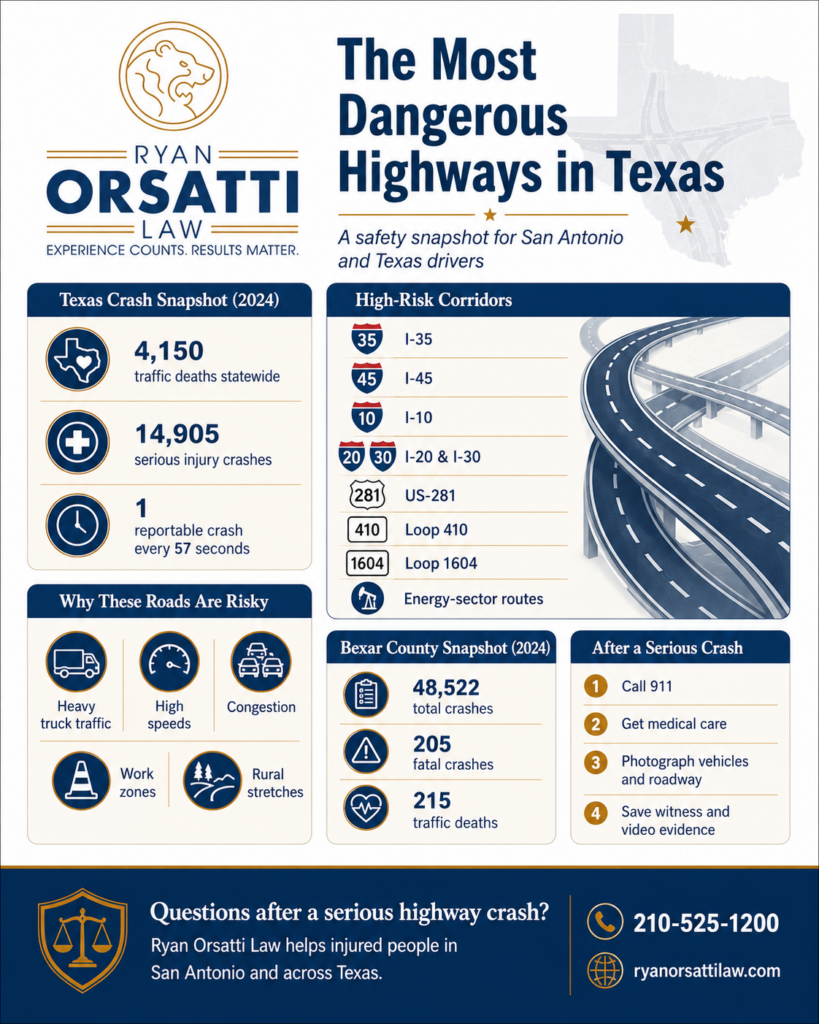
Quick Answer: The most dangerous highways in Texas are usually the corridors where speed, congestion, commercial traffic, work zones, and rural response times overlap. For practical safety and injury-claim purposes, that watch list includes I-35, I-45, I-10, I-20, I-30, US-281, Loop 410, Loop 1604, and energy-sector highways in the Permian Basin and Eagle Ford Shale. TxDOT reported 4,150 traffic deaths and 14,905 serious-injury crashes in Texas in 2024, with one reportable crash occurring every 57 seconds. Ryan Orsatti Law helps injured people in San Antonio and across Texas evaluate fault, insurance coverage, evidence, and deadlines after serious highway crashes.
Key Takeaways
- Texas does not have one single official “most dangerous highway” list that answers every case. Risk depends on crash frequency, severity, speed, traffic mix, construction, and location.
- I-35 deserves special caution because TxDOT has a dedicated I-35 Safety Campaign focused on slowing down and staying alert, especially in work zones. (TxDOT)
- San Antonio’s major corridors matter locally. In 2024, Bexar County had 48,522 total crashes, 205 fatal crashes, and 215 traffic deaths.
- Energy-sector routes are a major statewide danger. TxDOT reported nearly 79,000 crashes and 1,023 deaths in Texas’s five major energy regions in 2024. (TxDOT)
- After a serious highway crash, evidence preservation matters early because video, vehicle data, witness memory, and commercial-driver records can disappear quickly.
What Are the Most Dangerous Highways in Texas?
The most dangerous highways in Texas are generally the high-speed corridors where serious crash risk is increased by traffic volume, 18-wheelers, work zones, distracted driving, and rural stretches with limited shoulders or longer emergency response times. A fair answer should not pretend there is one perfect statewide ranking for every year and every mile marker. The better approach is to identify the corridors where Texas crash data, TxDOT safety campaigns, and real injury-claim patterns repeatedly show elevated danger.
| Texas highway or corridor | Why it belongs on the danger watch list | Claim issue to watch after a crash |
|---|---|---|
| I-35 | I-35 carries heavy commuter and freight traffic through San Antonio, Austin, Waco, and DFW. TxDOT has a dedicated I-35 safety campaign urging drivers to slow down and stay alert, especially in work zones. (TxDOT) | Work-zone evidence, lane-change disputes, rear-end chains, 18-wheeler data, dashcam footage |
| I-45 | I-45 connects Dallas, Houston, and Galveston with fast urban and rural transitions. Serious crashes often involve congestion, stalled vehicles, nighttime driving, or commercial traffic. | Secondary crashes, disabled vehicles, truck visibility, freeway camera footage, witness location |
| I-10 | I-10 crosses Texas from El Paso through San Antonio to Houston. It combines long rural distances, city congestion, high speeds, and freight traffic. | Fatigue, speed, construction zones, multi-county investigation, trucking records |
| I-20 and I-30 | These DFW and East-West freight corridors carry commuter traffic, commercial vehicles, and high-speed rural traffic. | Tractor-trailer policies, cargo issues, company vehicle status, crash reconstruction |
| US-281, Loop 410, and Loop 1604 | These San Antonio corridors combine commuters, construction, merging traffic, and frontage-road conflicts. Bexar County recorded 48,522 total crashes in 2024. | Local witnesses, frontage-road impact points, construction signage, medical documentation |
| Energy-sector routes in the Permian Basin and Eagle Ford Shale | Oil and gas activity places large trucks and heavy equipment on rural roads and highways. TxDOT reported nearly 79,000 crashes and 1,023 deaths in the five major energy regions in 2024. (TxDOT) | Employer liability, truck inspections, driver logs, company safety practices, road-surface issues |
Key takeaway: The “most dangerous highway” is not always the road with the most crashes. For an injury claim, the dangerous part is the combination of speed, impact severity, available evidence, commercial traffic, and whether the crash happened in a place where fault can be disputed.
Why Are Texas Highways So Dangerous?
Texas highways are dangerous because they combine long distances, high speeds, heavy commercial traffic, fast-growing cities, construction zones, and distracted or impaired driving. TxDOT’s 2024 statewide crash facts show the scale of the problem: 4,150 traffic deaths, 251,977 injured people, 617 head-on crash deaths, and no deathless days on Texas roadways.
Highway crashes also tend to be more severe than low-speed city crashes. A rear-end collision on a frontage road may cause injury, but a rear-end collision at interstate speed can cause traumatic brain injury, spinal injury, fractures, or wrongful death.
The biggest danger factors include:
- Speed too fast for traffic, weather, or construction
- Sudden stops in congested traffic
- 18-wheelers and commercial vehicles with longer stopping distances
- Work zones with narrow lanes, shifted traffic, barrels, and temporary signage
- Distracted driving
- Impaired driving, especially late at night
- Rural roads with limited lighting, shoulders, and emergency access
- Chain-reaction crashes where multiple drivers dispute fault
TxDOT reported more than 28,000 work-zone crashes in Texas in 2025, resulting in 203 deaths, including seven roadside workers. (TxDOT) TxDOT also reported that distracted driving caused 86,384 crashes in Texas in 2025, with 2,437 serious injuries and 299 deaths. (TxDOT)
Why Is I-35 One of the Main Texas Highway Corridors to Watch?
I-35 is one of the main Texas highway corridors to watch because it carries commuter traffic, freight traffic, and construction activity through several of the state’s fastest-growing regions. In San Antonio, I-35 also intersects with Loop 410, Loop 1604, I-10, US-281, and other major routes where merging and sudden slowdowns can create serious crash risk. TxDOT’s I-35 Safety Campaign specifically asks drivers to slow down and stay alert on I-35, especially in work zones. (TxDOT)
For personal injury claims, I-35 crashes often require quick investigation. The key evidence may include dashcam video, nearby business video, TxDOT camera information, 911 records, police bodycam, commercial vehicle data, and witness statements from drivers who may leave the area before police finish the scene.
Why Are Loop 1604, Loop 410, and US-281 Important for San Antonio Drivers?
Loop 1604, Loop 410, and US-281 are important for San Antonio drivers because they carry a mix of local commuters, commercial vehicles, construction traffic, frontage-road traffic, and high-speed merging traffic. Bexar County’s 2024 crash numbers show why local evidence matters: TxDOT reported 48,522 total crashes, 205 fatal crashes, and 215 traffic deaths in Bexar County that year.
A crash on Loop 1604 near I-10 or US-281 is different from a crash on a neighborhood street. There may be multiple lanes, multiple vehicles, temporary construction patterns, confusing merge points, and drivers who disagree about where the impact happened. In those cases, photographs of final resting positions, debris fields, lane markings, traffic barrels, and vehicle damage can matter.
What Evidence Matters After a Crash on a Dangerous Texas Highway?
The most important evidence after a Texas highway crash is the evidence that proves how the collision happened before vehicles are moved, video is deleted, or witnesses disappear. In serious cases, that evidence can include the Texas Peace Officer’s Crash Report, scene photos, vehicle damage, medical records, witness information, 911 records, dashcam footage, and commercial vehicle data. Under Texas Transportation Code § 550.062, an officer who investigates a crash involving injury, death, or apparent property damage of $1,000 or more must make a written report, and that report must be filed electronically with TxDOT not later than the 10th day after the crash. (Texas Legislature Online)
Use this checklist after a highway crash if you can do so safely:
- Call 911 and request police and EMS.
- Move to a safe location if traffic creates a continuing danger.
- Photograph all vehicles before they are towed, if it is safe.
- Photograph skid marks, debris, lane markings, construction barrels, signs, and lighting conditions.
- Get names and phone numbers for witnesses.
- Save dashcam footage before it records over itself.
- Get medical care and explain all symptoms accurately.
- Do not guess about fault in a recorded statement.
- Report the claim to your insurer, but be careful with the other driver’s insurer.
- Speak with a Texas personal injury lawyer before signing a release in a serious injury case.
How Do Fault and Insurance Work After a Texas Highway Crash?
Fault and insurance after a Texas highway crash usually turn on negligence, comparative responsibility, and available coverage. Negligence means failing to use reasonable care, such as speeding, following too closely, driving distracted, ignoring a work-zone pattern, or changing lanes unsafely. Comparative responsibility means Texas can reduce a claimant’s recovery by that person’s percentage of fault, and Texas Civil Practice & Remedies Code § 33.001 bars recovery if the claimant’s percentage of responsibility is greater than 50 percent. (Texas Statutes)
Insurance coverage also affects the practical value of a claim. Liability coverage is the at-fault driver’s insurance for injuries and losses caused to others. Texas minimum auto liability coverage is commonly called 30/60/25, meaning $30,000 for injuries per person, up to $60,000 per accident, and $25,000 for property damage. (Texas Department of Insurance)
That minimum coverage can be too low for a serious highway crash. This is why a lawyer will often look for:
- The at-fault driver’s bodily injury limits
- Employer or company vehicle coverage
- Commercial motor vehicle coverage
- Umbrella or excess policies
- Uninsured or underinsured motorist coverage, often called UM/UIM
- Personal injury protection, often called PIP
- Medical payments coverage, often called MedPay
- Health insurance lien or subrogation claims
Subrogation means a health insurer may claim a right to be paid back from part of a settlement. A hospital lien is a legal claim a hospital may assert against part of a personal injury recovery if statutory requirements are met.
What Changes if an 18-Wheeler or Company Vehicle Is Involved?
An 18-wheeler or company vehicle can change the case because the investigation may involve the driver, the employer, the vehicle owner, the motor carrier, maintenance vendors, cargo companies, and insurance policies that do not apply in an ordinary two-car crash. In Bexar County alone, TxDOT reported 2,684 commercial motor vehicle involved crashes in 2024, including 18 fatalities.
A serious truck crash investigation should usually consider:
- Driver qualification files
- Hours-of-service records
- Electronic logging device data
- Inspection and maintenance records
- Dispatch records
- Cell phone evidence
- Engine control module or event data recorder information
- Load securement and cargo documents
- Prior safety history, when legally discoverable
This is one reason early legal review matters. Some evidence is in the hands of the trucking company or its insurer. A preservation letter, sometimes called a spoliation letter, should identify the evidence that must be saved.
How Long Do I Have to File a Texas Highway Accident Claim?
Most Texas personal injury lawsuits from highway crashes must be filed within two years, but some cases have shorter notice issues. Texas Civil Practice & Remedies Code § 16.003 creates a two-year limitations period for personal injury claims, and wrongful death claims also generally must be filed not later than two years after the cause of action accrues. (Texas Statutes)
Do not wait two years to investigate. The filing deadline is not the evidence deadline. Video may be overwritten in days or weeks, witnesses may become hard to find, and vehicle data may be lost if a car or truck is repaired, sold, or destroyed.
If a governmental unit may be involved, the timeline can be more urgent. Texas Civil Practice & Remedies Code § 101.101 gives a governmental unit the right to notice of a claim not later than six months after the incident, and city charter or ordinance notice rules may create shorter notice issues unless an actual-notice exception applies. (Texas Legislature Online)
When Should I Call a Lawyer After a Crash on I-35, I-10, Loop 1604, or Another Texas Highway?
You should call a lawyer after a Texas highway crash when you are injured, fault is disputed, a commercial vehicle is involved, a government vehicle may be involved, medical bills are significant, or an insurance adjuster asks for a recorded statement before you understand your injuries. Highway crash claims are adversarial because the insurance company’s job is to evaluate and limit what it pays under the policy. Early legal help can protect evidence, identify coverage, and reduce mistakes before the claim is boxed in.
Ryan Orsatti Law helps injured people in San Antonio and across Texas with car accident claims, truck accident claims, commercial vehicle crashes, and catastrophic injury cases. The goal is to evaluate the evidence, insurance, medical documentation, and deadlines before the insurance company frames the case against you.
Attorney Insight: In serious highway cases, one of the biggest claim problems is not the crash report. It is missing evidence. Adjusters often focus on gaps: delayed treatment, unclear impact location, no witness names, no photos before towing, and no proof of how the lane pattern looked that day. On roads like I-35, Loop 1604, and I-10, the case can change if you preserve video, construction-zone photos, dashcam footage, and commercial vehicle records early.
What Can Ryan Orsatti Law Do After a Serious Texas Highway Crash?
Ryan Orsatti Law can help evaluate liability, insurance coverage, medical documentation, liens, evidence preservation, and filing deadlines after a serious Texas highway crash. The firm is based in San Antonio and handles Texas personal injury matters involving car crashes, 18-wheeler wrecks, commercial vehicles, serious injuries, and wrongful death. For help after a crash, you can contact the firm through the Ryan Orsatti Law contact page.
A serious highway claim may require more than sending medical bills to an adjuster. It may require identifying all defendants, sending preservation letters, investigating company vehicles, checking UM/UIM coverage, reviewing health insurance liens, documenting future medical needs, and preparing the case as if litigation may become necessary.
FAQ
What is the most dangerous highway in Texas?
The most dangerous highway in Texas depends on how the question is measured. I-35, I-45, I-10, I-20, I-30, US-281, Loop 410, Loop 1604, and energy-sector highways all deserve caution because they combine speed, congestion, commercial traffic, work zones, or rural risk. TxDOT’s statewide data confirms Texas had 4,150 traffic deaths in 2024.
Is I-35 dangerous in San Antonio and Central Texas?
Yes. I-35 is a major safety concern because it carries commuters, freight, construction traffic, and long-distance travelers through San Antonio, Austin, Waco, and DFW. TxDOT’s I-35 Safety Campaign specifically urges drivers to slow down and stay alert on I-35, especially in work zones. (TxDOT)
What should I do first after a crash on Loop 1604 or Loop 410?
After a crash on Loop 1604 or Loop 410, call 911, move to safety if possible, get medical help, photograph the vehicles and roadway, identify witnesses, and avoid guessing about fault. San Antonio highway crashes often involve fast traffic, merge disputes, construction patterns, and multiple vehicles, so early evidence can matter.
How long do I have to file a Texas highway accident lawsuit?
Most Texas highway accident lawsuits involving personal injury must be filed within two years under Texas Civil Practice & Remedies Code § 16.003. Some claims, especially those involving a governmental unit, can have shorter notice issues. Treat the two-year deadline as the lawsuit deadline, not the deadline to begin investigating. (Texas Statutes)
Does the Texas crash report decide who is legally at fault?
No. A Texas crash report is important, but it does not always decide legal fault by itself. The report may identify contributing factors, parties, vehicles, witnesses, and the investigating officer’s information. Legal responsibility can still depend on photos, video, testimony, vehicle data, medical evidence, and Texas proportionate responsibility rules.
What if the crash involved an 18-wheeler or work truck?
If the crash involved an 18-wheeler or work truck, the case may involve more than the driver. A lawyer may investigate the motor carrier, employer, maintenance company, cargo issues, logs, inspections, and commercial insurance. In Bexar County, TxDOT reported 2,684 commercial motor vehicle involved crashes in 2024.
Should I give a recorded statement after a Texas highway crash?
You should be careful before giving a recorded statement to the other driver’s insurance company after a Texas highway crash. Adjusters may ask questions before your injuries are fully diagnosed or before fault evidence is preserved. You can cooperate with your own insurer, but serious injury cases deserve legal review before broad recorded statements.
Ryan Orsatti Law
4634 De Zavala Rd, San Antonio, TX 78249
Phone: 210-525-1200
ryanorsattilaw.com
This blog is for informational purposes only, not legal advice. Reading it does not create an attorney-client relationship. Past results do not guarantee future results.
Hurt in an accident in San Antonio? Learn how a San Antonio car accident lawyer can help with your claim. Call 210-525-1200 or request a free consultation.
The firm works on a contingency fee. You pay nothing unless the firm recovers money for you, and that covers case expenses as well as the fee: if there is no recovery, you owe no attorney's fee and no case expenses. Ask for the fee agreement and read the fee and expense section before you sign anything.
Related San Antonio legal resources
Primary legal and public-data sources
- Texas Civil Practice and Remedies Code Chapter 71: wrongful death
- Texas Civil Practice and Remedies Code Chapter 16: limitations
Ryan Orsatti Law
4634 De Zavala Road, San Antonio, TX 78249
General reference links. Consult each source for its current text.