
Quick Answer
Start with the truck’s USDOT number and the Texas CR-3 crash report, then compare those public clues with the written lease, dispatch records, settlement sheets, tax documents, insurance, and evidence showing who controlled the trip. The truck owner, operating motor carrier, and driver’s employer can be different entities. A 1099 or an “independent contractor” label does not settle the issue under Texas law.
Key Takeaways
- “Owner-operator” describes an operating arrangement, not a final legal classification.
- The USDOT number and CR-3 usually identify the operating carrier, not necessarily the driver’s employer.
- A federal motor-carrier lease can identify the owner, carrier, lease period, compensation, expenses, and insurance duties.
- Texas generally uses a right-to-control test, so the contract and the parties’ actual conduct both matter.
- Electronic logs and supporting documents may have a federal minimum retention period of only six months.
This distinction can affect which companies, policies, and legal theories require investigation after a collision on I-10, I-35, Loop 410, Loop 1604, or US-281. In its 2024 county report, the Texas Department of Transportation recorded 2,684 commercial-motor-vehicle crashes in Bexar County, including 18 fatal crashes. (Texas Department of Transportation)
What are you actually trying to identify?
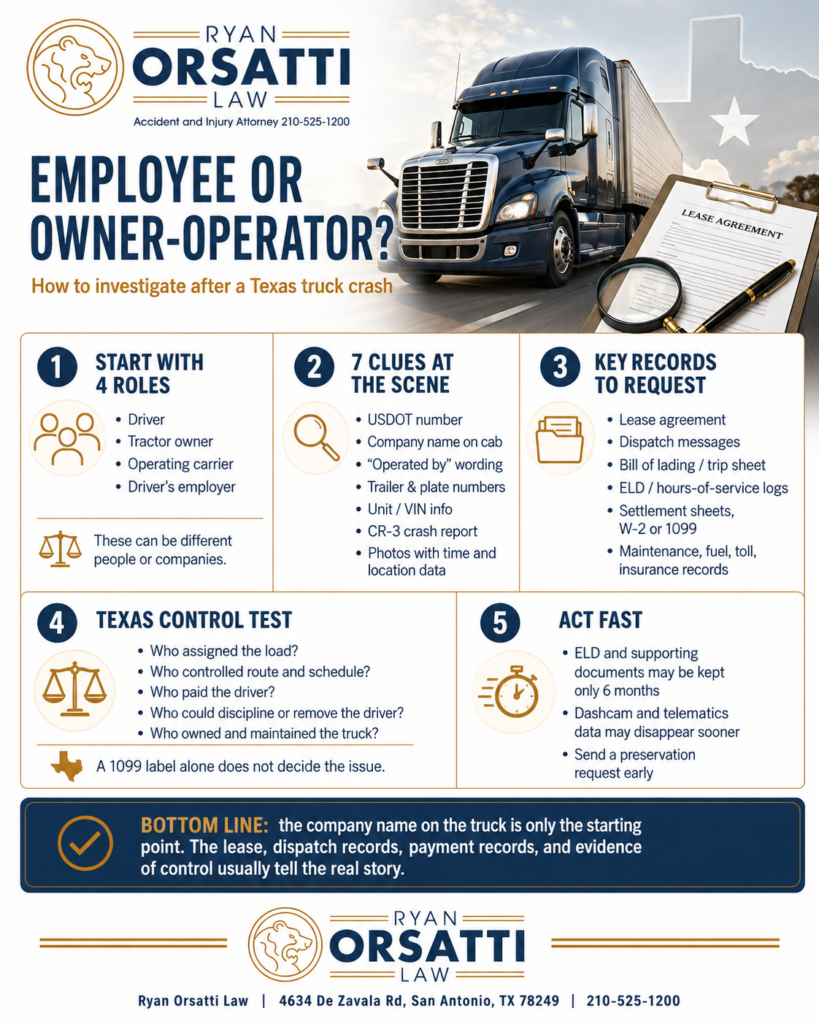
You are trying to separate four roles that may belong to different people or businesses: the driver, tractor owner, operating motor carrier, and driver’s employer.
A lessor owns the equipment and grants its use. A lessee obtains that use. An owner-operator may own the tractor personally or through an LLC, then lease it to a carrier whose USDOT number appears on the cab. The driver could also work for the owner-operator’s LLC.
| Common arrangement | Tractor owner | USDOT number commonly displayed | What remains disputed |
|---|---|---|---|
| Company fleet driver | Carrier or affiliate | Carrier | Payroll status, control, and job duties |
| Leased owner-operator | Driver or driver-owned LLC | Lessee carrier | Lease dates, actual control, payment, and trip status |
| Owner-operator under own authority | Driver or driver-owned LLC | Owner-operator’s business | Whether another entity controlled the load |
| Driver hired by owner-operator LLC | Owner-operator LLC | Owner-operator or lessee carrier | Who employed the driver and controlled the work |
These are common patterns, not legal conclusions. A tractor’s owner, operating carrier, trailer owner, and driver payor may differ.
What can I learn from the truck and the Texas CR-3?
You can usually identify the operating motor carrier, but not conclusively classify the driver, from the cab markings and Texas Peace Officer’s Crash Report.
Under 49 C.F.R. § 390.21T, a covered commercial vehicle must display the operating carrier’s legal or trade name and USDOT number. When another name appears, the carrier’s identification is generally preceded by “operated by.” Verify all markings. (eCFR)
After a truck crash, document these seven identifiers
- Photograph the legal name, trade name, USDOT number, and any MC number on both sides of the cab.
- Capture any “operated by,” “leased to,” or similar wording.
- Photograph tractor and trailer plates, unit numbers, and visible VIN information.
- Record separate names on the tractor, trailer, container, and available shipping papers.
- Save any insurance or employer information voluntarily provided.
- Obtain the crash report number and investigating agency’s name.
- Preserve original photos and videos with timestamps and location data.
Do not enter the truck, remove documents, or interfere with an investigation.
On a Texas CR-3, the motor carrier can be different from the registered truck owner. TxDOT’s 2025 reporting instructions tell officers that the carrier is the entity responsible for operation at the time of the crash and give a leased owner-operator example in which the lessee carrier, not the truck owner, is listed. (Texas Department of Transportation)
An involved person or another person with a qualifying interest may obtain the CR-3 through TxDOT’s crash-report system. The report is an important lead, but the carrier entry is not a judicial ruling on employment status. (Texas Department of Transportation)
How do I use the USDOT number to identify the operating carrier?
Enter the number into FMCSA’s SAFER Company Snapshot, then compare the result with the FMCSA Licensing and Insurance search.
SAFER permits searches by USDOT number, MC or MX number, or company name. Record the legal name, DBA, address, operating status, and identifying numbers. The Licensing and Insurance system adds authority and insurance-filing information. Save dated copies. (SAFER WEB)
These databases identify a carrier, not the driver’s common-law status. A carrier’s USDOT number paired with a tractor registered to another business may signal a lease.
Which records show whether the driver was an employee or owner-operator?
The strongest answer comes from comparing the lease and payment records with trip-specific evidence showing who directed, equipped, and controlled the work.
| Record | What it may show | Retention or timing issue |
|---|---|---|
| Lease, addenda, equipment receipts | Parties, tractor, lease dates, pay, expenses, insurance | Request and preserve promptly |
| Bill of lading, manifest, trip sheet, dispatch messages | Freight, responsible carrier, destination, timing, instructions | Ties the arrangement to the crash trip |
| ELD and records of duty status | Carrier served, vehicle, route, and work periods | 49 C.F.R. § 395.8(k) generally requires at least six months |
| Settlement sheets, W-2, 1099, payroll, deductions | Payment method, tax treatment, charge-backs, expenses | Tax labels are relevant, not conclusive |
| Title, maintenance, fuel, toll, permit records | Who furnished the truck and paid costs | Bears on Texas control factors |
| Driver qualification file, policies, discipline | Which carrier qualified, monitored, or restricted the driver | 49 C.F.R. § 391.51 generally requires retention during the relationship and three years afterward |
In truck-crash matters we have handled, the answer often comes from dispatch messages, settlement sheets, and lease dates, not the 1099 alone. A preservation letter, sometimes called a spoliation letter, asks relevant people and businesses to retain specified evidence. Spoliation means the loss or destruction of relevant evidence. The letter does not itself compel production.
What must a federal owner-operator lease say?
When 49 C.F.R. Part 376 applies, the written lease must identify the carrier and equipment owner, state when the lease begins and ends, address compensation and expenses, allocate insurance responsibilities, and be signed by the parties.
Federal leasing rules do not let a carrier settle the employment question with one sentence in a contract. Section 376.12(c)(1) requires exclusive possession and complete operational responsibility during the lease, while § 376.12(c)(4) says that required provision does not itself decide whether the lessor or driver is an employee or independent contractor. (eCFR)
The carrier and owner must keep lease copies. If a copy is not carried on the truck, § 376.11(c)(2) generally requires a statement identifying the owner, lease dates, restrictions, and original lease location. Trip documents must identify the equipment owner, origin, departure, destination, cargo, and carrier responsibility. (eCFR)
Part 376 does not govern every local, intrastate, exempt, or rental operation. Even then, the agreement, payment structure, dispatch records, and actual control remain important.
How does Texas decide whether the driver was an employee?
Texas generally asks whether the alleged employer had the right to control the progress, details, and methods of the driver’s work.
In Renaissance Medical Foundation v. Lugo, the Supreme Court of Texas restated five common-law factors: the independent nature of the worker’s business, who furnishes tools and materials, the worker’s control over progress, the duration of the relationship, and whether payment is by time or by the job. Control may appear in the contract or in actual practice. (Texas Courts)
For a truck driver, the investigation asks:
- Could the driver accept or reject loads?
- Who selected routes, delivery windows, fuel stops, and rest periods?
- Who owned, maintained, and insured the tractor?
- Could the driver work for other carriers or hire a substitute?
- Was payment hourly, per mile, per load, or a percentage of revenue?
- Who could suspend, discipline, retrain, or remove the driver?
- Was the relationship ongoing or limited to individual loads?
A 1099, LLC, or contract label is evidence, but none answers these questions alone. Also, 49 C.F.R. § 390.5T includes an independent contractor within “employee” while operating a commercial motor vehicle for federal safety-compliance purposes. That definition does not resolve every Texas liability, tax, insurance, or employment question. (eCFR)
Vicarious liability means legal responsibility for another person’s negligence. Even if employee status is shown, the evidence must establish that the driver was acting within the course and scope of the work and that negligence caused the injuries.
Why should the lease, ELD, and dispatch evidence be preserved immediately?
The evidence should be preserved immediately because some federal retention periods are short and private video or telematics systems may overwrite data.
Time matters because 49 C.F.R. § 395.8(k) generally requires a motor carrier to keep records of duty status and supporting documents for at least six months. A prompt preservation request should also cover dispatch, telematics, dashcam video, settlement sheets, load records, trip documents, the lease, and communications with the driver. (eCFR)
A driver qualification file is generally retained throughout the carrier relationship and for three years afterward. For an event meeting the federal definition of an accident, the carrier’s accident register must generally be kept for three years. Company dashcam, mobile-device, and GPS retention varies by system. (eCFR)
Attorney Insight: In truck-crash investigations, the first insurance letter often names only one business. We compare five independent markers: the USDOT number displayed, the entity shown on the shipping papers, who dispatched the trip, who paid the driver, and who could discipline or remove the driver. A mismatch can reveal another record source or potentially responsible party.
What if the carrier and owner-operator blame each other?
Do not accept either company’s label without comparing the lease, trip records, control evidence, and insurance policies in effect on the crash date.
The carrier may call the driver an independent contractor, while the owner-operator says the carrier controlled the load. The investigation may also address driver negligence, the carrier’s own conduct, maintenance, loading, equipment ownership, and other shipment participants.
The lease should address the carrier’s public-liability obligation and other coverage, including bobtail or non-trucking coverage. Policy application can turn on dispatch status, trip purpose, tractor-trailer configuration, exclusions, and endorsements. Our guides on company liability for contractor drivers, trucking-company liability after a Texas crash, and commercial truck insurance requirements explain those separate issues.
What should I do next after a San Antonio truck crash?
Start by preserving the truck identifiers, CR-3, medical documentation, witness information, and every communication from the driver, carrier, or insurer.
A focused investigation can map each entity, send tailored preservation notices, request the lease and insurance materials, and use formal discovery or subpoenas when voluntary production is incomplete. Our San Antonio truck accident resource explains the broader claim process.
Texas Civil Practice and Remedies Code § 16.003 generally provides a two-year limitations period for personal-injury claims, although exceptions and shorter notice requirements can apply. The practical evidence deadline may arrive far sooner because electronic and business records can disappear. (Texas Statutes)
What are common questions about employee drivers and owner-operators?
The following answers address the classification and evidence questions that often arise after a leased-truck collision.
Does the company name on the truck prove who employed the driver?
No. Federal marking rules generally identify the operating motor carrier, which may be leasing a tractor from an owner-operator. The title owner, operating carrier, and driver’s employer may differ. Use the name and USDOT number as leads, then verify them against the CR-3, lease, driver payment records, dispatch evidence, and corporate records. (eCFR)
Does a 1099 prove the truck driver was an independent contractor?
No. A 1099 shows tax treatment, but Texas common law focuses on the right to control the work. Courts also consider who supplied the truck and operating materials, the relationship’s duration, the worker’s independent business, control over progress, and the method of payment. Review the contract and actual conduct together. (Texas Courts)
Can I obtain the owner-operator lease without filing a lawsuit?
Sometimes. A carrier, owner, driver, or insurer may provide it during a pre-suit investigation, but a preservation letter does not force production. If the lease is withheld, formal discovery or a subpoena may be necessary after suit is filed. Federal regulations require the carrier and equipment owner to keep copies during the lease arrangement. (eCFR)
What if the driver owned the tractor but displayed another carrier’s USDOT number?
That often indicates operation under the other carrier’s authority, possibly through a lease, but it is not conclusive. Check lease dates, equipment receipts, trip documents, the bill of lading, ELD carrier name, and dispatch messages to determine whether that carrier was responsible for the specific transportation when the crash occurred. (eCFR)
Does FMCSA treat an independent owner-operator as an employee?
For federal motor-carrier safety regulations, 49 C.F.R. § 390.5T defines “employee” to include an independent contractor while operating a commercial motor vehicle. That keeps safety duties from disappearing merely because a carrier uses contractors. It does not automatically decide Texas common-law employment status, vicarious liability, payroll classification, or coverage under a particular insurance policy. (eCFR)
How long do I have to investigate a Texas truck accident claim?
Texas law generally allows two years to file a personal-injury lawsuit, subject to exceptions. That is not a safe evidence-preservation timetable. ELD records and supporting documents may have a six-month federal minimum, and private dashcam or telematics data may be overwritten sooner. Preservation efforts should begin as early as reasonably possible. (Texas Statutes)
Ryan Orsatti Law
4634 De Zavala Rd, San Antonio, TX 78249
Phone: 210-525-1200
ryanorsattilaw.com
This blog is for informational purposes only, not legal advice. Reading it does not create an attorney-client relationship. Past results do not guarantee future results.
Hurt in an accident in San Antonio? Learn how a San Antonio personal injury lawyer can help with your claim. Call 210-525-1200 or request a free consultation.
The firm works on a contingency fee. You pay nothing unless the firm recovers money for you, and that covers case expenses as well as the fee: if there is no recovery, you owe no attorney's fee and no case expenses. Ask for the fee agreement and read the fee and expense section before you sign anything.
Related San Antonio legal resources
Primary legal and public-data sources
- Texas Civil Practice and Remedies Code Chapter 16: limitations
- Texas Civil Practice and Remedies Code Chapter 33: proportionate responsibility
Ryan Orsatti Law
4634 De Zavala Road, San Antonio, TX 78249
General reference links. Consult each source for its current text.