
Quick Answer: You should consult a Texas personal injury attorney before settling with an insurance company because signing a release can end your injury claim permanently, even if you later need more treatment. The Texas Department of Insurance warns that after an accident caused by another driver, the insurer may ask you to sign a release promising you will not file more claims, and you should consider future medical treatment before signing. Ryan Orsatti Law helps injured people in San Antonio and across Texas review settlement offers, fault issues, insurance coverage, medical bills, liens, and release language before they make a final decision. (Texas Department of Insurance)
Key Takeaways
- Do not sign an insurance settlement release until you understand what claims, parties, injuries, and future expenses you are giving up.
- Texas injury claims often involve more than one coverage source, including liability insurance, PIP, MedPay, UM/UIM, health insurance, and possible hospital liens.
- Texas generally gives injured people two years to file a personal injury lawsuit, but shorter notice deadlines can apply in government-entity cases.
- Fault matters. Under Texas proportionate responsibility law, your recovery can be reduced by your percentage of fault, and you may be barred if your responsibility is greater than 50 percent.
- A settlement should be evaluated by net recovery, not just the gross offer.
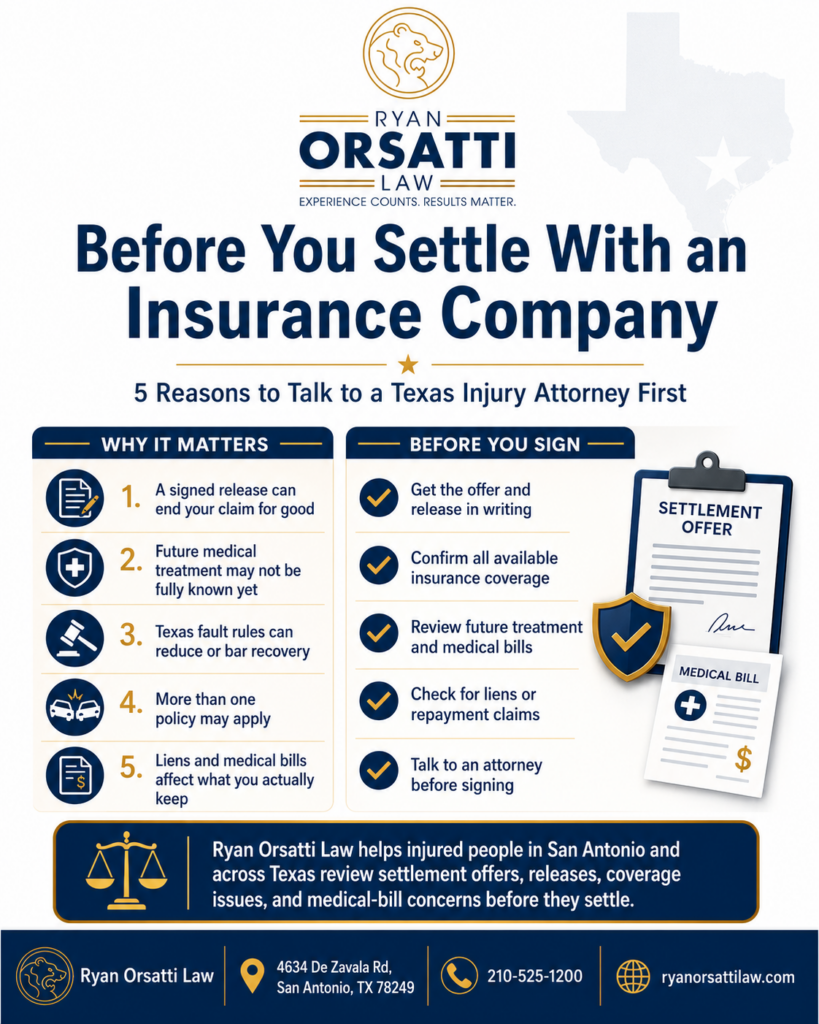
Why should you consult an attorney before settling with an insurance company in Texas?
You should consult an attorney before settling with an insurance company in Texas because the settlement number is only one part of the decision. A Texas injury settlement should also be reviewed for liability disputes, policy limits, future medical needs, unpaid bills, health-insurance reimbursement claims, hospital liens, and the exact wording of the release.
Insurance companies resolve claims by buying finality. That means the insurer usually wants a signed release that closes the claim in exchange for payment. Once that release is signed, the issue is not whether the offer “felt fair” at the time. The issue is whether the written agreement legally gave up more than you understood.
This matters in San Antonio car accident claims because crash injuries often develop in stages. A person may leave the scene on Loop 1604, I-10, I-35, Loop 410, or US-281 thinking they have soreness, then later learn they need imaging, injections, surgery, extended therapy, or time away from work.
TxDOT reported that 251,977 people were injured in Texas motor vehicle traffic crashes in 2024, and one reportable crash occurred every 57 seconds. That same TxDOT report states the data came from Texas Peace Officer’s Crash Reports, also known as CR-3 reports. (Texas Department of Transportation)
For more background on how injury negotiations work, see Ryan Orsatti Law’s guide on how car accident settlements work.
What rights can you give up when you sign an insurance settlement release?
A settlement release usually gives up your right to bring more claims for the same accident against the released parties. The Texas Department of Insurance explains that an insurer may offer a settlement for medical bills and ask you to sign a release promising that you will not file more claims for the accident. (Texas Department of Insurance)
A release is not just a receipt for payment. It is usually a legal document that can affect your rights against the at-fault driver, the driver’s employer, a commercial vehicle company, a property owner, or other entities named in the document.
Before signing, you need to know:
- Whether the release covers only one defendant or multiple parties
- Whether it includes unknown injuries
- Whether it includes property damage and bodily injury together
- Whether it affects UM/UIM claims against your own policy
- Whether it requires confidentiality, indemnity, or repayment promises
- Whether all liens and medical balances are resolved
A common mistake is focusing only on the settlement check and ignoring the release language. Another mistake is accepting a bodily injury settlement before confirming whether all treatment is complete and whether the medical bills in the file are accurate.
What should be reviewed before you accept a settlement offer?
Before you accept a settlement offer, you should review liability, damages, insurance coverage, medical proof, future care, liens, subrogation, and the release terms. “Subrogation” means a health insurer or benefits plan may claim a right to be paid back from part of your settlement.
| Issue to review | Why it matters | Texas-specific concern |
|---|---|---|
| Fault allocation | Texas can reduce recovery based on your percentage of responsibility | More than 50 percent responsibility can bar recovery under Texas Civil Practice & Remedies Code Chapter 33 |
| Medical treatment status | Early offers may not include future care | TDI advises considering future medical treatment before signing a release |
| Insurance coverage | The at-fault policy may not be the only source | Texas minimum liability limits are 30/60/25, and PIP or UM/UIM may apply |
| Liens and subrogation | A gross offer may shrink after repayment claims | Texas hospital liens and health-plan reimbursement claims can affect net recovery |
| Release language | The document controls what rights are waived | Broad releases may include unknown claims, future claims, or multiple parties |
Key takeaway: A settlement is not just about whether the offer sounds reasonable. It is about whether the final net result still makes sense after fault, coverage, medical proof, liens, and release language are reviewed.
Has your medical condition stabilized?
You should usually wait to evaluate a serious injury settlement until your medical condition is stable enough to understand your diagnosis, treatment plan, and future risks. TDI specifically advises injured people to talk to their doctor about future medical treatment before signing an insurer’s release. (Texas Department of Insurance)
This does not mean every case must wait forever. It means you need enough medical information to make an informed decision. For example, a soft-tissue injury that resolves quickly is different from a disc injury, fracture, concussion, surgery recommendation, or condition requiring long-term work restrictions.
In Texas personal injury claims, medical documentation often drives the settlement discussion. Records, billing, causation opinions, work-status notes, and future-care recommendations help show whether the offer reflects the real harm caused by the incident.
Have all insurance policies been identified?
You should identify every possible insurance policy before accepting a settlement because the at-fault driver’s liability policy may not be enough. TDI states that Texas law requires at least $30,000 in bodily injury coverage per person, $60,000 per accident, and $25,000 for property damage, commonly called 30/60/25 coverage. (Texas Department of Insurance)
Those minimum limits can be too low when an accident causes ambulance transport, ER care, imaging, surgery, missed work, or long-term symptoms. TDI also explains that Texas auto policies include PIP unless rejected in writing, and insurance companies must offer uninsured/underinsured motorist coverage unless it is rejected in writing. (Texas Department of Insurance)
A lawyer can review:
- The at-fault driver’s liability limits
- Employer or commercial vehicle coverage
- PIP coverage
- MedPay coverage
- UM/UIM coverage
- Umbrella or excess coverage
- Rideshare or delivery-app coverage
- Health insurance and benefit-plan reimbursement issues
For a deeper review of coverage gaps, see Ryan Orsatti Law’s guide to UM/UIM coverage in Texas.
Have liens and medical repayment claims been accounted for?
You should account for liens and medical repayment claims before settling because they can change the amount you actually keep. A hospital lien is a legal claim a hospital may assert against part of a personal injury recovery for certain accident-related care.
Under Texas Property Code Chapter 55, a hospital may have a lien on an accident claim when the injured person receives covered hospital services for injuries attributed to another person’s negligence. Texas law also includes timing and amount rules, including the 72-hour admission issue and limits on the lien amount. (Justia Law)
Medical repayment issues may include:
- Hospital liens
- EMS liens in certain counties
- Health-insurance subrogation claims
- ERISA plan reimbursement claims
- Medicare or Medicaid reimbursement
- Letters of protection
- Unpaid provider balances
Attorney Insight: A settlement offer is not the same as net recovery. In serious injury claims, the number that matters is what remains after unresolved medical balances, health-insurance reimbursement claims, hospital liens, case costs, and future treatment risks are accounted for. A quick offer can look reasonable until the release closes the file and the unpaid medical issues are still there.
How do Texas fault rules affect settlement value?
Texas fault rules can reduce or defeat an injury claim, so fault should be reviewed before settlement. Under Texas Civil Practice & Remedies Code § 33.001, a claimant may not recover damages if the claimant’s percentage of responsibility is greater than 50 percent. (Texas Statutes)
Comparative responsibility means Texas can reduce your recovery by your percentage of fault. Under Texas Civil Practice & Remedies Code § 33.012, if the claimant is not barred, the court reduces damages by a percentage equal to the claimant’s percentage of responsibility. (Texas Statutes)
That matters in settlement negotiations because insurers often argue comparative fault before a jury ever sees the case. In car accident claims, they may point to speed, lookout, following distance, unsafe lane changes, sudden stops, unclear crash diagrams, inconsistent statements, or missing witnesses.
Before settling, you should ask:
- What fault percentage is the insurance company claiming?
- What evidence supports or refutes that percentage?
- Does the CR-3 crash report list contributing factors?
- Are there photos, dashcam footage, surveillance clips, or witness statements?
- Would further investigation change the liability analysis?
- Is the insurer discounting the offer because of a fault argument that can be challenged?
Ryan Orsatti Law helps injured people evaluate these issues in San Antonio and across Texas, including crashes involving disputed liability, commercial vehicles, rideshare drivers, hit-and-run drivers, and underinsured drivers.
What deadlines matter before you settle or wait?
The main Texas deadline for most personal injury lawsuits is two years from the date the claim accrues, but some cases have shorter notice or policy deadlines. Texas Civil Practice & Remedies Code § 16.003 generally requires suit for personal injury to be brought not later than two years after the day the cause of action accrues. (Texas Statutes)
Waiting can be dangerous when evidence disappears. Surveillance footage may be overwritten, witnesses may become harder to locate, vehicles may be repaired or salvaged, and businesses may not keep video unless they receive a preservation request.
Shorter deadlines may apply when:
- A city, county, school district, transit agency, or other governmental unit is involved
- A policy requires prompt notice of a UM/UIM claim
- A hit-and-run claim requires police reporting
- A business needs to preserve surveillance footage
- A commercial trucking case requires preservation of electronic data
- Medical providers, Medicare, Medicaid, or health plans assert reimbursement rights
For government claims, Texas Civil Practice & Remedies Code § 101.101 generally gives a governmental unit the right to receive notice of a claim within six months after the incident, and the notice must reasonably describe the injury, time and place, and incident. Some city-charter notice issues may require separate review. (Texas Legislature Online)
What should you do before responding to a settlement offer?
Before responding to a settlement offer, gather the documents needed to evaluate the offer and avoid making recorded statements or written admissions that can be used against you. Your response should be based on evidence, not pressure from an adjuster.
Use this checklist before saying yes, no, or making a counteroffer:
- Get the offer in writing. Confirm whether it is for bodily injury, property damage, or both.
- Ask for the release. Review the actual document before agreeing.
- Confirm the policy limits. Identify the at-fault liability limits and any other available coverage.
- Review your own policy. Look for PIP, MedPay, UM/UIM, rental, and collision coverage.
- Collect medical records and bills. Make sure the records match the injuries being claimed.
- Ask your doctor about future care. Do this before signing any final release.
- Check for liens and reimbursement claims. Include hospitals, health insurers, Medicare, Medicaid, and benefit plans.
- Calculate net recovery. Subtract known liens, balances, fees, and costs from the gross offer.
- Preserve evidence. Save photos, video, witness names, crash reports, messages, and repair records.
- Talk to a Texas personal injury attorney. Get a legal review before final settlement documents are signed.
TDI also notes that the prompt payment law deadlines apply to your own insurance company, but not when another driver’s insurance company is paying the claim. TDI says the other driver’s company still must act in good faith and try to settle quickly and fairly. (Texas Department of Insurance)
For more on the stages of a claim, see Ryan Orsatti Law’s guide to the personal injury settlement timeline in Texas and the firm’s overview of how a personal injury lawsuit works.
How can Ryan Orsatti Law help before you settle with an insurance company?
Ryan Orsatti Law can help review the settlement offer, the release, the insurance coverage, the medical documentation, and the practical risks before you make a final decision. The goal is to help you understand what the offer does and does not resolve under Texas law.
In a settlement-review conversation, the firm may examine:
- Whether the offer includes all known accident-related injuries
- Whether future treatment has been addressed
- Whether the insurer is applying a fault discount
- Whether policy limits have been confirmed
- Whether UM/UIM or PIP should be reviewed
- Whether hospital liens or subrogation claims may affect net recovery
- Whether the release language is broader than expected
- Whether filing suit may be needed to preserve the claim before limitations expires
Ryan Orsatti Law is based in San Antonio and represents injured people throughout Bexar County and across Texas. If your case involves a serious crash, a disputed fault claim, an underinsured driver, a commercial vehicle, or an insurer pushing for a quick release, a legal review before signing can help you avoid preventable mistakes.
For local crash claims, visit the firm’s San Antonio car accident lawyer page.
FAQs About Consulting an Attorney Before Settling with an Insurance Company
These FAQs answer common Texas questions about settlement offers, releases, insurance coverage, and when legal review is especially important before signing.
Should I accept the first settlement offer from the insurance company?
You should not accept the first settlement offer until you understand your injuries, medical bills, future treatment, fault issues, and net recovery. In Texas, a signed release may prevent future claims from the same accident. Ask for the offer and release in writing, then review them with a Texas personal injury attorney before signing.
Can I settle my Texas injury claim without a lawyer?
You can settle a Texas injury claim without a lawyer, but it can be risky if you were hurt, fault is disputed, medical bills are unpaid, or policy limits are unclear. A lawyer can review whether the offer accounts for future care, liens, subrogation, UM/UIM coverage, and the release language before the claim is closed.
What does an attorney look for in an insurance settlement release?
An attorney looks for which parties are being released, which claims are being waived, whether unknown or future injuries are included, whether the release affects other insurance claims, and whether indemnity or repayment language creates risk. The release is often more important than the settlement letter because it controls what rights are given up.
How long do I have to settle a personal injury claim in Texas?
Most Texas personal injury lawsuits must be filed within two years under Texas Civil Practice & Remedies Code § 16.003, but settlement negotiations do not automatically extend that deadline. Claims involving governmental units, hit-and-run coverage, UM/UIM notice, or evidence preservation may require faster action. Waiting too long can weaken both proof and leverage.
What if the insurance company says the offer is final?
If the insurance company says the offer is final, you should still review the evidence, policy limits, medical proof, liens, and release before accepting. “Final” may be a negotiation position, not a legal deadline. A Texas personal injury attorney can evaluate whether the offer reflects the risk and evidence or whether more documentation is needed.
Will hiring a lawyer delay my settlement?
Hiring a lawyer may change the settlement timeline, but delay is not always bad if the case needs medical proof, lien review, policy investigation, or liability evidence. Settling too early can be more harmful than waiting a reasonable time to understand the injury. The better question is whether the settlement is informed, documented, and safe to sign.
What if I already verbally agreed to settle?
If you verbally agreed to settle but have not signed the release, talk to an attorney immediately. The enforceability of a settlement can depend on the facts, communications, writings, signatures, payment status, and whether a lawsuit is pending. Do not sign additional documents or cash a settlement check until you understand your options.
Is it worth calling a lawyer for a small settlement offer?
It can be worth calling a lawyer even for a small settlement offer if you were injured, treated at a hospital, missed work, have unpaid bills, or are unsure what the release covers. Some cases are simple, but a short review can identify coverage, lien, or future-treatment issues that are easy to miss.
Ryan Orsatti Law
4634 De Zavala Rd, San Antonio, TX 78249
Phone: 210-525-1200
ryanorsattilaw.com
This blog is for informational purposes only, not legal advice. Reading it does not create an attorney-client relationship. Past results do not guarantee future results.
Hurt in an accident in San Antonio? Learn how a San Antonio car accident lawyer can help with your claim. Call 210-525-1200 or request a free consultation.
The firm works on a contingency fee. You pay nothing unless the firm recovers money for you, and that covers case expenses as well as the fee: if there is no recovery, you owe no attorney's fee and no case expenses. Ask for the fee agreement and read the fee and expense section before you sign anything.
Related San Antonio legal resources
Primary legal and public-data sources
- TxDOT: Texas crash reports, data, and statistics
- Texas Civil Practice and Remedies Code Chapter 33: proportionate responsibility
Ryan Orsatti Law
4634 De Zavala Road, San Antonio, TX 78249
General reference links. Consult each source for its current text.