
When a driver causes a crash and then says, “The sun was in my eyes,” it can sound like an excuse rather than a real defense. In many Texas car-accident cases, that is exactly how insurers, judges, and juries see it.
The better question is not whether the sun was bright. The real question is what the driver did after visibility became a problem. In Texas, drivers still have a duty to operate at a reasonable speed, keep a safe following distance, and yield the right-of-way when turning left. If glare makes it unsafe to continue, the driver is expected to slow down, wait, or stop—not keep going blindly.
Quick Answer
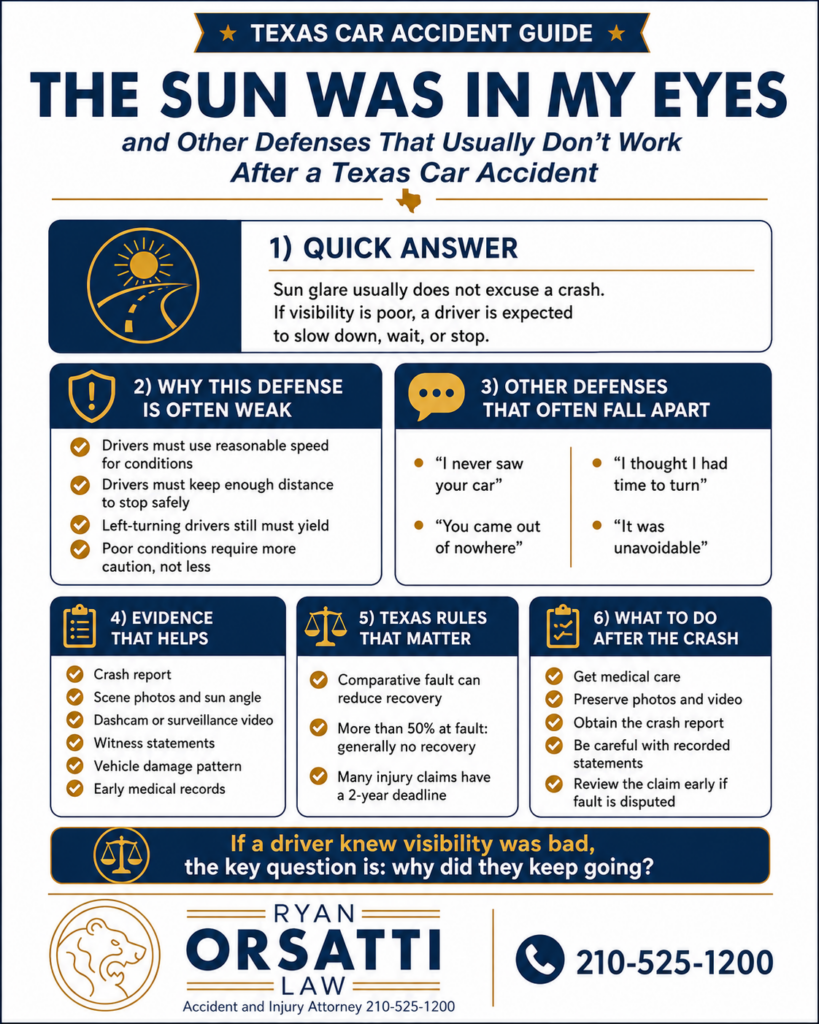
A driver usually cannot avoid responsibility for a Texas crash just by saying the sun was in their eyes. Sun glare does not cancel the basic duty to drive carefully. Texas law still requires drivers to use reasonable speed for conditions, maintain enough distance to stop safely, and yield before making certain turns.
That said, glare cases can turn into comparative-fault disputes. The insurance company may argue that the injured person was also partly at fault—for example, by speeding, changing lanes unsafely, or entering an intersection late. In Texas, a claimant’s recovery can be reduced by their percentage of responsibility, and recovery is barred if the claimant is more than 50% responsible.
For people in San Antonio and Bexar County, these cases often come up during early-morning and late-afternoon commutes, especially when one driver turns across traffic, rear-ends another vehicle, or pulls out when visibility is poor. The practical issue is usually simple: if the driver knew visibility was bad, why did they proceed anyway?
Why “The Sun Was in My Eyes” Usually Does Not Excuse a Crash
Texas negligence cases are often built around ordinary rules of safe driving. A driver does not get a free pass because conditions were difficult. In fact, difficult conditions usually require more caution, not less.
Here is why the defense is often weak:
1. Drivers must use a reasonable and prudent speed
Texas Transportation Code section 545.351 requires drivers to operate at a speed that is reasonable and prudent under existing conditions. If glare makes it hard to see, that usually means the safe speed is lower than the posted speed limit.
2. Drivers must keep enough distance to stop safely
Texas law also requires a following driver to maintain an assured clear distance so they can stop safely without hitting the vehicle in front. Rear-end cases involving glare are often difficult for the at-fault driver to defend for this reason.
3. Left-turning drivers still have to yield
If a driver turns left and says the sun blocked their view, that usually does not erase the duty to yield to oncoming traffic that is already in the intersection or close enough to be an immediate hazard.
Put differently: if you cannot see well enough to drive safely, Texas law generally expects you to wait until you can.
Defenses That Often Sound Better Than They Actually Are
| Defense | Why it is usually weak | What often defeats it |
|---|---|---|
| “The sun was in my eyes.” | Poor visibility is usually a reason to slow down or stop, not proceed blindly. | Crash report, witness statements, dashcam, vehicle damage pattern |
| “I never saw your car.” | Failure to see what should have been seen can still be negligence. | Right-of-way evidence, scene photos, surveillance, skid marks |
| “You came out of nowhere.” | Often just means the driver misjudged speed, distance, or gap. | Intersection timing, damage location, EDR data, witnesses |
| “I thought I had time to turn.” | A mistaken judgment call does not eliminate the duty to yield. | Oncoming lane evidence, impact angle, signal timing, witnesses |
| “I was only blinded for a second.” | A few seconds is long enough to cause a serious crash at city or highway speeds. | Speed estimate, distance traveled, braking evidence |
| “It was unavoidable.” | Many “unavoidable” crashes are actually late-reaction crashes. | Prior line of sight, roadway layout, traffic conditions |
Can an Insurance Company Deny Liability Because of Sun Glare?
Insurance companies often try to turn glare into a reasonably unavoidable accident narrative. But in practice, adjusters usually evaluate glare cases by asking ordinary liability questions:
- Who had the right-of-way?
- Was the driver following too closely?
- Was the driver turning left across traffic?
- Did the driver admit they could not see?
- Did the driver brake, hesitate, or try to avoid the collision?
- What do the crash report, photos, and witnesses show?
When the at-fault driver admits, “I couldn’t see because of the sun,” that statement can actually help the injured person’s claim. It can support the argument that the driver knew visibility was compromised and still chose to continue.
What Evidence Helps Most in a Sun-Glare Crash Case?
In these cases, details matter. The difference between a denied claim and a serious settlement discussion is often the quality of the evidence collected in the first days and weeks.
Helpful evidence checklist
- Texas crash report (CR-3)
Texas peace officers use the CR-3 crash report, and eligible people can obtain a copy through TxDOT. - Scene photographs
Photos showing lane markings, sun angle, traffic controls, obstructions, and vehicle positions can matter. - Dashcam or surveillance footage
This can show whether the driver rolled into a turn, failed to brake, or followed too closely. - Witness statements
Independent witnesses can be especially important when the at-fault driver changes their story later. - Vehicle damage and event data
The point of impact, crush pattern, and sometimes electronic data can help reconstruct what happened. - Medical records from the beginning of treatment
Early documentation often makes it harder for an insurer to argue that the injuries are unrelated or minor.
What If the Insurance Company Says You Were Partly at Fault?
That is common.
In Texas, proportionate-responsibility rules can reduce recovery by the injured person’s percentage of fault. If a jury finds the injured person more than 50% responsible, they generally cannot recover damages.
In a glare case, insurers may try arguments like:
- you were speeding,
- you changed lanes abruptly,
- your brake lights were not working,
- you entered the intersection late,
- you could have avoided the collision.
Some of these arguments are legitimate in the right case. Some are just negotiation tactics. The key is to separate real comparative-fault facts from generic blame-shifting.
How Adjusters Usually Value These Claims
A glare excuse does not value a case by itself. Adjusters typically focus on:
- Clear liability or disputed liability
A rear-end crash is often easier to evaluate than a multi-vehicle intersection crash. - Severity of injury
Emergency care, imaging, specialist treatment, surgery recommendations, and work restrictions usually matter more than rhetoric about glare. - Consistency of treatment
Gaps in treatment often get used against injured people. - Insurance coverage
Texas requires minimum auto liability coverage, but minimum limits can be low for serious-injury cases. The Texas Department of Insurance explains that Texas minimum liability policies generally provide 30/60/25 limits. - Whether the story makes sense
If the defense is “I could not see,” the obvious follow-up is: why did the driver keep moving?
What Representation Often Looks Like in This Type of Case
A good glare-case investigation usually involves more than just sending a demand letter.
Typical steps
1. Immediate investigation
A lawyer may gather the crash report, scene photos, witness names, vehicle photos, and any available video.
2. Liability analysis
The claim is evaluated around right-of-way, lookout, speed, following distance, and whether the driver had time to avoid the crash.
3. Insurance review
This includes the at-fault driver’s liability coverage and any potentially helpful first-party coverage.
4. Medical documentation
Treatment records, diagnoses, restrictions, and future-care issues need to be organized in a way an adjuster or jury can understand.
5. Demand and negotiation
The strongest demands explain both why liability is clear and why the injuries matter.
6. Litigation if necessary
If liability is denied or the value dispute is unreasonable, filing suit may be the next step.
Attorney Insight
In these cases, the sun itself is usually not the real issue.
The real issue is decision-making.
When a driver says they were blinded by glare, that often raises a damaging follow-up question: if you knew you could not see, why did you continue to accelerate, turn, or follow so closely? From a plaintiff-side perspective, that is often where the case turns.
Another practical point: do not assume the police report alone will resolve everything. In contested intersection cases, insurers often look beyond the report to photographs, witness accounts, business-camera footage, and vehicle damage. Early evidence preservation matters.
Common Mistakes That Can Hurt a Sun-Glare Injury Claim
- Waiting too long to get scene photos or video
- Assuming the other driver’s admission will be enough
- Giving a recorded statement without preparation
- Downplaying injuries early and then trying to “catch up” later
- Ignoring comparative-fault arguments until the insurer raises them
- Missing deadlines
Many Texas personal-injury claims are subject to a two-year limitations period, although exceptions and shorter notice requirements can apply in some situations.
What Should You Do After a Crash Involving Sun Glare?
If you believe the other driver caused the wreck and is blaming the sun, a practical next-step list looks like this:
- Get medical care and follow through with treatment.
- Obtain the crash report.
- Save photos, video, and witness information.
- Do not assume the insurer will accept fault just because the excuse sounds weak.
- Review the claim early if liability is being contested or your injuries are significant.
FAQs
Can a driver avoid liability just by saying the sun was in their eyes?
Usually no. Sun glare does not remove the duty to drive safely. Drivers still have to use reasonable speed, maintain safe distance, and yield when required.
What if the crash happened during a left turn?
That often makes the defense harder. A left-turning driver generally must yield to oncoming traffic that is already in the intersection or close enough to be an immediate hazard.
What if I was rear-ended and the other driver blames glare?
That excuse is often weak because Texas law requires drivers to maintain enough distance to stop safely.
Does a real sun-glare condition automatically make the crash unavoidable?
No. Real glare can be part of the facts, but it does not automatically make the crash unavoidable. The central question is whether the driver responded reasonably once visibility became poor.
What if the insurance company says I was partly at fault too?
Texas comparative-fault rules may reduce recovery by your percentage of fault, and recovery is generally barred if you are more than 50% responsible.
How long do I have to file a Texas car-accident lawsuit?
Many Texas personal-injury claims must be filed within two years, but exceptions can apply and some claims involve earlier notice issues.
Talk to Ryan Orsatti Law
If you were injured in a Texas crash and the other driver is trying to excuse it with “the sun was in my eyes,” it is worth getting the facts reviewed carefully. These cases often depend on early evidence, liability framing, and how quickly the defense gets challenged.
Ryan Orsatti Law
4634 De Zavala Rd, San Antonio, TX 78249
Phone: 210-525-1200
This blog is for informational purposes only, not legal advice. Reading it does not create an attorney-client relationship. Past results do not guarantee future results.
Hurt in an accident in San Antonio? Learn how a San Antonio car accident lawyer can help with your claim. Call 210-525-1200 or request a free consultation.
The firm works on a contingency fee. You pay nothing unless the firm recovers money for you, and that covers case expenses as well as the fee: if there is no recovery, you owe no attorney's fee and no case expenses. Ask for the fee agreement and read the fee and expense section before you sign anything.
Related San Antonio legal resources
Primary legal and public-data sources
- TxDOT: Texas crash reports, data, and statistics
- Texas Civil Practice and Remedies Code Chapter 33: proportionate responsibility
Ryan Orsatti Law
4634 De Zavala Road, San Antonio, TX 78249
General reference links. Consult each source for its current text.