
Quick Answer: Yes. You may be able to bring a Texas motorcycle accident claim after a crash caused by road construction or bad pavement on I-35, but the responsible party depends on the evidence: a careless driver, a road contractor, TxDOT, a city, a county, or more than one party. Texas generally gives injured riders two years to file a personal injury lawsuit, but governmental claims can require written notice within six months, so pavement photos, witness names, video, and construction-zone details should be preserved quickly. TxDOT reported more than 28,000 Texas work-zone crashes in 2025 and nearly 9,000 Texas motorcycle crashes that year, including 557 motorcyclist deaths. (Texas Statutes)
Key Takeaways
- I-35 construction zones can be especially dangerous for motorcyclists because milled pavement, vertical asphalt edges, loose gravel, steel plates, dust, mud, and sudden lane shifts affect motorcycles more severely than passenger vehicles.
- A crash may involve multiple responsible parties, including another driver, a construction contractor, a subcontractor, a governmental unit, or an uninsured driver.
- Most Texas personal injury lawsuits must be filed within two years, but claims involving TxDOT, a city, or another governmental unit may require notice within six months or sooner.
- Texas comparative responsibility rules can reduce a rider’s claim by the rider’s percentage of fault and bar recovery if the rider is found more than 50 percent responsible.
- Preserve the motorcycle, helmet, riding gear, photos, video, crash report, medical records, and the exact location of the road condition before the work zone changes.
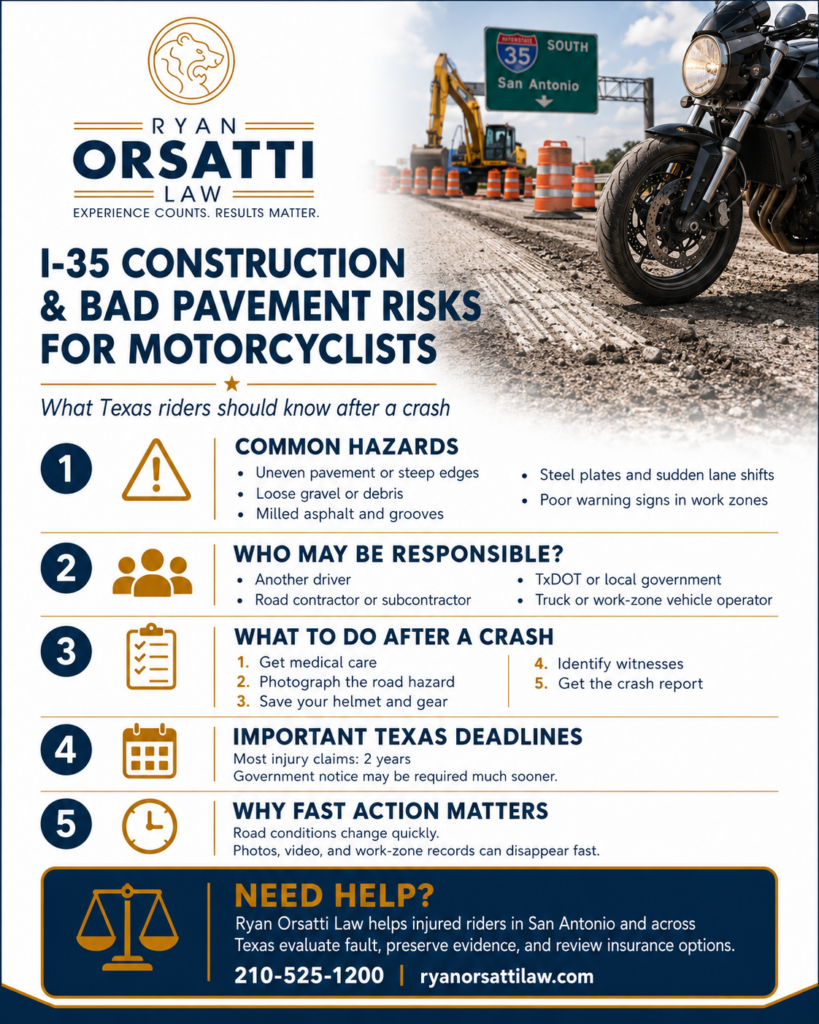
Why are I-35 construction zones and bad pavement dangerous for motorcyclists?
I-35 construction zones and bad pavement are dangerous for motorcyclists because small surface defects can cause a rider to lose control. TxDOT’s own roadway guidance recognizes that rutting, potholes, cracks, tar snakes, milled pavement, vertical asphalt edges, debris, dust, mud, loose rocks, and disturbed surfaces can present special risks to motorcycle riders. (Texas Department of Transportation)
This matters in San Antonio because I-35 is not just another highway. The I-35 Northeast Expansion, known as I-35 NEX, includes major non-tolled improvements through northeast San Antonio, Live Oak, Selma, Schertz, Bexar County, and Guadalupe County, with current and planned construction phases extending for years. (Texas Department of Transportation)
For a motorcycle, the danger is not limited to a direct hit from another vehicle. A rider can be seriously hurt when a tire catches a pavement lip, slides on loose gravel, crosses grooved pavement, hits a steel plate, or enters a poorly marked traffic shift at highway speed.
Common I-35 construction-zone hazards for riders include:
- Uneven pavement between old and newly paved lanes
- Vertical or steep asphalt edges
- Milled pavement that grabs or redirects tires
- Loose gravel, sand, mud, or construction debris
- Steel plates, bridge joints, and temporary road coverings
- Confusing lane shifts, barrels, cones, and merge points
- Missing, blocked, or late warning signs
- Poor lighting in night work zones
- Trucks entering and exiting the work area
TxDOT has also warned that vertical joints greater than one inch can be especially difficult for motorcyclists and bicyclists to cross. For an injured rider, that kind of detail can matter because it helps show whether the crash was caused by a normal driving risk or by an unsafe temporary roadway condition. (Texas Department of Transportation)
Who may be responsible for an I-35 motorcycle crash caused by construction or pavement?
More than one party may be responsible for an I-35 motorcycle crash caused by construction or pavement. The claim may involve a negligent driver, a road contractor, a subcontractor, TxDOT, a city, a county, or an insurance coverage issue such as uninsured motorist coverage.
The key question is what caused the rider to crash. If a driver made an unsafe lane change in a construction zone, the driver may be responsible. If a contractor left loose debris, an abrupt pavement edge, or inadequate warnings, the contractor’s work records may become important. If a governmental unit controlled the roadway condition, Texas notice rules and governmental-immunity issues must be evaluated quickly.
| Possible responsible party | What may matter | Evidence to request or preserve |
|---|---|---|
| Other driver | Unsafe lane change, failure to slow down, following too closely, distracted driving, failure to yield | Crash report, witness statements, dashcam video, vehicle photos, phone records, scene photos |
| Road contractor or design-builder | Unsafe temporary traffic control, unprotected pavement edge, loose gravel, mud, missing warning signs, poor lane transition | Traffic control plan, lane-closure logs, daily work reports, inspection records, cleanup records, photos |
| Subcontractor or material hauler | Dropped materials, mud tracked onto pavement, debris from trucks, unsafe work-zone entry or exit | Haul tickets, truck logs, dispatch records, driver information, camera footage |
| TxDOT, city, or county | Roadway condition, special defect, warning signs, prior complaints, construction oversight | Written notice, maintenance records, inspection records, contracts, prior reports, public records |
| Unknown, hit-and-run, or underinsured driver | Lack of available liability insurance or insufficient bodily injury limits | UM/UIM policy, PIP or MedPay coverage, police report, insurance declarations |
Key takeaway: Liability in an I-35 construction-zone motorcycle crash usually turns on small details that disappear quickly, including edge height, warning signs, debris cleanup, lane-closure timing, lighting, and driver conduct.
What Texas deadlines apply after a motorcycle crash on I-35?
Most Texas motorcycle accident lawsuits must be filed within two years of the crash. That deadline comes from Texas Civil Practice and Remedies Code § 16.003, which applies to many personal injury and property-damage claims. (Texas Statutes)
A statute of limitations means the lawsuit-filing deadline. Missing it can prevent an injured person from bringing the claim, even if the crash was serious and liability appears strong.
Governmental claims may have earlier notice requirements. Under Texas Civil Practice and Remedies Code § 101.101, a governmental unit is generally entitled to notice of a claim not later than six months after the incident, and the notice must describe the injury, time and place, and incident. The statute also recognizes that city charter provisions may require notice sooner. (Texas Legislative Services)
That means a motorcycle crash involving TxDOT, a city street crew, a county road condition, or a government-controlled work zone should be reviewed early. The two-year deadline may not be the only deadline that matters.
Can TxDOT or a government agency be liable for a dangerous road condition?
TxDOT or another governmental unit may be liable only in limited, fact-specific situations. Texas law treats claims against governmental entities differently from ordinary claims against private drivers or contractors, and the Texas Tort Claims Act must be evaluated before assuming a road-condition claim can proceed.
Texas Civil Practice and Remedies Code § 101.021 addresses certain claims involving motor-driven vehicles, equipment, and the condition or use of tangible personal or real property. Texas Civil Practice and Remedies Code § 101.022 separately addresses premises defects and special defects, including certain excavations or obstructions on roads, streets, and highways. (FindLaw)
For a rider, the practical issue is not just “the road was bad.” The evidence must connect the dangerous condition to the crash and show why the governmental unit or contractor may be legally responsible. That may require photos, measurements, public records, prior complaints, inspection logs, construction contracts, and traffic-control documents.
What evidence should you save after an I-35 pavement or construction-zone motorcycle crash?
You should save evidence that shows the pavement condition, work-zone layout, warning signs, driver conduct, motorcycle damage, riding gear, and your injuries. Construction zones change fast, so the best evidence may be gone within hours or days.
Use this checklist after a crash if you can do so safely:
- Get medical care immediately. Tell the provider you were in a motorcycle crash and describe every symptom, including head, neck, back, shoulder, knee, wrist, numbness, dizziness, and road-rash symptoms.
- Photograph the hazard from a safe location. Capture the pavement edge, gravel, grooves, steel plate, pothole, debris, lane shift, cones, barrels, warning signs, lighting, and traffic pattern.
- Record the exact location. Note the highway, direction of travel, nearest exit, mile marker, cross street, GPS location, lane, and whether you were near Loop 410, Loop 1604, Live Oak, Selma, Schertz, or another I-35 corridor location.
- Preserve the motorcycle and gear. Do not repair or discard the motorcycle, helmet, jacket, gloves, boots, pants, or damaged parts until they have been documented.
- Identify witnesses. Get names, phone numbers, license plates, and any information from nearby drivers, construction workers, police officers, tow operators, or roadside assistance personnel.
- Save video and digital evidence. Preserve helmet-camera video, dashcam video, phone photos, GPS data, call logs, text messages, and insurance communications.
- Get the Texas crash report. TxDOT is the custodian of Texas crash records, and Texas Transportation Code § 550.062 requires an officer to submit a written crash report to TxDOT by the 10th day after investigating a crash involving injury, death, or at least $1,000 in property damage. (Texas Department of Transportation)
- Avoid signing releases too early. Do not give away injury, property-damage, UM/UIM, or medical-bill rights before you understand fault, coverage, treatment needs, and lien issues.
Should I report the pavement defect or construction hazard?
Yes, you should report a dangerous pavement defect or construction hazard if you can do it safely, but reporting the hazard is not the same as preserving a legal claim. A report may help prevent another crash, while photos, video, witness names, medical records, and construction documents help prove what happened in your case.
If the crash happened in an active I-35 work zone, document the scene before cones, signs, equipment, and pavement conditions change. Construction contractors and public agencies may have records that identify who controlled the lane closure, who inspected the work zone, and what warnings were required.
How will insurance companies try to blame the motorcyclist?
Insurance companies often try to blame the motorcyclist by arguing speed, lane position, delayed braking, unsafe passing, lack of visibility, lane splitting, or failure to adjust to construction conditions. Those arguments can matter because Texas uses proportionate responsibility rules.
Comparative responsibility means Texas can reduce a person’s recovery based on that person’s percentage of fault. Under Texas Civil Practice and Remedies Code § 33.001, a claimant may not recover damages if the claimant’s percentage of responsibility is greater than 50 percent, and § 33.012 provides for reduction by the claimant’s percentage of responsibility when the claim is not barred. (Texas Statutes)
Texas motorcycle lane law can also come up in construction-zone crash disputes. Texas Transportation Code § 545.0605 says a motorcycle is entitled to full use of a lane, but it generally prohibits operating a motorcycle between lanes of traffic moving in the same direction or passing a motor vehicle while in the same lane. (Texas Legislature Online)
Speed and road conditions matter too. Texas Transportation Code § 545.351 requires drivers to operate at a speed that is reasonable and prudent under the circumstances, and Texas Transportation Code § 545.062 requires a following driver to maintain an assured clear distance considering speed, traffic, and highway conditions. (FindLaw)
Attorney Insight: In construction-zone motorcycle claims, the defense often tries to turn “the road was rough” into “the rider should have avoided it.” The practical difference is evidence. Photos showing no advance warning, a sharp vertical edge, loose gravel through the lane, poor lighting, or a sudden traffic switch can change the fault discussion before the adjuster’s version hardens.
What medical bills and insurance coverages matter after this kind of crash?
The main coverages to review after an I-35 motorcycle crash are liability insurance, personal injury protection, medical payments coverage, uninsured motorist coverage, underinsured motorist coverage, and health insurance. Serious motorcycle injuries often involve emergency care, orthopedic treatment, imaging, surgery, therapy, missed work, and lien issues.
Personal injury protection, or PIP, is auto coverage that can help pay medical bills and certain lost income regardless of fault. The Texas Department of Insurance states that Texas auto policies include PIP unless it is rejected in writing, and insurers must also offer uninsured and underinsured motorist coverage unless it is rejected in writing. (Texas Department of Insurance)
Subrogation means a health insurer may claim a right to be repaid from a settlement for medical bills it paid. A hospital lien is a legal claim a hospital may assert against part of a personal injury recovery. Under Texas Property Code § 55.002, a hospital lien may attach to certain claims when the injured person is admitted to a hospital not later than 72 hours after the accident. (Texas Statutes)
Medical billing issues should be reviewed before a demand is sent. A motorcycle crash claim can be harmed when treatment gaps are not explained, bills are not organized, liens are ignored, or the injured person settles before understanding future care needs.
When should a rider contact a Texas motorcycle accident lawyer?
A rider should contact a Texas motorcycle accident lawyer early when the crash involves serious injuries, road construction, bad pavement, a disputed police report, a commercial vehicle, a governmental unit, or an insurance adjuster blaming the rider. These cases are evidence-sensitive because the road condition may be repaired, lane closures may change, and video may be deleted.
Ryan Orsatti Law helps injured riders in San Antonio and across Texas evaluate fault, insurance coverage, medical-bill issues, and evidence preservation after serious motorcycle crashes. The firm’s San Antonio motorcycle accident lawyerresource covers rider-specific claim issues, and this guide on whether to contact a lawyer after a motorcycle accidentexplains common decision points after a crash.
If another driver caused or contributed to the crash, the claim may also involve ordinary auto negligence issues. Riders, passengers, and family members can review the firm’s San Antonio car accident lawyer resource for broader Texas crash-claim information.
How can Ryan Orsatti Law evaluate an I-35 construction-zone motorcycle crash?
Ryan Orsatti Law can evaluate an I-35 construction-zone motorcycle crash by reviewing the crash report, scene photos, road condition, medical records, insurance coverage, work-zone evidence, and applicable Texas deadlines. The goal is to identify who may be responsible and what evidence must be preserved before it disappears.
In a pavement or construction-zone motorcycle case, the review may include:
- Whether another driver made an unsafe lane change, followed too closely, or failed to slow down
- Whether the road had loose gravel, milled pavement, a steep edge, a steel plate, or missing warnings
- Whether TxDOT, a city, a county, a contractor, or a subcontractor controlled the work zone
- Whether governmental notice deadlines may apply
- Whether PIP, MedPay, UM/UIM, or health insurance can help with bills
- Whether liens, subrogation claims, or future treatment need to be addressed
- Whether the motorcycle, helmet, and gear should be preserved for inspection
Ryan Orsatti Law is based in San Antonio and represents injured people in motorcycle and motor vehicle crash claims across Texas. You can learn more about Ryan Orsatti Law or contact Ryan Orsatti Law to discuss the next steps after an I-35 motorcycle crash.
FAQ
Can I sue TxDOT after a motorcycle crash caused by bad pavement on I-35?
You may be able to bring a claim involving TxDOT, but claims against governmental units are limited and deadline-sensitive. Texas law may require written notice within six months, and some city charter rules may require earlier notice. A lawyer should review the pavement condition, warnings, prior complaints, construction contracts, and whether a contractor also shares responsibility.
Is a road contractor liable if milled pavement caused my motorcycle to lose control?
A road contractor may be liable if unsafe work-zone conditions caused or contributed to the crash. Important facts include whether the milled pavement was properly marked, whether there was a dangerous pavement edge, whether signs warned motorcyclists, whether loose material was left in the lane, and whether the contractor followed the traffic-control plan.
How long do I have to file a motorcycle accident lawsuit in Texas?
Most Texas motorcycle accident injury lawsuits must be filed within two years of the crash under Texas Civil Practice and Remedies Code § 16.003. Do not wait two years to investigate. If TxDOT, a city, a county, or another governmental unit may be involved, notice may be required within six months or sooner.
What if an insurance adjuster says I was speeding because I was on a motorcycle?
An adjuster’s assumption is not proof. Speed, lane position, braking, visibility, pavement condition, and warnings should be evaluated using the crash report, witness statements, photos, video, motorcycle damage, debris patterns, and road geometry. Texas comparative responsibility rules can reduce or bar recovery, so unsupported blame should be challenged with evidence.
Does Texas motorcycle lane-splitting law affect an I-35 construction crash claim?
Yes, it can affect the fault analysis if lane splitting or same-lane passing is alleged. Texas law gives a motorcycle the right to full use of a lane, but it generally prohibits riding between lanes of moving traffic or passing a vehicle while in the same lane. That issue does not automatically decide the whole claim.
What should I do if I hit gravel, a pavement edge, or a steel plate on I-35?
Get medical care, call police if anyone is injured, photograph the hazard from a safe location, save the motorcycle and riding gear, identify witnesses, preserve video, and document the exact location. Avoid giving a recorded statement or signing a release before you understand fault, available insurance, medical bills, and possible governmental notice issues.
Can PIP or UM/UIM help after a construction-zone motorcycle crash?
PIP may help pay medical bills or certain lost income regardless of fault if the coverage applies and was not rejected. UM/UIM may help if the at-fault driver had no insurance, too little insurance, or fled the scene. Coverage depends on the policy, exclusions, rejection forms, and facts of the crash.
Ryan Orsatti Law
4634 De Zavala Rd, San Antonio, TX 78249
Phone: 210-525-1200
ryanorsattilaw.com
This blog is for informational purposes only, not legal advice. Reading it does not create an attorney-client relationship. Past results do not guarantee future results.
Hurt in an accident in San Antonio? Learn how a San Antonio personal injury lawyer can help with your claim. Call 210-525-1200 or request a free consultation.
The firm works on a contingency fee. You pay nothing unless the firm recovers money for you, and that covers case expenses as well as the fee: if there is no recovery, you owe no attorney's fee and no case expenses. Ask for the fee agreement and read the fee and expense section before you sign anything.
Related San Antonio legal resources
- San Antonio motorcycle-accident representation
- Texas personal-injury services
- Contact Ryan Orsatti Law
Primary legal and public-data sources
- Texas Transportation Code Chapter 661: motorcycle protective headgear
- Texas Civil Practice and Remedies Code Chapter 33: proportionate responsibility
Ryan Orsatti Law
4634 De Zavala Road, San Antonio, TX 78249
General reference links. Consult each source for its current text.