
Quick Answer
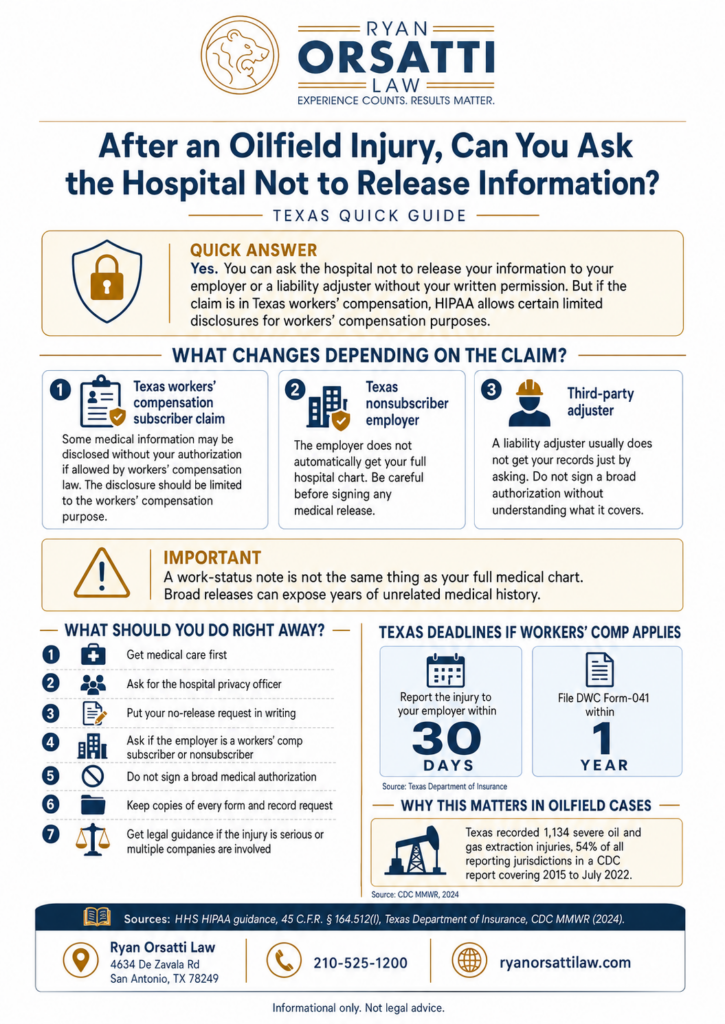
Yes. After an oilfield injury, you can ask the hospital not to release your medical information to your employer, company safety department, or insurance adjuster without your written permission. Put that request in writing and ask for the hospital’s privacy officer or medical records department.
But there is an important exception: if your injury is being handled through Texas workers’ compensation, federal HIPAA rules allow certain medical information to be disclosed for workers’ compensation purposes without your authorization. That does not mean the employer or adjuster gets unlimited access to your entire medical history.
Key Takeaways
- You can ask the hospital to restrict disclosures and to communicate with you privately, but the hospital may not have to grant every restriction.
- In a Texas workers’ compensation claim, HIPAA allows certain disclosures to workers’ compensation insurers, administrators, employers, and others involved in the claim. (HHS.gov)
- If the employer is a Texas nonsubscriber or a third-party liability adjuster is requesting records, do not sign a broad medical authorization without understanding its scope.
- A written HIPAA authorization can usually be revoked in writing, but revocation does not undo records already released. (eCFR)
- Medical privacy, hospital liens, subrogation, and work restrictions are separate issues. Treat each one carefully.
How much control do I have over hospital records after an oilfield injury?
You have the right to ask for privacy protections, but your control depends on who is asking, why they are asking, and whether Texas workers’ compensation law applies.
HIPAA, the Health Insurance Portability and Accountability Act, is the federal privacy law that limits how covered health care providers use and disclose protected health information. Protected health information, often called PHI, means medical information that identifies you, such as diagnoses, imaging, treatment notes, work restrictions, billing records, and discharge instructions.
After an oilfield injury in South Texas, the request for records may come from several places:
- Your employer or supervisor
- A company safety representative
- A workers’ compensation carrier
- A nonsubscriber benefit plan administrator
- A liability adjuster for another contractor, trucking company, equipment company, or lease operator
- Your own health insurance plan
- Your lawyer
Those are not all treated the same.
A hospital may use your information for treatment, billing, and health care operations. It may also disclose some information when another law allows or requires it. That is why the answer is not simply “HIPAA blocks everyone.” It is more accurate to say: HIPAA gives you privacy rights, but it also contains exceptions.
Quotable answer: After an oilfield injury in Texas, a worker can ask the hospital in writing not to release medical information to the employer or adjuster. The request matters most when the requester is a liability adjuster, nonsubscriber plan, or employer representative rather than a Texas workers’ compensation carrier acting within the compensation system.
For more background on oilfield injury claims, see Ryan Orsatti Law’s oil field accident resources for Texas workers.
What can the hospital disclose in a Texas workers’ compensation claim?
In a Texas workers’ compensation claim, HIPAA allows the hospital to disclose medical information that is authorized by workers’ compensation law and necessary for the claim.
The U.S. Department of Health and Human Services explains that HIPAA permits disclosures to workers’ compensation insurers, state administrators, employers, and other participants in workers’ compensation systems without the injured worker’s authorization when the disclosure is authorized by law, required by law, or needed for payment. (HHS.gov)
The specific HIPAA regulation is 45 C.F.R. § 164.512(l). It says a covered entity may disclose protected health information as authorized by and to the extent necessary to comply with workers’ compensation laws or similar programs that provide benefits for work-related injuries without regard to fault. (eCFR)
Texas has its own workers’ compensation structure. The Texas Department of Insurance states that private Texas employers can choose whether to carry workers’ compensation insurance in most cases, while governmental entities must have coverage. (Texas Department of Insurance)
That coverage question is critical. If your employer is a subscriber, meaning it carries workers’ compensation insurance, the medical-record flow may be very different than a personal injury claim against a third party.
Quotable answer: Under 45 C.F.R. § 164.512(l), HIPAA permits a hospital to disclose protected health information for workers’ compensation purposes when the disclosure is authorized by and necessary to comply with workers’ compensation law. That exception does not give an oilfield employer automatic access to every unrelated medical record in the worker’s past.
Texas workers’ compensation deadlines also matter. The Texas Department of Insurance says an injured employee must report the injury to the employer within 30 days and send DWC Form-041 to the Division of Workers’ Compensation within one year to protect workers’ compensation rights. (Texas Department of Insurance)
What if my employer is a Texas nonsubscriber or a third-party adjuster is calling?
If the employer is a Texas nonsubscriber or a third-party adjuster is calling, the hospital usually should not release your complete medical chart just because that person asks.
A nonsubscriber is a Texas employer that does not carry workers’ compensation insurance. The Texas Department of Insurance states that employers without workers’ compensation coverage must notify employees and DWC, and must report certain work-related injuries, illnesses, and deaths. (Texas Department of Insurance)
That does not mean a nonsubscriber employer automatically gets full hospital records. In nonsubscriber and third-party claims, adjusters often ask injured workers to sign medical authorizations. An authorization is written permission allowing a provider to disclose specified records to a specified person or company.
A third-party claim is a claim against someone other than your employer. In oilfield cases, that may include:
- A rig contractor
- A trucking company
- A frac company
- A welding contractor
- A crane company
- A chemical supplier
- A landowner or premises operator
- A defective equipment manufacturer
Texas Labor Code § 406.033 affects claims against nonsubscriber employers by limiting certain common-law defenses. For example, the statute addresses defenses such as contributory negligence, assumption of the risk, and negligence of a fellow employee in nonsubscriber cases. (Texas Statutes)
In practical terms, the medical-record request often becomes a strategy issue. The adjuster may want old records to argue your injury was preexisting, unrelated to the job, or less serious than the hospital notes suggest.
For related workplace-injury information, see Ryan Orsatti Law’s page on third-party liability in workplace injury claims.
Should I sign the employer’s or adjuster’s medical authorization?
You should not sign a broad medical authorization until you understand exactly what it allows, who receives the records, what dates it covers, and whether it can be revoked.
A broad release can create problems. Some forms authorize “any and all” medical records, mental health records, prescription history, prior claims, imaging, billing, employment health files, and records from years before the oilfield injury. That may be much broader than what is needed to evaluate the actual injury.
A more careful authorization should identify:
- The provider releasing records
- The person or entity receiving records
- The injury or body parts involved
- The date range
- Whether billing records are included
- Whether prior medical history is included
- When the authorization expires
- How to revoke it in writing
HIPAA allows a person to revoke a valid authorization in writing, except to the extent the covered entity has already acted in reliance on it. (eCFR)
Quotable answer: An oilfield worker should read every medical authorization before signing it. A narrow release may cover emergency-room records from the date of the injury, while a broad release may allow an adjuster to collect years of unrelated medical history and use old complaints to dispute causation, damages, or work restrictions.
| Situation | Can records be released without your signed authorization? | Practical move |
|---|---|---|
| Texas workers’ compensation subscriber claim | Sometimes, for workers’ compensation purposes allowed by law | Ask what records are being sent and whether the request is limited to the work injury |
| Texas nonsubscriber claim | Usually not just because the employer asks | Do not sign a broad release without review |
| Third-party liability adjuster | Usually not without authorization, subpoena, court order, or another legal basis | Limit any authorization by provider, date range, and injury |
| Your own health insurance payment | Some payment-related information may be shared for billing | Track what insurance paid because subrogation may arise later |
| Litigation subpoena or court order | Possibly, depending on the legal process | Request notice and legal review before production |
What should I put in writing to the hospital before records go out?
You should send a short written privacy request to the hospital’s medical records department and privacy officer as soon as you are stable.
Keep the request clear. Do not argue the whole case in the request. The goal is to create a record that you object to unnecessary disclosure and want any release limited to the minimum information legally required.
A practical request can say:
- I request that my protected health information not be released to my employer, its representatives, a liability adjuster, or any third-party insurance company unless I provide written authorization or the disclosure is legally required.
- If any request is made for my records, please notify me in writing before production when allowed by law.
- If the request relates to workers’ compensation, please limit any disclosure to the minimum necessary information related to the work injury.
- Please communicate with me at the phone number, email, and mailing address I provided, not through my employer.
- Please place this request in my chart and medical-records file.
HIPAA also recognizes confidential communications requests in some situations. That means you can ask the provider to communicate with you at a different address, phone number, or email if disclosure through ordinary channels could create a problem.
How do hospital bills, liens, and subrogation fit into medical privacy?
Hospital billing issues can expose information about your injury even when the full medical chart is not released.
A hospital lien is a legal claim by a hospital against certain injury recoveries. Texas Property Code Chapter 55 gives hospitals lien rights in some accident-related injury claims. Section 55.002 states that a hospital has a lien on certain claims of an individual who receives hospital services for injuries caused by an accident attributed to another person’s negligence, subject to statutory requirements. (Texas Statutes)
Subrogation means a health insurer or benefit plan seeks reimbursement from a later settlement or recovery. ERISA, the Employee Retirement Income Security Act, may apply to some employer health plans and can affect reimbursement rights. Medicare, Medicaid, private health insurance, and employer benefit plans can each raise different reimbursement issues.
A letter of protection is an agreement where a medical provider treats now and waits for payment from a future injury recovery. A letter of protection can help with treatment access, but it does not solve privacy problems by itself.
If the oilfield injury involved a crash, auto coverages may also matter. Medical payments coverage, often called MedPay, may pay medical bills regardless of fault. Uninsured or underinsured motorist coverage, often called UM/UIM, may apply if a careless driver caused a work-related crash and lacked enough insurance. Those coverages create separate record requests and reimbursement issues.
For more detail on medical billing and reimbursement issues, see Ryan Orsatti Law’s guide to liens on personal injury settlements in Texas and the firm’s article on subrogation after a Texas injury claim.
Why does this issue matter so much in oilfield injury cases?
Medical-record control matters because oilfield claims often turn on causation, work restrictions, prior injuries, and who had operational control at the site.
Oilfield injuries are often serious. A CDC and NIOSH report found that from January 2015 through July 2022, OSHA received 2,101 severe injury reports from the oil and gas extraction industry, and Texas accounted for 1,134 of those reports, or 54 percent. (CDC)
The U.S. Bureau of Labor Statistics also reported 65 fatal occupational injuries in oil and gas extraction industries in 2024, including oil and gas extraction, drilling oil and gas wells, and support activities for oil and gas operations. (Bureau of Labor Statistics)
Those numbers matter because serious claims attract early investigation. In the Eagle Ford Shale, Permian Basin, and other Texas oilfield regions, the employer, operator, subcontractors, and insurers may start collecting statements and records quickly.
Attorney Insight: In oilfield injury files, the first medical records often become the foundation of the claim. The ER history, discharge diagnosis, imaging results, work-status note, and medication list can help or hurt causation. I would rather control the record request early than try to fix an overbroad release after an adjuster already has years of unrelated records.
After an oilfield injury, what should I do before anyone gets my hospital records?
After an oilfield injury, take these steps before signing any record release or letting an adjuster collect your hospital chart.
- Get emergency care first. Your health comes before the claim. Tell the providers exactly how the injury happened, including the equipment, location, and work activity involved.
- Ask for the hospital privacy officer. Request that no records be released to your employer, company representative, or liability adjuster unless you authorize it or the law requires it.
- Find out whether your employer has Texas workers’ compensation coverage. The Texas Department of Insurance provides coverage verification information and states that private Texas employers may choose whether to carry workers’ compensation in most cases. (Texas Department of Insurance)
- Report the injury on time. If workers’ compensation applies, TDI says you generally must report the injury to your employer within 30 days and file DWC Form-041 within one year. (Texas Department of Insurance)
- Do not sign a blank or unlimited medical authorization. Limit any release by date range, provider, body part, and purpose.
- Request a copy of anything you sign. Keep the signed authorization, privacy request, incident report, discharge papers, work-status note, and any text messages with supervisors.
- Preserve evidence. Save photos, PPE, boots, gloves, harnesses, hard hat, job safety analysis paperwork, call sheets, witness names, and equipment information.
- Track every record request. Write down who asked, when they asked, what they requested, and whether you gave permission.
For additional steps after an oilfield accident, see Ryan Orsatti Law’s guide on what to do immediately after an oilfield accident in Texas.
When should an oilfield worker talk to a lawyer about medical-record requests?
You should talk to a lawyer before signing a broad medical authorization, especially if the injury is serious, the employer is a nonsubscriber, multiple companies were on site, or an adjuster is pushing for fast access.
A lawyer can help identify which system applies:
- Texas workers’ compensation
- Texas nonsubscriber employer liability
- Third-party negligence
- Product liability
- Premises liability
- Vehicle crash coverage
- Health insurance reimbursement
- Hospital lien issues
In matters we have handled, record requests often arrive before the worker understands the legal structure of the claim. That timing can put the injured worker at a disadvantage. A company may know whether it is a subscriber, nonsubscriber, contractor, or third-party defendant long before the injured worker does.
Texas injury deadlines are also separate from privacy rights. For many personal injury lawsuits, Texas Civil Practice and Remedies Code § 16.003 sets a two-year limitations period. Workers’ compensation deadlines can be shorter for reporting and claim filing. Governmental claims may involve special notice rules. The right deadline depends on the facts.
Ryan Orsatti Law helps injured Texans evaluate oilfield injury claims, including claims involving hospital records, medical authorizations, workers’ compensation coverage, nonsubscriber employers, and third-party responsibility. You can also visit the firm’s contact page to reach the office.
FAQ
Can I tell the ER not to talk to my oilfield employer?
Yes. You can tell the ER, hospital, or trauma center that you do not want your medical information released to your employer unless the law requires it or you give written authorization. Put the request in writing and ask that it be added to your chart. If workers’ compensation applies, some limited disclosures may still be allowed.
Does HIPAA stop a workers’ comp adjuster from getting my hospital records?
Not always. HIPAA has a workers’ compensation exception. HHS explains that covered providers may disclose protected health information to workers’ compensation insurers, administrators, employers, and others involved in the system without authorization when allowed by workers’ compensation law. The disclosure should still be tied to the compensation purpose, not unlimited medical history.
Can I refuse to sign the adjuster’s medical release?
You can refuse to sign a voluntary medical authorization, but the practical effect depends on the claim type. In a workers’ compensation claim, certain records may still be obtainable under the compensation system. In a third-party or nonsubscriber claim, the adjuster usually needs a valid authorization, subpoena, court order, or another legal basis.
What if I already signed a broad medical authorization?
If you already signed a broad authorization, request a copy immediately and ask how to revoke it in writing. HIPAA generally allows written revocation, but it does not undo disclosures already made in reliance on the authorization. A lawyer can review whether the release was too broad and help narrow future record production.
Can my employer get my diagnosis and work restrictions?
Your employer may need work-status information, such as whether you can return to work, lift, drive, climb, or operate equipment. That is different from access to your full chart. A work-status note can often communicate restrictions without giving the employer unrelated diagnoses, prior medical history, prescription history, or private treatment details.
What if the hospital says it must send everything to workers’ comp?
Ask the hospital to identify the legal basis for the disclosure and to limit the production to what is authorized and necessary for the workers’ compensation purpose. HHS guidance recognizes that workers’ compensation disclosures are allowed, but also discusses the “minimum necessary” concept for many such disclosures. Do not assume “workers’ comp” means every past medical record is fair game.
Does a hospital lien mean the hospital can tell the adjuster everything?
No. A hospital lien and a medical-record release are different things. A lien is a claim for payment under Texas Property Code Chapter 55 in certain accident-related cases. It does not automatically mean the hospital can send the adjuster your entire medical chart. The records issue still depends on HIPAA, authorization, workers’ compensation rules, and legal process.
What records should I keep after an oilfield injury?
Keep your discharge papers, imaging reports, work-status notes, prescriptions, billing statements, privacy requests, medical authorizations, incident reports, photos, witness information, and text messages with supervisors. In oilfield cases, small details matter because multiple companies may dispute who controlled the equipment, safety meeting, worksite, or task that caused the injury.
Ryan Orsatti Law
4634 De Zavala Rd, San Antonio, TX 78249
Phone: 210-525-1200
ryanorsattilaw.com
This blog is for informational purposes only, not legal advice. Reading it does not create an attorney-client relationship. Past results do not guarantee future results.
Hurt in an accident in San Antonio? Learn how a San Antonio personal injury lawyer can help with your claim. Call 210-525-1200 or request a free consultation.
The firm works on a contingency fee. You pay nothing unless the firm recovers money for you, and that covers case expenses as well as the fee: if there is no recovery, you owe no attorney's fee and no case expenses. Ask for the fee agreement and read the fee and expense section before you sign anything.
Related San Antonio legal resources
- San Antonio construction-accident representation
- Texas personal-injury services
- Contact Ryan Orsatti Law
Primary legal and public-data sources
- Texas Civil Practice and Remedies Code Chapter 16: limitations
- Texas Civil Practice and Remedies Code Chapter 33: proportionate responsibility
Ryan Orsatti Law
4634 De Zavala Road, San Antonio, TX 78249
General reference links. Consult each source for its current text.