
Quick Answer
After an oilfield accident, document the scene, the equipment, the people present, the job being performed, your injuries, your medical care, and every company communication before the story gets filtered through supervisors, safety personnel, contractors, and insurance representatives. Your goal is not to argue fault on the spot. Your goal is to preserve facts before the scene changes.
In Texas oilfield cases, early documentation can affect workers’ compensation, non-subscriber claims, third-party claims, OSHA issues, and later litigation. If you are hurt near San Antonio, Bexar County, the Eagle Ford Shale, or another Texas oilfield site, start with medical care, then preserve evidence as soon as it is safe.
Key Takeaways
- Do not guess in an incident report. Write only what you know, what you saw, and what you felt.
- Photograph the scene before equipment is moved, repaired, cleaned, or taken out of service.
- Identify every company on site, including operators, drilling contractors, service companies, trucking companies, and safety vendors.
- Save job safety analyses, permits, text messages, PPE, medical papers, and witness names.
- OSHA reporting is not the same thing as preserving evidence for a Texas injury claim.
- Texas deadlines matter, but evidence can disappear long before a statute of limitations expires.
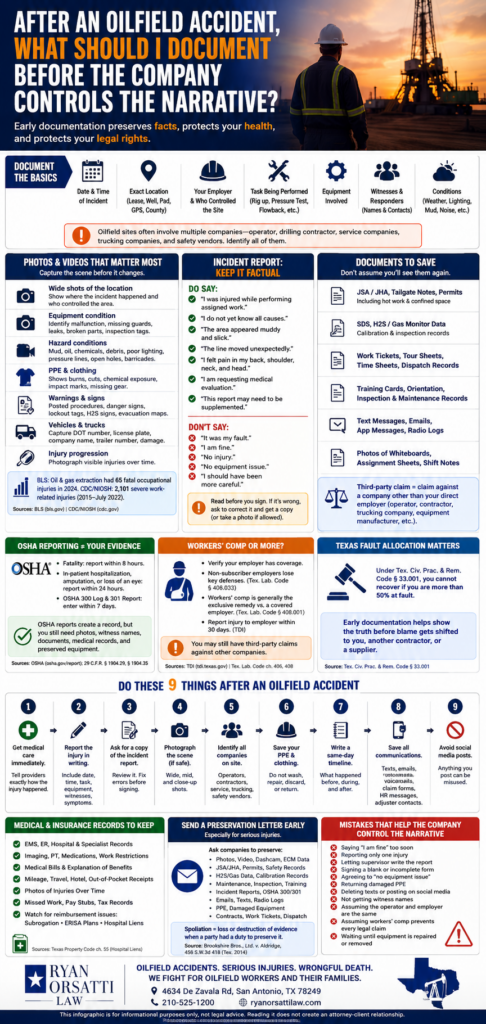
What should I document first after an oilfield accident?
You should first document facts that can disappear: the exact location, the job being performed, the equipment involved, the companies on site, visible hazards, witnesses, and your injuries. Do this only after you are safe and have requested medical help.
In a Texas oilfield accident, the strongest early documentation is not a conclusion about fault. It is a precise record of the lease or pad, the contractors present, the equipment involved, the job being performed, and the condition of the scene before it is moved, repaired, cleaned, or rewritten in a company incident report.
Start with the basics:
- Date and time of the incident
- County, lease name, well name, pad name, rig number, or GPS location
- Your employer and the company that controlled the site
- The task being performed, such as rig up, pressure testing, flowback, hot work, trucking, well servicing, workover, or equipment maintenance
- The specific equipment involved
- Weather, lighting, mud, floor conditions, barricades, noise, and visibility
- Names and phone numbers of workers who saw what happened
- Names of supervisors, company men, safety personnel, medics, and contractors who responded
This matters because oilfield work often involves several companies at the same location. The operator, drilling contractor, pressure pumping company, wireline company, trucking company, crane company, and safety contractor may all have different documents and different incentives.
For broader Texas oilfield injury guidance, Ryan Orsatti Law has a related resource on what to do immediately after an oilfield accident in Texas.
What photos and videos matter most before the scene changes?
The most useful photos and videos show the condition of the scene before cleanup, repair, removal, or re-staging. Take wide shots, mid-range shots, and close-ups so the viewer can understand both the setting and the specific hazard.
Do not interfere with emergency response. Do not trespass into restricted areas. Do not put yourself or others at risk. But if you can safely document the scene, capture:
| Evidence to capture | Why it matters | Practical tip |
|---|---|---|
| Wide photos of the location | Shows where the incident happened and who controlled the area | Include landmarks, rig name, well pad, vehicles, tanks, stairs, catwalk, or roadway |
| Equipment condition | Helps identify malfunction, missing guards, broken parts, leaking lines, or unsafe setup | Photograph make, model, serial number, unit number, inspection tags, and calibration stickers |
| Hazard conditions | Preserves proof of mud, oil, chemicals, debris, poor lighting, open holes, pressure lines, or missing barricades | Take close-ups and a wider photo showing scale |
| PPE and clothing | Can show burns, cuts, chemical exposure, impact marks, or missing required gear | Save hard hat, gloves, boots, FR clothing, harness, eye protection, and damaged clothing |
| Warnings and signs | Shows what the company did or did not warn workers about | Photograph posted procedures, danger signs, lockout tags, H2S signs, and evacuation maps |
| Vehicles and trucks | Identifies commercial carriers and contractors | Capture DOT number, license plate, company name, trailer number, and visible damage |
| Injury progression | Helps connect medical symptoms to the event | Photograph visible injuries over time, including bruising, burns, swelling, stitches, casts, and scars |
According to the U.S. Bureau of Labor Statistics, oil and gas extraction industries recorded 65 fatal occupational injuries in 2024. The same BLS chart defines that category to include oil and gas extraction, drilling oil and gas wells, and support activities for oil and gas operations.
The CDC and NIOSH reported 2,101 severe work-related injuries in the oil and gas extraction industry from January 2015 through July 2022 in 32 federal OSHA jurisdictions. In that report, contact with objects and equipment was the largest event category, which is why photos of tools, guards, lines, stairs, surfaces, and machinery are often central in these cases.
Should I sign the company incident report after an oilfield injury?
You should not sign an incident report unless it is accurate, complete, and limited to facts you know. If the report is wrong or incomplete, ask to add corrections before signing, and request a copy or take a photo of the final version if permitted.
An incident report can become one of the first written versions of the event. That means every word matters. Phrases like “I slipped,” “I was careless,” or “I did not see it” can later be used without the full context, especially if the report omits oil, mud, missing lighting, unsafe pressure, defective equipment, rushed instructions, or conflicting commands.
Use careful language:
- “I was injured while performing assigned work on the rig floor.”
- “I do not yet know all causes of the incident.”
- “The area appeared muddy and slick.”
- “The line moved unexpectedly.”
- “I felt pain in my back, shoulder, neck, and head after the impact.”
- “I am requesting medical evaluation.”
- “This report may need to be supplemented after medical evaluation and investigation.”
Avoid conclusions you cannot verify:
- “It was my fault.”
- “No one else caused it.”
- “I am fine.”
- “No injury.”
- “No equipment issue.”
- “I should have been more careful.”
If you are medicated, in shock, in severe pain, or missing facts, say so in writing. “I am in pain and do not have all information yet” is often more accurate than trying to give a complete account at the worst moment.
What documents should I save from the jobsite?
You should save any document that identifies the task, the hazard, the equipment, the companies involved, or the safety rules in place that day. Oilfield cases are often won or lost in paperwork that workers see briefly, then never see again.
Examples include:
- Job Safety Analysis, often called a JSA
- Job Hazard Analysis, often called a JHA
- Tailgate safety meeting notes
- Permit to work
- Hot work permit
- Confined space permit
- Lockout or tagout forms
- Safety Data Sheets for chemicals, often called SDS
- H2S monitor logs or calibration documents
- Gas detection readings
- Inspection checklists
- Maintenance tags
- Pressure test charts
- Work tickets
- Tour sheets
- Dispatch records
- Time sheets
- Training cards
- Site orientation paperwork
- Text messages, emails, and app messages about the job
- Photos of whiteboards, assignment sheets, or shift notes, if allowed and safe
Do not steal company property or access records you are not authorized to access. But keep copies of documents already given to you, photos you are allowed to take, and communications sent to your phone or email.
A “third-party claim” means a legal claim against a company other than your direct employer. In oilfield cases, third-party claims may involve trucking companies, equipment manufacturers, maintenance contractors, operators, drillers, service companies, or subcontractors whose conduct contributed to the injury.
How does OSHA reporting affect my oilfield accident documentation?
OSHA reporting can create an official safety record, but it does not replace your own evidence file. The company’s OSHA obligations and your personal injury claim serve different purposes.
Under OSHA’s severe injury reporting rule, employers must report a work-related fatality within 8 hours. Employers must report a work-related in-patient hospitalization, amputation, or loss of an eye within 24 hours. OSHA’s 29 C.F.R. § 1904.29 also requires covered employers to enter each recordable injury or illness on the OSHA 300 Log and 301 Incident Report within seven calendar days after receiving information that a recordable injury or illness occurred.
OSHA reporting does not replace a civil evidence investigation. Federal OSHA requires employers to report work-related deaths within 8 hours and certain hospitalizations, amputations, or eye losses within 24 hours, but a worker still needs photos, witness names, incident documents, medical records, and preserved equipment to prove what happened.
Workers also have rights under OSHA. OSHA states that workers have the right to report work-related injuries and illnesses free from retaliation, and 29 C.F.R. § 1904.35 requires covered employers to provide access to injury and illness records for employees and their representatives, subject to the rule’s limits.
If the event involved a spill, leak, discharge, fire, air release, pipeline issue, or oil and gas facility emergency, the Railroad Commission of Texas may also be involved. That does not mean the Railroad Commission handles your injury claim. It means there may be a separate regulatory trail worth preserving.
What if the company says workers’ comp is my only option?
Whether workers’ compensation is your only option depends on who employed you, who caused the incident, whether your employer carried Texas workers’ compensation coverage, and whether another company contributed to the injury. Do not assume the safety department’s explanation is complete.
Texas workers’ compensation can be confusing because not every Texas employer carries workers’ compensation insurance. The Texas Department of Insurance explains that employees can verify workers’ compensation coverage. TDI also explains that a “non-subscriber” is an employer that does not have workers’ compensation coverage or has terminated coverage.
Under Texas Labor Code § 408.001, workers’ compensation benefits are generally the exclusive remedy against a covered employer for a work-related injury, with a statutory exemplary damages exception in certain fatality cases involving intentional acts or gross negligence. That rule does not automatically protect every other company on the jobsite.
Under Texas Labor Code § 406.033, if an employer does not carry workers’ compensation coverage, certain common-law defenses are not available in an employee injury case, including contributory negligence, assumption of the risk, and negligence of a fellow employee. The injured worker still must prove negligence.
TDI also states that an injured employee generally must report a work injury to the employer within 30 days from the date of injury or the date the employee knew the injury or illness was work-related. See TDI’s injured employee FAQ.
Why does Texas fault allocation make early documentation so important?
Texas fault allocation matters because defendants often try to shift blame to the injured worker, another contractor, a supplier, or a company that is not in the lawsuit. Early documentation helps show what actually happened before blame gets redistributed.
In many negligence cases against third parties, Texas Civil Practice & Remedies Code § 33.001 bars recovery if the claimant’s percentage of responsibility is greater than 50 percent. “Proportionate responsibility” means the jury may assign fault percentages to different people or entities.
This is why documentation matters. If the company narrative becomes “he was not watching,” your evidence may need to show:
- The worker was following instructions
- The task was rushed
- The equipment was defective or poorly maintained
- The hazard was not visible
- Lighting was poor
- PPE was missing or inadequate
- Training was incomplete
- A supervisor directed the unsafe method
- The company failed to follow its own JSA, permit, or safety procedure
Fault disputes in Texas oilfield cases often start early. A short, incomplete incident report can become the seed of a blame defense. Detailed documentation can preserve the difference between “worker error” and a preventable system failure.
After an oilfield accident, do these 9 things to protect your documentation
You should follow a simple sequence: medical care first, written notice second, evidence preservation third. That order protects your health and creates a clearer factual record.
- Get medical care immediately. Tell providers exactly how the injury happened and identify every body part that hurts. Do not minimize symptoms to get back to work faster.
- Report the injury in writing. Include date, time, location, task, equipment, witnesses, and symptoms. Keep proof that you reported it.
- Ask for a copy of the incident report. If the report is inaccurate, request changes before signing. If you are not allowed a copy, write down who refused and when.
- Photograph the scene and equipment if safe. Capture wide, mid-range, and close-up photos.
- Identify all companies on site. Get names of operators, contractors, trucking companies, service companies, and safety vendors.
- Save your PPE and clothing. Do not wash, repair, discard, or return damaged gear until you get advice.
- Write a same-day timeline. Include what happened before, during, and after the incident. Note who gave instructions and who responded.
- Save all communications. Keep texts, calls, voicemails, emails, HR messages, claim forms, safety messages, and adjuster contacts.
- Avoid social media posts about the incident. Photos, jokes, comments, and check-ins can be taken out of context.
Attorney Insight: In oilfield cases, the company’s first written story often forms before the injured worker understands the medical diagnosis. That is backwards for the worker. A careful file should preserve the scene, the job plan, the equipment trail, the contractor list, and the medical timeline before anyone starts simplifying the event into “employee error.”
What medical and insurance records should I keep?
You should keep every medical record, bill, discharge paper, work status form, prescription, referral, mileage note, and health insurance communication. These records help prove both injury causation and damages.
“Causation” means the link between the incident and the injury. Insurance adjusters often look for gaps in care, missing symptoms, prior injuries, and inconsistent histories. After an oilfield accident, the first medical records are critical because they usually contain the earliest description of the incident and the first list of symptoms.
Save:
- EMS records
- ER discharge papers
- Hospital records
- Imaging reports
- Orthopedic, neurology, pain management, burn, or occupational medicine notes
- Physical therapy records
- Work restrictions
- Prescription records
- Medical bills and explanation of benefits forms
- Mileage, travel, hotel, and out-of-pocket expense receipts
- Photos of injuries over time
- Missed work documentation
- Pay stubs and tax records
Also watch for reimbursement issues. “Subrogation” means a health insurer or benefit plan may claim a right to be repaid from a later recovery. An “ERISA plan” is often an employer health plan governed by federal law, and its reimbursement language can matter. A “hospital lien” is a statutory claim a hospital may assert against an injury claim. Under Texas Property Code Chapter 55, hospital and emergency medical services liens have specific requirements.
A “letter of protection” is an agreement that medical providers may use to treat an injured person now and seek payment from a later recovery. It can help some clients access care, but it can also affect lien negotiations and net recovery.
When should I send a preservation letter?
A preservation letter should be sent as soon as a serious injury claim is reasonably possible. In oilfield cases, that often means immediately after hospitalization, surgery, amputation, burn injury, crush injury, head injury, toxic exposure, fall, explosion, equipment failure, or death.
A preservation letter tells companies to preserve evidence. In Texas, spoliation means the loss, destruction, or failure to preserve relevant evidence when a party had a duty to preserve it. The Texas Supreme Court discussed spoliation standards in Brookshire Brothers, Ltd. v. Aldridge.
Under Texas Civil Practice & Remedies Code § 16.003, many personal injury claims must be filed within two years, but waiting months to collect oilfield evidence can damage the case long before the deadline arrives. Jobsite video, calibration records, JSA forms, and damaged PPE can disappear quickly.
A preservation letter in an oilfield case may demand preservation of:
- Site photos and video
- Surveillance footage
- Dashcam or in-cab camera footage
- Electronic control module data
- Event data from trucks or heavy equipment
- JSA and JHA documents
- Safety meeting records
- Permit to work documents
- Hot work and confined space permits
- H2S and gas monitor data
- Calibration records
- Maintenance and inspection records
- Training records
- Incident reports
- OSHA 300 and 301 records
- Emails, texts, app messages, and radio logs
- PPE and damaged equipment
- Contractor agreements and master service agreements
- Daily drilling reports, tour sheets, work tickets, and dispatch records
Ryan Orsatti Law’s San Antonio oil field accident page explains more about oilfield injury claims in Texas. If the incident involved an oilfield truck, company vehicle, or contractor transport, the firm also has a resource on commercial vehicle accident claims in San Antonio.
What mistakes help the company control the narrative?
The biggest mistakes are signing an inaccurate report, giving a recorded statement while medicated or in shock, failing to identify contractors, losing PPE, and waiting too long to request evidence. These mistakes let the company’s version harden before your facts are preserved.
Common pitfalls include:
- Saying “I am fine” before adrenaline wears off
- Reporting only one injury when several body parts hurt
- Letting a supervisor write the report without reviewing it
- Signing a blank or incomplete form
- Agreeing to “no equipment issue” without inspection
- Returning damaged PPE
- Deleting texts
- Posting on social media
- Failing to get witness names before crews rotate
- Assuming the operator and employer are the same company
- Assuming workers’ compensation prevents every legal claim
- Waiting until the equipment has been repaired or removed
In matters we have reviewed, the first 48 hours often reveal the biggest difference between a documented case and a disputed case. The facts may still be there, but they are scattered among phones, job tickets, safety logs, contractors, medical records, and equipment data. The earlier those pieces are identified, the harder it is for a one-sided version to take over.
How can Ryan Orsatti Law help after an oilfield accident?
Ryan Orsatti Law can help by identifying responsible parties, preserving evidence, reviewing incident documents, coordinating with medical records, evaluating workers’ compensation or non-subscriber issues, and pursuing claims against negligent third parties when the facts support it.
Oilfield accidents near San Antonio often connect to work in the Eagle Ford Shale, South Texas, West Texas, the Permian Basin, and transportation corridors like I-35, I-10, I-37, US-281, and Loop 1604. A worker may live in Bexar County but get hurt on a lease in Atascosa, Karnes, La Salle, Dimmit, Webb, McMullen, Gonzales, Wilson, or another Texas county.
Ryan Orsatti Law is based in San Antonio and handles Texas personal injury matters, including oilfield, commercial vehicle, catastrophic injury, and wrongful death cases. You can also learn more about the firm on the Ryan Orsatti Law About Us page.
FAQ
What should I write in an oilfield incident report?
Write the date, time, location, task, equipment involved, names of witnesses, visible hazards, and every body part that hurts. Do not guess about root cause. If you are unsure, write that you do not yet know all causes and that the report may need to be supplemented after medical evaluation and investigation.
Can I take photos after an oilfield accident in Texas?
You can generally preserve your own observations if it is safe and lawful, but do not enter restricted areas, interfere with emergency response, or take company documents you are not authorized to access. Focus on your injuries, your PPE, visible hazards, equipment identifiers, the scene layout, vehicles, and communications already provided to you.
What if my supervisor tells me not to report the injury?
Report the injury in writing anyway and keep proof. TDI states that injured employees generally must report a work injury to the employer within 30 days to protect workers’ compensation benefits. OSHA also states workers have the right to report work-related injuries and illnesses free from retaliation.
Should I give a recorded statement to the company or insurance adjuster?
Be careful with recorded statements, especially if you are medicated, in pain, tired, or missing facts. A recorded statement can lock in an incomplete version before you know your diagnosis, the equipment history, or which contractors were involved. You can politely ask to wait until you understand your medical condition and rights.
What equipment should be preserved after an oilfield injury?
Preserve any equipment connected to the incident, including lines, valves, tools, guards, harnesses, ladders, stairs, vehicles, pressure equipment, gas monitors, PPE, damaged clothing, and electronic data. The preservation request should also cover inspection records, maintenance records, calibration records, safety permits, JSA forms, video, photos, and communications.
Does OSHA investigate every oilfield accident?
No. OSHA has reporting requirements for fatalities and certain severe injuries, but an OSHA report does not automatically prove a civil claim or preserve every piece of evidence. A separate legal investigation may still be needed to identify contractors, equipment history, training gaps, safety rule violations, and third-party responsibility.
How long do I have to file an oilfield injury lawsuit in Texas?
Many Texas personal injury claims have a two-year limitations period under Texas Civil Practice & Remedies Code § 16.003, but the correct deadline depends on the facts. Workers’ compensation, non-subscriber claims, government entities, death cases, and other issues may change the analysis. Evidence preservation should happen immediately, not near the deadline.
What if the company says the accident was my fault?
Do not accept blame without a full investigation. Texas oilfield accidents often involve multiple companies, equipment records, safety procedures, supervision decisions, and contractor communications. Early documentation can show whether the worker followed instructions, whether the hazard was hidden, whether equipment failed, or whether the company failed to follow its own safety rules.
Ryan Orsatti Law
4634 De Zavala Rd, San Antonio, TX 78249
Phone: 210-525-1200
ryanorsattilaw.com
This blog is for informational purposes only, not legal advice. Reading it does not create an attorney-client relationship. Past results do not guarantee future results.
Hurt in an accident in San Antonio? Learn how a San Antonio personal injury lawyer can help with your claim. Call 210-525-1200 or request a free consultation.
The firm works on a contingency fee. You pay nothing unless the firm recovers money for you, and that covers case expenses as well as the fee: if there is no recovery, you owe no attorney's fee and no case expenses. Ask for the fee agreement and read the fee and expense section before you sign anything.
Related San Antonio legal resources
- San Antonio construction-accident representation
- Texas personal-injury services
- Contact Ryan Orsatti Law
Primary legal and public-data sources
- Texas Civil Practice and Remedies Code Chapter 16: limitations
- Texas Civil Practice and Remedies Code Chapter 33: proportionate responsibility
Ryan Orsatti Law
4634 De Zavala Road, San Antonio, TX 78249
General reference links. Consult each source for its current text.