
Quick Answer
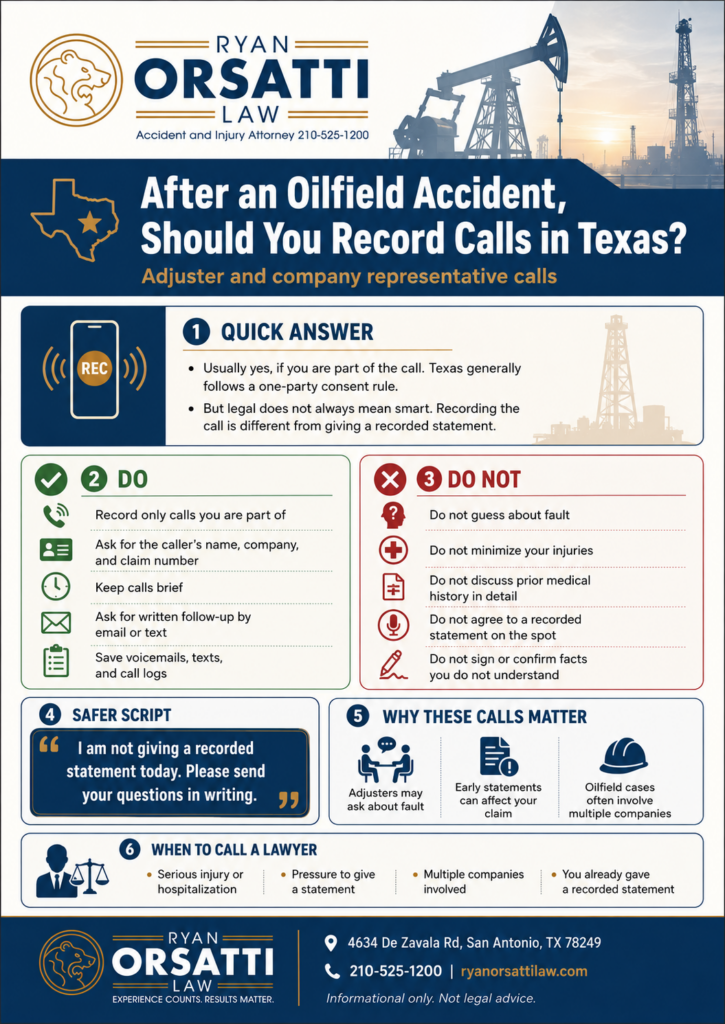
After an oilfield accident in Texas, you generally may record a call with an adjuster or company representative if you are a participant in the call, because Texas follows a one-party consent rule for many in-person, telephone, and electronic conversations. But legal does not always mean smart. Do not give a recorded statement, guess about fault, minimize injuries, discuss medication, or let the call become an interrogation.
The safer approach is to preserve voicemails, keep calls brief, record only calls you are part of, ask for written follow-up, and speak with a Texas oilfield injury attorney before giving detailed facts.
Key Takeaways
- Texas generally allows a person who is part of a conversation to record it, unless the recording is made for a criminal or tortious purpose. (Reporters Committee)
- Do not secretly record conversations between other people if you are not a participant or do not have consent from a participant.
- A protective recording is different from an adjuster’s recorded statement. One preserves what was said. The other can lock you into answers before the facts are complete.
- In oilfield cases, early calls often focus on fault, prior injuries, intoxication, safety training, job duties, and whether the worker “felt okay” right after the incident.
- Ask the adjuster or representative to communicate by email or text so there is a written record.
- If the call involves another state, a company policy, a workers’ compensation carrier, or an employer benefit plan, get legal advice before recording or answering detailed questions.
Should I record calls with the adjuster or company representative after an oilfield accident in Texas?
You generally can record your own call in Texas, but you should use recording as a protection tool, not as an invitation to talk more. Texas Penal Code § 16.02 is commonly described as a one-party consent recording law, meaning a participant in the conversation can usually consent to recording it. The Reporters Committee for Freedom of the Press summarizes Texas law this way: a person who is party to an in-person, telephone, or electronic conversation, or who has consent from one party, can lawfully record it unless the recording is for a criminal or tortious purpose. (Reporters Committee)
That rule matters after a drilling rig injury, frac-site incident, H2S exposure, tank battery explosion, trucking incident, or well-service accident. The first calls can come from many sources: the employer, a company safety manager, a risk manager, a workers’ compensation adjuster, a third-party liability carrier, or an investigator hired by an oilfield contractor.
A recorded call may help preserve exactly what the representative said about the accident, witnesses, incident reports, video, job safety analysis documents, or whether equipment was taken out of service. But the recording also captures your words. If you speculate, apologize, minimize symptoms, or say you “think” you are fine, that statement may become a problem later.
For broader guidance on preserving health, evidence, and legal options, see Ryan Orsatti Law’s guide on what to do immediately after an oilfield accident in Texas.
Is Texas a one-party consent state for recording adjuster calls?
Texas is generally treated as a one-party consent state, which means one participant’s consent can be enough for many recorded conversations. If you are on the call, you are one of the parties. That is different from leaving a device in a room, recording other people’s private conversation, or intercepting a call between people when you are not part of it.
Texas law also has limits. The one-party rule does not protect a recording made for a criminal or tortious purpose. “Tortious” means conduct that could support a civil lawsuit, such as fraud, invasion of privacy, or another wrongful act. The rule also does not mean every recording is wise, admissible, or free from employment consequences.
Texas Civil Practice and Remedies Code Chapter 123 also creates civil remedies for unlawful interception of communications. Texas Civil Practice and Remedies Code § 123.004 allows remedies that can include an injunction, statutory damages of $10,000 for each occurrence, actual damages above that amount, punitive damages, and attorney’s fees and costs. (Justia Law)
Quotable passage: In Texas oilfield injury claims, the safest rule is narrow: record only conversations you personally participate in, do not record for a wrongful purpose, do not record other people’s private calls, and do not let a company representative turn your protective recording into an adjuster-led recorded statement.
What is the difference between recording a call and giving a recorded statement?
Recording your own call preserves the conversation, while giving a recorded statement lets the adjuster control the questions, structure, and transcript. This distinction is critical after an oilfield accident because the facts are often incomplete during the first few days.
A protective recording might capture the representative’s identity, claim number, what documents they want, and what they say about preserving evidence. A recorded statement usually goes much further. It may ask you to describe the incident, assign fault, list every injury, discuss prior medical history, explain your job training, and answer leading questions before you have reviewed the incident report, medical records, witness names, or safety documents.
| Type of call | Who controls it? | Main risk | Safer response |
|---|---|---|---|
| Your brief recorded call | You control the length and scope | You may still say too much | Keep it limited to identity, claim information, and written follow-up |
| Adjuster’s recorded statement | Adjuster controls the questions | Your answers may be used to dispute injury, fault, or causation | Politely decline until you speak with counsel |
| Company safety call | Employer or contractor controls the topic | It may focus on rule violations, training, intoxication, or blame | Ask whether it is required, who will receive it, and whether it is recorded |
| Workers’ compensation call | Carrier controls claim intake | Cooperation duties may apply, but details still matter | Give required basic information, avoid speculation, ask for written questions |
| Third-party liability call | Opposing insurer controls the claim | They may seek admissions against you | Do not discuss fault, injuries, or settlement without legal advice |
A simple script is often enough: “I am not giving a recorded statement today. Please send your questions in writing, and I will respond after I understand my medical condition and legal rights.”
Why are adjuster calls risky after a Texas oilfield accident?
Adjuster calls are risky because the representative is often building a liability and damages file before you know what evidence exists. In oilfield cases, the early record may later affect negligence, causation, workers’ compensation, nonsubscriber liability, third-party claims, subrogation, hospital liens, and benefit-plan reimbursement.
Oilfield accidents often involve several entities. One company may own the lease. Another may operate the site. A drilling contractor, trucking company, equipment supplier, wireline company, pressure-pumping company, or safety contractor may also be involved. Each may have its own insurer and its own reason to shape the early facts.
OSHA identifies oil and gas extraction as involving many safety hazards, including vehicle collisions, struck-by and caught-between incidents, explosions and fires, falls, confined spaces, ergonomic hazards, high-pressure lines, hazardous energy, and machine hazards. OSHA also states that highway vehicle crashes are the leading cause of oil and gas extraction worker fatalities, accounting for roughly 4 of every 10 worker deaths in the industry. (OSHA)
That is why a casual call can become important. A representative may ask:
- “Were you in a hurry?”
- “Did you see the pressure gauge?”
- “Did you attend the job safety analysis meeting?”
- “Were you wearing all required PPE?”
- “Had you ever done this task before?”
- “Did you report pain immediately?”
- “Were you taking any medication?”
- “Did anyone tell you the equipment was unsafe?”
- “Did you sign the incident report?”
- “Did you refuse medical treatment at the site?”
Those questions are not random. They often track future defenses.
What should I say if the adjuster or company representative calls?
You should identify the caller, gather claim information, avoid detailed facts, and ask for written communication. You do not need to be rude. You need to be precise.
Use this call structure:
- Ask for the caller’s full name, company, phone number, email, and role.
- Ask which company or insurance carrier they represent.
- Ask for the claim number.
- Ask whether the call is being recorded.
- State that you are not giving a recorded statement.
- Do not discuss fault, safety rules, training, medical history, medication, or settlement.
- Ask them to send all requests in writing.
- Save the voicemail, call log, text messages, and emails.
- Write down the date, time, caller, and a short summary.
- Contact a Texas oilfield injury attorney before responding to detailed questions.
Quotable passage: After a Texas oilfield accident, the injured worker should separate claim administration from evidence testimony. It is usually reasonable to provide basic identifying information, claim numbers, and contact information, but detailed answers about fault, medical history, training, and job duties should wait until the worker understands the evidence.
If you were injured in a work truck crash, rig move, hauling incident, or collision on an oilfield access road, the same recording issues may overlap with trucking evidence. Ryan Orsatti Law also handles serious commercial vehicle matters through its San Antonio truck accident lawyer practice.
Can recording a call help prove what the company said?
A recording can help prove what was said, but it is not a substitute for a complete evidence-preservation plan. In oilfield cases, the more important evidence may include incident reports, JSAs, stop-work authority documents, safety meeting notes, maintenance logs, inspection records, photographs, electronic control data, dispatch records, driver logs, ELD data, video, witness statements, and equipment-preservation records.
A recording can be useful if the company representative says, for example, that a pressure line failed before, a valve was tagged out, a supervisor told workers to keep going, a witness was present, or video exists. But you should not depend on the call alone. Written preservation letters should be sent quickly to the right companies.
Spoliation means destruction or failure to preserve relevant evidence. In a serious oilfield injury case, early evidence preservation can matter because equipment may be repaired, moved, cleaned, replaced, or returned to service quickly.
For more on oilfield injury claims in San Antonio and South Texas, review Ryan Orsatti Law’s page on oil field accidents in San Antonio.
What if the call involves workers’ compensation, a nonsubscriber, or a third party?
The recording strategy depends on who is calling and what legal lane the claim is in. Texas oilfield cases can involve workers’ compensation, a nonsubscriber employer, a third-party negligence claim, or all three.
Workers’ compensation is a benefit system for covered work injuries. If the employer has Texas workers’ compensation coverage, Texas Labor Code § 408.001 generally makes workers’ compensation benefits the exclusive remedy against the covered employer for a work-related injury or death, with important statutory exceptions. (Texas Statutes)
A nonsubscriber is a Texas employer that does not carry workers’ compensation insurance in the manner authorized by Texas law. In a nonsubscriber case, Texas Labor Code § 406.033 removes certain employer defenses, including contributory negligence, assumption of risk, and fellow-employee negligence, but the injured worker still must prove negligence. (Justia Law)
A third-party claim is a claim against someone other than your employer, such as a trucking company, equipment manufacturer, subcontractor, site operator, or property owner. Texas proportionate responsibility under Texas Civil Practice and Remedies Code Chapter 33 can affect how fault is allocated among responsible parties. Under § 33.001, a claimant may not recover damages if the claimant’s percentage of responsibility is greater than 50 percent. (Texas Statutes)
| Caller type | Legal lane | What to watch for |
|---|---|---|
| Employer safety manager | Internal investigation, workers’ compensation, or nonsubscriber defense | Questions about rules, PPE, training, intoxication, and whether you “caused” the incident |
| Workers’ compensation adjuster | Benefit claim | Cooperation may matter, but do not guess about medical causation or return-to-work ability |
| Third-party adjuster | Liability claim against another company | They may seek admissions to reduce or deny responsibility |
| Health insurer or ERISA plan | Subrogation or reimbursement | They may later claim repayment from settlement funds |
| Hospital or medical provider | Billing, hospital lien, or letter of protection | Make sure bills and liens are tracked before settlement |
Subrogation means a health plan or insurer may claim repayment from money recovered from a responsible party. A hospital lien is a statutory claim by a hospital against certain injury recoveries. A letter of protection, often called an LOP, is an agreement that a medical provider may wait for payment until the injury claim resolves. These issues are not usually solved on an adjuster call, but careless statements can affect how the claim is valued.
Should I tell the adjuster that I am recording the call?
You may choose to tell the adjuster you are recording, even when Texas law may not require it, because disclosure can reduce later arguments about fairness, context, or company policy. Telling the caller can also make the conversation more professional and shorter.
A practical phrase is: “I am recording this call for accuracy. I am not giving a recorded statement. Please send any questions in writing.”
If the caller objects, end the call politely and ask for written communication. If the caller is in another state, if you are in another state, or if the call includes people outside Texas, do not assume Texas law is the only law that matters.
What mistakes should I avoid on a recorded oilfield accident call?
The biggest mistake is talking like the call is informal when it may later be treated like evidence. Assume the recording, transcript, notes, or claim log may be reviewed months later by lawyers, insurers, supervisors, and possibly a jury.
Avoid these statements:
- “I’m fine.”
- “It was probably my fault.”
- “I should have been more careful.”
- “Nobody did anything wrong.”
- “I do not need more treatment.”
- “I have always had back problems.”
- “I do not remember, but I guess that sounds right.”
- “I just want to settle quickly.”
- “The company has been good to me, so I do not want to cause trouble.”
- “I signed the report even though I did not read it.”
Quotable passage: In Bexar County and South Texas oilfield cases, early call notes often become claim anchors. If the first recorded version says the worker felt “okay,” skipped treatment, or accepted blame, the insurer may later use that statement to dispute causation, damages, or responsibility even when medical records tell a fuller story.
After an oilfield accident, should I record calls with the adjuster or company representative in Texas if I am badly injured?
If you are badly injured, medicated, in the hospital, concussed, burned, oxygen-deprived, or dealing with severe pain, do not handle a detailed recorded call at all. Your priority is medical care and evidence preservation, not answering liability questions.
Traumatic brain injury, toxic exposure, burn injury, crush injury, spinal trauma, and orthopedic injuries can affect memory, concentration, speech, and judgment. A statement given while medicated or in acute pain may be incomplete. That does not mean you are dishonest. It means the timing is bad.
In serious cases, have the representative send the request in writing. Then counsel can determine who is asking, what coverage applies, what cooperation duties exist, and whether the request is reasonable.
Ryan Orsatti Law’s About Us page explains the firm’s personal-injury focus, including oil field accident matters, catastrophic injuries, commercial vehicle accidents, and wrongful death cases.
Attorney Insight
The first call after an oilfield injury often sounds like customer service, but it can function like early cross-examination. I do not want an injured worker guessing about pressure readings, safety meetings, fault, prior injuries, or return-to-work status before we know who controlled the job, who owned the equipment, and what documents exist.
What is the safest call script after a Texas oilfield accident?
The safest script is short, polite, and firm. It gives basic information without giving testimony.
Use this:
“Thank you for calling. Please give me your name, company, phone number, email, claim number, and the party you represent. I am not giving a recorded statement or discussing fault, injuries, medical history, job training, or settlement today. Please send any request in writing. I will respond after I have reviewed my rights and medical condition.”
Then stop talking. Silence often causes people to fill the gap. Do not fill it.
When should I call a lawyer about recording adjuster calls?
Call a lawyer before any detailed call if you suffered a serious injury, missed work, were hospitalized, signed an incident report, were blamed for the accident, were asked for a recorded statement, or received paperwork from the company or insurer. You should also call if more than one company was involved, the employer is a nonsubscriber, or the incident involved a fatality, explosion, fire, vehicle crash, H2S exposure, high-pressure line, crane, rig, tank, or heavy equipment.
Texas Civil Practice and Remedies Code § 16.003 generally gives two years to file a personal-injury lawsuit, and it also provides a two-year limitations period for injury resulting in death. (Texas Statutes) Some deadlines can be shorter depending on the defendant, insurance policy, benefit plan, arbitration agreement, workers’ compensation issue, or evidence-preservation need.
For a direct case review, you can contact Ryan Orsatti Law in San Antonio.
FAQ
Can I secretly record an insurance adjuster in Texas after an oilfield accident?
Texas generally allows you to record a conversation if you are a participant in it, but you should not record other people’s private conversations when you are not involved. The safer practice is to record only your own calls, keep the discussion short, and avoid giving a recorded statement about fault, injuries, training, or settlement.
Do I have to give a recorded statement to the company’s insurance adjuster?
You usually do not have to give a recorded statement to the opposing company’s insurance adjuster before filing a lawsuit. Workers’ compensation and employer benefit issues may create cooperation duties, but that does not mean you should guess or answer broad questions without advice. Ask for written questions and speak with a lawyer first.
What if the adjuster says recording the call will speed up my oilfield injury claim?
A recorded statement may speed up the insurer’s file review, but it can also give the insurer statements to use against you. After an oilfield accident, your diagnosis, work restrictions, fault evidence, and responsible parties may not be clear yet. It is usually safer to provide basic claim information and delay detailed recorded answers.
Can the company fire me for recording a call after an oilfield accident?
Recording law and employment consequences are different issues. Texas may allow one-party recording in many situations, but an employer may still claim that a workplace policy, confidentiality rule, or device policy was violated. If your job is still active or you are being pressured by a supervisor, get legal advice before recording workplace conversations.
Is a voicemail from the adjuster useful evidence?
Yes, a voicemail can be useful because it preserves the caller’s identity, timing, tone, request, and sometimes admissions about the claim or investigation. Save voicemails, screenshots of missed calls, text messages, emails, claim letters, and written requests. Do not edit the recording. Keep the original file if possible.
Should I record calls if the accident involved a work truck or highway crash?
Recording may help preserve what the adjuster says, but trucking and roadway oilfield accidents require fast evidence preservation beyond phone calls. Relevant evidence may include driver logs, ELD data, vehicle inspections, dispatch records, dashcam video, load documents, maintenance files, and crash reports. Do not rely on a phone recording alone.
What if I already gave a recorded statement after my oilfield accident?
If you already gave a recorded statement, do not panic and do not try to “fix” it with another unsupervised call. Write down when it happened, who took it, what you remember saying, and whether you were medicated, in pain, or missing information. Ask for a copy or transcript, then speak with a lawyer.
Can I use a recording in court in Texas?
A recording may be usable if it was lawfully obtained, relevant, authentic, and not excluded by another evidence rule. “Authentic” means you can show the recording is what you claim it is. Do not edit, splice, caption, or alter recordings. Preserve the original file, metadata if available, and the device or app information.
Ryan Orsatti Law
4634 De Zavala Rd, San Antonio, TX 78249
Phone: 210-525-1200
ryanorsattilaw.com
This blog is for informational purposes only, not legal advice. Reading it does not create an attorney-client relationship. Past results do not guarantee future results.
Hurt in an accident in San Antonio? Learn how a San Antonio personal injury lawyer can help with your claim. Call 210-525-1200 or request a free consultation.
The firm works on a contingency fee. You pay nothing unless the firm recovers money for you, and that covers case expenses as well as the fee: if there is no recovery, you owe no attorney's fee and no case expenses. Ask for the fee agreement and read the fee and expense section before you sign anything.
Related San Antonio legal resources
- San Antonio construction-accident representation
- Texas personal-injury services
- Contact Ryan Orsatti Law
Primary legal and public-data sources
- Texas Civil Practice and Remedies Code Chapter 16: limitations
- Texas Civil Practice and Remedies Code Chapter 33: proportionate responsibility
Ryan Orsatti Law
4634 De Zavala Road, San Antonio, TX 78249
General reference links. Consult each source for its current text.