
Quick Answer
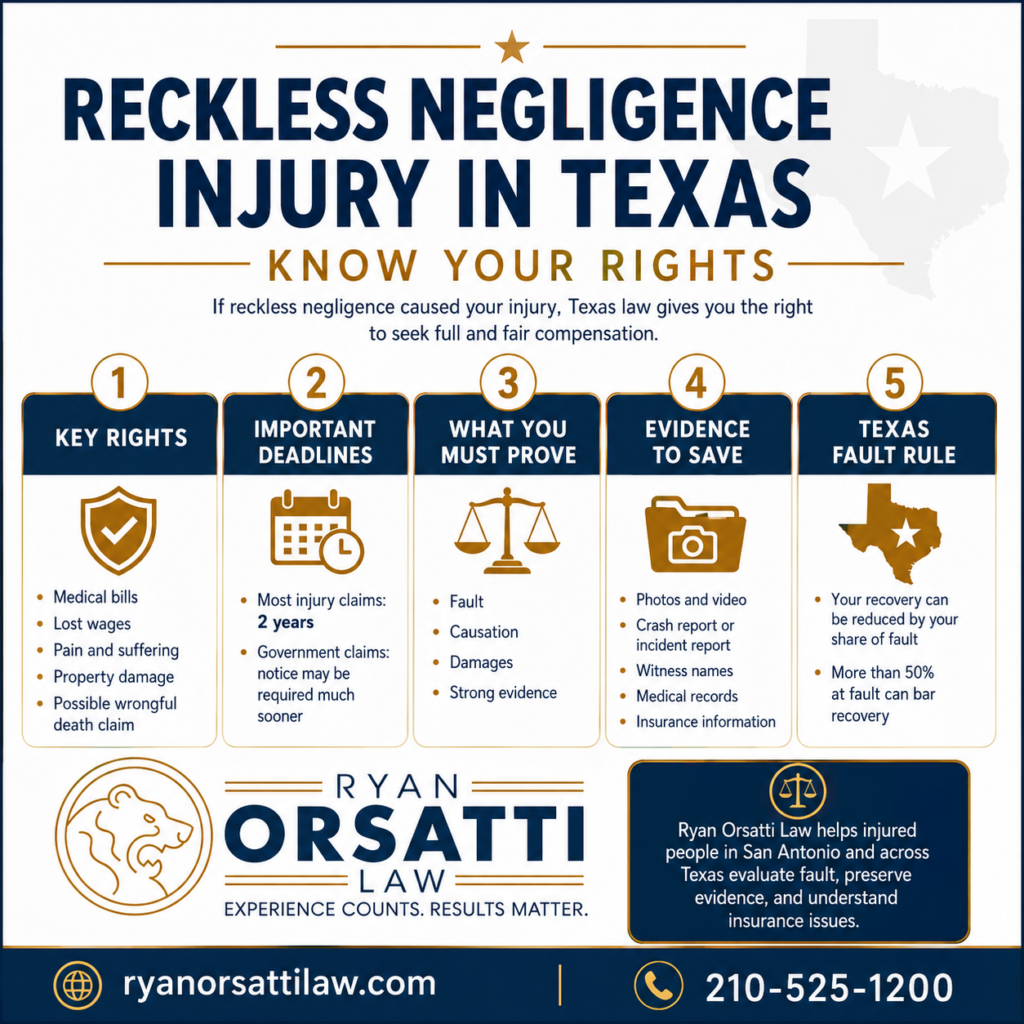
If reckless negligence caused your injury in Texas, your rights may include a civil injury claim for medical bills, lost income, pain, impairment, and other provable losses. Most Texas personal injury lawsuits must be filed within two years, but claims involving a government entity can require written notice within six months. “Reckless negligence” is usually a client-search phrase, not a precise Texas claim label, so the facts may be analyzed as ordinary negligence, gross negligence, reckless driving, or a statutory violation. Ryan Orsatti Law helps injured people in San Antonio and across Texas evaluate fault, insurance coverage, medical proof, and evidence preservation after serious injury incidents. (Texas Statutes)
Key Takeaways
- “Reckless negligence” in Texas often points to conduct that may be more serious than ordinary carelessness, especially if the person or company knew about a dangerous risk and ignored it.
- Texas generally gives injured people two years to file a personal injury lawsuit, but notice deadlines can be much shorter when a city, county, school district, or other governmental unit is involved. (Texas Statutes)
- Texas proportionate responsibility can reduce or bar a claim. If the injured person is found more than 50% responsible, Texas law bars recovery. (Texas Statutes)
- TxDOT reported 14,905 serious injury crashes in Texas in 2024, with 18,218 people sustaining a serious injury, which shows why early proof matters in serious crash claims. (Texas Department of Transportation)
- Insurance coverage matters. Texas minimum auto liability coverage is 30/60/25, which can be too low for serious injuries, multiple injured people, or major property damage. (Texas Department of Insurance)
What Does “Reckless Negligence” Mean in a Texas Injury Case?
“Reckless negligence” usually means the injured person believes the defendant did more than make a simple mistake. In Texas injury cases, lawyers usually translate that phrase into specific legal theories, such as ordinary negligence, gross negligence, reckless driving, negligence per se, or intentional conduct.
Texas law defines gross negligence as conduct involving an extreme degree of risk, plus actual subjective awareness of that risk and conscious indifference to the rights, safety, or welfare of others. Texas Transportation Code § 545.401 also defines reckless driving as driving in “wilful or wanton disregard” for the safety of persons or property. (Texas Statutes)
| Texas concept | Plain-English meaning | Why it matters in an injury claim |
|---|---|---|
| Ordinary negligence | Someone failed to use reasonable care under the circumstances. | Most Texas injury claims start here. The focus is duty, breach, causation, and damages. |
| Reckless driving | A driver acted with willful or wanton disregard for safety. | A citation or charge can be important evidence, but the civil injury case still needs proof of fault, causation, and damages. |
| Gross negligence | The conduct involved extreme risk, the actor knew about the risk, and the actor proceeded with conscious indifference. | This may support a request for exemplary damages, but Texas requires a higher proof standard. |
| Intentional conduct | The person acted deliberately, not merely carelessly. | This may affect insurance coverage, damages, criminal proceedings, and civil strategy. |
Key takeaway: The words “reckless negligence” matter less than the evidence showing what the defendant knew, what safety rule was violated, and how that conduct caused the injury.
What Rights Do You Have After Reckless Negligence Causes an Injury in Texas?
After reckless negligence causes an injury in Texas, your rights may include pursuing a claim against the responsible person, business, property owner, trucking company, employer, or applicable insurance policy. The claim usually focuses on proving fault, connecting the conduct to your injuries, and documenting the full harm caused by the incident.
Depending on the facts, damages may include medical expenses, lost wages, lost earning capacity, physical pain, mental anguish, disfigurement, impairment, and future care needs. In rare cases involving fraud, malice, or gross negligence, Texas law may allow exemplary damages, which are meant as a penalty rather than compensation. (Texas Statutes)
Can You Get Exemplary Damages for Reckless Negligence in Texas?
Exemplary damages are possible in some Texas injury cases, but they are not automatic just because the defendant acted badly. Texas Civil Practice & Remedies Code § 41.003 requires clear and convincing evidence that the harm resulted from fraud, malice, or gross negligence, and ordinary negligence is not enough. (Texas Statutes)
Texas also places statutory limits on exemplary damages in many cases. Under Texas Civil Practice & Remedies Code § 41.008, exemplary damages generally may not exceed the greater of $200,000 or a formula tied to economic damages plus certain noneconomic damages up to $750,000. (Texas Statutes)
What Insurance Coverages May Matter After Reckless Negligence?
Insurance coverage can determine how medical bills, wage loss, vehicle damage, and other losses are handled after a reckless injury. In Texas auto cases, the at-fault driver’s liability insurance, your own uninsured or underinsured motorist coverage, PIP, MedPay, collision coverage, and health insurance can all matter.
The Texas Department of Insurance explains that minimum liability coverage is $30,000 per injured person, $60,000 per accident, and $25,000 for property damage. TDI also explains that PIP pays medical bills and certain nonmedical costs, while uninsured or underinsured motorist coverage may apply if the other driver has no insurance or not enough insurance. (Texas Department of Insurance)
How Long Do You Have to Act After Reckless Negligence in Texas?
Most Texas personal injury lawsuits must be filed not later than two years after the cause of action accrues. If the injury results in death, Texas Civil Practice & Remedies Code § 16.003 also uses a two-year period measured from the date of death. (Texas Statutes)
That does not mean you should wait two years. Video footage, vehicle data, inspection records, 911 audio, witness memory, and physical scene evidence can disappear quickly, especially after crashes on I-10, I-35, Loop 410, Loop 1604, and US-281 in San Antonio.
What Changes When a Government Entity Is Involved?
Claims involving a Texas governmental unit can require written notice much earlier than the lawsuit deadline. Texas Civil Practice & Remedies Code § 101.101 generally requires notice not later than six months after the incident, and that notice must reasonably describe the injury, the time and place, and the incident itself. (Texas Statutes)
This can matter if the injury involves a city vehicle, public school bus, county road crew, public hospital, law enforcement vehicle, or unsafe public property. Government claims also involve immunity issues, statutory exceptions, and damage limitations, so they should be reviewed quickly.
How Does Fault Work If the Injured Person Is Blamed Too?
Texas proportionate responsibility can reduce or bar an injury claim if the injured person is accused of sharing fault. Under Texas Civil Practice & Remedies Code § 33.001, a claimant may not recover damages if the claimant’s percentage of responsibility is greater than 50%. (Texas Statutes)
Comparative responsibility means Texas can reduce a recovery by the injured person’s percentage of fault. For example, if an adjuster claims you were speeding, distracted, not wearing a seat belt, failed to look, delayed treatment, or ignored a warning sign, that allegation becomes part of the liability fight.
What Evidence Helps Defeat Blame-Shifting?
The best evidence against blame-shifting is evidence gathered before it disappears. In Texas crash cases, TxDOT explains that crash data comes from Texas Peace Officer’s Crash Reports, also called CR-3 reports, and TxDOT maintains a statewide CRIS database for reportable crashes. (Texas Department of Transportation)
Useful evidence may include scene photos, vehicle photos, witness names, dashcam video, nearby business video, 911 records, bodycam footage, inspection records, maintenance records, driver logs, event data recorder information, cell phone records, and medical documentation that connects the incident to the injury.
What Should You Do in the First Week After a Reckless Injury?
After a reckless injury in Texas, the first week should be used to protect your health, preserve evidence, and avoid statements that may be used out of context. Serious injury claims are often damaged early by missing medical records, lost video, unclear photos, and recorded statements given before the injured person understands the diagnosis.
- Get medical care and describe every symptom clearly, even if adrenaline made the injury seem minor at first.
- Follow discharge instructions, referrals, work restrictions, and follow-up appointments.
- Photograph visible injuries, vehicles, hazards, property damage, skid marks, debris, lighting, weather conditions, and warning signs.
- Save names, phone numbers, license plates, insurance cards, police report numbers, and witness information.
- Do not repair or dispose of key evidence until it is photographed and documented.
- Avoid giving a recorded statement to another party’s insurer before understanding your injuries, facts, and coverage issues.
- Keep all bills, receipts, work notes, mileage logs, prescriptions, and out-of-pocket expense records.
- Contact a Texas personal injury attorney quickly if the injury is serious, fault is disputed, a commercial vehicle is involved, video may exist, or a government entity may be responsible.
Attorney Insight: In serious San Antonio injury claims, the first value fight often starts before a demand is written. Adjusters look for treatment gaps, inconsistent injury histories, unclear liability facts, and missing photos or video. A case with strong facts can still be discounted if the medical timeline does not clearly connect the incident, symptoms, diagnoses, work restrictions, and future care.
How Are Medical Bills, Subrogation, and Hospital Liens Handled?
Medical bills after reckless negligence may be handled through health insurance, PIP, MedPay, letters of protection, out-of-pocket payments, or a combination of sources. PIP means personal injury protection, and TDI explains that Texas auto policies include PIP unless the insured rejects it in writing. (Texas Department of Insurance)
Subrogation means a health insurer or benefit plan may claim a right to be paid back from part of a settlement. A hospital lien is a legal claim a hospital may assert against part of a personal injury recovery, and Texas Property Code Chapter 55 governs hospital and emergency medical services liens. (Texas Statutes)
Medical bill issues can affect the client’s net result, not just the gross settlement number. That is why serious cases should account for billed charges, paid amounts, health insurance adjustments, liens, subrogation claims, future care, and whether any provider is claiming a balance.
When Should You Call a Texas Personal Injury Lawyer?
You should consider calling a Texas personal injury lawyer early if reckless negligence caused serious injuries, disputed fault, a death, commercial vehicle involvement, drunk or distracted driving, a dangerous property condition, a defective product issue, or a government-entity claim. These cases often require fast preservation letters, coverage analysis, witness follow-up, medical record review, and strategic handling of insurance communications.
Ryan Orsatti Law helps injured people in San Antonio, Bexar County, and across Texas evaluate serious injury claims involving car crashes, commercial vehicle crashes, traumatic brain injuries, and wrongful death. Helpful related resources include the firm’s pages on San Antonio car accident cases, San Antonio truck accident cases, traumatic brain injury claims, and wrongful death in Texas.
How Does Ryan Orsatti Law Evaluate Reckless Negligence Injury Cases?
Ryan Orsatti Law evaluates reckless negligence injury cases by identifying the responsible parties, preserving evidence, mapping all available insurance coverage, documenting medical damages, and addressing fault defenses early. The goal is to understand what happened, what proof exists, what coverage applies, and what medical and financial harms can be documented.
In San Antonio and Bexar County cases, that may include crash-scene investigation, CR-3 review, nearby business-video requests, 911 and public-records requests, commercial-vehicle preservation letters, medical chronology review, lien analysis, and communication with insurers. For help evaluating a serious Texas injury claim, you can contact Ryan Orsatti Law.
FAQ
Is reckless negligence a real legal claim in Texas?
“Reckless negligence” is commonly used by injured people, but Texas lawyers usually analyze the facts under more specific legal theories. The case may involve ordinary negligence, gross negligence, reckless driving, negligence per se, or intentional conduct. Texas gross negligence requires proof of extreme risk, actual awareness, and conscious indifference. (Texas Statutes)
What is the difference between negligence and gross negligence in Texas?
Negligence usually means a person failed to use reasonable care under the circumstances. Gross negligence is harder to prove because Texas law requires an extreme degree of risk and proof that the actor actually knew about the risk but proceeded with conscious indifference to others’ safety or welfare. (Texas Statutes)
Can a reckless driving ticket prove my Texas injury case?
A reckless driving citation can help, but it does not automatically prove every part of a Texas injury claim. You still need evidence that the conduct caused your injuries and damages. Texas Transportation Code § 545.401 defines reckless driving as driving with willful or wanton disregard for safety. (Texas Statutes)
How long do I have to file a reckless negligence injury lawsuit in Texas?
Most Texas personal injury lawsuits must be filed within two years after the claim accrues. If the injury caused death, the wrongful death deadline is generally two years from the date of death. Government-entity claims can require written notice within six months, so deadlines should be checked immediately. (Texas Statutes)
What if I was partly at fault for the accident?
Texas proportionate responsibility can reduce or bar your claim. If you are found more than 50% responsible, Texas Civil Practice & Remedies Code § 33.001 bars recovery. If you are 50% or less responsible, your damages may be reduced by your percentage of fault. (Texas Statutes)
Does Texas cap exemplary damages in gross negligence cases?
Texas caps exemplary damages in many cases. Under Texas Civil Practice & Remedies Code § 41.008, the limit is generally the greater of $200,000 or a statutory formula based on economic damages plus certain noneconomic damages up to $750,000. Exceptions can apply, so the facts and claim type matter. (Texas Statutes)
What if reckless negligence caused a loved one’s death?
If reckless negligence caused a death in Texas, the case may involve wrongful death and survival claims. Texas wrongful death law generally allows the surviving spouse, children, and parents to bring the claim for their losses. The deadline is often two years from death, with shorter notice issues for government defendants. (Justia Law)
Ryan Orsatti Law
4634 De Zavala Rd, San Antonio, TX 78249
Phone: 210-525-1200
ryanorsattilaw.com
This blog is for informational purposes only, not legal advice. Reading it does not create an attorney-client relationship. Past results do not guarantee future results.
Hurt in an accident in San Antonio? Learn how a San Antonio car accident lawyer can help with your claim. Call 210-525-1200 or request a free consultation. There is no fee unless we win.