
Quick Answer
If a truck was carrying placarded hazardous materials and there is a leak or spill, move away from the truck, get uphill, upwind, and upstream if you can do so safely, and call 911 immediately. Do not touch the spill, walk through liquid, breathe fumes, or move closer just to take photos. If you can safely see the placard number, truck company, trailer markings, or spill location from a distance, tell the dispatcher. Then follow police, fire, EMS, and hazmat instructions, and get medical evaluation for any possible exposure.
Key Takeaways
- A hazmat spill is a safety event first and a legal claim second.
- Do not approach the truck, placard, vapor cloud, liquid, smoke, or runoff.
- Placards, shipping papers, emergency response information, dash cam video, ELD data, cleanup records, and spill reports can become key evidence.
- Texas hazmat truck cases may involve the driver, motor carrier, shipper, loader, maintenance contractor, cargo tank company, or cleanup contractor.
- Most Texas personal-injury claims have a two-year filing deadline, but hazmat evidence can disappear much faster.
- Medical documentation should clearly mention the suspected chemical exposure, symptoms, decontamination, and any placard or UN/NA number you saw.
What should I do first if a placarded hazmat truck is leaking or spilling?
Your first job is distance, not documentation. A placarded hazardous materials truck may be carrying flammable liquid, corrosive material, poison gas, explosives, radioactive material, oxidizers, or another regulated substance. A placard is the diamond-shaped warning sign on a truck or trailer that identifies the general hazard class and sometimes shows a four-digit UN/NA identification number.
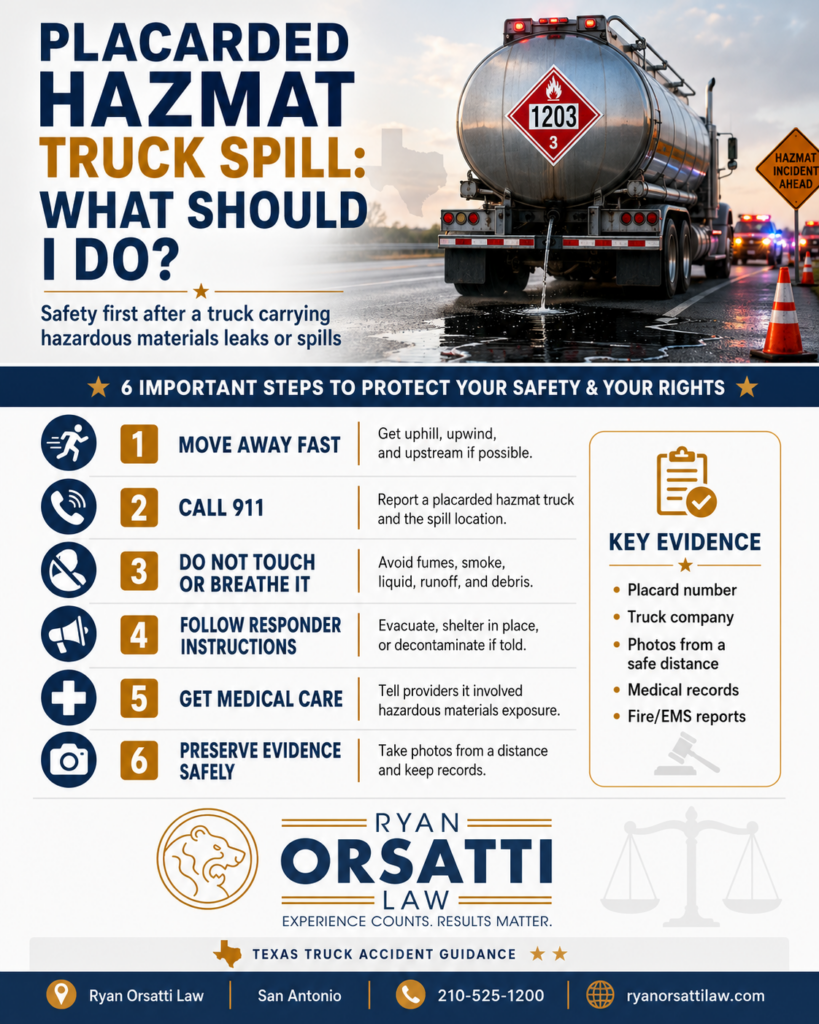
The safest first steps are:
- Move away from the truck and spill.
- Go uphill, upwind, and upstream if possible.
- Avoid smoke, fumes, vapor clouds, liquid runoff, powder, residue, and contaminated debris.
- Call 911 and say a “placarded hazardous materials truck” is leaking or spilling.
- Follow evacuation, shelter-in-place, and decontamination instructions from responders.
The 2024 PHMSA Emergency Response Guidebook tells responders to approach hazmat incidents from upwind, uphill, and upstream, and to stay clear of spills, vapors, fumes, smoke, and other hazards. Crash victims should apply the same safety principle from a layperson’s perspective: get away before you gather evidence.
A placard is not an invitation to investigate. In a Texas hazmat truck crash, the 2024 PHMSA Emergency Response Guidebook tells responders to approach from upwind, uphill and/or upstream and stay clear of spills, vapors, fumes, smoke, and other hazards. Injured drivers and passengers should create distance first.
In San Antonio, this can matter on corridors like I-10, I-35, Loop 410, Loop 1604, US-281, and industrial routes near distribution centers, fuel depots, rail yards, construction sites, and oilfield supply operations. Traffic congestion can make evacuation harder, so do not assume the safest place is beside your vehicle.
What information should I give 911 if I can do it safely?
Tell 911 what you know without guessing or moving closer. Dispatchers need practical information that helps police, fire, EMS, and hazmat teams respond safely.
Give the dispatcher:
- Exact location, including highway, direction of travel, exit, cross street, mile marker, or nearby landmark.
- Whether anyone is injured, trapped, unconscious, burned, dizzy, vomiting, coughing, or having trouble breathing.
- Whether there is fire, smoke, odor, liquid, powder, vapor, or runoff into a ditch, drain, creek, parking lot, or roadway.
- Placard color, symbol, hazard class number, or four-digit UN/NA number, only if visible from a safe distance.
- Trucking company name, USDOT number, trailer number, license plate, or tank markings, only if visible.
- Whether the spill is moving toward people, traffic, homes, businesses, drains, or waterways.
- Whether you were exposed, splashed, walked through liquid, breathed fumes, or had contaminated clothing.
Do not tell 911 what the chemical is unless you are sure. It is better to say, “I see a red diamond placard with the number 1203,” than to guess. For example, UN 1203 commonly corresponds to gasoline, but the key point for a witness is the number and visible warning, not a chemical opinion.
Should I photograph the placard, spill, or truck?
Photograph evidence only if you can do it from a safe location. Do not cross a spill, enter a vapor cloud, stand near a leaking tank, ignore evacuation orders, or delay medical care for photos.
Useful photos and videos may include:
- The placard from a distance.
- The truck, trailer, tank, cargo container, or company logo.
- Spill direction and drainage path.
- Traffic controls, fire trucks, hazmat units, and road closures.
- Your vehicle damage.
- Visible injuries, burns, skin changes, or contaminated clothing.
- Nearby cameras on businesses, traffic poles, gas stations, or warehouses.
- Weather conditions, wind direction, and road conditions.
Use zoom instead of walking closer. If responders tell you to move, move. A photo is not worth chemical burns, inhalation injury, fire risk, secondary impact, or contamination.
Why do placards and shipping papers matter in a Texas hazmat truck accident?
Placards and shipping papers identify what was being transported and help determine whether the shipper, carrier, driver, and emergency response chain followed hazardous-materials rules. Shipping papers are transportation documents that describe the hazardous material, usually including the identification number, proper shipping name, hazard class, packing group when required, total quantity, and emergency response telephone number.
The FMCSA hazardous-materials compliance guidance explains that hazmat shipping papers include the basic description and an emergency response phone number. FMCSA also states that the emergency response number must be monitored at all times while the material is in transportation.
The PHMSA emergency response information guidance explains that federal hazardous materials rules require emergency response information to be current, accurate, timely, and immediately available to emergency responders. That information can address immediate health hazards, fire or explosion risks, immediate precautions, spill or leak handling, and first aid.
Under 49 CFR Part 172, Subpart C and Subpart G, hazardous-materials shipments generally use shipping papers and emergency response information to identify the material, hazards, precautions, fire and spill methods, leak handling, and first aid. In a crash, those documents often matter as much as the police crash report.
| Evidence item | What it can show | Why it matters |
|---|---|---|
| Placard | Hazard class, warning symbol, and sometimes UN/NA number | Helps identify the cargo and initial danger |
| Shipping papers | Proper shipping name, hazard class, ID number, packing group, quantity, emergency phone number | Shows what the driver and carrier should have known |
| Emergency response information | Health hazards, fire risk, spill control, leak handling, first aid | Shows whether responders had proper information |
| Driver qualification and training records | Whether the driver was qualified and trained for hazmat transport | May support negligent training or supervision issues |
| ELD and dispatch data | Hours, route, timing, and communications | May show fatigue, delay, routing decisions, or pressure |
| Dash cam and nearby video | Crash sequence and post-crash spill conditions | Can confirm impact, leak timing, and scene hazards |
| Cleanup and remediation records | What was released, where it traveled, and how it was handled | Can help prove exposure, property damage, and contamination |
| PHMSA, TCEQ, NRC, fire, and police records | Agency response and reportable spill information | May identify substances, violations, and responsible parties |
What medical steps should I take after possible chemical exposure?
Get medical evaluation promptly and tell medical providers this was a placarded hazardous materials truck spill. Chemical exposure cases are harder to prove when the records only say “car accident” and do not document fumes, splash exposure, decontamination, respiratory symptoms, skin symptoms, eye irritation, headaches, nausea, dizziness, coughing, or burns.
Ask medical providers to document:
- That the crash involved a placarded hazardous materials truck.
- Any placard number, color, smell, smoke, vapor, liquid, or powder you observed.
- Whether you were decontaminated by responders.
- Whether clothing, shoes, bags, tools, car seats, or personal items may have been contaminated.
- Every symptom, even if it seems minor at first.
- Whether follow-up care, imaging, lab work, pulmonary evaluation, ophthalmology, dermatology, or burn care is recommended.
If you were told to discard clothing or avoid handling property, follow responder and medical instructions. Do not place possibly contaminated clothes in your personal vehicle, home, office, or washing machine unless emergency personnel tell you it is safe.
For crashes involving burns or chemical skin injuries, Ryan Orsatti Law has additional information about burn injury claims in San Antonio.
What Texas and federal reports may exist after a hazmat spill?
A serious hazmat spill can create more records than an ordinary truck crash. Depending on the facts, the incident may generate police reports, fire department records, EMS records, hazmat unit notes, environmental spill reports, cleanup invoices, carrier incident files, PHMSA reports, insurance files, and maintenance records.
According to TxDOT’s 2024 Commercial Motor Vehicle (CMV) Involved Crashes and Injuries by County report, Texas had 39,393 CMV-involved crashes in 2024, including 546 fatal crashes and 1,601 suspected serious injuries. Those numbers show why commercial vehicle evidence must be handled carefully, especially when a placarded load adds fire, spill, inhalation, or contamination issues.
Important reporting sources may include:
| Report or record | Who may create it | What it may contain |
|---|---|---|
| Texas Peace Officer’s Crash Report, often called a CR-3 | Police agency | Crash facts, parties, injuries, commercial vehicle information, contributing factors |
| Fire, EMS, and hazmat response records | Fire department, EMS, hazmat unit | Decontamination, exposure complaints, evacuations, spill response, scene hazards |
| TCEQ spill report | Responsible party or reporting person | Environmental release details, substance, quantity, location, response |
| National Response Center report | Reporting party for qualifying federal releases | Federal spill notification and response information |
| PHMSA DOT Form 5800.1 | Person subject to federal hazmat incident reporting rules | Reportable hazardous-materials incident details |
| Carrier and shipper records | Motor carrier, shipper, broker, loading facility | Training, route, shipping papers, emergency response phone, load securement |
| Cleanup contractor records | Environmental contractor | Substance, cleanup method, disposal, air monitoring, contaminated soil or water |
The TCEQ spill reporting page lists the State of Texas Spill-Reporting Hotline at 1-800-832-8224 and states that federal spill reports can be made to the National Response Center at 1-800-424-8802. TCEQ also notes that notifying the National Response Center does not constitute notice to the State of Texas. For immediate danger to life or safety, call 911 first.
The TCEQ reportable quantities page explains that reporting duties depend on the substance and where it was released. For example, different rules can apply to releases onto land, into water, or involving petroleum products. These reporting rules are technical, which is one reason early preservation letters matter.
Who may be responsible for a placarded hazmat truck leak or spill?
Responsibility may extend beyond the truck driver when the cargo, tank, route, training, securement, maintenance, or emergency information contributed to the harm. Negligence means failing to use reasonable care under the circumstances. In a hazmat truck case, reasonable care can include obeying traffic laws, following federal hazardous materials regulations, properly training drivers, securing cargo, maintaining tanks and valves, and providing accurate emergency response information.
Potential responsible parties may include:
- Truck driver.
- Motor carrier.
- Shipper or manufacturer of the hazardous material.
- Freight broker or logistics company, depending on its role.
- Loading facility.
- Cargo tank inspection, repair, or maintenance company.
- Trailer or valve manufacturer.
- Cleanup contractor, if cleanup work creates separate harm.
- Another driver who caused or contributed to the crash.
- Governmental entity, only in limited situations involving road design, maintenance, or public vehicles, and only after separate notice and immunity issues are evaluated.
In Texas, a hazmat truck case is usually investigated under ordinary negligence principles, federal Hazardous Materials Regulations, and Texas Civil Practice & Remedies Code Chapter 33. The driver, motor carrier, shipper, loader, maintenance contractor, cargo-tank facility, or another party may share responsibility depending on what failed.
Texas also uses proportionate responsibility. Under Texas Civil Practice & Remedies Code § 33.001, a claimant cannot recover damages if the claimant’s percentage of responsibility is greater than 50 percent. If responsibility is 50 percent or less, damages may be reduced by the claimant’s percentage of fault.
That rule matters because trucking insurers may argue that a driver stopped too close, ignored instructions, failed to avoid exposure, delayed medical care, or caused part of the crash. The facts, photos, witness statements, emergency response records, and medical records are often the answer to those arguments.
How does insurance work after a hazmat truck accident in Texas?
Insurance can include the motor carrier’s liability coverage, possible pollution coverage, cargo or environmental coverage, and your own auto or health insurance. Liability coverage means insurance that may pay for harm caused by an insured person or company. Pollution or environmental coverage may apply to cleanup, contamination, evacuation, or third-party exposure claims, depending on the policy language.
Other coverage and payment issues may include:
- Health insurance, which may pay medical bills now but assert subrogation later.
- Subrogation, which means a health plan or insurer seeks repayment from a settlement or judgment.
- Hospital liens, which are legal claims hospitals may assert against personal-injury recoveries in certain circumstances.
- ERISA plan reimbursement claims, which can be complex when an employer health plan paid medical bills.
- MedPay or PIP, which may provide first-party medical benefits if included in your auto policy.
- UM/UIM coverage, which may matter if another at-fault vehicle is uninsured or underinsured.
- Letters of protection, which are agreements allowing medical providers to wait for payment from a future recovery, if appropriate and accepted by the provider.
Do not assume the trucking company’s insurer is the only insurance source. Hazmat cases can involve several carriers with different adjusters, different policy exclusions, and different incentives. A release signed with one party may affect claims against others.
How long do I have to bring a Texas hazmat truck accident claim?
Most Texas personal-injury and wrongful-death lawsuits must be filed within two years, but evidence in hazmat cases must be preserved immediately. Texas Civil Practice & Remedies Code § 16.003 generally sets a two-year limitations period for personal-injury claims and wrongful-death claims.
Texas Civil Practice & Remedies Code § 16.003 generally gives two years to file a personal-injury lawsuit and two years from death for wrongful-death claims. That filing deadline is not an evidence-retention deadline. Hazmat placard photos, shipping papers, dash cam video, ELD data, cleanup records, and air-monitoring data can disappear much sooner.
Shorter notice deadlines may apply if a governmental entity is involved, such as a city vehicle, county vehicle, state vehicle, public road condition, or emergency response issue. Those situations are fact-specific and should be reviewed quickly.
After a placarded hazardous materials truck spill, do these 7 things
After a placarded hazardous materials truck spill, follow a safety-first checklist before dealing with insurance. The order matters because exposure, evidence loss, and insurance mistakes often happen early.
- Move away from the spill. Get uphill, upwind, and upstream if possible. Avoid runoff, vapor, smoke, dust, powder, and debris.
- Call 911. Say there is a crash involving a placarded hazardous materials truck and that there may be a leak or spill.
- Follow responder instructions. If police, fire, EMS, or hazmat responders tell you to evacuate, shelter in place, decontaminate, discard clothing, or seek care, follow those instructions.
- Get medical evaluation. Tell the provider this was a hazmat truck spill, not just a vehicle crash. Ask that exposure details be included in the record.
- Document safely. From a safe location, photograph your vehicle, visible injuries, road closures, placards, company markings, spill path, and witness vehicles.
- Preserve records. Keep discharge papers, EMS reports, prescriptions, photos, receipts, repair estimates, tow records, hotel receipts, lost-wage documentation, and a symptom timeline.
- Be careful with insurance statements and releases. Do not give a recorded statement to the trucking company’s insurer, pollution carrier, or cleanup contractor’s insurer before you understand your exposure, medical condition, liens, and evidence needs.
Attorney Insight: what changes when the crash involves a placarded load?
In matters involving placarded loads, the early investigation is less about one impact and more about systems: carrier training, load securement, tank integrity, shipping papers, emergency response number, route decisions, dispatch pressure, and who handled cleanup. An ordinary crash file becomes a hazmat evidence file very quickly.
How Ryan Orsatti Law approaches hazmat truck spill cases in San Antonio
Ryan Orsatti Law approaches hazmat truck spill cases by preserving evidence early, identifying all potentially responsible parties, and connecting the crash evidence to the medical and exposure evidence. A placarded-load case is not handled the same way as a routine property-damage claim because the cargo can change the injuries, investigation, insurance coverage, and witness list.
In a San Antonio or Bexar County case, early investigation may include:
- Sending preservation letters for shipping papers, emergency response information, ELD data, dash cam video, ECM data, dispatch messages, driver qualification records, maintenance records, and cleanup records.
- Requesting police, fire, EMS, hazmat, TCEQ, and National Response Center records where applicable.
- Identifying nearby video from businesses, warehouses, fuel stations, intersections, and traffic cameras.
- Reviewing truck route, load securement, tank inspection, and maintenance issues.
- Coordinating medical documentation for chemical exposure, burns, respiratory complaints, eye irritation, and delayed symptoms.
- Evaluating liens, subrogation, health insurance reimbursement, and policy coverage before settlement discussions.
For general truck-crash steps, see our guide on what to do after a truck accident. For representation information, review our San Antonio truck accident lawyer page and our page on commercial vehicle accident claims.
FAQ
Can I leave the scene if a hazmat truck is leaking after a crash?
Yes, if staying at the scene is unsafe, move to safety and follow evacuation instructions. Call 911, give your name and location, and explain why you moved. If you need medical care, tell the dispatcher or responding officer. Do not remain beside a leaking placarded truck just to exchange insurance information.
What if I breathed fumes but felt fine at the scene?
Get checked by a medical provider and explain that the crash involved a placarded hazardous materials truck. Ask the provider to document the exposure details, symptoms, and any decontamination. A symptom timeline can help connect later complaints to the incident, but the medical record should be accurate and not exaggerated.
Should I call TCEQ or the National Response Center myself?
Call 911 first if there is immediate danger, injury, fire, smoke, fumes, or an active spill. TCEQ lists the Texas spill hotline as 1-800-832-8224, and EPA lists the National Response Center as 1-800-424-8802 for federal spill reports. Reporting systems do not replace emergency response, and responsible parties may have separate reporting duties.
What if I could not read the placard number?
Do not move closer to read it. Tell 911 the placard color, symbol, truck type, trailer type, company name, location, and what you see, such as smoke, liquid, vapor, fire, or odor. Responders can use placards, shipping papers, carrier records, and emergency response information to identify the material.
Who pays for medical bills after a hazardous materials truck crash?
Medical bills may involve the at-fault carrier’s liability insurer, your health insurance, MedPay, PIP, UM/UIM coverage, or another policy. Health plans, hospitals, and ERISA plans may later assert reimbursement or lien claims. Before resolving a claim, the medical bills, liens, subrogation interests, and future care needs should be reviewed.
Does the two-year Texas deadline mean I can wait to call a lawyer?
No. Texas Civil Practice & Remedies Code § 16.003 generally provides a two-year filing deadline for personal-injury and wrongful-death lawsuits, but hazmat evidence may disappear long before then. Shipping papers, ELD data, dash cam video, cleanup records, spill reports, air-monitoring data, and witness memories should be preserved quickly.
Can nearby residents or drivers have claims if they were not hit by the truck?
Possibly. A person may have a claim if they can prove exposure, injury, property damage, evacuation losses, lost income, or another legally recognized harm caused by the spill. These cases are fact-dependent. Medical documentation, location data, evacuation records, air or soil testing, and cleanup records may become important.
What if the insurance adjuster asks for a recorded statement?
Be careful. You may have duties to cooperate with your own insurer, but a trucking company’s insurer, pollution carrier, or cleanup contractor’s insurer is not neutral. In a hazmat case, a recorded statement given too early can miss exposure details, delayed symptoms, unknown chemical information, and lien issues.
Ryan Orsatti Law
4634 De Zavala Rd, San Antonio, TX 78249
Phone: 210-525-1200
ryanorsattilaw.com
This blog is for informational purposes only, not legal advice. Reading it does not create an attorney-client relationship. Past results do not guarantee future results.
Hurt in an accident in San Antonio? Learn how a San Antonio personal injury lawyer can help with your claim. Call 210-525-1200 or request a free consultation.
The firm works on a contingency fee. You pay nothing unless the firm recovers money for you, and that covers case expenses as well as the fee: if there is no recovery, you owe no attorney's fee and no case expenses. Ask for the fee agreement and read the fee and expense section before you sign anything.
Related San Antonio legal resources
Primary legal and public-data sources
- Texas Civil Practice and Remedies Code Chapter 16: limitations
- Texas Civil Practice and Remedies Code Chapter 33: proportionate responsibility
Ryan Orsatti Law
4634 De Zavala Road, San Antonio, TX 78249
General reference links. Consult each source for its current text.