
Quick Answer
To preserve the contact information of a fellow trucker or motorist witness who has to leave the scene, get their name, cell number, email, vehicle or truck identifier, location when they saw the crash, and permission for follow-up before they drive away. If they only have seconds, ask them to text you their name and one sentence: “I witnessed the crash at [location] at [time].” Save the original text, call log, photos, and any recording, then give the witness information to the investigating officer.
Key Takeaways
- Safety comes first: move out of traffic, call 911, and get medical help before gathering witness information.
- A text from the witness is often better than a handwritten note because it creates a time-stamped contact path.
- Ask for what the witness saw, not legal opinions about who is “liable” or “at fault.”
- If the witness is another trucker, ask about dashcam footage, carrier name, tractor number, trailer number, and dispatcher or safety department contact.
- Do not rely on the crash report alone. Preserve the witness contact information yourself and give it to the officer.
- In truck crash cases, witness evidence can disappear quickly because drivers, cameras, logs, and dispatch records keep moving.
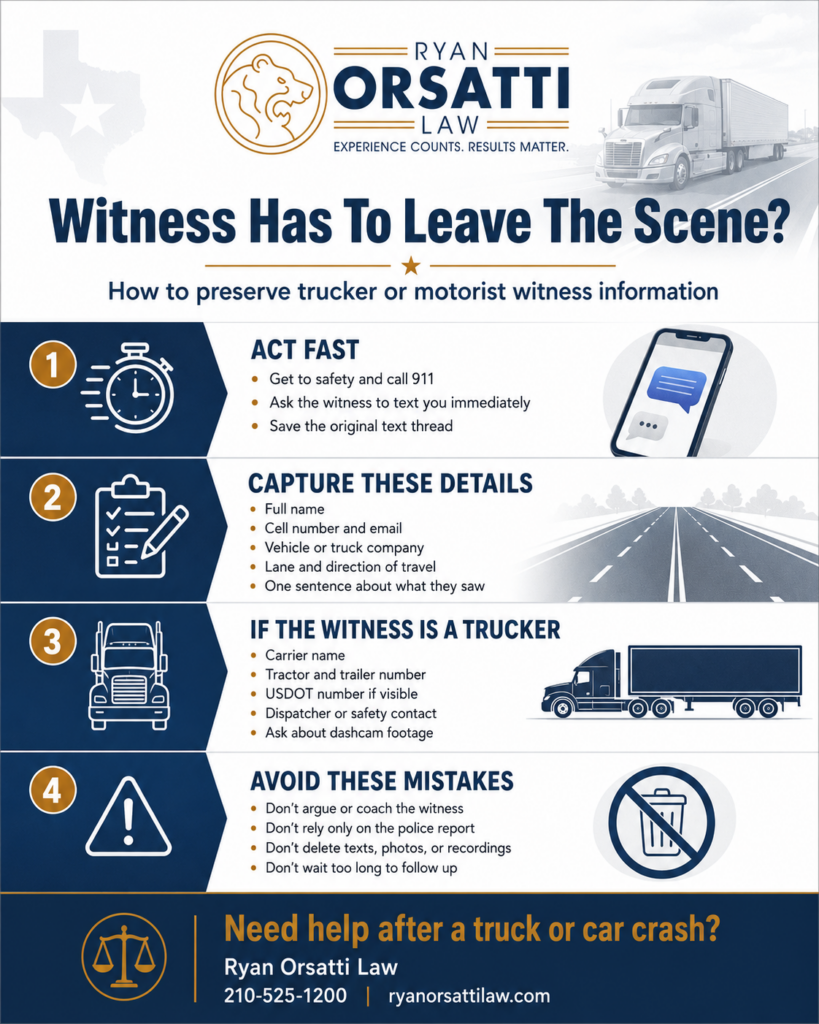
Why does witness contact information matter in a Texas truck or motor vehicle crash?
Witness contact information matters because an independent witness can help prove how the crash happened when drivers, insurers, or commercial carriers dispute fault. “Negligence” means failing to use reasonable care. “Liability” means legal responsibility for harm. A neutral witness can help show lane position, speed, traffic signals, braking, distraction, or whether a truck drifted, cut off traffic, or failed to stop.
TxDOT’s 2024 Texas Motor Vehicle Traffic Crash Facts reported 14,905 serious injury crashes in Texas, with 18,218 people sustaining serious injuries. TxDOT also reported one person injured every 2 minutes and 5 seconds, and one reportable crash every 57 seconds, based on reportable crashes in 2024. In that volume of wrecks, quick witness details can matter before memories fade and vehicles leave the scene.
Texas proportionate responsibility is the system Texas uses to divide fault among people or entities involved in a claim. Under Texas Civil Practice & Remedies Code § 33.001, a claimant generally cannot recover damages if their percentage of responsibility is greater than 50 percent. That makes independent witness evidence especially important when an insurer tries to shift blame onto the injured person. (Texas Statutes)
Quotable passage: In a Texas truck crash, the best 30-second witness-preservation move is to have the witness text you first: name, cell number, crash location, what lane they were in, and one sentence about what they saw. A live text thread creates a timestamp and avoids misspelled names or wrong numbers.
How do I preserve the contact information of a fellow trucker or motorist witness who has to leave the scene?
You preserve the contact information of a fellow trucker or motorist witness by creating a reliable contact path before the witness leaves. Do not try to conduct a full investigation on the shoulder of I-35, I-10, Loop 410, Loop 1604, or US-281. The goal is to preserve enough information so the witness can be reached later.
After a crash, do these 7 things:
- Get to safety first. Move out of live traffic if you can do so safely. Call 911 if anyone may be hurt or if the crash blocks traffic.
- Ask for the witness’s name and best cell number. Repeat the number back to confirm it.
- Have the witness text you immediately. Ask them to send their name, phone number, and the words “I witnessed the crash at [location].”
- Ask for email and permission for follow-up. A second contact method helps if the phone number changes or voicemail fills up.
- Capture identifying details. If visible or volunteered, photograph the witness’s license plate, vehicle, business card, tractor number, trailer number, company name, or USDOT number. Do not demand private documents.
- Ask for one sentence about what they saw. Keep it factual: lane, direction, light color, braking, impact, or vehicle movement.
- Give the witness information to the officer. Ask the witness to speak with the officer if time allows. If not, give the officer the witness’s name and number.
Quotable passage: TxDOT says reporting agencies have 10 days to submit the Texas Peace Officer’s Crash Report, commonly called the CR-3, to TxDOT. If a witness has to leave before the officer finishes, give the officer the witness’s name and number before the scene clears. (Texas Department of Transportation)
For San Antonio truck accident claims, this step can matter because commercial drivers may be moving freight, under dispatch, or out of state by the time an adjuster starts asking questions.
What should you ask the witness for before they leave?
You should ask the witness for contact details, location details, what they saw, and whether any video exists. Keep it short, calm, and factual. Do not argue, coach, or tell the witness what to say.
| Information to preserve | Why it matters | Fast way to capture it |
|---|---|---|
| Full name | Confirms who the witness is | Ask them to text their name to you |
| Cell number | Creates the fastest follow-up path | Call or text the number while they are standing there |
| Email address | Gives a backup contact method | Ask them to text it with their name |
| Vehicle description or plate | Helps identify the witness later | Photograph only what is visible in public |
| Lane and direction | Shows where the witness was positioned | Ask: “Where were you when you saw it?” |
| One-sentence statement | Preserves fresh memory | Ask: “What did you see happen?” |
| Dashcam, phone video, or photos | May preserve the crash itself | Ask whether video exists and who controls it |
| Employer, carrier, or dispatcher | Important for trucker witnesses | Ask for carrier name, unit number, or safety contact |
| Permission for follow-up | Reduces later confusion | Ask: “May my lawyer or insurer contact you?” |
A witness does not need to know legal terms. In fact, it is better if they do not try to decide fault at the scene. You want observable facts: “The white pickup changed lanes,” “The tractor-trailer crossed the line,” “The light was red,” or “Traffic was stopped.”
What if the witness only has 30 seconds?
If the witness only has 30 seconds, ask for a text message, not a long conversation. A short text creates a working number, a name, a timestamp, and a starting point for later follow-up.
Use this script:
“Could you please text me your name, phone number, and this sentence: ‘I witnessed the crash at [road/location] around [time]. I was in the [lane/direction] and saw [one sentence].’”
If the witness is already getting back into the truck or car, use the 10-second version:
“Can you text me your name and ‘I saw the crash on I-35 near [exit]’ before you leave?”
That is not a complete statement. It is a preservation step. A lawyer, investigator, insurer, or officer may later need a formal recorded statement, affidavit, deposition, or trial testimony. An affidavit is a written statement signed under oath. A deposition is sworn testimony given before trial.
Can a witness legally leave the crash scene in Texas?
A witness who was not involved in the crash usually is not under the same Texas Transportation Code Chapter 550 duty that applies to drivers involved in the collision, but leaving can make the claim harder to prove. The duties to stop, provide information, and render aid apply to operators involved in certain crashes, not every bystander who saw the collision. (Texas Statutes)
This is fact-dependent. If the person was actually involved, contributed to the crash, was ordered by law enforcement to remain, or has other legal obligations through employment or company policy, the analysis can change. From an evidence standpoint, the practical issue is simple: once a witness leaves without contact information, finding them later can become difficult.
Texas Civil Practice & Remedies Code § 16.003 gives many Texas personal injury claims a two-year limitations period, but evidence does not wait two years. Witness memory, phone numbers, dashcam footage, and dispatch records can disappear much faster. (Texas Statutes)
Should you record a quick witness statement on your phone?
You may ask to record a quick witness statement, but you should get clear permission first. Texas Penal Code § 16.02 generally permits recording when one party to the communication consents, but the cleaner roadside practice is to ask: “Is it okay if I record your name, number, and what you saw so I do not write it down wrong?” (Texas Statutes)
Keep the recording focused on facts. Ask:
- What is your name and phone number?
- Where were you when you saw the crash?
- What direction were you traveling?
- What did you see happen?
- Do you have dashcam, phone video, or photos?
- May someone follow up with you later?
A roadside recording is not automatically the same as admissible trial testimony. “Hearsay” means an out-of-court statement offered to prove the truth of what it says. A quick recording may help identify a witness and preserve memory, but lawyers may still need to evaluate admissibility, authentication, and whether formal testimony is needed under the Texas Rules of Evidence. (Texas Courts)
How do you make sure the witness gets into the police report?
You help get the witness into the police report by telling the investigating officer about the witness before the scene clears. TxDOT collects crash data submitted by Texas law enforcement officers on the Texas Peace Officer’s Crash Report form, often called the CR-3. Reporting agencies have 10 days to submit crash reports to TxDOT. (Texas Department of Transportation)
Do not assume the officer will automatically identify every witness. Officers may be managing injuries, blocked lanes, tow trucks, fire crews, leaking fluids, commercial vehicles, and angry drivers all at once. If the witness cannot wait, give the officer the witness’s name, phone number, and vehicle description.
Ask for the crash report number or incident number. Later, eligible people can obtain the CR-3 through TxDOT’s crash report system. If the report misses the witness, your saved text messages, call log, photos, and notes may still help locate that person.
What changes when the witness is another truck driver?
When the witness is another truck driver, preserve carrier and equipment information in addition to the driver’s personal contact details. A fellow trucker may have dashcam video, electronic logging device data, GPS route data, dispatch notes, or company safety contacts that can help confirm where the truck was and what the driver saw.
Quotable passage: For a fellow trucker witness, preserve more than a name and phone number. Ask for carrier name, tractor number, trailer number, lane position, direction of travel, dashcam status, and whether a dispatcher or safety department should receive a preservation notice. Those details are often easier to get at the roadside.
Ask for these details if the trucker can safely provide them:
- Driver name and cell number
- Carrier name
- Tractor number
- Trailer number
- USDOT number or MC number, if visible
- Dispatcher or safety department contact
- Direction of travel and lane position
- Whether the truck had forward-facing dashcam footage
- Whether the driver has a phone video or photo
- Whether company policy limits what they can share directly
Do not pressure a commercial driver to violate employer policy. Instead, preserve the identity of the driver, carrier, equipment, and video source. In serious commercial vehicle accident cases, a lawyer may send a spoliation letter. A spoliation letter is a written preservation notice that tells a person or company to keep evidence that may be relevant to a claim.
What mistakes can damage witness evidence after a crash?
The main mistakes are waiting too long, coaching the witness, losing the original communication, and assuming the crash report will capture everything. Witness evidence is most useful when it is prompt, factual, and traceable.
Avoid these mistakes:
- Asking the witness to say the other driver was “at fault”
- Telling the witness what you think happened before asking what they saw
- Arguing with the witness at the scene
- Only saving a screenshot instead of the original text thread
- Failing to call or text the number immediately to confirm it works
- Forgetting to ask where the witness was positioned
- Forgetting to ask about dashcam footage
- Not giving the witness information to the officer
- Posting witness statements or crash footage online
- Waiting weeks to follow up
A witness’s value often comes from independence. If an insurer later claims the witness was coached, confused, or influenced by social media posts, the statement may lose force. Keep the interaction short and clean.
Attorney Insight: In Bexar County crash files, the witness problem usually is not that nobody saw the crash. It is that the witness was a trucker on a deadline, a nurse on the way to work, or a rideshare passenger who left before the report was completed. A name without a working phone number is often not enough. The best field move is to have the witness text you first, because that creates an instant contact path, a timestamp, and a spelling check.
When should a lawyer get involved after you preserve witness information?
A lawyer should usually get involved quickly when the crash involves a commercial vehicle, serious injury, disputed fault, missing video, multiple vehicles, or a witness who may be hard to locate later. The faster witness information is preserved, the easier it may be to request video, identify companies, and prevent evidence from being overwritten or lost.
In litigation, subpoenas may be used under the Texas Rules of Civil Procedure to obtain testimony or records from nonparties. A subpoena is a court-backed command to provide testimony, documents, or both. That can matter if a witness later becomes unavailable, a carrier controls dashcam footage, or a business has records tied to the crash. (Texas Courts)
Witness evidence can also affect insurance and medical-bill issues. UM/UIM coverage means uninsured or underinsured motorist coverage, which may apply through your own policy when the at-fault driver has no insurance or not enough insurance. MedPay means medical payments coverage. Subrogation means a health insurer’s claimed right to repayment. A hospital lien is a hospital’s legal claim against part of a recovery. An ERISA plan is an employer health plan governed by federal benefits law that may assert reimbursement rights. A letter of protection is an agreement that may allow treatment now with payment addressed from case proceeds later. These issues are fact-specific, and witness evidence can affect how responsibility and damages are evaluated.
Ryan Orsatti Law handles Texas personal injury representation in San Antonio and can be contacted through the firm’s contact page for questions about truck, commercial vehicle, and motor vehicle crash evidence.
FAQ
What if a witness refuses to give me their phone number after a Texas crash?
If a witness refuses to give you a phone number, do not pressure them. Ask if they will speak to the investigating officer, call 911 to report what they saw, or provide an email instead. If they decline, write down their vehicle description, plate if visible, location, and what they said, but keep the interaction respectful and safe.
Can I ask a trucker witness for dashcam video at the scene?
Yes, you can ask whether dashcam video exists, but do not demand that a trucker violate company policy or hand over equipment roadside. Ask for the carrier name, tractor number, trailer number, dispatcher contact, and safety department contact. A preservation letter may then be sent to request that relevant video be saved.
Will the Texas crash report include the witness’s contact information?
The Texas crash report may include witness information, but you should not rely on that alone. Officers may be handling injuries, traffic control, and vehicle removal. TxDOT states reporting agencies have 10 days to submit the CR-3 crash report, so preserve the witness information yourself and give it to the officer before leaving. (Texas Department of Transportation)
Is a text message from a witness enough for an insurance claim?
A text message from a witness can help, but it usually is not the full proof needed for a disputed claim. The text helps identify the witness, preserve a contact path, and capture fresh memory. An insurer, lawyer, or court may still need an interview, affidavit, deposition, records, or sworn testimony.
What should I say when a motorist witness says they cannot stay?
Say this: “I understand. Can you please text me your name, phone number, and one sentence about what you saw before you leave?” If there is an officer nearby, ask whether the witness can give the officer their number. Keep it short. The goal is contact preservation, not a full roadside statement.
Does witness contact information matter if the other driver admitted fault?
Yes. Witness contact information still matters because stories can change after drivers speak with insurers, employers, family members, or defense representatives. In truck crash and multi-vehicle cases, carriers and insurers may later dispute speed, lane position, causation, or comparative responsibility. A neutral witness can help anchor what happened at the scene.
Should I give witness information to my insurance company?
You can give witness information to your insurer, but be careful about recorded statements, fault discussions, and incomplete facts if you are injured or unsure what happened. In serious crashes, especially truck or commercial vehicle wrecks, it may be wise to speak with a Texas personal injury attorney before giving detailed statements to any insurer.
How long should I keep witness texts, call logs, photos, and recordings?
Keep witness texts, call logs, photos, and recordings until the claim is fully resolved and all related issues are closed. Do not delete the original thread after taking screenshots. Originals may contain metadata, timestamps, phone numbers, and context that screenshots may miss. Back up the evidence in more than one secure location.
Ryan Orsatti Law
4634 De Zavala Rd, San Antonio, TX 78249
Phone: 210-525-1200
ryanorsattilaw.com
This blog is for informational purposes only, not legal advice. Reading it does not create an attorney-client relationship. Past results do not guarantee future results.
Hurt in an accident in San Antonio? Learn how a San Antonio personal injury lawyer can help with your claim. Call 210-525-1200 or request a free consultation.
The firm works on a contingency fee. You pay nothing unless the firm recovers money for you, and that covers case expenses as well as the fee: if there is no recovery, you owe no attorney's fee and no case expenses. Ask for the fee agreement and read the fee and expense section before you sign anything.
Related San Antonio legal resources
Primary legal and public-data sources
- Texas Civil Practice and Remedies Code Chapter 16: limitations
- Texas Civil Practice and Remedies Code Chapter 33: proportionate responsibility
Ryan Orsatti Law
4634 De Zavala Road, San Antonio, TX 78249
General reference links. Consult each source for its current text.