
Quick Answer
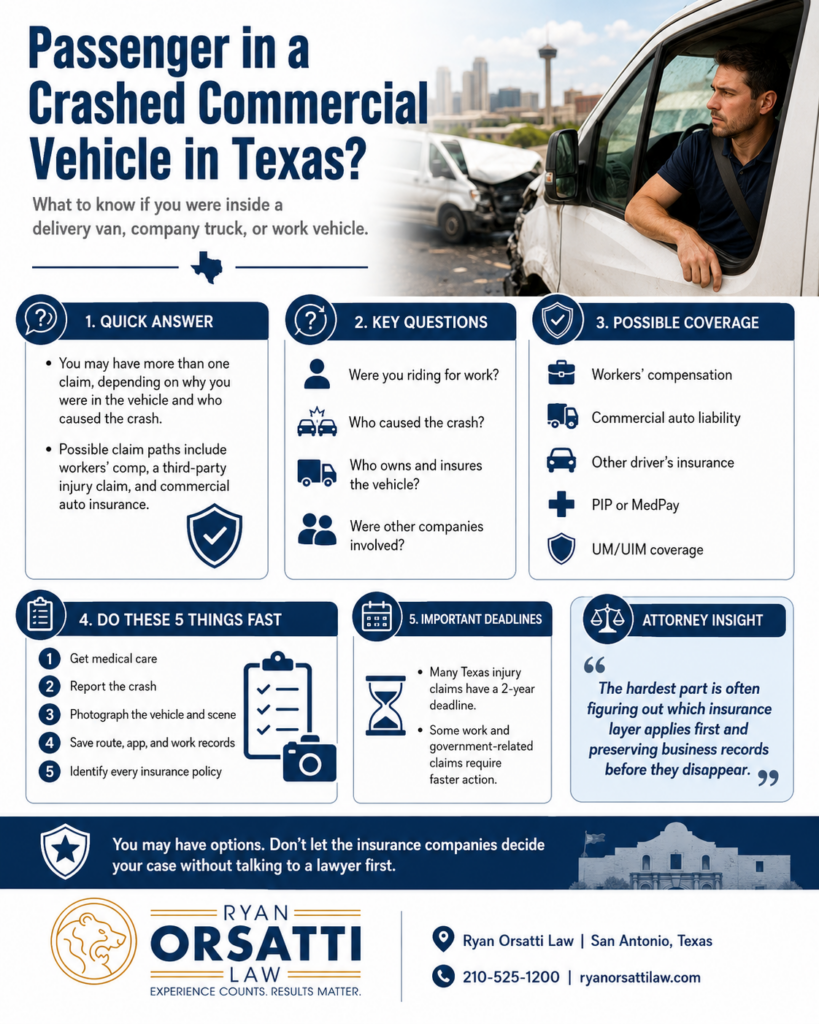
If you were a passenger inside the commercial vehicle that crashed in Texas, you may have more than one claim: workers’ compensation if you were on the job, a third-party injury claim if an outside person or company contributed to the crash, and insurance claims under commercial auto, PIP, MedPay, or UM/UIM coverage. The key question is your legal role in the vehicle, not just the logo on the door. Texas private employers can choose whether to carry workers’ compensation in most cases, and injured employees may still pursue liable third parties in appropriate cases. (Texas Department of Insurance)
Key Takeaways
- Do not assume an Amazon DSP van, company pickup, box truck, or work truck creates one simple claim.
- If you were riding for work, first confirm whether the employer carried Texas workers’ compensation coverage.
- If another driver, maintenance company, loading company, vehicle owner, or contractor helped cause the crash, you may have a separate third-party claim.
- Commercial vehicle cases often require fast preservation of route data, dashcam video, app records, dispatch messages, inspection records, and insurance information.
- Before giving a recorded statement or signing a release, identify every potential coverage layer and lien issue.
What rights do I have if I was a passenger inside the commercial vehicle that crashed?
A passenger inside a crashed commercial vehicle has the right to investigate who caused the crash, what insurance applies, and whether the passenger was in the vehicle for work or personal reasons. That includes people riding in Amazon DSP vans, delivery vehicles, construction trucks, company pickups, shuttle vans, box trucks, utility vehicles, and service trucks.
In Texas injury law, negligence means failing to use reasonable care. A passenger claim usually asks whether a driver, company, vehicle owner, maintenance contractor, loading contractor, or other party failed to use reasonable care and caused injury.
A passenger is often not accused of causing the crash itself. But that does not mean fault is irrelevant. Texas uses proportionate responsibility, which means a claimant generally cannot recover damages if their percentage of responsibility is greater than 50 percent. In a passenger case, that issue usually shows up through arguments about seat belt use, failure to speak up about a dangerous driver, or disputed facts about whether the passenger was authorized to ride. (Texas Statutes)
TxDOT reported 14,905 serious injury crashes in Texas in 2024, with 18,218 people sustaining a serious injury. TxDOT also reported 251,977 people injured in motor vehicle traffic crashes that year. Passenger claims inside commercial vehicles sit inside that broader roadway risk, but the insurance and employment questions are usually more complex than a basic two-car wreck. (Texas Department of Transportation)
Does it matter that the vehicle was an Amazon DSP van, delivery van, or work truck?
Yes, the commercial branding matters for investigation, but it does not automatically tell you who is legally responsible. An Amazon logo, delivery-route label, contractor decal, company magnet, USDOT number, or business name is a starting point, not the final answer.
In a Texas Amazon DSP or delivery-van crash, the logo on the van is only the starting point. Liability usually turns on who employed the driver, who controlled the route, who owned or maintained the vehicle, who loaded it, and whether a third-party driver caused or contributed to the wreck.
Commercial vehicle crashes can involve several entities at once. In a San Antonio crash on Loop 410, I-35, I-10, Loop 1604, or US-281, the responsible parties might include:
- The driver of the commercial vehicle
- The employer or delivery service partner
- The vehicle owner
- A fleet maintenance company
- A loading or warehouse contractor
- Another driver who hit the commercial vehicle
- A tire, brake, or vehicle component manufacturer
- A road contractor, in limited fact-specific situations
For more on commercial vehicle injury claims in San Antonio, see Ryan Orsatti Law’s page on commercial vehicle accident cases.
Was I working when the commercial vehicle crashed?
If you were riding in the commercial vehicle to further your employer’s business, the crash may be treated as an on-the-job injury. That matters because Texas workers’ compensation coverage, if available, can affect where your claim starts and who can be sued.
Workers’ compensation is a state-regulated system that may provide medical and income benefits for a work-related injury. In Texas, private employers generally may choose whether to carry workers’ compensation coverage, unless a specific law or contract requires it. TDI describes Texas employers as workers’ compensation subscribers, certified self-insured employers, or non-subscribers. (Texas Department of Insurance)
Texas private employers are not required in most cases to carry workers’ compensation insurance. That single fact changes a passenger-in-work-truck case: a subscribing employer points you toward DWC benefits, while a non-subscribing employer may face a negligence lawsuit under Texas Labor Code § 406.033. (Texas Department of Insurance)
| Your role in the commercial vehicle | Likely claim path | What must be checked |
|---|---|---|
| Employee passenger, employer has workers’ compensation | Division of Workers’ Compensation claim, plus possible third-party claim | Employer coverage status, DWC forms, medical network rules, wage benefits, third-party fault |
| Employee passenger, employer does not have workers’ compensation | Potential negligence claim against employer, plus other liable parties | Non-subscriber status, unsafe driving, hiring, training, supervision, vehicle maintenance |
| Contractor, helper, temp worker, or gig worker | Fact-specific employment and insurance analysis | Who paid you, who controlled the work, written agreements, app records, vehicle ownership |
| Non-work passenger, customer, or ride-along | Personal injury claim against negligent parties | Authorization to ride, commercial auto coverage, outside driver liability, PIP, MedPay, UM/UIM |
| Unauthorized passenger | Still fact-specific, not automatically a no-claim situation | Why you were in the vehicle, driver permission, company policies, comparative fault arguments |
If you were hurt while working, report the injury to your employer in writing and ask for the workers’ compensation carrier information. TDI also allows injured workers to ask the Division of Workers’ Compensation to confirm whether an employer has workers’ compensation coverage. (Texas Department of Insurance)
Can I still sue someone if workers’ compensation applies?
Yes, workers’ compensation can exist at the same time as a third-party injury claim. A third-party claim means a claim against someone other than your employer or coworker, such as an outside driver, maintenance contractor, product manufacturer, vehicle owner, or negligent contractor.
A Texas work-passenger claim can have two tracks at the same time: a Division of Workers’ Compensation claim with the employer’s carrier, and a third-party injury claim against an outside driver, maintenance contractor, vehicle owner, or product manufacturer. The third-party recovery must account for workers’ compensation subrogation. (Texas Department of Insurance)
Subrogation means an insurer or benefit provider may claim reimbursement from money recovered from a responsible third party. In Texas workers’ compensation cases, the carrier may have a statutory reimbursement interest when the injured worker recovers from a liable third party. (Texas Department of Insurance)
There is an important limit. If the employer carried workers’ compensation, Texas Labor Code § 408.001 generally makes workers’ compensation benefits the exclusive remedy against the employer and certain employer-related parties for a work-related injury. That rule does not automatically protect unrelated third parties. (Texas Statutes)
For serious commercial vehicle crashes, Ryan Orsatti Law also discusses early investigation issues in its guide on what to do after a truck accident.
What insurance may apply after a passenger injury in a commercial vehicle crash?
Several insurance layers may apply after a passenger injury in a commercial vehicle crash, and the crash report alone rarely identifies all of them. The correct coverage analysis depends on who owned the vehicle, who employed the driver, whether you were working, whether another driver contributed, and what policies were in force.
| Possible coverage or payment source | Why it matters |
|---|---|
| Workers’ compensation | May pay work-related medical and income benefits if the employer carried coverage |
| Employer non-subscriber liability coverage | May apply if the employer opted out of Texas workers’ compensation and carried a private injury policy |
| Commercial auto liability coverage | May apply if the commercial driver, vehicle owner, or company is legally responsible |
| Outside driver’s liability insurance | May apply if another driver caused or contributed to the crash |
| Personal injury protection (PIP) | Texas auto policies include PIP unless rejected in writing, and it may cover medical bills, lost wages, and certain other costs |
| Medical payments coverage (MedPay) | Optional coverage that may help with medical bills, depending on the policy |
| UM/UIM coverage | May apply if the at-fault driver had no insurance or not enough insurance, if coverage exists and was not rejected where required |
| Health insurance | May pay treatment but may later assert reimbursement rights |
| Hospital lien | A hospital may claim a legal interest in certain injury recoveries if Texas Property Code Chapter 55 requirements are met |
TDI explains that Texas auto policies include PIP unless rejected in writing, that MedPay may pay medical bills, and that UM/UIM coverage may apply when the other driver has no insurance or not enough insurance. Those coverages must be reviewed carefully because a passenger may not know which policies apply until the commercial policy, personal policy, and any household policies are checked. (Texas Department of Insurance)
A hospital lien is a legal claim by a hospital against certain injury recoveries. Under Texas Property Code Chapter 55, hospital lien issues can arise when hospital treatment occurs soon after the accident, including the statute’s 72-hour timing requirement for a hospital lien to attach. (Texas Statutes)
What evidence should be preserved after an Amazon DSP van or work truck crash?
Evidence should be preserved immediately because commercial vehicle data and business records can disappear quickly. The most useful evidence is often controlled by the company, the vehicle owner, the app platform, the maintenance vendor, or another insurer.
In commercial vehicle passenger cases, the best early evidence often includes:
- Crash report information
- Photos of the vehicle, interior, seat belt, cargo, and crash scene
- Dashcam or inward-facing camera footage
- Route app data, GPS data, and dispatch messages
- Clock-in records and job assignment records
- Vehicle inspection, maintenance, and repair records
- Driver qualification, training, and disciplinary records
- Cargo loading information
- Witness names and phone numbers
- Insurance policy declarations pages
- Medical records and bills
After a commercial vehicle passenger crash, do these 7 things
- Get medical care and describe every symptom, even if symptoms seem minor at first.
- Make sure the crash was reported to law enforcement if anyone was injured.
- Photograph the vehicle, license plate, logos, unit number, seat position, seat belt, cabin, cargo, and nearby businesses with cameras.
- Save texts, app screenshots, dispatch instructions, clock-in records, route information, and coworker names.
- If you were working, report the injury to your employer in writing and ask for the workers’ compensation carrier or non-subscriber information.
- Identify every possible insurer: employer, commercial auto carrier, vehicle owner, outside driver, PIP, MedPay, UM/UIM, and health insurer.
- Do not sign a broad release or give a recorded statement until you understand the claim path, coverage layers, and lien issues.
TDI recommends that people involved in a crash exchange information, gather witness details, photograph the scene and damage, notify the insurer promptly, and send documents such as the police report when available. Those steps are even more important when the vehicle is commercial and business records may be needed. (Texas Department of Insurance)
How long do I have to act in Texas?
Most Texas bodily-injury lawsuits must be filed within two years, but some notices and evidence deadlines arrive much earlier. Texas Civil Practice and Remedies Code § 16.003 sets a two-year limitations period for personal injury claims. (Texas Statutes)
Texas Civil Practice and Remedies Code § 16.003 generally gives an injured passenger two years to file a bodily-injury lawsuit. That does not protect short-lived evidence like van telematics, route-app data, dashcam video, driver statements, workers’ compensation notices, or governmental notice requirements.
Some cases require faster action. If a city, county, school district, transit authority, state vehicle, or public roadway defect is involved, governmental notice rules may apply. Texas Civil Practice and Remedies Code § 101.101 generally requires notice of a claim within six months unless a shorter charter or ordinance provision applies. (Justia Law)
If the crash happened while you were working, workers’ compensation reporting and DWC paperwork can also affect the case. TDI instructs injured workers to report the injury to the employer and explains that injured workers may receive DWC Form-041 in an injured employee packet. (Texas Department of Insurance)
What if the company says I was just a passenger and not their problem?
A company cannot end the analysis by saying you were “just a passenger.” Passenger status may reduce arguments that you caused the crash, but it does not answer who owed duties, who controlled the driver, what coverage applies, or whether your ride was part of your job.
In Bexar County commercial vehicle passenger cases, adjusters usually look at five things first: why the passenger was in the vehicle, who controlled the driver, whether workers’ compensation applies, whether a third-party driver shares fault, and whether medical records connect the injury to the crash.
Texas law also allows seat belt evidence in limited circumstances. The Texas Supreme Court has held that relevant seat belt use or nonuse evidence may be admissible for apportioning responsibility if supported by proper proof and if it satisfies the Rules of Evidence. That does not mean seat belt nonuse caused the crash, but insurers may argue it affected injury severity. (Justia Law)
Attorney Insight: In commercial-vehicle passenger cases, the early fight is often not whether the passenger was hurt. It is which insurance layer pays first, which company controls the records, and whether a workers’ compensation carrier, health insurer, hospital lien, or benefit plan will claim reimbursement from the same recovery. We look for those issues before a demand is sent, because fixing lien problems late can reduce the client’s practical options.
How does Ryan Orsatti Law review a commercial vehicle passenger case?
A lawyer should review the crash report, employer paperwork, insurance information, vehicle records, and medical documentation before any recorded statement or release. In matters involving commercial vehicles, the order of investigation matters because one mistaken assumption can send the claim down the wrong path.
For example, an injured passenger in an Amazon DSP van on Loop 1604 might have a workers’ compensation issue, an outside-driver claim, commercial auto coverage, app data, route records, PIP, MedPay, health insurance reimbursement, and a hospital lien question. A passenger in a company pickup on I-10 near Boerne may have a different set of issues if the employer is a Texas non-subscriber.
Ryan Orsatti Law reviews commercial vehicle and car crash cases from its San Antonio office. You can learn more about the firm’s San Antonio car accident representation, its commercial vehicle accident work, or contact the firm through its contact page.
FAQ
Can I sue if I was a passenger in an Amazon DSP van that crashed in Texas?
Yes, you may be able to bring a claim, but the correct claim depends on why you were in the van and who caused the crash. If you were working, workers’ compensation or non-subscriber rules may matter. If another driver, company, or contractor contributed, a third-party injury claim may also exist.
Is a work truck passenger crash automatically a workers’ compensation case?
No. A work truck passenger crash is not automatically a workers’ compensation case because Texas private employers generally can choose whether to carry workers’ compensation coverage. If the employer carried coverage, DWC benefits may apply. If the employer did not, the case may involve a Texas non-subscriber negligence claim. (Texas Department of Insurance)
Can I make a claim against my coworker driver?
It depends on workers’ compensation coverage and the facts. If the employer carried Texas workers’ compensation and the crash was work-related, Labor Code § 408.001 may limit claims against the employer and certain related parties. If a third party contributed, or if the employer was a non-subscriber, the analysis changes. (Texas Statutes)
What if another driver hit the commercial vehicle I was riding in?
If another driver hit the commercial vehicle, you may have a claim against that driver’s liability insurance. You may also need to check commercial auto coverage, PIP, MedPay, UM/UIM, workers’ compensation, and health insurance reimbursement issues. A passenger claim often requires reviewing every policy, not just the at-fault driver’s policy. (Texas Department of Insurance)
What if I was not wearing a seat belt in the commercial vehicle?
Seat belt nonuse does not usually cause the crash itself, but Texas defendants may try to use it to argue injury severity or responsibility for damages. The Texas Supreme Court has allowed relevant seat belt evidence in apportionment issues when supported by proper proof and subject to evidence rules. (Justia Law)
What if the commercial vehicle was rented, leased, or maintained by another company?
A rented, leased, or vendor-maintained vehicle can add responsible parties and insurance layers. The investigation should check the rental agreement, lease, maintenance contract, inspection records, vehicle ownership, driver employer, and all insurance policies. The company name on the door may not be the same entity that owned, maintained, or insured the vehicle.
How soon should I contact a lawyer after being hurt as a passenger in a commercial vehicle?
You should contact a lawyer as soon as practical, especially before giving a recorded statement or signing a release. Texas generally gives two years to file a bodily-injury lawsuit, but commercial vehicle records, video, app data, workers’ compensation paperwork, and governmental notices can create much earlier practical deadlines. (Texas Statutes)
Ryan Orsatti Law
4634 De Zavala Rd, San Antonio, TX 78249
Phone: 210-525-1200
ryanorsattilaw.com
This blog is for informational purposes only, not legal advice. Reading it does not create an attorney-client relationship. Past results do not guarantee future results.
Hurt in an accident in San Antonio? Learn how a San Antonio personal injury lawyer can help with your claim. Call 210-525-1200 or request a free consultation.
The firm works on a contingency fee. You pay nothing unless the firm recovers money for you, and that covers case expenses as well as the fee: if there is no recovery, you owe no attorney's fee and no case expenses. Ask for the fee agreement and read the fee and expense section before you sign anything.
Related San Antonio legal resources
Primary legal and public-data sources
Ryan Orsatti Law
4634 De Zavala Road, San Antonio, TX 78249
General reference links. Consult each source for its current text.