
Quick Answer
If your Texas crash occurred in a marked school zone, active construction zone, or TxDOT work zone, the location can affect fault, evidence, insurance, and deadlines. It does not automatically prove liability, but violations of school-zone speed limits, cellphone restrictions, work-zone signs, flagger instructions, or TxDOT traffic-control rules can become important evidence. Preserve photos, dashcam video, witness information, the crash report, and any TxDOT or contractor records quickly, especially if a governmental unit may be involved.
Key Takeaways
- A marked school zone can change the fault analysis because reduced speed limits, crosswalks, buses, cellphone restrictions, and children nearby all matter.
- A construction or maintenance work zone can add evidence such as cones, barrels, barricades, lane closures, flaggers, arrow boards, signs, and contractor records.
- TxDOT work-zone cases may involve private contractors, subcontractors, traffic-control plans, inspection records, and possible government notice issues.
- Texas uses proportionate responsibility, meaning fault can be divided among drivers, contractors, employers, governmental units, and sometimes the injured person.
- Do not rely only on the police crash report. The zone setup can change quickly, so photographs and preservation letters matter.
- Insurance limits, UM/UIM coverage, PIP, MedPay, hospital liens, and subrogation can affect the practical value of the claim.
Does a Texas crash in a marked school zone, active construction zone, or TxDOT work zone change my claim?
Yes, a Texas crash in a marked school zone, active construction zone, or TxDOT work zone can change how fault is evaluated, what evidence matters, and which parties may be involved. The location does not automatically mean the other driver is legally responsible, but it often gives the claim a more specific liability framework.
A regular rear-end crash may focus mostly on speed, following distance, distraction, and injury causation. A school-zone or work-zone crash adds more questions:
- Was the reduced speed limit active?
- Were school-zone lights flashing?
- Was the driver using a phone where Texas law restricted it?
- Were workers present?
- Were barrels, cones, signs, barricades, or arrow boards placed correctly?
- Did a flagger direct traffic?
- Did a TxDOT contractor follow the Traffic Control Plan?
- Did a sudden lane closure, pavement drop-off, missing sign, or confusing taper contribute to the crash?
A Texas school-zone or work-zone crash is not automatically a stronger injury claim simply because of the location. The useful question is whether a driver, contractor, employer, or public entity violated a specific safety rule, sign, traffic-control plan, or notice requirement that was designed to protect people in that exact zone.
This article focuses on injury claims after motor vehicle crashes, not defending a traffic ticket.
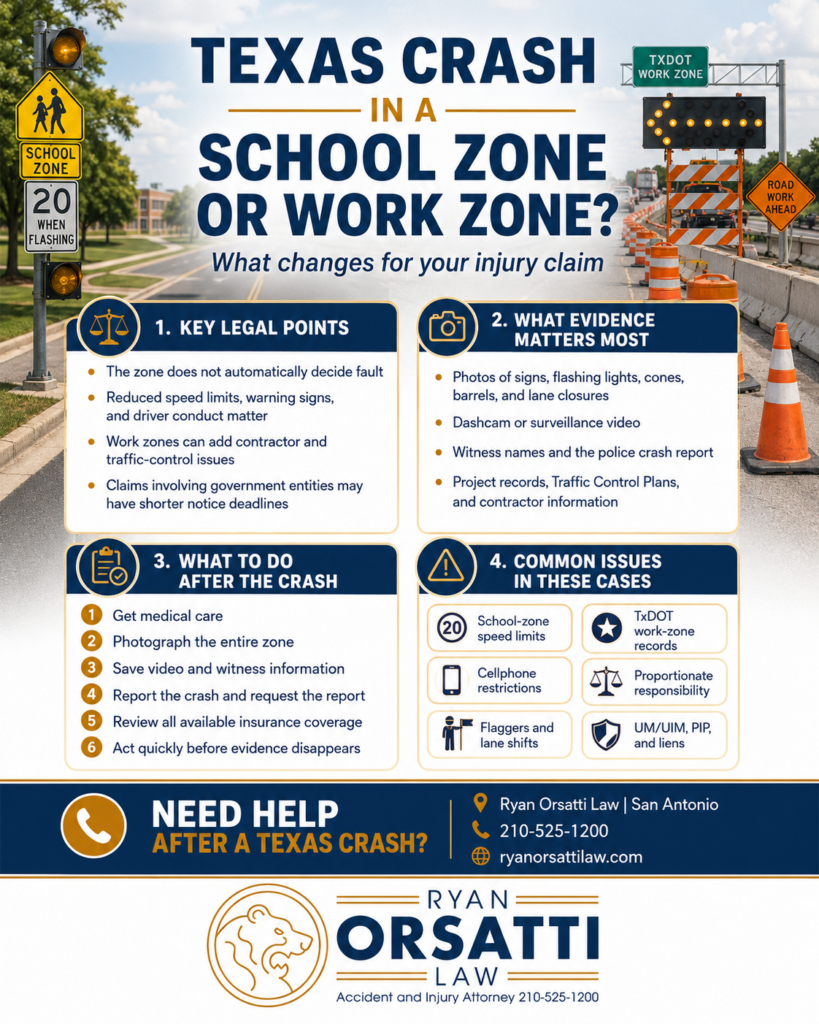
What is a marked school zone under Texas law?
A marked school zone usually means a reduced-speed school crossing zone designated to help children safely travel to or from a public or private elementary or secondary school while the reduced limit applies. Texas Transportation Code § 541.302 defines a school crossing zone as a reduced-speed zone designated by a local authority to facilitate safe crossing by children going to or leaving school. (Texas Legislature Online)
That definition makes timing important. A driver may argue that the school zone was not active. An injured person may need photos, the time of the crash, school-day information, flashing-light evidence, witness statements, and the crash report to show what rules were in effect.
School-zone crashes are not rare. TxDOT reported that, in 2024, Texas school zones had 781 traffic crashes, causing 2 deaths and 17 serious injuries. TxDOT also reported 2,480 school-bus-related crashes in 2024, causing 11 deaths and 93 serious injuries. (TxDOT)
Texas also restricts cellphone use in school crossing zones. Texas Transportation Code § 545.425 prohibits operating a motor vehicle while using a wireless communication device in a school crossing zone unless the vehicle is stopped or the device is used hands-free. Local enforcement requires proper signs at each entrance to the school crossing zone. (Texas Legislature Online)
Under Texas Transportation Code § 541.302, a school crossing zone is a reduced-speed zone designated for children going to or leaving school while the reduced speed limit applies. That definition makes the crash time, flashing lights, signs, school calendar, crosswalk location, and witness accounts central evidence in a Texas school-zone injury claim.
What if the crash happened in an active construction zone or maintenance work zone?
An active construction or maintenance work zone can make the claim more evidence-heavy because the crash may involve temporary traffic controls, narrow lanes, sudden stops, lane shifts, equipment, workers, and signs that were not present before the project. TxDOT warns that work zones may include uneven pavement, narrow lanes, concrete barriers, slow-moving equipment, and sudden stops. (TxDOT)
In 2025, TxDOT reported more than 28,000 Texas work-zone crashes, with 203 people killed, including seven roadside workers. (TxDOT) Those numbers matter because they show work-zone crashes are a recurring statewide safety issue, not a one-off event.
Texas law also treats certain work-zone traffic violations differently. TxDOT states that traffic fines double in work zones when workers are present, and TxDOT has identified rear-end collisions as the most common type of work-zone crash. (TxDOT) The civil injury claim, however, is not decided by the fine alone.
Texas Transportation Code § 542.404 can double the minimum and maximum fines for certain traffic offenses committed in a construction or maintenance work zone when workers are present. The civil injury case still turns on proof of fault, causation, damages, and Texas proportionate responsibility under Chapter 33.
Common work-zone liability issues include:
- Following too closely before a lane closure
- Speeding through a reduced-speed construction area
- Distracted driving near workers, barrels, or stopped traffic
- Unsafe merging at a taper
- Ignoring a flagger or police traffic-control direction
- Hitting a stopped vehicle near construction congestion
- Crashing because signs, barrels, lighting, or lane markings were confusing, missing, or inconsistent
What makes a TxDOT work zone different from a private construction area?
A TxDOT work-zone crash can require investigation into both the drivers and the design, setup, inspection, and maintenance of temporary traffic controls. TxDOT maintains traffic-control standards and design practices for state highway construction and maintenance projects, including temporary traffic-control resources under the Texas Manual on Uniform Traffic Control Devices. (TxDOT)
The 2025 Texas Manual on Uniform Traffic Control Devices became effective January 18, 2026, and TxDOT identifies Part 6 as covering Temporary Traffic Control and Part 7 as covering Traffic Control for School Areas. (TxDOT) That can matter when a crash occurs on I-35, I-10, Loop 410, Loop 1604, US-281, I-45, I-20, or another Texas highway corridor.
TxDOT’s Traffic Control Plan guidance explains that TCP sheets direct contractor and construction staff on how to configure traffic flow, signs, markings, lane widths, and temporary devices to move traffic safely and protect the traveling public, workers, pedestrians, and construction equipment. (TxDOT)
In a TxDOT work zone, the best evidence is often not just the police crash report. Traffic Control Plan sheets, inspection records, lane-closure logs, contractor documents, flagger assignments, and photographs of signs, barrels, pavement markings, and lane widths can show whether the temporary setup matched the plan.
This is why a TxDOT work-zone crash on a San Antonio freeway may require more than a driver-versus-driver insurance claim. It may require project records, contractor information, subcontractor roles, inspection logs, and preservation letters directed to the correct entities.
How do school zones, construction zones, and TxDOT work zones change the evidence?
These zones change the evidence because the physical setup, signs, timing, and traffic-control rules can become just as important as the vehicles themselves. A crash in a normal lane of travel may be reconstructed from vehicle damage, statements, photos, skid marks, and the crash report. A zone crash may require proof of what the zone looked like at the exact time of impact.
| Crash location | Why it matters | Evidence to preserve | Watch for |
|---|---|---|---|
| Marked school zone | Reduced speeds, crosswalks, children, school buses, and cellphone restrictions may apply | Flashing lights, school-zone signs, crosswalks, school calendar, time of crash, witness names, dashcam video | Driver claiming the zone was inactive |
| Active construction zone | Temporary lanes, barrels, cones, flaggers, equipment, and sudden stops may affect fault | Photos of signs, lane closures, cones, barrels, barricades, arrow boards, workers, flaggers, and final vehicle positions | Adjuster treating the case as a simple rear-end crash |
| TxDOT work zone | State highway project records and contractor traffic-control documents may matter | Traffic Control Plan, lane-closure logs, inspection records, contractor records, project photos, police traffic-control records | Delay that allows temporary evidence to disappear |
| Emergency or TxDOT vehicle on shoulder | Move Over/Slow Down duties may apply near certain stopped vehicles with lights activated | Photos or video of stopped vehicle, lights, shoulder location, lane availability, and traffic conditions | Disputes about whether moving over was possible |
Texas also has a Move Over/Slow Down law. TxDOT explains that drivers must move over or slow to 20 mph below the posted speed limit when approaching certain stopped vehicles with activated overhead lights, including law enforcement, emergency responders, tow trucks, utility service vehicles, TxDOT vehicles, and other listed vehicles. (TxDOT)
Who can be at fault after a school-zone or work-zone crash in Texas?
Fault can be assigned to one driver, multiple drivers, a trucking company, a construction contractor, a subcontractor, a governmental unit, or the injured person, depending on what caused the crash. Texas Civil Practice & Remedies Code § 33.001 bars recovery if the claimant’s percentage of responsibility is greater than 50 percent. (Texas Statutes)
Proportionate responsibility means the jury or factfinder can divide fault by percentage. In plain English, if several people or entities contributed to the crash, Texas law allows responsibility to be allocated among them. That allocation can reduce or bar recovery depending on the injured person’s percentage of fault.
Possible responsible parties may include:
- A speeding driver in a school zone
- A distracted driver using a phone in a school crossing zone
- A driver who failed to yield at a crosswalk
- A commercial driver who followed too closely in a work zone
- A trucking company if training, scheduling, maintenance, or driver conduct contributed
- A contractor or subcontractor responsible for signs, cones, lane closures, barriers, or flagging
- A governmental unit if a roadway condition or traffic-control issue legally supports a claim, subject to immunity and notice rules
- The injured person, if the defense argues speeding, distraction, improper lane change, or failure to follow signs
For crashes involving 18-wheelers, dump trucks, delivery vehicles, contractor pickups, or other commercial vehicles, internal company evidence can matter. Ryan Orsatti Law has separate resources for San Antonio truck accident claimsand commercial vehicle accident claims.
What deadlines apply if TxDOT, a city, a county, or another governmental unit may be involved?
Deadlines can be shorter and more complicated when TxDOT, a city, a county, a school district, or another governmental unit may be involved. Texas Civil Practice & Remedies Code § 101.101 generally requires notice of a claim to a governmental unit not later than six months after the incident, and the notice must reasonably describe the injury or damage, the time and place of the incident, and what happened. (Texas Legislature Online)
That six-month rule is not the only deadline to watch. Some local charters or ordinances may create shorter notice requirements, and the ordinary lawsuit deadline still matters. Texas Civil Practice & Remedies Code § 16.003 generally gives two years for personal-injury claims and wrongful-death claims, though exceptions and special rules can apply. (Texas Statutes)
TxDOT also states that claims involving highway conditions under the Texas Civil Practice & Remedies Code must be submitted in writing and that oral claims are not accepted. TxDOT’s claim guidance asks for details such as location, county, type of damage, contact information, and supporting documentation. (TxDOT)
A notice letter is not the same thing as filing a lawsuit. It also does not guarantee that a governmental claim is legally allowed. These cases require early evaluation because sovereign immunity, contractor responsibility, roadway condition evidence, and notice compliance can all become disputed.
After a school-zone, construction-zone, or TxDOT work-zone crash, what should I do first?
After this kind of crash, preserve evidence that shows what the zone looked like at the exact time of the collision. School-zone lights stop flashing, workers leave, lanes reopen, barrels move, signs change, and dashcam footage can be overwritten.
Use this checklist as soon as you can safely do so:
- Call 911 and report the crash. Ask for medical help if anyone may be hurt.
- Photograph the full zone from every safe angle. Include school-zone signs, flashing lights, speed-limit signs, crosswalks, cones, barrels, barricades, arrow boards, lane closures, workers, flaggers, equipment, and “End Road Work” or “End School Zone” signs.
- Capture the timing evidence. Save the exact time, date, weather, lighting, school-day status, traffic conditions, and whether workers or children were present.
- Save vehicle-position evidence. Photograph final resting positions, debris, skid marks, lane markings, shoulder conditions, pavement drop-offs, and impact damage.
- Get witness information. Look for crossing guards, school staff, construction workers, nearby drivers, business employees, and anyone with dashcam or surveillance video.
- Preserve your own video. Download dashcam footage, phone video, vehicle app data, and photos before anything is deleted or overwritten.
- Get medical care and follow through. Delayed symptoms are common after crashes, and medical records help connect the injury to the collision.
- Avoid guessing in recorded statements. You can report the claim without speculating about speed, fault, distance, or whether the zone was active.
- Ask about available insurance coverages. Liability coverage, UM/UIM, PIP, MedPay, and commercial coverage may all need review.
- Request evidence preservation quickly. A lawyer can send preservation letters for traffic-control plans, contractor records, dashcam video, surveillance footage, and project documents. Spoliation means evidence was lost or destroyed when it should have been preserved.
Attorney Insight: In matters involving Bexar County work zones, the liability dispute often starts with a simple story: “one driver hit another.” That can miss the point. I want to know the lane history in the last half mile, where the first warning sign appeared, whether the taper matched the Traffic Control Plan, whether a flagger changed directions, and whether the driver had enough time to react.
How do insurance, medical bills, liens, and subrogation work in these crashes?
The crash location can strengthen the liability story, but practical recovery still depends on insurance limits, medical proof, and reimbursement claims. Texas law requires drivers to carry at least 30/60/25 liability coverage, meaning $30,000 for injuries to one person, $60,000 total per accident, and $25,000 for property damage. (Texas Department of Insurance)
Those limits may be too low for serious injuries. If the at-fault driver has no insurance or not enough insurance, uninsured or underinsured motorist coverage, commonly called UM/UIM, may apply. TDI explains that insurers must offer UM/UIM coverage, and a policyholder who does not want it must reject it in writing. (Texas Department of Insurance) Ryan Orsatti Law has a separate guide to Texas UM/UIM coverage.
Other payment and reimbursement issues may include:
- Liability coverage: Insurance that may pay an injured person when the insured driver is legally responsible.
- Commercial coverage: Insurance tied to a company vehicle, contractor truck, delivery vehicle, 18-wheeler, or employer.
- PIP: Personal Injury Protection, a no-fault auto coverage that may help with medical expenses and lost income depending on the policy.
- MedPay: Medical Payments coverage, which may help pay crash-related medical bills depending on the policy.
- Subrogation: A reimbursement claim by a health insurer or benefit plan that paid medical bills.
- ERISA reimbursement: A potential reimbursement claim by certain employer health plans governed by federal law.
- Hospital lien: A claim by a hospital against a personal injury recovery. Texas Property Code Chapter 55 gives hospitals lien rights in certain accident-related injury claims. (Texas Statutes)
- Letter of protection: An agreement where a medical provider treats now and seeks payment from a future settlement or recovery. It is not a guarantee that a case will resolve or that the provider will reduce the bill.
How long does a Texas school-zone or work-zone crash claim take?
The timeline depends on medical treatment, liability disputes, insurance limits, and whether contractor or governmental records must be obtained. A school-zone crash with clear liability and limited injuries may move faster than a TxDOT work-zone crash involving serious injuries, multiple vehicles, contractors, traffic-control records, and disputed fault.
| Stage | What usually happens | Why it matters |
|---|---|---|
| First days | Medical care, photos, witness information, crash report request, insurance notice | Preserves evidence before signs, lanes, and memories change |
| First few weeks | Dashcam and surveillance requests, preservation letters, zone evidence review | Prevents key video and project records from disappearing |
| Investigation phase | Review of crash report, vehicles, medical records, school-zone evidence, construction records, or TxDOT documents | Identifies who may be responsible and what rules applied |
| Treatment phase | Diagnosis, follow-up care, therapy, imaging, referrals, work restrictions | Damages should be evaluated after the medical picture is clearer |
| Claim presentation | Liability evidence, medical records, bills, wage loss, liens, and coverage information are organized | Adjuster evaluation depends on proof, not just the crash location |
| Litigation, if needed | Lawsuit, written discovery, depositions, expert review, mediation, trial settings | May be necessary when fault, damages, coverage, or government issues are disputed |
In San Antonio and Bexar County, these crashes often happen on high-volume corridors such as I-35, I-10, Loop 410, Loop 1604, and US-281. The same legal issues can also arise in Comal, Guadalupe, Kendall, Wilson, Atascosa, Medina, Harris, Fort Bend, Montgomery, Dallas, Tarrant, Collin, Denton, Travis, Williamson, Hays, Nueces, Hidalgo, Cameron, Webb, and Lubbock Counties.
When should I call a lawyer after a Texas school-zone, construction-zone, or TxDOT work-zone crash?
You should consider legal guidance quickly if you were injured, fault is disputed, a child, pedestrian, school bus, worker, 18-wheeler, contractor vehicle, or governmental unit may be involved, or the crash happened in a changing traffic-control setup. Delay can make the evidence harder to recover.
A lawyer can help evaluate whether the claim is mainly against a driver, a company, a contractor, a government unit, or some combination of parties. That evaluation may include crash reports, photos, medical records, school-zone signs, traffic-control plans, construction records, insurance policies, and preservation letters.
For passenger-vehicle crashes, see Ryan Orsatti Law’s San Antonio car accident lawyers. For 18-wheelers and work trucks, review the firm’s San Antonio truck accident lawyer and commercial vehicle accident resources. To discuss a specific crash, you can contact Ryan Orsatti Law.
FAQ
Does a school-zone crash automatically make the other driver liable in Texas?
No. A school-zone crash does not automatically prove liability. It can create strong evidence if the other driver violated an active reduced speed limit, failed to yield at a crosswalk, used a wireless device where Texas law restricted it, or ignored school-zone signs. The claim still depends on proof of fault, causation, injuries, and Texas proportionate responsibility.
Are fines doubled for a crash in a Texas construction zone?
Traffic fines can be doubled for certain offenses in a construction or maintenance work zone when workers are present, but that does not automatically decide the civil injury claim. The civil case focuses on who caused the crash, whether the violation contributed to the injuries, what damages can be proven, and whether fault should be divided among multiple parties. (TxDOT)
Can I sue TxDOT after a work-zone crash?
Possibly, but claims involving TxDOT or another governmental unit are fact-dependent and can involve sovereign immunity, notice rules, and written-claim requirements. Many work-zone cases are primarily against a negligent driver, contractor, or commercial company rather than TxDOT itself. If a governmental unit may be involved, the notice analysis should happen early. (Texas Legislature Online)
What if no workers were present in the construction zone?
The absence of workers may affect whether a work-zone fine enhancement applies, but it does not end the injury analysis. A civil claim may still involve speeding, distraction, unsafe lane changes, confusing signs, missing devices, poor lighting, uneven pavement, or lane closures. Photos and video are especially useful because the setup may change soon after the crash.
How do I prove the school zone or work zone was active?
You prove activity through evidence such as crash time, photos of flashing school-zone lights, posted speed signs, school calendars, witness statements, crossing-guard information, dashcam video, bodycam video, construction signs, workers, flaggers, lane closures, and Traffic Control Plan records. The police crash report helps, but it may not capture every sign, lane shift, or temporary device.
What if I was partly at fault in a Texas school-zone or work-zone crash?
Texas uses proportionate responsibility. If you are partly at fault, your recovery can be reduced by your percentage of responsibility. If your percentage of responsibility is greater than 50 percent, Texas Civil Practice & Remedies Code § 33.001 generally bars recovery. Do not guess about fault before the zone evidence is reviewed. (Texas Statutes)
Should I use my own UM/UIM, PIP, or MedPay after a work-zone crash?
You may need to review your own coverages, especially if the at-fault driver has no insurance or not enough insurance. UM/UIM may apply in that situation, while PIP or MedPay may help with medical bills depending on your policy. Using your own coverage does not necessarily mean you were at fault. (Texas Department of Insurance)
Ryan Orsatti Law
4634 De Zavala Rd, San Antonio, TX 78249
Phone: 210-525-1200
ryanorsattilaw.com
This blog is for informational purposes only, not legal advice. Reading it does not create an attorney-client relationship. Past results do not guarantee future results.
Hurt in an accident in San Antonio? Learn how a San Antonio personal injury lawyer can help with your claim. Call 210-525-1200 or request a free consultation.
The firm works on a contingency fee. You pay nothing unless the firm recovers money for you, and that covers case expenses as well as the fee: if there is no recovery, you owe no attorney's fee and no case expenses. Ask for the fee agreement and read the fee and expense section before you sign anything.
Related San Antonio legal resources
Primary legal and public-data sources
- Texas Civil Practice and Remedies Code Chapter 16: limitations
- Texas Civil Practice and Remedies Code Chapter 33: proportionate responsibility
Ryan Orsatti Law
4634 De Zavala Road, San Antonio, TX 78249
General reference links. Consult each source for its current text.