
Quick Answer
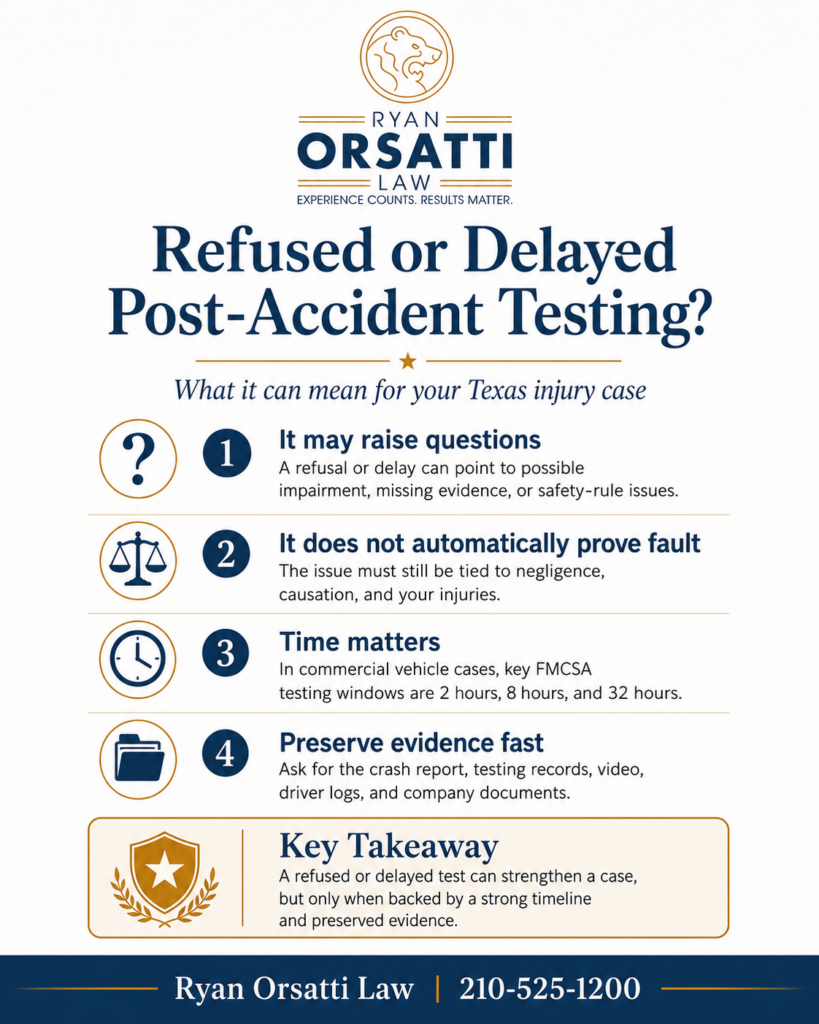
If the driver refused or delayed post-accident testing, it may help your Texas injury case by raising questions about impairment, company safety compliance, and missing evidence. It does not automatically prove fault. In commercial-vehicle cases, 49 C.F.R. § 382.303 requires testing after certain crashes, with alcohol testing documentation beginning at 2 hours, alcohol attempts ending at 8 hours, and controlled-substance attempts ending at 32 hours. (eCFR)
Key Takeaways
- A refused or delayed test is usually an evidence issue, not an automatic win.
- Federal testing rules matter most in 18-wheeler, commercial truck, bus, delivery vehicle, and other covered commercial motor vehicle cases.
- A late negative test may not end the impairment question, especially if the delay changed what the test could show.
- The most important records are the testing decision notes, refusal documentation, chain of custody forms, driver logs, dispatch messages, dashcam footage, and electronic truck data.
- Texas fault rules still apply. If the defense blames you, the testing issue must be tied to negligence, causation, and damages.
- Act quickly. Testing records, video, electronic control module data, and witness memories can disappear long before the lawsuit deadline.
What Does Refused or Delayed Post-Accident Testing Mean in a Texas Injury Case?
Refused or delayed post-accident testing means the case should be investigated for impairment, safety-rule violations, and missing evidence, but it does not automatically prove liability.
In plain English, post-accident testing usually means alcohol or drug testing after a crash. In a Texas personal injury case, the issue matters because it can affect how the crash happened, whether the driver followed safety rules, and whether the employer responded properly.
According to TxDOT’s 2024 Texas Motor Vehicle Traffic Crash Facts, 1,053 people were killed in Texas crashes where a driver was under the influence of alcohol, representing 25.37% of all Texas motor vehicle traffic deaths that year. TxDOT also reported that more DUI-alcohol crashes occurred between 2:00 a.m. and 2:59 a.m. than any other hour. (Texas Department of Transportation)
That statistic matters because alcohol and drug evidence can change how insurers evaluate fault. But the legal question is narrower: did the driver or company have a duty to test, did they fail that duty, and did that failure help explain the crash or the missing proof?
When Is Post-Accident Testing Required for a Commercial Driver?
Post-accident testing is required under FMCSA rules only when a covered commercial motor vehicle crash meets specific federal triggers.
A commercial motor vehicle, often called a CMV, can include an 18-wheeler, tractor-trailer, bus, hazardous-material vehicle, or other regulated commercial vehicle. Under 49 C.F.R. § 382.303, the employer must test surviving covered drivers after certain crashes involving a CMV operating on a public road in commerce. FMCSA’s public guidance summarizes the same triggers. (eCFR)
| Crash situation | Is FMCSA post-accident testing required? | Why it matters |
|---|---|---|
| Human fatality involving a covered CMV | Yes, regardless of whether the CMV driver received a citation | Fatality alone triggers testing |
| Bodily injury requiring immediate medical treatment away from the scene | Yes, if the CMV driver receives a moving-violation citation within the federal testing window | The citation timing can decide whether testing was federally required |
| Disabling damage requiring a vehicle to be towed | Yes, if the CMV driver receives a moving-violation citation within the federal testing window | Tow-away damage alone is not enough without the required citation |
| Minor crash with no fatality, no immediate medical treatment away, no tow-away damage, and no qualifying citation | Not necessarily under FMCSA post-accident testing rules | Other evidence may still support impairment or negligence |
| Private passenger-car driver | FMCSA rules usually do not apply | Look instead for police DWI evidence, employer policy, witness observations, and medical records |
The timing rules are strict. If an alcohol test is required but not done within 2 hours, the employer must prepare and keep a record explaining why it was not promptly administered. If the alcohol test is not done within 8 hours, the employer must stop trying to administer it and keep the same type of record. If a required controlled-substance test is not done within 32 hours, the employer must stop attempts and document the reason. (eCFR)
What Is the Difference Between a Refusal and a Delay?
A refusal is a testing failure tied to the driver’s conduct, while a delay is a timing problem that may be caused by medical care, police activity, employer confusion, or lack of a timely citation.
Under 49 C.F.R. § 382.211, a covered driver may not refuse a required post-accident alcohol or controlled-substance test. The same rule says an employer may not allow a driver who refuses such a test to perform or continue safety-sensitive functions. (eCFR)
A delay is different. A delay may happen because the driver was taken for emergency care, the investigating officer was still deciding whether to issue a citation, the company failed to arrange testing, or the testing site was not available. FMCSA also says a driver subject to post-accident testing must remain readily available for testing, but the rule does not require delaying necessary medical attention or emergency assistance. (eCFR)
A refusal usually raises a sharper question: why did the driver not complete a required test? A delay raises a timeline question: who knew testing was needed, when did they know it, and what did they do before the testing window closed?
How Can Delayed Testing Affect Proof of Impairment?
Delayed testing can weaken or complicate impairment proof because it changes what the test can reliably show.
Alcohol evidence is especially time-sensitive. A test taken hours later may not show the driver’s condition at the moment of impact as clearly as a prompt test. Drug testing can also become more complicated because the collection method, lab process, medical review, and chain of custody all matter.
Chain of custody means the documented handling of a sample from collection to lab review. A medical review officer, often called an MRO, is the person who reviews certain drug test results and evaluates whether there is a legitimate medical explanation for the result.
In a serious crash on I-35, Loop 410, Loop 1604, I-10, or US-281, the testing delay should be compared against the rest of the evidence: lane position, speed, braking, witness statements, dashcam footage, phone data, dispatch messages, electronic logging device data, and crash reconstruction.
Does a Refused or Delayed Test Prove the Driver Caused the Crash?
No, a refused or delayed test is not automatic proof of causation, but it can become important supporting evidence when combined with other facts.
Causation means the legal connection between the unsafe conduct and the injury. A driver may have refused testing, but the injured person still must prove that the driver’s negligence caused the crash and caused the injuries being claimed.
Texas also uses proportionate responsibility, sometimes called the 51% bar rule. Under Texas Civil Practice and Remedies Code § 33.001, a claimant may not recover damages if the claimant’s percentage of responsibility is greater than 50%. (Texas Statutes)
That is why insurance companies often fight over fault even when testing looks suspicious. They may argue that the injured person stopped suddenly, changed lanes, failed to yield, or had unrelated medical problems. The testing issue helps most when it fits a broader liability story.
What Evidence Should Be Preserved After Refused or Delayed Post-Accident Testing?
The key evidence is the record showing who decided whether to test, when that decision was made, and what the driver and company did before the testing window closed.
In a truck or commercial vehicle case, the preservation request should usually include:
- Alcohol test forms and controlled-substance chain of custody forms
- Documentation explaining why a test was not done within 2, 8, or 32 hours
- Refusal documentation
- The company’s written drug and alcohol policy
- Driver qualification file
- Dispatch notes, text messages, app messages, and phone logs
- Electronic logging device records, often called ELD records
- Electronic control module data, often called ECM or “black box” data
- Dashcam, inward-facing camera, and nearby surveillance video
- Bill of lading, trip documents, load records, and route information
- Maintenance and inspection records
- Crash report, photographs, bodycam footage, and 911 audio when available
FMCSA regulations require employers to keep certain testing records. Documentation of refusals to take required alcohol or controlled-substance tests must be kept for at least five years. Records of negative and canceled controlled-substance tests and alcohol results below 0.02 must be kept for at least one year. (eCFR)
After a Crash Involving a Testing Refusal or Delay, Do These 7 Things
These steps help preserve testing evidence, protect your credibility, and keep the insurer from controlling the story before the facts are developed.
- Get medical care and follow treatment instructions. Your health comes first, and medical records help connect the crash to your injuries.
- Request the Texas Peace Officer’s Crash Report, Form CR-3. TxDOT allows people to obtain a CR-3 through its Crash Report Online Purchase System. (Texas Department of Transportation)
- Write down what you noticed about the driver. Include odor of alcohol, slurred speech, red eyes, confusion, open containers, statements, fatigue, or unusual behavior.
- Save photos, videos, and vehicle damage evidence. Photograph the vehicles, roadway, skid marks, debris, traffic signals, injuries, and nearby businesses with cameras.
- Do not assume a “negative” late test ends the issue. Ask when the test occurred, what type of test was used, who collected it, and whether the original testing window was missed.
- Send a preservation letter quickly. A preservation letter is a written demand that the driver, company, insurer, and related parties preserve evidence that may matter in the claim.
- Avoid giving a recorded statement before the testing timeline is understood. Adjusters may ask questions in a way that separates the refusal or delay from the crash facts.
How Do Insurance Adjusters Evaluate a Refused or Delayed Test?
Insurance adjusters usually separate the issue into three questions: was testing legally required, was the delay excused, and does the missing or late test actually prove anything about the crash?
In Bexar County commercial crash claims, a trucking insurer may argue that no test was required because the driver did not receive a qualifying citation. In another case, the insurer may admit the test was late but claim medical care, police investigation, or collection-site logistics caused the delay.
The injured person’s side should not rely only on suspicion. The better approach is to build a timeline:
- Time of crash
- Time police arrived
- Time EMS treated or transported anyone
- Time tow trucks were requested
- Time citation was issued, if any
- Time employer learned of the crash
- Time testing was ordered
- Time sample was collected
- Time results were reported
- Time the driver returned to safety-sensitive work
That timeline can expose whether the delay was reasonable, careless, or part of a broader safety failure.
What If the Driver Was Not a Commercial Driver?
The analysis is different for a private driver because FMCSA post-accident testing rules generally apply to covered commercial drivers, not ordinary passenger-car drivers.
If a private driver refused a police breath or blood test after a suspected DWI crash, that may matter in the criminal investigation and the civil case. But it is not the same as a motor carrier failing to follow FMCSA post-accident testing rules.
For non-commercial crashes, the key evidence may include officer observations, bodycam video, field sobriety testing, blood warrant records, bar or restaurant receipts, cell phone location, witness statements, and crash-scene conduct. The case may still involve a San Antonio car accident claim, but the testing framework is different from a San Antonio truck accident claim.
How Does This Affect Settlement Strategy?
A refused or delayed test can affect settlement strategy, but only after the testing issue is connected to liability, damages, insurance coverage, and collectability.
If the driver was working, the claim may involve the driver, motor carrier, owner-operator, broker, shipper, maintenance contractor, or other parties. In a commercial vehicle accident, that matters because multiple companies may have separate insurance and separate evidence.
Insurance coverage also matters. Liability coverage is the at-fault party’s insurance. UM/UIM means uninsured or underinsured motorist coverage, which may apply through your own policy if the responsible driver has no insurance or not enough insurance. MedPay means medical payments coverage. Subrogation means a health insurer or benefit plan may seek reimbursement from a settlement. ERISA plan reimbursement, hospital liens, and letters of protection can affect the net recovery even when liability evidence is strong.
A testing refusal can change how the case is presented, but it does not replace proof of injuries, medical bills, lost wages, future care, pain, impairment, and life impact.
What Mistakes Can Hurt This Kind of Claim?
The biggest mistakes are waiting to preserve evidence, overstating what the missing test proves, and giving the insurer a recorded statement before the testing timeline is understood.
Common mistakes include:
- Waiting weeks to request DOT testing records
- Assuming a refusal proves intoxication by itself
- Ignoring whether the FMCSA testing trigger actually applied
- Failing to identify the employer, motor carrier, USDOT number, and insurance layers
- Accepting a quick settlement before medical treatment and lien issues are known
- Letting the defense frame a late negative test as the end of the impairment issue
- Posting about the crash or the driver online
Attorney Insight: A missed DOT test is not just one missing lab result. In a truck crash on I-35 or Loop 410, the important records often show who made the testing decision, when the citation issued, who contacted the collection site, what the driver did in the first 8 hours, and whether the company followed its own written policy.
How Long Do I Have to Act in Texas?
You should act within days to preserve testing evidence, even though Texas generally gives two years to file a personal-injury lawsuit.
Under Texas Civil Practice and Remedies Code § 16.003, personal injury and wrongful death claims generally have a two-year limitations period. (Texas Statutes)
That lawsuit deadline should not be confused with evidence preservation. Testing windows can close in hours. Video may be overwritten in days. ECM data can be lost if the truck returns to service. Witnesses can forget important details. A claim involving a refused or delayed test should be treated as urgent.
When Should You Call a Lawyer?
You should call a lawyer quickly if the crash involved a commercial vehicle, serious injury, fatality, tow-away damage, a moving citation, suspicious driver behavior, or any dispute about testing.
A lawyer can send preservation letters, identify the motor carrier, request testing records, investigate FMCSA compliance, track the CR-3, evaluate insurance coverage, and help you avoid statements that may be used out of context. For truck-specific issues, see Ryan Orsatti Law’s guide on when to hire a truck accident lawyer in San Antonio.
FAQ
Can I sue because the driver refused post-accident testing?
You usually do not sue only because the driver refused testing. The claim is still based on negligence, meaning unsafe conduct that caused injury. A refusal can support the case if it helps show impairment, safety-rule violations, missing evidence, or company failures. The strength of that issue depends on the crash facts and testing rules.
What if the truck driver says medical treatment delayed the test?
Medical care can explain some delay, but it does not end the inquiry. FMCSA rules do not require delaying necessary medical attention, but the employer should still document why required testing was not promptly completed. The timeline should show when medical care occurred, when the company learned of the crash, and what testing steps were taken.
Does a negative test after a long delay help the driver?
A negative test may help the driver, but a late test does not always answer what mattered at the time of the crash. The analysis depends on what was tested, when the sample was collected, whether alcohol or drugs were suspected, and whether the delay reduced the test’s usefulness. Other evidence may still matter.
How do I know if FMCSA post-accident testing was required?
Start with the crash type, vehicle type, injury level, tow-away status, and citation timing. A fatal crash involving a covered commercial motor vehicle triggers testing regardless of citation. For injury-away or tow-away crashes, the driver’s moving-violation citation timing matters. Alcohol and controlled-substance testing have different federal timing rules.
Can I get the driver’s drug or alcohol test records before filing a lawsuit?
Sometimes records can be obtained during the claim investigation, but contested cases often require formal discovery after a lawsuit is filed. Discovery means the legal process for requesting documents, sworn answers, and testimony. Testing records may also involve privacy objections, protective orders, subpoenas, or court rulings depending on the facts.
What if the company says post-accident testing was not required?
Do not accept that statement without checking the facts. The company may be right, but the conclusion depends on the CMV status, whether anyone died, whether someone received immediate treatment away from the scene, whether a vehicle was towed, and when any moving citation was issued. The CR-3, citation records, and dispatch records help verify it.
Should I give a recorded statement about the testing issue?
Be careful. A recorded statement can lock you into incomplete answers before you know the testing timeline, the driver’s employment status, the citation timing, or the company’s records. You can cooperate with reasonable claim investigation while still protecting yourself from questions designed to minimize the refusal or delay.
Ryan Orsatti Law
4634 De Zavala Rd, San Antonio, TX 78249
Phone: 210-525-1200
ryanorsattilaw.com
This blog is for informational purposes only, not legal advice. Reading it does not create an attorney-client relationship. Past results do not guarantee future results.
Hurt in an accident in San Antonio? Learn how a San Antonio personal injury lawyer can help with your claim. Call 210-525-1200 or request a free consultation.
The firm works on a contingency fee. You pay nothing unless the firm recovers money for you, and that covers case expenses as well as the fee: if there is no recovery, you owe no attorney's fee and no case expenses. Ask for the fee agreement and read the fee and expense section before you sign anything.
Related San Antonio legal resources
Primary legal and public-data sources
- Texas Civil Practice and Remedies Code Chapter 16: limitations
- Texas Civil Practice and Remedies Code Chapter 33: proportionate responsibility
Ryan Orsatti Law
4634 De Zavala Road, San Antonio, TX 78249
General reference links. Consult each source for its current text.